
Fractions and percentages of amounts
What this lesson covers
- Multiplication, division, fractions, decimals, and percentages can be used to solve problems involving relative quantities and measures.
240 students, and 2/3 walk or bike
- How many students is that?
- You cannot multiply 240 by 2/3 in your head easily.
- But you can do it in two easy steps.
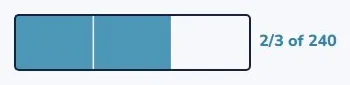
Find one third first
- Thirds means three equal groups.
- So divide: 240 ÷ 3 = 80.
- One third of the school is 80 students.
| Step | Working | Answer |
|---|---|---|
| Find 1/3 | 240 ÷ 3 | 80 |
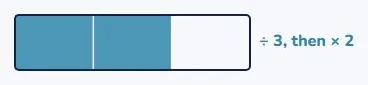
Then take two of them
- We want two thirds, and one third is 80.
- So 80 × 2 = 160.
- 160 students walk or bike.
- A division, then a multiplication. Both easy.
| Step | Working | Answer |
|---|---|---|
| Find 1/3 | 240 ÷ 3 | 80 |
| Then take 2 of them | 80 × 2 | 160 |
Try it: change a percentage
Divide by the bottom, multiply by the top
- The bottom number says how many groups.
- The top number says how many of them you want.
- So: divide by the bottom, then multiply by the top.
- Always in that order: it keeps the numbers small.
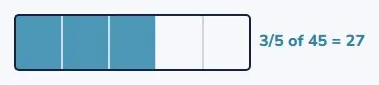
Three fifths of 45
- Divide by the bottom: 45 ÷ 5 = 9.
- Multiply by the top: 9 × 3 = 27.
- So 3/5 of 45 is 27.
- Two steps, and neither of them is hard.
Why divide first
- You could multiply first: 45 × 3 = 135, then ÷ 5 = 27.
- Same answer. But 135 is a harder number to hold.
- Dividing first keeps everything small.
| Order | Working | Answer |
|---|---|---|
| ÷ then × | 45 ÷ 5 = 9, × 3 | 27 |
| × then ÷ | 45 × 3 = 135, ÷ 5 | 27 |
Percentages are just fractions of 100
- 50% means 50 out of every 100.
- So a percentage of an amount is the same kind of job.
- But six of them are worth doing by shortcut, not by division.
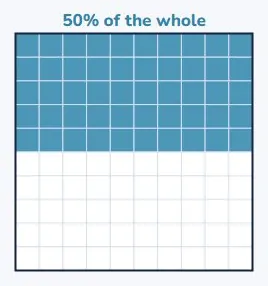
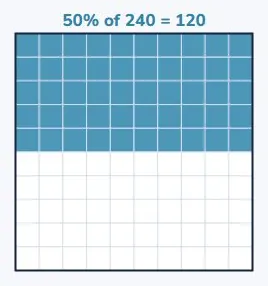
50% is just half
- Half of 240 is 120.
- No division by 100 needed.
- If you ever divide by 100 to find 50%, stop.
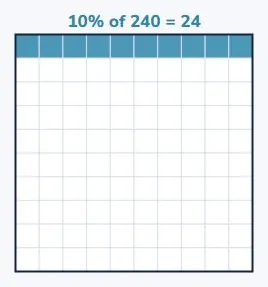
10% is dividing by 10
- 240 ÷ 10 = 24.
- Every digit moves down one column.
- 10% is the most useful one to know, by a long way.
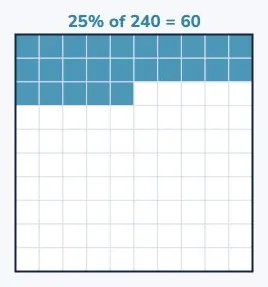
25% is half of a half
- Half of 240 is 120. Half again is 60.
- So 25% of 240 is 60.
- Two halvings beat any division by four.
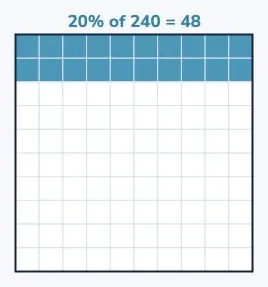
20% is 10% doubled
- 10% of 240 is 24, so double it: 48.
- 20% of 240 is 48.
- Once you have 10%, most others are one step away.
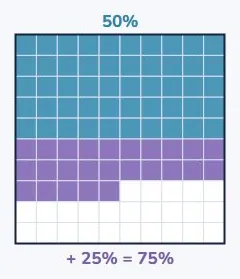
75% is 50% plus 25%
- 50% is 120 and 25% is 60.
- Add them: 180.
- So 75% of 240 is 180. Three quarters of the school.
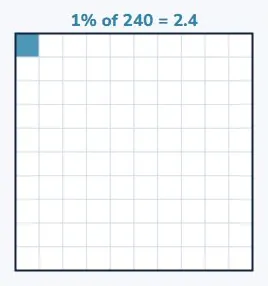
1% is dividing by 100
- 240 ÷ 100 = 2.4.
- Not a whole number, and that is perfectly fine.
- Money does this constantly.
- 1% is the one you build unusual percentages from.
Try it: per cent means per hundred
Six shortcuts, and you can build the rest
- None of these needs a written calculation.
- 30%? That is 10% three times: 3 × 24 = 72.
- 15%? 10% plus half of 10%.
- Learn the six and you can reach almost anything.
| Percent | How | Of 240 |
|---|---|---|
| 1% | 240 ÷ 100 | 2.4 |
| 10% | 240 ÷ 10 | 24 |
| 20% | double 10% | 48 |
| 25% | half of half | 60 |
| 50% | half of 240 | 120 |
| 75% | 50% + 25% | 180 |
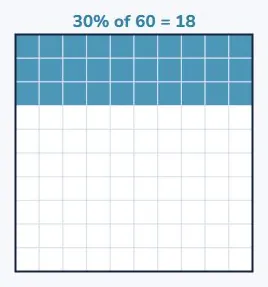
30% of 60
- Start with 10%: 60 ÷ 10 = 6.
- 30% is three lots of 10%.
- So 6 × 3 = 18.
- 30% of 60 is 18, worked out entirely in your head.
Now the other direction
- A netball club: 3/4 of the members are 90 players.
- How many members are there altogether?
- This is the reverse of everything so far.
- And it is where nearly every mark gets lost.
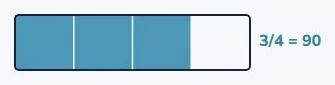
Same two steps, swapped over
- Forwards you divide by the bottom. Backwards, divide by the top.
- 3/4 is 90, so one quarter is 90 ÷ 3 = 30.
- Then multiply by the bottom: 30 × 4 = 120.
- The club has 120 members.
| Step | Working | Answer |
|---|---|---|
| 3/4 of the set is 90 | ||
| Find 1/4 | 90 ÷ 3 | 30 |
| Then take 4 of them | 30 × 4 | 120 |
The same with a percentage: 75% is 24
- 75% is three lots of 25%, so 25% is 24 ÷ 3 = 8.
- 100% is four lots of 25%.
- So 8 × 4 = 32.
- The whole amount is 32.
| Step | Working | Answer |
|---|---|---|
| 75% is 24 | ||
| Find 25% | 24 ÷ 3 | 8 |
| Then 100% | 8 × 4 | 32 |
The trap, and the check that catches it
- Told "3/4 of the set is 90", many people work out 3/4 of 90.
- That gives 67.5: the right method, the wrong direction.
- The check: the whole must be BIGGER than the part.
- 67.5 is smaller than 90, so it was never going to be right.
| Answer | Bigger than 90? | Possible? |
|---|---|---|
| 67.5 | no | no |
| 120 | yes | yes |
Common mistakes
- 3/4 of the club is 90 players, so the club has 3/4 of 90 = 67.5 members.Go backwards: 1/4 is 90 ÷ 3 = 30, so the whole club is 30 × 4 = 120. The whole must be bigger than the part.
- 3/5 of 45: 45 ÷ 3 = 15, then 15 × 5 = 75.Divide by the bottom, then multiply by the top: 45 ÷ 5 = 9, and 9 × 3 = 27.
- 1% of 240 is 24.1% means divide by 100, so 1% of 240 is 2.4. 24 is 10%.
- 50% of a number is 17, so the number is 8.5.17 is half of the number, so the whole is 17 × 2 = 34.
Eight to try
What is 3/8 of 64?
What is 20% of 350?
2/5 of a class is 12 students. How big is the class?
50% of a number is 17. What is the number?
A Nelson school has 80 students and 75% of them take the bus. How many is that?
What is 15% of 60?
Tama scored 18 out of 24 on a test and Mere scored 70%. Who did better?
Hemi says: if 75% of a number is 36, the number is 27. What is the number really?
Show answer
Answers: 1. 64 ÷ 8 = 8, × 3 = 24. 2. 10% is 35, so 20% is 70. 3. 12 ÷ 2 = 6 is one fifth, × 5 = 30 students. 4. 34. Questions 3 and 4 are the reverse direction; if the answer to 3 comes out smaller than 12 (4.8, say), they have gone forwards, and the check in beat 18 is the one to revisit. 5. 60. 50% of 80 is 40 and 25% is 20, so 75% is 40 + 20 = 60. 6. 9. 10% of 60 is 6, half of that is 5%, which is 3, and 6 + 3 = 9. 7. Tama, with 75%. 18 out of 24 is 3/4, which is 75%, and 75% is more than 70%. 8. 48. 25% is 36 ÷ 3 = 12, so 100% is 12 × 4 = 48. Hemi found 75% of 36, and the whole must be bigger than 36.
Both directions, side by side
- Forwards: divide by the bottom, multiply by the top.
- Backwards: divide by the top, multiply by the bottom.
- And check the whole came out bigger than the part.
| Question | Divide by | Multiply by |
|---|---|---|
| 2/3 of 240 | the bottom (3) | the top (2) |
| 3/4 of it is 90 | the top (3) | the bottom (4) |
Challenge
At a school athletics day every student is in one house: Kauri, Rimu or Tōtara. 45% of the students are in Kauri and 38 are in Rimu. The other 35 students are in Tōtara. How many students are there altogether, and how many more are in Kauri than in Rimu?
Hint
Write 45% and 38 as fractions with the same bottom number. 40 is a good choice. What fraction of the school is left for Tōtara?
Answer
200 students; Kauri has 90 and Rimu 75, so Kauri has 15 more
Step by step
- 45% is 45100, which is 1840. And 38 is 1540.
- Together Kauri and Rimu are 3340 of the school, so Tōtara is the other 740.
- 740 of the school is 35 students. Going backwards: divide by the top, so 140 is 35 ÷ 7 = 5.
- Then multiply by the bottom: the whole school is 5 × 40 = 200 students.
- Kauri is 18 × 5 = 90 and Rimu is 15 × 5 = 75, so Kauri has 15 more. Check: 90 + 75 + 35 = 200.
Full working
- 45% = 45100 = 920 = 1840divide by 5, then double top and bottom
- 38 = 154040 is a multiple of 8
- 1 − 1840 − 1540 = 740Tōtara's share
- 740 is 35, so 140 is 35 ÷ 7 = 5backwards: divide by the top
- whole = 5 × 40 = 200then multiply by the bottom
- Kauri 18 × 5 = 90, Rimu 15 × 5 = 75, 90 + 75 + 35 = 200check
- 200 students; Kauri has 90 − 75 = 15 more than Rimu
In Room 12, 35 of the students are girls and the rest are boys. One morning 25% of the girls and 50% of the boys walked to school. That was 14 students altogether. How many students are in Room 12, and how many girls walked?
Hint
Imagine a class of 20 first. How many girls and boys would that be, and how many of them would walk? Then compare with 14.
Answer
40 students; 6 girls walked (and 8 boys)
Step by step
- Try a class of 20, because 20 divides nicely by 5 and by 4.
- Then there would be 35 of 20 = 12 girls and 8 boys.
- 25% of 12 girls is 3, and 50% of 8 boys is 4, so 7 students would walk.
- But 14 walked, which is double 7, so the class must be double 20: 40 students.
- That gives 24 girls and 16 boys, and 25% of 24 is 6 girls walking. Check: 6 + 8 = 14.
Full working
- class of 20: girls 20 ÷ 5 × 3 = 12, boys 20 − 12 = 8divide by the bottom, multiply by the top
- walkers: 25% of 12 = 3, 50% of 8 = 4, total 7a quarter and a half
- so 7 out of every 20 students walkthe same in any class this shape
- 14 = 7 × 2, so the class is 20 × 2 = 40backwards
- girls 40 ÷ 5 × 3 = 24, boys 16; 25% of 24 = 6, 50% of 16 = 86 + 8 = 14 checks
- 40 students, and 6 girls walked
Aroha's drink bottle is 35 full. She drinks 120 mL, and now it is 35% full. How much does the full bottle hold, and how much drink is left in it? How much more must she drink so that exactly 14 of the bottle is left?
Hint
Write 35 as a percentage first. Then what percentage of the bottle was the 120 mL she drank?
Answer
The full bottle holds 480 mL; 168 mL is left; she must drink 48 mL more
Step by step
- 35 is 60100, so the bottle started 60% full.
- It went from 60% to 35%, so the 120 mL she drank was 25% of the bottle.
- 25% is a quarter, and going backwards the whole is four quarters: 120 × 4 = 480 mL.
- 35% of 480: 10% is 48, so 30% is 144 and 5% is 24. That makes 144 + 24 = 168 mL left.
- 14 of the bottle is 480 ÷ 4 = 120 mL, so she must drink 168 − 120 = 48 mL more. Check: 48 mL is 10% of 480, and 35% − 10% = 25%.
Full working
- 35 = 60100 = 60%make the forms match
- 60% − 35% = 25%, so 25% is 120 mLthe part she drank
- 100% = 4 × 25% = 4 × 120 = 480 mLbackwards to the whole
- 35% of 480 = 30% + 5% = 144 + 24 = 168 mL10% is 48
- 14 of 480 = 120 mL, and 168 − 120 = 48 mLwhat is left minus a quarter
- Full bottle 480 mL; 168 mL left; she must drink 48 mL more
Where science uses this
Practise this
Report a mistake
More in Number
 Big numbers and rounding7 min
 Negative numbers, squares and cubes7 min
 Order of operations and column methods7 min
 Division and what to do with the remainder6 min
 Tenths, hundredths and thousandths7 min
 Comparing and adding fractions7 minFractions and percentages of amounts7 min
 Money, discounts and having enough6 min