
Tenths, hundredths and thousandths
What this lesson covers
- Thousandths can be created by dividing whole numbers by 1,000 and can be expressed as fractions or decimals.
- Equivalent fractions can be generated and simplified using common factors.
There is a thousandth in your pencil case
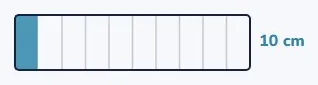
- Take a metre. Cut it into ten equal pieces.
- Each piece is 10 cm: one tenth of a metre.
- Keep cutting and you reach the smallest mark on your ruler.
One whole, ten equal parts
- Ten equal parts means each one is a tenth.
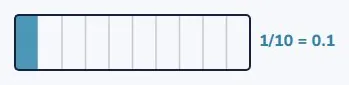
- As a fraction that is 1/10. As a decimal, 0.1.
- Same amount. Two ways of writing it.
Cut each tenth into ten again
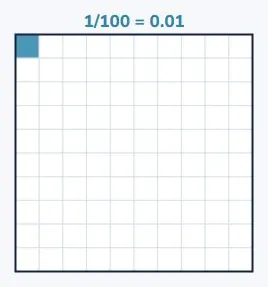
- Ten tenths, each split into ten, gives one hundred parts.
- One of them is 1/100, or 0.01.
- On a metre, that is one centimetre.
Once more, and you have thousandths
- Split each hundredth into ten. Now there are a thousand.
- One of them is 1/1000, or 0.001.
- On a metre, that is one millimetre. A thousand of them fit.
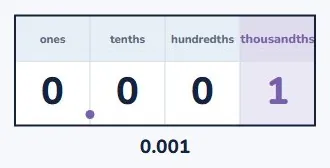
Every column has a name
- To the right of the point: tenths, then hundredths, then thousandths.
- Each column is worth ten times less than the one before it.
- The column a digit sits in tells you what it is worth.
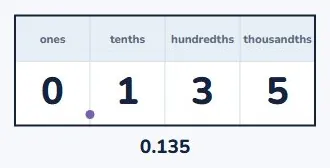
Try it: tenths, hundredths, thousandths
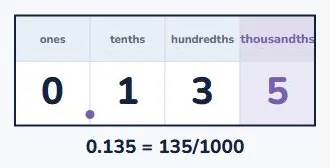
Reading 0.135
- The 1 is in the tenths column: one tenth.
- The 3 is in the hundredths column: three hundredths.
- The 5 is in the thousandths column: five thousandths.
- Altogether, 135 thousandths.
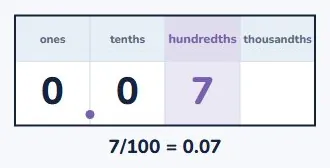
Writing seven hundredths
- Seven hundredths means a 7 in the hundredths column.
- The tenths column has nothing in it, so it gets a zero.
- That zero is doing a job: it holds the 7 in place.
- Seven hundredths is 0.07, not 0.7.
The same amount, fewer pieces
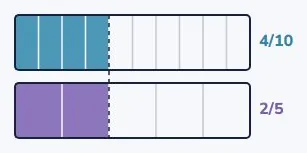
- 4/10 of the bar is shaded.
- 4 and 10 share a common factor of 2.
- Divide both by 2 and you get 2/5.
- The shading has not moved. Only the names changed.
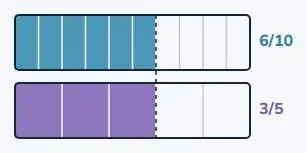
Simplifying 6/10
- What goes into both 6 and 10? Two does.
- 6 ÷ 2 = 3, and 10 ÷ 2 = 5.
- So 6/10 is 3/5.
- Nothing goes into 3 and 5 now, so that is as simple as it gets.
Per cent means per hundred
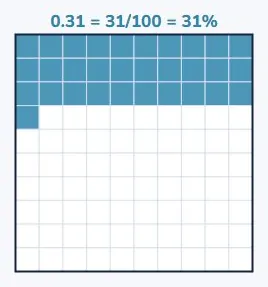
- This grid has one hundred squares. 31 are shaded.
- As a fraction, 31/100. As a decimal, 0.31.
- As a percentage, 31%.
- Three names for one amount.
Try it: fraction, decimal, percentage
Worth knowing by heart: one half
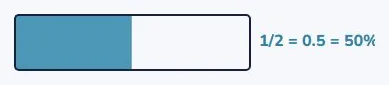
- Half of the bar is shaded.
- 1/2 is 0.5, which is 50%.
- You should not have to work this one out.
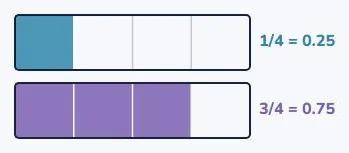
Quarters
- 1/4 is 0.25, or 25%.
- 3/4 is 0.75, or 75%.
- Two quarters is a half, so 0.5 sits between them.
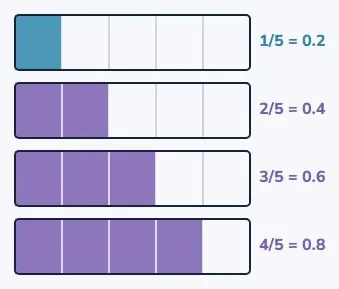
Fifths go up in twos
- 1/5 is 0.2. 2/5 is 0.4.
- 3/5 is 0.6. 4/5 is 0.8.
- Every fifth adds another two tenths. That is the whole pattern.
Which is bigger: 0.38 or 0.4?
- Thirty-eight is a bigger number than four.
- So 0.38 must be bigger than 0.4.
- That argument is wrong, and it is worth knowing exactly why.
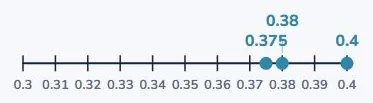
Put them on a number line
- The digits after the point are not a whole number.
- 0.4 is four tenths. 0.38 is not even four tenths yet.
- 0.375 is smaller still, however many digits it has.
- Further right means bigger. The line does not care how long a number looks.
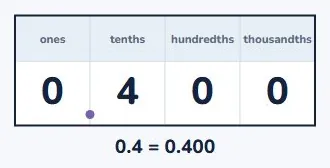
Give them the same number of places
- Writing 0.4 as 0.400 does not change it.
- The extra zeros add no tenths, hundredths or thousandths.
- Now compare 0.400, 0.380 and 0.375 (all thousandths).
- 400, 380, 375. Now the digits can be trusted.
Multiplying by ten
- 1.3 × 10. Every digit becomes worth ten times more.
- The 1 was ones and becomes tens. The 3 was tenths and becomes ones.
- So 1.3 × 10 = 13.
- The digits did not change. They moved up a column.
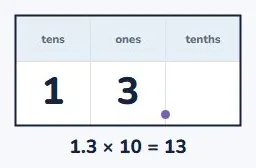
Dividing by a hundred
- 13 ÷ 100. Now every digit is worth a hundred times less.
- The 1 drops from tens to tenths, and the 3 from ones to hundredths.
- So 13 ÷ 100 = 0.13.
- Two columns down, because a hundred is two tens.
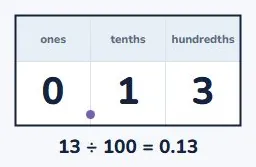
Common mistakes
- 0.38 is bigger than 0.4, because 38 is bigger than 4.Write 0.4 as 0.40. Then 40 hundredths beats 38 hundredths, so 0.4 is bigger.
- 9/100 = 0.90.9 is nine tenths. Nine hundredths needs a zero in the tenths place, so 9/100 = 0.09.
- 2.4 ÷ 10 = 2.04÷ 10 moves every digit one place to the right, so the 2 becomes tenths: 2.4 ÷ 10 = 0.24.
- 3/5 = 0.353/5 = 6/10, so 3/5 = 0.6, which is 60%. The digits of a fraction are not the digits of its decimal.
Eight to try
Write 9/100 as a decimal.
Simplify 8/10.
Put these in order, smallest first: 0.6, 0.58, 0.605.
What is 2.4 ÷ 10?
In 0.472, what is the 7 worth?
Which pair shows 3/4 as a decimal and as a percentage?
In a class survey, 40% walk to school. Write 40% as a fraction in its simplest form.
Jack says 0.6 × 100 = 0.600. What is 0.6 × 100?
Show answer
Answers: 1. 0.09; watch for 0.9, which is the placeholder-zero mistake from the "writing seven hundredths" beat. 2. 4/5 (divide both by 2). 3. 0.58, 0.6, 0.605. This is the trap beat again; ask for the same number of places first (0.580, 0.600, 0.605). 4. 0.24. Ask which column each digit moved to rather than accepting "move the point". 5. 7 hundredths. The 4 is in the tenths column, the 7 in the hundredths column and the 2 in the thousandths column. 6. 0.75 and 75%. Three quarters is 75 hundredths, which is 0.75, and per cent means per hundred. 7. 2/5. 40% is 40/100, which is 4/10, and dividing both by 2 gives 2/5. 8. 60. Each digit moves two columns up, so 6 tenths becomes 6 tens; zeros added after the point change nothing.
Fraction, decimal, percentage
- The seven worth knowing without thinking.
- Same amount, three names each.
Challenge
Four friends each eat part of an identical pizza. Rangi eats 38 of his, Sina eats 0.38 of hers, Leo eats 37% of his and Ana eats 1950 of hers. Write each amount in thousandths, and decide who ate the most. Is there a twist?
Hint
To turn eighths into thousandths, think about what 8 must be multiplied by to make 1000.
Answer
375, 380, 370 and 380 thousandths: Sina and Ana tie for the most
Step by step
- 8 × 125 = 1000, so 38 = 3751000 = 0.375.
- 0.38 is 380 thousandths.
- 37% is 37 hundredths, which is 370 thousandths.
- 50 × 20 = 1000, so 1950 = 3801000 = 0.380.
- The twist: Sina and Ana ate exactly the same amount, 0.38, so they tie for the most. Leo ate the least.
Full working
- 38 = 3 × 1258 × 125 = 3751000 = 0.3758 × 125 = 1000
- 0.38 = 0.380 = 3801000add a zero in the thousandths
- 37% = 37100 = 3701000 = 0.370per cent means per hundred
- 1950 = 19 × 2050 × 20 = 3801000 = 0.38050 × 20 = 1000
- 0.370 < 0.375 < 0.380 = 0.380compare thousandths
- Sina and Ana tie for the most, 0.38 each
Ana starts with the fraction 38. She adds the same whole number to its top and to its bottom, and the new fraction is equal to 0.75. What number did she add, and what is the new fraction? Then write 38 and 0.75 in thousandths: what do you notice?
Hint
Adding the same number to the top and bottom never changes the gap between them. 0.75 is 34: how big is the gap in 34, and what must that gap become?
Answer
She added 12, making 1520; 38 is 375 thousandths and 0.75 is 750 thousandths, exactly double
Step by step
- In 38 the bottom is 5 more than the top, and adding the same number to both keeps that gap at 5.
- 0.75 = 75100 = 34, so the new fraction has a top of 3 parts and a bottom of 4 parts: the gap is 1 part.
- That gap of 1 part is 5, so the top is 3 × 5 = 15 and the bottom is 4 × 5 = 20.
- The top went from 3 to 15, so she added 12. Check: 8 + 12 = 20.
- 38 = 3751000 and 1520 = 7501000, so the new fraction is exactly double the old one.
Full working
- 8 − 3 = 5the gap stays 5 after adding
- 0.75 = 75100 = 34divide top and bottom by 25
- 1 part = 5, so 15203 × 5 = 15 and 4 × 5 = 20
- 15 − 3 = 12 and 20 − 8 = 12the same number added to both
- 38 = 3751000 and 1520 = 75010008 × 125 = 1000 and 20 × 50 = 1000
- She added 12; 1520 = 0.750, double 38 = 0.375
Look at the 99 fractions 4011000, 4021000, 4031000, ..., 4991000. How many of them can be simplified?
Hint
1000 = 2 × 2 × 2 × 5 × 5 × 5. A fraction over 1000 can be simplified only if the top shares a factor with 1000. Which numbers can that factor be built from?
Answer
59
Step by step
- The only numbers bigger than 1 that go into 1000 are built from 2s and 5s, so a fraction can be simplified exactly when its top is even or ends in 5 or 0.
- Even tops from 402 to 498: there are 49.
- Tops that are multiples of 5 from 405 to 495: there are 19.
- The tops ending in 0 (410, 420, ..., 490) were counted in both lists: there are 9.
- So the count is 49 + 19 − 9 = 59.
Full working
- 1000 = 2 × 2 × 2 × 5 × 5 × 5the top must share a 2 or a 5
- 402, 404, ..., 498 → 49 numbers(498 − 402) ÷ 2 + 1 = 49
- 405, 410, ..., 495 → 19 numbers(495 − 405) ÷ 5 + 1 = 19
- 410, 420, ..., 490 → 9 numberscounted twice, take them off once
- 49 + 19 − 9 = 59
- 59 of the fractions can be simplified
Where science uses this
Practise this
Report a mistake
More in Number
 Big numbers and rounding7 min
 Negative numbers, squares and cubes7 min
 Order of operations and column methods7 min
 Division and what to do with the remainder6 minTenths, hundredths and thousandths7 min
 Comparing and adding fractions7 min
 Fractions and percentages of amounts7 min
 Money, discounts and having enough6 min