
Big numbers and rounding
What this lesson covers
- The base 10 number system extends infinitely in two directions.
- Rounding can support predicting or estimating the result of a calculation.
- Rounding is based on identifying the nearest place value or unit (ten, hundred, thousand) for a given number; a number line supports this.
- Square numbers are produced by multiplying a number by itself.
- Cube numbers are produced by multiplying a number by itself twice (e.g. 4 × 4 × 4).
Nobody says the exact number
- About five million people live in New Zealand.
- On any given day there is an exact number.
- Nobody ever says it, and that is not laziness.
| Millions | Thousands | Ones |
|---|---|---|
| 5 | 283 | 471 |
Big numbers come in threes
- Digits are grouped in threes from the right.
- Each group has a name: ones, thousands, millions.
- The commas are not decoration. They mark the groups.
| Millions | Thousands | Ones |
|---|---|---|
| 5 | 283 | 471 |
Try it: build a number
Reading it out loud
- Read each group, then say its name.
- 5: five million.
- 283: two hundred and eighty-three thousand.
- 471: four hundred and seventy-one.
| Millions | Thousands | Ones |
|---|---|---|
| 5 | 283 | 471 |
Try it: round a number
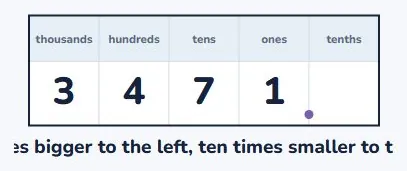
Every column is ten times the last
- Move left and each column is worth ten times more.
- Move right and each is worth ten times less.
- Neither direction runs out. That is what base ten means.
Comparing two big numbers
- Line them up and read from the left.
- Both start with 5 million. Both have 2 hundred thousand.
- The first difference is the ten thousands: 8 against 9.
- So 5,293,000 is the bigger number.
| Millions | Thousands | Ones |
|---|---|---|
| 5 | 283 | 471 |
| 5 | 293 | 000 |
More digits is not the same as bigger
- Count the digits first: 7 beats 6 every time.
- Only when the digit count matches do you compare left to right.
- A number with more digits cannot lose.
| Number | Digits |
|---|---|
| 998,999 | 6 |
| 5,283,471 | 7 |
What rounding is for
- A rounded number is easier to hold in your head.
- It is also how you check an answer is sensible.
- If 5,283,471 ÷ 5 came out near 1 million, something is wrong.
| Millions | Thousands | Ones |
|---|---|---|
| 5 | 283 | 471 |
| 5 | 000 | 000 |
Rounding on a number line
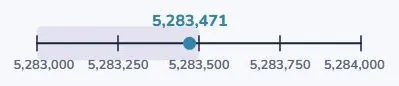
- To round to the nearest thousand, find the thousands either side.
- 5,283,471 sits between 5,283,000 and 5,284,000.
- Halfway is 5,283,500. Our number is left of it.
- So it is nearer 5,283,000.
The only question is which side of halfway
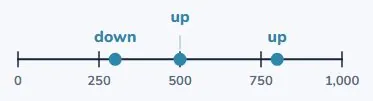
- Left of halfway rounds down. Right of halfway rounds up.
- Exactly halfway rounds up, by agreement.
- That is the whole rule, and the line shows it.
The shortcut: look at the next digit right
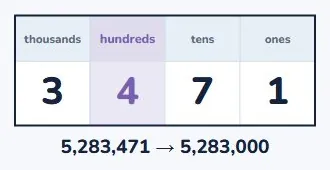
- Rounding to the thousands? Look at the hundreds digit.
- It is 4. Four is less than five, so round down.
- The digit to the right is all halfway ever was.
Same number, six different answers
- To the nearest ten: look at the ones. 1, so down: 5,283,470.
- To the nearest hundred: look at the tens. 7, so up: 5,283,500.
- To the nearest million: look at the hundred thousands. 2, so down.
- "Rounded" means nothing until you say what to.
| Nearest | 5,283,471 becomes |
|---|---|
| million | 5,000,000 |
| hundred thousand | 5,300,000 |
| ten thousand | 5,280,000 |
| thousand | 5,283,000 |
Rounding a decimal to the nearest whole number
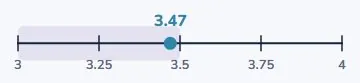
- Round 3.47 to the nearest whole number.
- It sits between 3 and 4, and halfway is 3.5.
- 3.47 is just left of halfway.
- So 3.47 rounds to 3.
The same number, to the nearest tenth
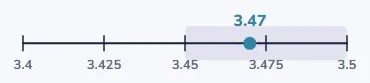
- Now the tenths either side are 3.4 and 3.5.
- Halfway is 3.45, and 3.47 is past it.
- So to the nearest tenth, 3.47 rounds to 3.5.
- Down to a whole number, up to a tenth. Both correct.
Numbers you can build by multiplying
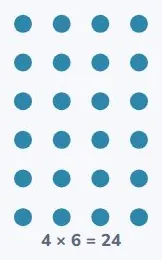
- 24 dots make a neat rectangle 4 across and 6 down.
- 4 × 6 = 24, so 4 and 6 are a factor pair of 24.
- A factor pair is two numbers that multiply to give yours.
Finding every factor pair of 24
- Start at 1 and work up. 1 × 24.
- 2 × 12. Then 3 × 8. Then 4 × 6.
- 5 does not divide 24, so it is skipped.
- Past 4 the pairs repeat backwards, so you are done.
| First | Second |
|---|---|
| 1 | 24 |
| 2 | 12 |
| 3 | 8 |
| 4 | 6 |
Try it: find every factor pair
When both halves of a pair are the same
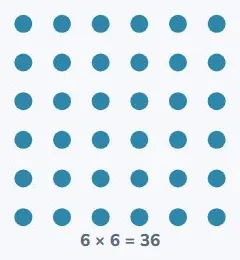
- 36 has a pair where both numbers are 6.
- 6 × 6 = 36, and the dots make an actual square.
- A number multiplied by itself gives a square number.
- 1, 4, 9, 16, 25, 36: every one of them is a square.
Multiply by itself twice and you get a cube
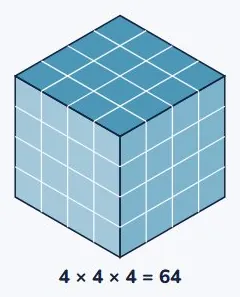
- 4 × 4 = 16 makes a square, 4 across and 4 down.
- Stack 4 of those squares and you have a cube.
- 4 × 4 × 4 = 64, so 64 is a cube number.
- It is called a cube because it makes one.
Rounding to check an answer
- 5,283,471 ÷ 5. Round it first: about 5 million.
- 5 million ÷ 5 is about 1 million.
- So the real answer should be near a million.
- If your calculator says 105,669, you mistyped something.
| Step | Value |
|---|---|
| Round first | 5,000,000 |
| Divide by 5 | 1,000,000 |
| Real answer | 1,056,694.2 |
Try it: round it, then check it
Common mistakes
- 998,999 is bigger than 5,283,471, because 9 is bigger than 5.Count the digits first. 5,283,471 has 7 digits and 998,999 has only 6, so 5,283,471 is bigger.
- 62,851 to the nearest thousand is 62,000.Look at the hundreds digit. It is 8, which is 5 or more, so round up to 63,000.
- 5,283,471 to the nearest thousand is 5,283.Rounding keeps the number the same size. The places you drop become zeros, so it is 5,283,000.
- 3.47 to the nearest tenth is 3.4.Halfway between 3.4 and 3.5 is 3.45, and 3.47 is past it, so it rounds up to 3.5.
Eight to try
Read 4,060,900 out loud.
Round 62,851 to the nearest thousand.
Find all the factor pairs of 36.
Round 7.28 to the nearest tenth.
Write eight million, forty thousand and seven in digits.
Which of these numbers is the largest?
Rounded to the nearest hundred thousand, a town's population is 5,300,000. Which could be the exact number?
Ana works out 3,987,250 ÷ 4 and gets 99,681.25. Use rounding to judge her answer.
Show answer
Answers: 1. four million, sixty thousand, nine hundred; watch for the empty thousands digit being skipped rather than read as "sixty". 2. 63,000 (the hundreds digit is 8, so up). 3. 1×36, 2×18, 3×12, 4×9, 6×6: five pairs, and 6×6 makes it a square number. 4. 7.3 (the hundredths digit is 8, so up). Ask which digit they looked at, not just what the answer was. 5. 8,040,007. Millions group 8, thousands group 040, ones group 007; the empty places need zeros. 6. 1,020,003. 998,999 has only 6 digits, so it loses; of the 7-digit ones, 1,020,003 has 2 in the ten thousands, where the others have 0. 7. 5,286,410. Its ten thousands digit is 8, so it rounds up to 5,300,000. 5,239,700 rounds down to 5,200,000, and 5,350,000 and 5,362,900 round up to 5,400,000. 8. Wrong: 3,987,250 is about 4,000,000, and 4,000,000 ÷ 4 = 1,000,000, so her answer is ten times too small.
One number, six roundings
- The same 5,283,471 every time.
- Say what you are rounding to, or the answer means nothing.
| Nearest | 5,283,471 becomes |
|---|---|
| million | 5,000,000 |
| hundred thousand | 5,300,000 |
| ten thousand | 5,280,000 |
| thousand | 5,283,000 |
| hundred | 5,283,500 |
| ten | 5,283,470 |
Challenge
Use each of the digits 1, 2, 3, 4, 5, 6 and 7 exactly once to make a seven-digit even number. It must round to 4,000,000 to the nearest million, and it must be as close to 4,000,000 as possible. What is the number?
Hint
Find the best number just below 4,000,000 and the best number just above it, then compare how far each one is from 4,000,000.
Answer
4,123,576
Step by step
- To round to 4,000,000 the number must be from 3,500,000 up to 4,499,999, so it starts with 3 or 4.
- Starting with 3, the closest is the biggest one you can make: 3,765,412 (it must end in an even digit).
- Starting with 4, the closest is the smallest one you can make: 4,123,576 (it must end in an even digit).
- 3,765,412 is 234,588 away and 4,123,576 is only 123,576 away.
- So 4,123,576 wins.
Full working
- 3,500,000 ≤ number < 4,500,000rounds to 4,000,000, so the millions digit is 3 or 4
- below: 3,765,412largest start-with-3 number, ending in 2 to be even
- 4,000,000 − 3,765,412 = 234,588distance below
- above: 4,123,576smallest start-with-4 number, ending in 6 to be even
- 4,123,576 − 4,000,000 = 123,576distance above, smaller
- The number is 4,123,576
Hemi rounds a whole number to the nearest hundred, then rounds his answer to the nearest thousand, and gets 5,000. Kiri rounds the same number straight to the nearest thousand and gets 4,000. How many different whole numbers could it be, and what are the smallest and largest?
Hint
Work backwards from Hemi's 5,000: which hundreds round to 5,000? Then which numbers round to those hundreds? Remember that exactly halfway rounds up.
Answer
50 numbers, from 4,450 to 4,499
Step by step
- Hemi's hundred must round to 5,000, so it is one of 4,500, 4,600, ..., 5,400.
- A number rounds to one of those hundreds when it is from 4,450 up to 5,449.
- Kiri's rounding to 4,000 means the number is from 3,500 up to 4,499.
- Both must be true, so the number is from 4,450 up to 4,499.
- Counting from 4,450 to 4,499 gives 50 numbers. For example 4,460 goes to 4,500 then 5,000 for Hemi, but straight to 4,000 for Kiri.
Full working
- 4,500, 4,600, ..., 5,400hundreds that round to 5,000
- 4,450 ≤ n ≤ 5,449numbers that round to one of those hundreds
- 3,500 ≤ n ≤ 4,499rounds straight to 4,000
- 4,450 ≤ n ≤ 4,499the overlap of the two
- 4,499 − 4,450 + 1 = 50count both ends
- 50 numbers: smallest 4,450, largest 4,499
Tane writes down the square numbers 1², 2², 3², and so on, all the way to 50². How many of them end in the digit 6? Then explain why none of them, and no square number at all, can end in 7.
Hint
The last digit of a square only depends on the last digit of the number you squared. Try squaring 0, 1, 2, ..., 9 and look at the last digits.
Answer
10 of them end in 6; a square can only end in 0, 1, 4, 5, 6 or 9, never 7
Step by step
- When you multiply two numbers, only their ones digits decide the ones digit of the answer.
- Squaring 0 to 9 gives last digits 0, 1, 4, 9, 6, 5, 6, 9, 4, 1.
- A square ends in 6 only when the number ends in 4 or 6.
- From 1 to 50 those numbers are 4, 6, 14, 16, 24, 26, 34, 36, 44, 46: that is 10.
- The digit 7 never appears in the list of last digits, so no square ends in 7.
Full working
- 0², 1², 2², ..., 9² end in 0, 1, 4, 9, 6, 5, 6, 9, 4, 1only the ones digit matters
- ends in 6 ⟹ number ends in 4 or 64² = 16 and 6² = 36
- 4, 6, 14, 16, 24, 26, 34, 36, 44, 46numbers up to 50 ending in 4 or 6
- possible last digits: 0, 1, 4, 5, 6, 97 is not among them
- 10 squares end in 6, and no square can end in 7
Practise this
Report a mistake
More in Number
Big numbers and rounding7 min Negative numbers, squares and cubes7 min
 Order of operations and column methods7 min
 Division and what to do with the remainder6 min
 Tenths, hundredths and thousandths7 min
 Comparing and adding fractions7 min
 Fractions and percentages of amounts7 min
 Money, discounts and having enough6 min