
Division and what to do with the remainder
What this lesson covers
- Standard written algorithms (e.g. column addition, column subtraction) rely on place value, regrouping, and renaming.
- Remainders from division can be represented as whole numbers, fractions, or decimals, depending on the context.
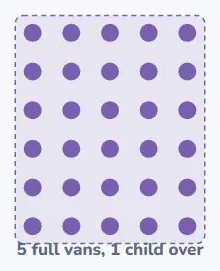
Thirty-one children, vans that hold six
- How many vans do you need to book?
- 31 ÷ 6 is 5, with 1 left over.
- But five vans leaves a child standing on the footpath.
The division itself is the easy part
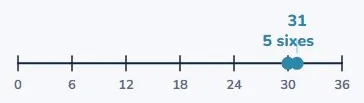
- How many sixes fit into 31? Five of them make 30.
- That uses up 30 and leaves 1 behind.
- So 31 ÷ 6 = 5 remainder 1.
One remainder, three ways to write it
- As a whole number with a remainder: 5 remainder 1.
- As a mixed number: 5 1/6.
- As a rounded decimal: 5.17.
- All three are correct. They are not interchangeable.
| Written as | Answer |
|---|---|
| Whole number and remainder | 5 remainder 1 |
| Mixed number | 5 1/6 |
| Rounded decimal | 5.17 |
Try it: one remainder, three answers
For the vans, the answer is six
- You cannot book 5.17 vans. There is no such thing.
- Five vans means one child does not go.
- So you round up: six vans, and the last one is nearly empty.
- Six is the answer, and the division never printed it.
| Option | What happens |
|---|---|
| 5 vans | 1 child left behind |
| 5.17 vans | does not exist |
| 6 vans | everyone goes |
Sharing sweets: keep the remainder
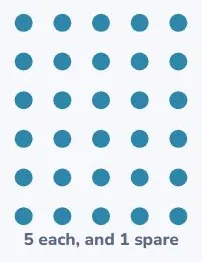
- 31 sweets shared between 6 children.
- Five each, and one sweet left in the bag.
- You cannot cut a sweet, so the remainder stays a remainder.
- 5 each, 1 over. That is the useful answer here.
Sharing cake: split the remainder
- 31 slices of cake between 6 people.
- Cake can be cut, so the leftover slice gets shared too.
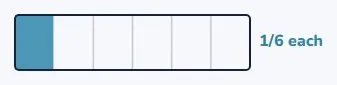
- That last slice splits six ways: one sixth each.
- So each person gets 5 1/6 slices.
Measuring rope: use a decimal
- 31 metres of rope cut into 6 equal lengths.
- A tape measure shows decimals, not sixths.
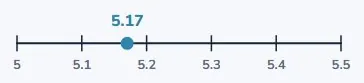
- 31 ÷ 6 is 5.1666… so round it: 5.17 metres.
- Same sum. A decimal is the useful shape this time.
The sum never changed
- Four situations. One division. Four different right answers.
- The arithmetic cannot tell you which one to give.
- You have to look at what the leftover 1 actually is.
| Situation | Answer | Because |
|---|---|---|
| Vans that hold 6 | 6 vans | round up: nobody is left behind |
| Sweets shared out | 5 each, 1 over | a whole number and a remainder |
| Cake shared out | 5 1/6 each | the leftover gets split |
| Metres of rope | 5.17 m | a decimal, to two places |
Bigger numbers, same idea
- Now 1283 ÷ 5, which is too big to do in your head.
- Short division works one digit at a time, left to right.
- Each step carries what is left over into the next digit.
Working through 1283 ÷ 5
- 1 ÷ 5 is 0, and 1 carries over to make 12.
- 12 ÷ 5 is 2, and 2 carries over to make 28.
- 28 ÷ 5 is 5, and 3 carries over to make 33.
- 33 ÷ 5 is 6, with 3 genuinely left over.
| Step | Result | So far |
|---|---|---|
| 1 ÷ 5 | 0, carry 1 | 0 |
| 12 ÷ 5 | 2, carry 2 | 02 |
| 28 ÷ 5 | 5, carry 3 | 025 |
| 33 ÷ 5 | 6, remainder 3 | 256 r 3 |
1283 ÷ 5 = 256 remainder 3
- Reading the digits off the top: 256.
- And 3 that would not divide.
- Check it: 256 × 5 is 1280, plus 3 is 1283.
| Check | Value |
|---|---|
| 256 × 5 | 1,280 |
| plus the remainder | 1,283 |
And that remainder, three ways
- As a remainder: 256 remainder 3.
- As a mixed number: 256 3/5, because 3 of 5 parts are left.
- 3/5 is 0.6, so as a decimal it is 256.6 exactly.
- No rounding needed this time: fifths land on decimals neatly.
| Written as | Answer |
|---|---|
| Remainder | 256 r 3 |
| Mixed number | 256 3/5 |
| Decimal | 256.6 |
A sixth of something IS dividing by six
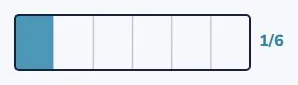
- Finding 1/6 of 31 and working out 31 ÷ 6 are the same job.
- Not similar. The same.
- Sharing into 6 equal parts is what both of them mean.
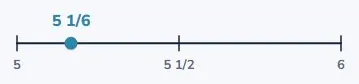
- So 1/6 of 31 is 5 1/6.
Try it: a sixth of a whole
Which is why the answer can be a fraction
- One sixth of 31 obviously is not a whole number.
- 31 does not split into 6 whole parts.
- The mixed number is the honest answer, not a rounded one.
A quarter of 90
- 1/4 of 90 means 90 ÷ 4.
- 4 twenty-twos make 88, so 22 with 2 left over.
- Those 2 split four ways: 2/4, which is 1/2.
- So a quarter of 90 is 22 1/2, or 22.5.
| Step | Value |
|---|---|
| 90 ÷ 4 | 22 remainder 2 |
| Remainder as a fraction | 2/4 = 1/2 |
| Answer | 22 1/2 = 22.5 |
Estimating first, as always
- 1283 ÷ 5. Round 1283 to 1300.
- 1300 ÷ 5 is 260, because 13 ÷ 5 is 2.6.
- Our answer, 256.6, sits just under 260.
- If the answer had come out 51 or 2,566, you would know.
| Step | Value |
|---|---|
| Estimate | 1,300 ÷ 5 = 260 |
| Actual | 256.6 |
Common mistakes
- 31 children, vans that hold 6: 31 ÷ 6 = 5 remainder 1, so book 5 vans.5 vans leaves one child behind. Everyone has to fit, so round up to 6 vans.
- 1283 ÷ 5 = 256 remainder 3, so as a decimal it is 256.3.3 left over out of 5 is 3/5, and 3/5 = 0.6, so the decimal is 256.6.
- 31 ÷ 6 = 5 remainder 1, so 1/6 of 31 is 5 remainder 1 and that is all.A sixth of 31 can be split, so give the leftover as a fraction: 1/6 of 31 = 5 1/6.
- 1283 ÷ 5: 1 ÷ 5 will not go, so I cross out the 1 and start with 2 ÷ 5.Carry the 1 into the next digit to make 12. Then 12 ÷ 5 = 2, with 2 carried on.
Eight to try
Work out 947 ÷ 4, with a remainder.
Write that remainder as a fraction, then as a decimal.
What is 1/8 of 60?
50 people, minibuses that hold 8. How many buses?
45 stickers are shared equally between 7 children. Stickers cannot be cut. How many does each child get?
A 22 m rope is cut into 8 equal lengths. How long is each piece, as a decimal?
Ben works out 3,624 ÷ 6 by short division and gets 64. What went wrong?
Dividing a number by 6 gave 214 remainder 3. What was the number?
Show answer
Answers: 1. 236 remainder 3. 2. 236 3/4, and 3/4 is 0.75, so 236.75 exactly. 3. 60 ÷ 8 = 7 remainder 4, and 4/8 is 1/2, so 7 1/2 or 7.5. 4. 7 buses: 50 ÷ 8 is 6 remainder 2, and those 2 people still need a bus. Question 4 is the van problem again; if they answer 6, or 6.25, that is the beat to go back to. 5. 6 each, 3 left over. 7 × 6 = 42, and the 3 left cannot be split, so the remainder stays a remainder. 6. 2.75 m. 22 ÷ 8 = 2 remainder 6, and 6/8 = 3/4 = 0.75, so each piece is 2.75 m. 7. He left out the 0: 6 goes into 36 six times but not into 2, so a 0 goes in the tens and the 2 carries to make 24. The answer is 604. 8. 1,287. Multiply back, then add the remainder: 214 × 6 = 1,284, and 1,284 + 3 = 1,287.
The remainder is a decision
- Three ways to write one, and the situation picks.
- Ask what the leftover actually is before you answer.
| Written as | Use it when |
|---|---|
| 5 remainder 1 | the leftover cannot be split |
| 5 1/6 | the leftover can be split |
| 5.17 | you are measuring |
| 6 | everyone has to fit |
Challenge
Mere writes KIAORA over and over with no gaps: KIAORAKIAORAKIA... and stops when she has written exactly 1000 letters. What is the 1000th letter, and how many times has she written the letter A?
Hint
The pattern repeats every 6 letters. How many full KIAORAs fit into 1000 letters, and what is left over?
Answer
The 1000th letter is O, and she has written A 333 times
Step by step
- KIAORA has 6 letters, so the pattern starts again every 6 letters.
- 1000 ÷ 6 = 166 remainder 4, so she writes 166 full KIAORAs and then 4 more letters.
- The 4 extra letters are K, I, A, O, so the 1000th letter is O.
- Each KIAORA has 2 As, so the full ones give 166 × 2 = 332 As.
- The extra K, I, A, O adds 1 more A, so there are 333 As.
Full working
- 1000 ÷ 6 = 166 r 4166 × 6 = 996, and 1000 − 996 = 4
- letters 997 to 1000 are K, I, A, Othe remainder 4 starts a new KIAORA
- 166 × 2 = 332two As in each full KIAORA
- 332 + 1 = 333one A in K, I, A, O
- 1000th letter O; 333 As
A Hawke's Bay farmer packs her eggs. In boxes of 4, the last box has only 3 eggs. In boxes of 5, the last box has only 4. In boxes of 6, the last box has only 5. She has between 100 and 200 eggs. How many eggs could she have? Give every possibility.
Hint
In each case the last box is one egg short of full. What happens if you imagine one extra egg?
Answer
119 or 179
Step by step
- Each time, one more egg would fill the last box exactly.
- So one more than her number of eggs divides exactly by 4, by 5 and by 6.
- The smallest number that 4, 5 and 6 all go into is 60, so that number is a multiple of 60.
- Multiples of 60 between 101 and 201 are 120 and 180.
- Take one off: she has 119 or 179 eggs. Check 119: 119 ÷ 4 = 29 r 3, 119 ÷ 5 = 23 r 4, 119 ÷ 6 = 19 r 5.
Full working
- eggs + 1 divides by 4, 5 and 6each last box is one short
- 60smallest number 4, 5 and 6 all go into
- eggs + 1 = 120 or 180multiples of 60 just above 100 to 200
- 119 ÷ 4 = 29 r 3, 119 ÷ 5 = 23 r 4, 119 ÷ 6 = 19 r 5check
- 179 ÷ 4 = 44 r 3, 179 ÷ 5 = 35 r 4, 179 ÷ 6 = 29 r 5check
- 119 or 179 eggs
Hone divides 2026 by a whole number and gets a remainder of 26. How many different whole numbers could he have divided by?
Hint
If the remainder is 26, take the 26 away first: the number he divided by must go exactly into what is left. And a remainder is always smaller than the number you divide by.
Answer
11
Step by step
- Taking away the remainder leaves 2026 − 26 = 2000, so the divisor goes exactly into 2000.
- The remainder must be smaller than the divisor, so the divisor is bigger than 26.
- The numbers that go exactly into 2000 are 1, 2, 4, 5, 8, 10, 16, 20, 25, 40, 50, 80, 100, 125, 200, 250, 400, 500, 1000, 2000.
- The ones bigger than 26 are 40, 50, 80, 100, 125, 200, 250, 400, 500, 1000, 2000.
- That is 11 numbers.
Full working
- 2026 − 26 = 2000the divisor goes exactly into 2000
- divisor > 26a remainder must be less than the divisor
- 2000 = 1 × 2000 = 2 × 1000 = 4 × 500 = 5 × 400 = 8 × 250 = 10 × 200 = 16 × 125 = 20 × 100 = 25 × 80 = 40 × 50factor pairs of 2000
- 40, 50, 80, 100, 125, 200, 250, 400, 500, 1000, 2000the factors bigger than 26
- 11 possible divisors
Where science uses this
Practise this
Report a mistake
More in Number
 Big numbers and rounding7 min
 Negative numbers, squares and cubes7 min
 Order of operations and column methods7 minDivision and what to do with the remainder6 min
 Tenths, hundredths and thousandths7 min
 Comparing and adding fractions7 min
 Fractions and percentages of amounts7 min
 Money, discounts and having enough6 min