
Negative numbers, squares and cubes
What this lesson covers
- Negative numbers are to the left of 0 on a horizontal number line and below 0 on a vertical number line.
- Negative numbers are represented symbolically with a negative sign (−) and named 'negative' along with the numeral (e.g. −4 is named negative four).
- Zero is neither positive nor negative.
- Negative numbers arise in a range of situations (e.g. debt, temperature).
There is a negative number in your kitchen
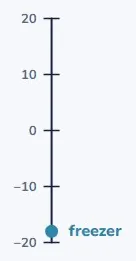
- A freezer sits at about 18 degrees below zero.
- That is not "no temperature". It is a real amount of cold.
- Numbers carry on past zero, and we need names for them.
To the left of zero
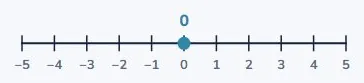
- On a horizontal number line, zero is not the end.
- The numbers keep going to the left.
- Those ones are the negative numbers.
It is called negative four
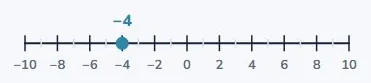
- −4 is read "negative four".
- Not "minus four": minus is something you do.
- 7 minus 4 is a subtraction. −4 is a number.
- Saying it properly keeps those two apart.
| You see | You say |
|---|---|
| −4 | negative four |
| 7 − 4 | seven minus four |
The sign belongs to the number
- The little dash in front is part of the number itself.
- It travels with it, like a surname.
- Drop it and you have written a completely different number.
Zero is neither
- Zero is not positive and it is not negative.
- It is the mark the other two are measured from.
- There is no such thing as −0.
Stand the line up and you have a thermometer
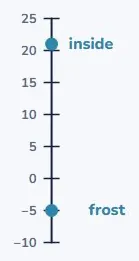
- Turn the number line vertical. Zero stays where it is.
- Positive numbers go up. Negative numbers go down.
- A frosty Central Otago morning reads below zero.
- Lower on the thermometer means colder, and smaller.
Where you actually meet them
- Anywhere there is a natural zero to go under.
- Temperature has one. So does a bank account.
- So does sea level, and the ground floor of a building.
| Where | Looks like |
|---|---|
| Temperature | −5 °C on a frosty morning |
| A freezer | −18 °C inside |
| Money owed | −$20 in your account |
| Below sea level | −3 m under the surface |
Counting backwards in twos from −6
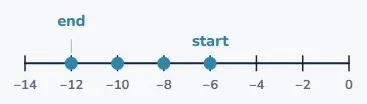
- Start at −6 and count back in twos.
- −6, then −8, then −10, then −12.
- Counting back means moving left, the same as always.
- The numerals grow, and the numbers get smaller.
Counting forwards through zero
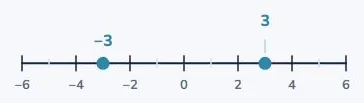
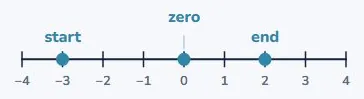
- Start at −3 and count up in ones.
- −3, −2, −1, then zero.
- Keep going and you are into the positives: 1, 2.
- Zero is a step on the way, not a wall.
Try it: count through zero
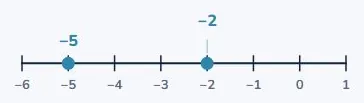
Which is bigger: −2 or −5?
- 5 is bigger than 2, so −5 must be bigger than −2.
- Wrong, and it is worth seeing why.
- On the line, −5 is further left. Further left is smaller.
- A colder day is a smaller temperature, not a bigger one.
Putting a mixed set in order
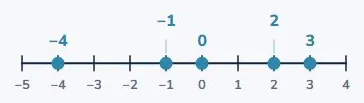
- Order these: 3, −4, 0, −1, 2.
- Find each one on the line, then read left to right.
- −4, −1, 0, 2, 3.
- The line does the ordering. You just read it off.
A small raised 2 means squared
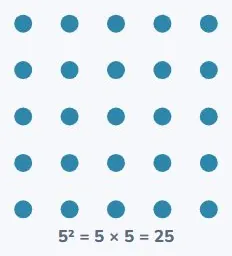
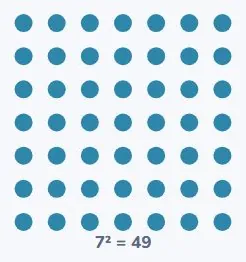
- 5² is a short way of writing 5 × 5.
- It is read "five squared", and it equals 25.
- The dots make a square, 5 by 5, hence the name.
A small raised 3 means cubed
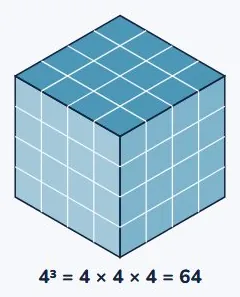
- 4³ is short for 4 × 4 × 4.
- It is read "four cubed", and it equals 64.
- Three of them multiplied, and it builds a cube.
The mistake everyone makes once
- 5² is not 5 × 2.
- The raised 2 says how many fives to multiply, not what by.
- 5 × 2 = 10. But 5² = 25. Nowhere near each other.
| Written | Means | Equals |
|---|---|---|
| 5² | 5 × 5 | 25 |
| 5 × 2 | 5 + 5 | 10 |
The square numbers to 144
- These twelve are worth knowing without working them out.
- Each one is a number multiplied by itself.
- 12² = 144 is the last one you need for Year 6.
| Number | Squared | Number | Squared |
|---|---|---|---|
| 1 | 1 | 7 | 49 |
| 2 | 4 | 8 | 64 |
| 3 | 9 | 9 | 81 |
| 4 | 16 | 10 | 100 |
| 5 | 25 | 11 | 121 |
| 6 | 36 | 12 | 144 |
Try it: which numbers make a square?
The cube numbers to 125
- There are only five to learn, so learn them.
- 1, 8, 27, 64, 125.
- They grow much faster than the squares do.
| Number | Cubed | Equals |
|---|---|---|
| 1 | 1 × 1 × 1 | 1 |
| 2 | 2 × 2 × 2 | 8 |
| 3 | 3 × 3 × 3 | 27 |
| 4 | 4 × 4 × 4 | 64 |
| 5 | 5 × 5 × 5 | 125 |
Is 49 a square number?
- Ask whether some number times itself makes 49.
- 7 × 7 = 49, so yes: 49 is 7².
- Now try 30. Nothing times itself makes 30.
- 5² is 25 and 6² is 36, so 30 falls in the gap.
Squared and cubed are not close
- Take the number 5.
- 5² = 25. Add one more five to multiply by.
- 5³ = 125: five times as big again.
- One extra step in the notation, a huge step in the answer.
| Written | Means | Equals |
|---|---|---|
| 5² | 5 × 5 | 25 |
| 5³ | 5 × 5 × 5 | 125 |
Common mistakes
- 5² = 5 × 2 = 10The small 2 means multiply 5 by itself: 5² = 5 × 5 = 25. 5 × 2 is 10.
- −5 is bigger than −2, because 5 is bigger than 2.−5 is further left on the number line, so it is smaller. −2 is the bigger number.
- Counting back in twos from −6: −6, −4, −2.Counting back means moving left, so the numbers get smaller: −6, −8, −10.
- 27 is a square number.No whole number times itself makes 27 (5² = 25, 6² = 36). But 3 × 3 × 3 = 27, so it is a cube number.
Eight to try
Start at −5 and count backwards in threes, three times.
Which is smaller, −8 or −3?
What is 9²?
Is 27 a square number, a cube number, or neither?
How should −7 be read out loud?
Put these in order, smallest first: 2, −6, 0, −1, 5.
At 6 am in Tekapo it is −4 °C. By noon it is 7 degrees warmer. What is the temperature at noon?
Which statement is true?
Show answer
Answers: 1. −8, −11, −14; watch for them counting forwards because the numerals get bigger. 2. −8, because it is further left. 3. 81. 4. A cube number, 3³, and not a square, since 5² is 25 and 6² is 36. Ask for the reasoning on 2 and 4; the answers alone do not show whether the sign or the gap between squares was understood. 5. Negative seven. The sign is part of the number; minus is something you do, as in 10 − 7. 6. −6, −1, 0, 2, 5. Read them off the number line from left to right; −6 is further left than −1, so it is smaller. 7. 3 °C. Count up 7 from −4: 4 steps reach 0, then 3 more reach 3. 8. 2³ is smaller than 3², because 2³ = 8 and 3² = 9. The others are false: 5² = 25, 3³ = 27, and 1³ = 1² = 1.
Number Line: Integers
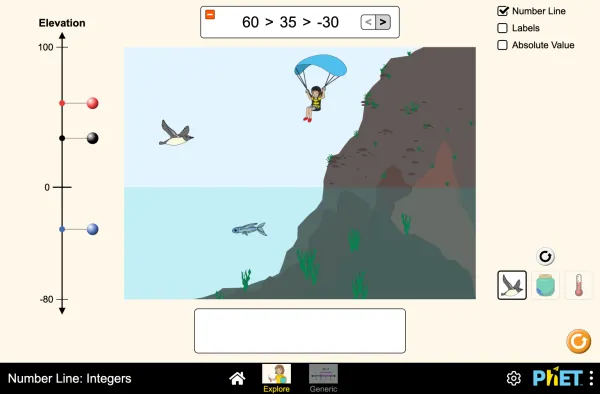
Full screen · PhET Interactive Simulations, University of Colorado Boulder, CC BY 4.0
Squared and cubed, side by side
- Squares to 144, cubes to 125.
- And on a number line, further left always means smaller.
| Number | Squared | Cubed |
|---|---|---|
| 1 | 1 | 1 |
| 2 | 4 | 8 |
| 3 | 9 | 27 |
| 4 | 16 | 64 |
| 5 | 25 | 125 |
Challenge
At 6 pm on a winter evening it is 4 °C in Twizel and −3 °C in Ranfurly. Overnight, Twizel cools by 2 degrees every hour and Ranfurly cools by 1 degree every hour. At what time are the two towns the same temperature, and what is that temperature?
Hint
How far apart are the two temperatures at 6 pm? Each hour, by how much does that gap shrink?
Answer
1 am, when both are −10 °C
Step by step
- At 6 pm, Twizel is 7 degrees warmer: from −3 up to 0 is 3, and from 0 up to 4 is 4.
- Each hour Twizel drops 1 degree more than Ranfurly, so the gap closes by 1 degree an hour.
- A gap of 7 degrees takes 7 hours to close, and 7 hours after 6 pm is 1 am.
- Twizel has dropped 14 degrees from 4 °C: 4 down to 0, then 10 more below zero gives −10 °C.
- Check Ranfurly: −3 °C dropping 7 degrees is −10 °C too.
Full working
- gap at 6 pm = 3 + 4 = 7 degrees−3 to 0 and 0 to 4 on the thermometer
- gap closes by 2 − 1 = 1 degree per hourTwizel cools faster
- 7 hours after 6 pm = 1 am7 ÷ 1 = 7 hours
- Twizel: 4 °C down 14 degrees = −10 °C2 × 7 = 14
- Ranfurly: −3 °C down 7 degrees = −10 °C1 × 7 = 7, it matches
- 1 am, both at −10 °C
Mia writes every integer from −20 up to 25 on its own card, including 0. Each card is a bank balance: a negative card means that many dollars owed, a positive card means that many dollars saved. If all the cards were put together into one account, what would the balance be?
Hint
Match each negative card with the positive card the same distance from zero, like −7 with 7. What is owing $7 and saving $7 together worth?
Answer
$115
Step by step
- −1 and 1 are the same distance from zero on opposite sides, so together they make 0. The same is true for −2 and 2, all the way to −20 and 20.
- So every card from −20 to 20 is cancelled out, and the 0 card adds nothing.
- The cards left over are 21, 22, 23, 24 and 25.
- 21 + 22 + 23 + 24 + 25 = 115, so the account holds $115.
Full working
- (−1 with 1), (−2 with 2), ..., (−20 with 20)each pair is owing and saving the same amount, worth 0
- 0 card adds nothingzero is neither positive nor negative
- left over: 21, 22, 23, 24, 25no negative partners
- 21 + 22 + 23 + 24 + 25 = 115five numbers averaging 23, and 5 × 23 = 115
- Balance = $115
Ihaia picks a negative integer greater than −50. On the number line, the distance from his number to 0 is a square number, and the distance from his number to 40 is also a square number. What is his number?
Hint
If his number is the negative of a square, like −16, its distance to 40 is that square plus 40. Try each square in turn.
Answer
−9
Step by step
- The distance to 0 is a square, so the number is one of −1, −4, −9, −16, −25, −36, −49.
- The distance from a negative number to 40 is the distance to 0 plus another 40.
- So add 40 to each square: 41, 44, 49, 56, 65, 76, 89.
- Only 49 is a square (7 × 7), and it came from 9.
- So the number is −9: it is 9 from zero, which is 3², and 49 from 40, which is 7².
Full working
- number = −1, −4, −9, −16, −25, −36 or −49distance to 0 is a square, number greater than −50
- distance to 40 = square + 40across zero, then 40 more
- 41, 44, 49, 56, 65, 76, 89add 40 to 1, 4, 9, 16, 25, 36, 49
- 49 = 7²the only square in the list, from 9 = 3²
- Ihaia's number is −9
Practise this
Report a mistake
More in Number
 Big numbers and rounding7 minNegative numbers, squares and cubes7 min
 Order of operations and column methods7 min
 Division and what to do with the remainder6 min
 Tenths, hundredths and thousandths7 min
 Comparing and adding fractions7 min
 Fractions and percentages of amounts7 min
 Money, discounts and having enough6 min