
Money, discounts and having enough
What this lesson covers
- Money uses our decimal place-value system to two decimal places.
A $280 bike, 25% off, and you have $220
- Can you buy it?
- Not "how much is the discount": can you actually pay.
- That takes three steps, and only one is a percentage.
Money always uses two decimal places
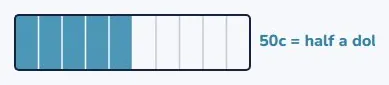
- A dollar splits into 100 cents.
- So one cent is one hundredth of a dollar.
- Hundredths is the second decimal place, hence exactly two.
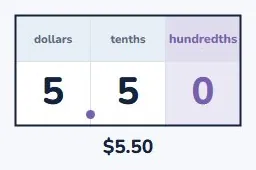
The second place is the cents
- In $5.50, the 5 after the point is 5 tenths (50 cents).
- The 0 is 0 hundredths: no single cents.
- Money is just decimals with a dollar sign in front.
Try it: change a percentage
$5.50 and $5.05 are not the same
- $5.50 is five dollars and fifty cents.
- $5.05 is five dollars and five cents.
- And $5.5 is unfinished; always write both places.
- That zero is holding a place, exactly as in any decimal.
| Written | Means | Verdict |
|---|---|---|
| $5.50 | five dollars fifty | correct |
| $5.05 | five dollars five cents | a different amount |
| $5.5 | incomplete | always write both places |
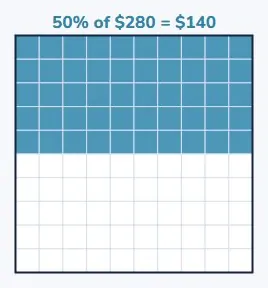
50% of $280
- 50% is half.
- Half of $280 is $140.00.
- Halving a whole dollar amount is the easiest one there is.
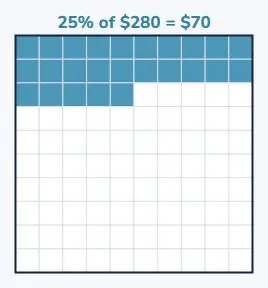
25% of $280
- 25% is half of a half.
- Half of $280 is $140. Half again is $70.00.
- So a quarter off this bike is $70.
10% of $280
- 10% is dividing by 10.
- $280 ÷ 10 = $28.00.
- These three cover most of the signs in any shop window.
| Percent | How | Of $280 |
|---|---|---|
| 10% | $280 ÷ 10 | $28.00 |
| 25% | half of half | $70.00 |
| 50% | half of $280 | $140.00 |
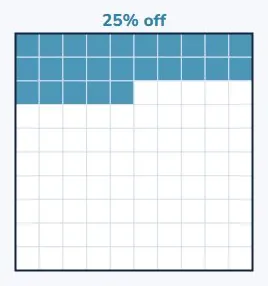
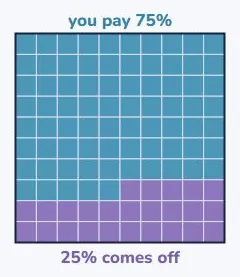
25% off means you pay 75%
- The sign says 25% off. That is what comes off, not what you pay.
- If a quarter comes off, three quarters stays on.
- So the price you pay is 75% of $280.
Taking the discount off
- $280 − $70 = $210.00.
- That is what the bike actually costs today.
- Step two of three, and now there is a real price to compare.
| Amount | |
|---|---|
| Ticket price | $280.00 |
| Less 25% | −$70.00 |
| You pay | $210.00 |
And the actual question
- You have $220. The bike costs $210.
- $220 is more than $210, so yes, you can buy it.
- And $220 − $210 leaves $10.00 change.
- That is the answer: yes, with ten dollars over.
| Step | Working | Result |
|---|---|---|
| Work out 25% off | $280 ÷ 4 | $70.00 |
| Take it off the price | $280 − $70 | $210.00 |
| Compare with what you have | $220 vs $210 | enough |
Checking it the other way
- Instead of taking 25% off, find 75% directly.
- 50% is $140 and 25% is $70, so 75% is $210.
- Same answer by a different route, which is a real check.
| Route | Working | Answer |
|---|---|---|
| Take off 25% | $280 − $70 | $210.00 |
| Find 75% | $140 + $70 | $210.00 |
A $45 top at 20% off
- 10% of $45 is $4.50.
- 20% is double that: $9.00.
- $45 − $9 = $36.00.
- Notice 10% of $45 needed both decimal places.
| Step | Amount |
|---|---|
| 10% of $45 | $4.50 |
| 20% of $45 | $9.00 |
| You pay | $36.00 |
The discount was never the question
- School questions ask how much comes off.
- Real ones ask whether you can pay for it.
- That needs the percentage, then a subtraction, then a comparison.
- And the answer is yes or no, not a number.
Estimate before you get to the counter
- You do not need the exact total to know if you have enough.
- Round everything up and add the rounded numbers.
- If the rounded-up total fits, the real one certainly does.
| Item | Rounded up |
|---|---|
| $12.50 | $13 |
| $8.99 | $9 |
| $4.25 | $5 |
| Estimate | $27 |
Adding up a basket
- Now the exact total: $12.50 + $8.99 + $4.25.
- Line the decimal points up, then add the cents column first.
- The total is $25.74.
- Under the $27 estimate, as it had to be.
| Item | Price |
|---|---|
| Drink bottle | $12.50 |
| Notebook | $8.99 |
| Pens | $4.25 |
| Total | $25.74 |
Try it: pay the exact amount
Line up the points, not the edges
- Money always has two places, so the columns always match.
- That is the one genuinely easy thing about adding money.
- Dollars under dollars, cents under cents.
| Dollars | Tenths | Hundredths | |
|---|---|---|---|
| 12 | 5 | 0 | |
| + | 8 | 9 | 9 |
| + | 4 | 2 | 5 |
| = | 25 | 7 | 4 |
Common mistakes
- The $280 bike is 25% off, and 25% of $280 is $70, so the bike costs $70.$70 is what comes off the price. You pay $280 − $70 = $210.
- Four dollars and five cents is $4.5.Five cents is 5 hundredths, so write $4.05. $4.5 would mean $4.50.
- Can you buy the bike with $220? Answer: $210.The question asks yes or no, so finish by comparing: $220 is more than $210, so yes, with $10 left over.
Eight to try
What is 25% of $60?
A $90 jacket is 10% off. What do you pay?
You have $50. Can you buy items at $19.99, $12.50 and $16.75?
Write eight dollars and five cents properly.
What is 10% of $63?
You pay for a $6.45 pie with a $10 note. How much change do you get?
You have $30. Round $9.20, $11.85 and $7.40 each up to the next whole dollar. What is the estimate, and is $30 enough?
A $36 hat is 50% off and a $28 cap is 25% off. Which costs less now, and by how much?
Show answer
Answers: 1. $15.00 (half of $60 is $30, half again is $15). 2. 10% is $9, so you pay $81.00. 3. Estimate first: $20 + $13 + $17 is $50, so it is close; the exact total is $49.24, so yes, with 76c over. 4. $4.05, not $4.5 or $4.50. Question 3 is the whole lesson: they need all three steps and a yes-or-no answer. 5. $6.30. Dividing by 10 moves every digit down one column: $63 ÷ 10 = $6.30. 6. $3.55. Line up the points: $10.00 − $6.45 = $3.55. 7. $30, so yes, there is enough. Rounded up it is $10 + $12 + $8 = $30, and the exact total, $28.45, can only be less. 8. The hat, by $3.00. 50% of $36 is $18, so the hat is $18.00; 25% of $28 is $7, so the cap is $21.00, and $21 − $18 = $3.00.
Three steps, then yes or no
- Find the percentage. Take it off. Compare with what you have.
- And write money with both decimal places, every time.
| Step | Working | Result |
|---|---|---|
| Work out 25% off | $280 ÷ 4 | $70.00 |
| Take it off the price | $280 − $70 | $210.00 |
| Compare with what you have | $220 vs $210 | enough |
Challenge
The same running shoes are sold in two shops. Shop A: $64.00, with 25% off. Shop B: $60.00, with $10 off, then a further 10% off the new price. Which shop is cheaper? Mia has $100. Can she buy two pairs at the cheaper shop and a pair of socks for $8.95?
Hint
Work out the real price in each shop. In Shop B, do the $10 off first, then find 10% of what is left.
Answer
Shop B is cheaper ($45.00 against $48.00). Yes: the total is $98.95, so she has $1.05 over.
Step by step
- Shop A: 25% of $64 is $16, so the shoes cost $64 − $16 = $48.00.
- Shop B: $60 − $10 = $50, then 10% of $50 is $5, so the shoes cost $45.00.
- Two pairs at Shop B cost $90.00. Add the socks: $98.95.
- $100 is more than $98.95, so yes, with $1.05 left over.
Full working
- $64 ÷ 4 = $16.0025% is a quarter
- $64 − $16 = $48.00Shop A price
- $60 − $10 = $50.00, $50 ÷ 10 = $5.00Shop B: $10 off, then 10%
- $50 − $5 = $45.00Shop B price
- 2 × $45 + $8.95 = $98.95two pairs and socks
- $100.00 − $98.95 = $1.05compare with what she has
- Shop B; yes, with $1.05 over
In a sale, a jacket is 20% off and now costs $68.00. What was its price before the sale? On the last day, the shop takes another 20% off the sale price. Sione says that is the same as 40% off the original price. Is he right? If not, how far out is he?
Hint
If 20% is taken off, what percentage of the original is $68? Find 10% of the original from that. For Sione: is the second 20% taken from the same amount as the first?
Answer
The original price was $85.00. Sione is wrong: the last-day price is $54.40, not $51.00, so he is out by $3.40.
Step by step
- 20% off means the $68 is 80% of the original price.
- 80% is 8 lots of 10%, so 10% is $68 ÷ 8 = $8.50, and 100% is $85.00.
- The second 20% comes off $68, not $85: 20% of $68 is $13.60, so the price becomes $54.40.
- 40% off $85 would be $85 − $34 = $51.00.
- The second discount is taken from a smaller amount, so it is smaller. The difference is $3.40.
Full working
- $68.00 is 80%100% − 20%
- $68 ÷ 8 = $8.5010% of the original
- $8.50 × 10 = $85.00original price
- 10% of $68 = $6.80, 20% = $13.60second discount
- $68.00 − $13.60 = $54.40last-day price
- 40% of $85 = $34.00, $85 − $34 = $51.00Sione's price
- $54.40 − $51.00 = $3.40he is out by $3.40
For a class party, Hemi spends exactly $50.00 on bottles of juice at $3.45 each and bags of chips at $2.80 each, with no change. He buys at least one of each. How many of each does he buy? Show that there is only one way to do it.
Hint
Look at the cents. The chips always cost a whole number of 10 cents. What does that tell you about how many juices there are? Then try only those numbers.
Answer
He buys 8 bottles of juice and 8 bags of chips. It is the only way.
Step by step
- Any number of chips costs an amount ending in 0 cents, and so does $50.00.
- So the juice must also end in 0 cents. An odd number of $3.45 bottles ends in 5 cents, so the number of juices is even.
- At most 14 juices fit (15 would cost $51.75), so try 2, 4, 6, 8, 10, 12 and 14.
- Only 8 juices leaves an amount that $2.80 goes into exactly: $50 − $27.60 = $22.40, and $22.40 ÷ $2.80 = 8.
- Every other even number leaves a remainder, so 8 and 8 is the only answer.
Full working
- chips: 2.80, 5.60, 8.40, ... all end in 0 centsso juice must too
- odd × $3.45 ends in 5 centsnumber of juices is even
- 2: $43.10 left; 4: $36.20; 6: $29.30none divide by $2.80
- 8: $50 − 8 × $3.45 = $50 − $27.60 = $22.40, $22.40 ÷ $2.80 = 8works
- 10: $15.50; 12: $8.60; 14: $1.70none divide by $2.80
- 8 bottles of juice and 8 bags of chips
Practise this
Report a mistake
More in Number
 Big numbers and rounding7 min
 Negative numbers, squares and cubes7 min
 Order of operations and column methods7 min
 Division and what to do with the remainder6 min
 Tenths, hundredths and thousandths7 min
 Comparing and adding fractions7 min
 Fractions and percentages of amounts7 minMoney, discounts and having enough6 min