
Earth's fresh water: ice, lakes, rivers and groundwater
What this lesson covers
- How small Earth's share of fresh water is
- Fresh water stored as ice, and in lakes and rivers
- Groundwater and aquifers
- Where our tap water comes from
- Showing amounts of water in grids, diagrams and graphs
Fresh water is rare
- Fresh water is water with very little salt in it. After cleaning, people, animals and plants can use it.
- The U.S. Geological Survey, a science agency that studies water, estimates that only 2.5% of Earth's water is fresh. All the rest is salty.
- That means for every 100 buckets of water on Earth, only about two and a half are fresh.
Where the fresh water is kept
- Most fresh water is frozen. A glacier is a huge, slow river of ice that creeps downhill, like the Franz Josef and Fox Glaciers in the Southern Alps. An ice cap is a thick sheet of ice covering land, like the one over Antarctica.
- The next biggest store is underground.
- Lakes and rivers, the fresh water we see most, hold only a tiny share. Lake Taupō is New Zealand's largest lake, and the Waikato River is its longest river.
| Fresh water store | Share of Earth's fresh water (%) |
|---|---|
| Ice caps, glaciers and permanent snow | 68.7 |
| Groundwater | 30.1 |
| Lakes | 0.26 |
| Air | 0.04 |
| Rivers | 0.006 |
Groundwater and aquifers
- Groundwater is fresh water stored underground, in the tiny gaps between grains of soil, sand and gravel, and in cracks in rock.
- An aquifer is a layer of rock or gravel that holds groundwater and lets it flow through, a bit like a giant sponge.
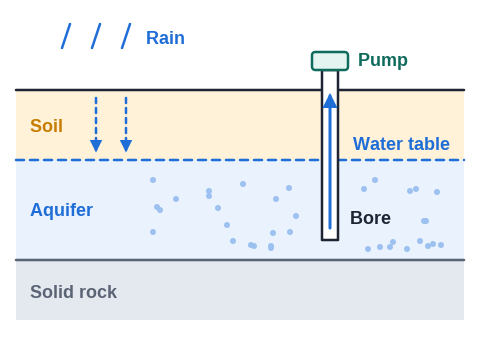
- Rain soaks down through the soil until it reaches ground that is already full of water. The top of this wet layer is called the water table.
- People reach groundwater by digging a well or drilling a narrow hole called a bore, then pumping the water up.
Where tap water comes from
- Rivers, lakes and groundwater supply nearly all the water people use. The ice is too far away and too hard to melt.
- Christchurch's tap water is pumped from aquifers deep under the Canterbury Plains.
- Auckland's comes mostly from dams in the Waitākere and Hūnua Ranges, which store rain and stream water in lakes, and from the Waikato River.
- Many farms and small towns have their own bores into the groundwater.
Try it: where is the fresh water?
Showing Earth's water in 100 squares
- Draw all of Earth's water as a grid of 100 squares, so each square stands for 1%. How many squares does each store get?
| Store | Share of all Earth's water (%) |
|---|---|
| Ice caps, glaciers and permanent snow | 1.74 |
| Fresh groundwater | 0.76 |
| Lakes, rivers and air together | less than 0.02 |
| Salty water | the rest |
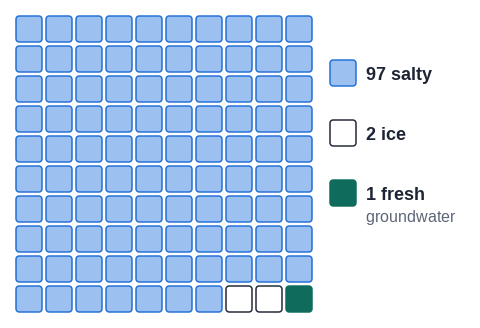
- Ice: 1.74 rounds to 2 squaresround to whole squares
- Fresh groundwater: 0.76 rounds to 1 squareround to whole squares
- Lakes, rivers and air: less than 0.02, so 0 squarestoo small to show
- Salty water: 100 − 2 − 1 = 97 squaresthe rest
- 97 salty squares, 2 ice squares and 1 groundwater square
- Rounding gives fresh water 3 squares, a little more than its real 2.5%
Try it: Earth's water in 100 squares
Other ways to show the amounts
- A bar graph puts each store on its own bar, so you can compare the sizes quickly.
- A pictogram uses a small picture, like a drop, for a set amount of water.
- A scaled model shrinks the real amounts. If all Earth's water fitted in a 1 litre jug, the fresh water would be just 25 mL, about 5 teaspoons.
- A map can show where the water is, such as which regions draw on groundwater.
Try it: find the fresh water
Common mistakes
- Most fresh water is in lakes and rivers.Most fresh water is frozen as ice, and most of the rest is groundwater; lakes and rivers hold well under 1% of it.
- Groundwater is an underground lake or river.Most groundwater fills the tiny gaps between grains of soil and gravel and the cracks in rock, like water in a sponge.
- With 2.5% fresh water, people can use 2.5% of all Earth's water.Most of that 2.5% is locked in ice far away, so the fresh water people can easily reach is far smaller.
Earth's water in a jug
You need: a 1 litre measuring jug, water, a teaspoon, 2 small cups, a saucer, an ice cube tray, salt
- Fill the jug to 1 litre. This stands for all the water on Earth.
- Take out 5 teaspoons (25 mL) into a cup. This is all the fresh water. Then stir a teaspoon of salt into the jug to make the rest salty, like the sea.
- Put 3 and a half teaspoons of the fresh water into the ice cube tray and freeze it. That is the ice caps and glaciers. The last 1 and a half teaspoons in the cup is groundwater.
- Dip a finger in the groundwater and let 2 or 3 drops fall onto the saucer. That is roughly all the lakes, and all the rivers would be less than one drop.
- Look for this: a full jug of water, but only a few teaspoons of fresh water, and just a few drops in the places people find easiest to reach.
Safety: Ask an adult to help, and do not drink the salty water, because seawater makes you thirstier; wipe up spills so nobody slips.
Your turn
If all of Earth's water was 1000 mL, how much would be fresh water?
Which store holds the most fresh water?
What is an aquifer?
Where does Christchurch get its tap water from?
In a 100-square grid of Earth's fresh water only, about how many squares would groundwater get?
Show answer
1. 2.5% of 1000 mL is 25 mL. 2. Ice caps, glaciers and permanent snow, with 68.7% of it. 3. A layer of rock or gravel that holds groundwater and lets it flow through. 4. From aquifers deep under the Canterbury Plains. 5. Groundwater is 30.1% of fresh water, so about 30 squares.
Recap
- Only about 2.5% of Earth's water is fresh.
- Most fresh water is frozen in ice caps and glaciers; most of the rest is groundwater.
- Lakes and rivers hold only a tiny share, but they are the easiest to reach.
- Groundwater sits in gaps in soil and rock; an aquifer holds it and lets it flow.
- Rivers, lakes and groundwater supply nearly all the water people use.
- Grids, bar graphs, pictograms and scaled models make the amounts easy to compare.
Challenge
Imagine all of Earth's water shared into 1 000 000 equal buckets. Use the lesson's figures: 2.5% of Earth's water is fresh, and of the fresh water, ice holds 68.7%, groundwater 30.1%, lakes 0.26% and rivers 0.006%. (a) How many buckets of fresh water are ice, groundwater, lakes and rivers? (b) Show that lakes and rivers together hold fewer than 1 bucket in every 15 000. (c) About how many times as much fresh water is underground as in lakes and rivers together? Why does that make groundwater so important to people?
Hint
Find the 25 000 fresh buckets first, then take each percentage of 25 000, not of 1 000 000. 1% of 25 000 is 250.
Answer
(a) Ice 17 175, groundwater 7525, lakes 65, rivers 1.5 buckets. (b) Lakes and rivers hold 66.5 buckets, and 66.5 × 15 000 = 997 500, which is less than 1 000 000. (c) About 113 times. Ice is mostly far away and frozen, so groundwater is by far the biggest store of fresh water people can actually reach with wells and bores.
Step by step
- Fresh water is 2.5% of 1 000 000 buckets, which is 25 000 buckets.
- 1% of 25 000 is 250, so ice is 68.7 × 250 = 17 175 and groundwater is 30.1 × 250 = 7525 buckets.
- Lakes are 0.26 × 250 = 65 buckets and rivers 0.006 × 250 = 1.5 buckets, 66.5 together.
- 15 000 lots of 66.5 buckets is 997 500, still short of 1 000 000, so it is fewer than 1 in 15 000.
- 7525 ÷ 66.5 is about 113, so groundwater holds over 100 times as much as lakes and rivers.
Full working
- 2.5% of 1 000 000 = 25 000fresh buckets
- 1% of 25 000 = 250a handy unit
- 68.7 × 250 = 17 175; 30.1 × 250 = 7525ice; groundwater
- 0.26 × 250 = 65; 0.006 × 250 = 1.5lakes; rivers
- 65 + 1.5 = 66.5; 66.5 × 15 000 = 997 500 < 1 000 000fewer than 1 in 15 000
- 7525 ÷ 66.5 ≈ 113groundwater compared with lakes and rivers
- Ice 17 175, groundwater 7525, lakes 65, rivers 1.5; about 113 times as much underground
A Canterbury farm has three bores, reaching 6 m, 10 m and 18 m below the ground. In these made-up readings, the water table was this far below the ground on the 1st of each month: January 7.5 m, February 9.0 m, March 10.5 m, April 9.5 m, May 7.0 m, June 4.5 m. A bore's pump only works when the water table is at least 1 m above the bottom of the bore. (a) In which of these months does each bore work? (b) The farmer wants to drill the 10 m bore deeper so it works in all six months. What is the least depth it needs? (c) Give two reasons the water table was deepest at the start of March.
Hint
A bigger number means the water is further down. A bore that reaches 10 m works only when the water table is no deeper than 10 − 1 = 9 m.
Answer
(a) The 6 m bore: June only. The 10 m bore: January, February, May and June. The 18 m bore: all six months. (b) 11.5 m. (c) After the dry summer, little rain had soaked down to refill the groundwater, and farms had been pumping a lot of it out to water crops.
Step by step
- Each bore needs the water table no deeper than 1 m above its bottom: 5 m, 9 m and 17 m.
- The 6 m bore needs 5 m or less: only June, at 4.5 m.
- The 10 m bore needs 9 m or less: January 7.5, February 9.0, May 7.0 and June 4.5. March and April are too deep.
- The 18 m bore needs 17 m or less, which every month meets.
- The deepest table was 10.5 m in March, so the bore must reach 10.5 + 1 = 11.5 m.
- In summer, rain is low and more water is pumped out, so the store falls until autumn rain refills it.
Full working
- 6 − 1 = 5 m; 10 − 1 = 9 m; 18 − 1 = 17 mdeepest water table each bore can use
- 6 m bore: 4.5 ≤ 5 only in Juneone month
- 10 m bore: 7.5, 9.0, 7.0, 4.5 ≤ 9; 10.5 and 9.5 are deeperJanuary, February, May, June
- 18 m bore: every reading ≤ 17all six months
- 10.5 + 1 = 11.5 mdeepest table plus 1 m
- 6 m bore June; 10 m bore January, February, May, June; 18 m bore all months; drill to 11.5 m; dry summer and summer pumping
Under a square block of farmland 1 km by 1 km lies a gravel aquifer. Every 1 m³ of this gravel holds 200 litres of water in the gaps between the stones (1 m³ is 1000 litres, so the stones fill the rest). A town of 5000 people pumps all its water from this block, 200 litres for each person each day. Rain soaking down refills the aquifer under the block with 300 000 000 litres a year. Pretend no groundwater flows in or out sideways, and use 365 days in a year. (a) How many litres of water are held in the top 2 m of the full gravel? (b) With no rain at all, how many days would the town take to lower the water table by 2 m? (c) With the rain, about how many years would it take?
Hint
Find the volume of gravel in the top 2 m in m³ first (1 km is 1000 m). Then compare a year of pumping with a year of refilling.
Answer
(a) 400 000 000 litres. (b) 400 days. (c) About 6 years (400 000 000 ÷ 65 000 000 ≈ 6.2).
Step by step
- The top 2 m of gravel is 1000 m × 1000 m × 2 m = 2 000 000 m³.
- Each m³ holds 200 litres, so that layer holds 2 000 000 × 200 = 400 000 000 litres.
- The town pumps 5000 × 200 = 1 000 000 litres a day, so with no rain the layer lasts 400 days.
- In a year the town pumps 365 000 000 litres, but rain puts back 300 000 000, so the aquifer loses 65 000 000 litres a year.
- 400 000 000 ÷ 65 000 000 is about 6.2, so the table falls 2 m in a little over 6 years.
Full working
- 1000 × 1000 × 2 = 2 000 000 m³gravel in the top 2 m
- 2 000 000 × 200 = 400 000 000 litreswater in that gravel
- 5000 × 200 = 1 000 000 litres a daythe town's use
- 400 000 000 ÷ 1 000 000 = 400 dayswith no rain
- 365 × 1 000 000 = 365 000 000 litres a yearpumped out
- 365 000 000 − 300 000 000 = 65 000 000 litres a yearlost each year
- 400 000 000 ÷ 65 000 000 ≈ 6.2years
- 400 000 000 litres; 400 days; about 6 years