
Traits, inheritance and variation in living things
What this lesson covers
- What a trait is
- Traits that sort into groups and traits that vary smoothly
- How surroundings can change the way a trait shows
- Young inherit traits from their parents
- Variation: no two individuals are exactly the same
- Why some variations help living things survive
- Collecting trait data and showing it in a histogram
What is a trait?
- A trait is a feature of a living thing that you can see or measure.
- The colour of a cat's fur, the size of a pōhutukawa leaf and the shape of a bird's beak are all traits.
- A kiwi's long, thin beak is a trait that lets it probe deep into soil for worms.
Groups or a range
- Some traits fall into clear groups with nothing in between. A sweet pea flower might be pink, white or purple.
- Other traits spread across a smooth range of values. Height, leaf length and mass can be any value between the smallest and the largest.
- To show a trait that falls into groups, use a bar graph with a gap between the bars. To show a trait with a range, sort the values into equal intervals and draw a histogram, where the bars touch.
| Trait | Clear groups or a range? |
|---|---|
| Flower colour of sweet peas | Clear groups |
| Whether a sheep has horns | Clear groups |
| Height of kōwhai trees | A range |
| Length of pōhutukawa leaves | A range |
Try it: groups or a range?
Passing traits on
- Offspring are the young of a living thing: puppies, chicks, lambs, or seedlings that grow from seeds.
- Offspring inherit, or receive, many traits from their parents.
- That is why pōhutukawa seeds grow into pōhutukawa trees and never into kōwhai, and why the lambs of black-faced sheep usually have black faces too.
Alike, but not the same
- A species is one kind of living thing whose members can breed together, such as tūī or house cats.
- Offspring look like their parents and like each other, but they are never exact copies. Kittens in one litter can have different patches and patterns.
- Variation means the differences between individuals of the same species. Garden snails, for example, can have shells with different colours and bands.
Surroundings shape traits too
- The environment is everything around a living thing: the weather, the soil, food, light and water.
- The environment can change how a trait turns out. Trees on a coast blasted by strong wind from one side grow bent over, like the famous leaning trees at Slope Point in Southland.
- The same kind of tree in a sheltered valley grows straight.
- So a trait depends on what is inherited and on the surroundings.
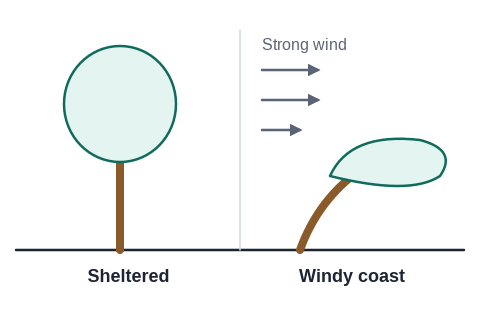
Try it: inherited or shaped by surroundings?
Some differences help living things survive
- Some variations make it easier for a living thing to survive and have young.
- Picture a field of dry, brown grass with green and brown grasshoppers in it. Birds spot the green ones more easily and eat more of them.
- More brown grasshoppers survive to have young, and those young inherit the brown colour, so over many years more of the grasshoppers there are brown.
Collecting trait data fairly
- To study variation, measure the same trait on many individuals of one species, in the same way every time.
- For leaves, choose them from all around the plant, not just the biggest ones, and measure from the tip to where the stalk starts.
- Pooling means putting everyone's results together. A pooled class set is bigger, so the pattern it shows is easier to trust.
Pōhutukawa leaves in a histogram
- Room 6 measured 40 leaves from one pōhutukawa tree and pooled their results into groups. What does the pattern show?
| Leaf length (cm) | Number of leaves |
|---|---|
| 4.0 to 4.9 | 3 |
| 5.0 to 5.9 | 7 |
| 6.0 to 6.9 | 13 |
| 7.0 to 7.9 | 10 |
| 8.0 to 8.9 | 5 |
| 9.0 to 9.9 | 2 |
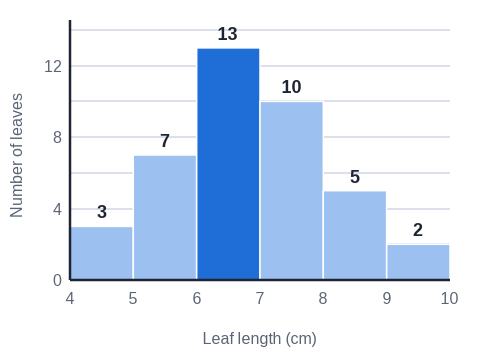
- 3 + 7 + 13 + 10 + 5 + 2 = 40 leavescheck the total
- The tallest bar is 6.0 to 6.9 cm, with 13 leavesthe most common group
- The lengths run from about 4 cm to 10 cmthe range
- Most leaves are in the middle and few are very short or very longthe shape
- Leaf length varies across a smooth range, with most leaves 6.0 to 6.9 cm long
Common mistakes
- Brothers and sisters from the same parents are exactly the same.Offspring are similar to each other but never identical; there is always some variation.
- Every trait comes only from the parents.The environment matters too: a tree bent by wind or a plant grown in shade shows how surroundings change a trait.
- A histogram has gaps between the bars, like a bar graph.In a histogram the bars touch, because the groups are a smooth range of values with no gaps between them.
- Measuring the five biggest leaves on a tree shows how leaf size varies.Pick leaves from all around the plant, or the results will be too big and will hide the variation.
Measure leaf variation in your garden
You need: a ruler marked in mm, paper and a pencil, a plant with plenty of leaves of one kind, such as a hedge
- With an adult, choose one plant and pick 20 leaves from all around it, high and low, sunny side and shady side.
- Measure each leaf from its tip to where the stalk starts, to the nearest millimetre, and write the lengths down.
- Sort the lengths into groups of 1 cm, for example 4.0 to 4.9 cm, and count how many leaves are in each group.
- Draw a histogram with the groups along the bottom and the number of leaves up the side, with the bars touching.
- Look for this: most leaves sit in the middle groups, with only a few very short or very long ones.
Safety: Ask an adult to choose the plant, because some garden plants are poisonous or have sap that burns the skin, and wash your hands afterwards.
Your turn
Which of these is a trait: the colour of a dog's coat, the dog's name, or the dog's favourite toy?
Does the length of a cat's tail fall into clear groups or a range?
Two kōwhai seedlings come from the same tree. One grows tall in the sun and one stays small in deep shade. What caused the difference?
White and brown mice live in a dark, brown forest. Owls hunt them by sight. Which colour will probably become more common, and why?
In Room 6's histogram, how many leaves were 8.0 cm or longer?
Show answer
1. The colour of its coat, a feature of its body you can see; a name and a favourite toy are not part of the dog. 2. A range, because tail length can be any value. 3. The environment: the amount of light changed how the trait turned out. 4. Brown, because owls see white mice more easily, so more brown mice survive and pass on their colour. 5. 5 + 2 = 7 leaves.
Natural Selection
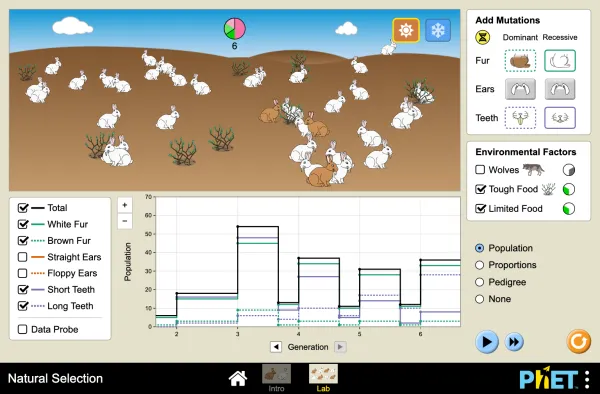
Full screen · PhET Interactive Simulations, University of Colorado Boulder, CC BY 4.0
Recap
- A trait is a feature you can see or measure.
- Some traits fall into clear groups; others vary across a smooth range.
- Offspring inherit traits from their parents but are never exact copies.
- Variation is the differences between individuals of one species.
- The environment can change how a trait shows, and some variations help survival.
- Pooled measurements in a histogram show how a trait varies.
Challenge
Moana has a hydrangea of a kind whose flower colour can change. Its flowers are pink. She takes cuttings from it: pieces of stem that grow roots and become new plants. A plant grown from a cutting has exactly the same inherited traits as the plant it was cut from. She plants one cutting in her own garden and gives one to her aunt. Two years later her cutting has pink flowers and her aunt's has blue flowers. (a) Is the difference in flower colour inherited, or caused by the environment? Explain how you know. (b) Her aunt takes a cutting from the blue plant and gives it back to Moana, who plants it in her own garden. Predict its flower colour and explain. (c) Name one feature of the two gardens that could be different and cause this.
Hint
Both plants came from one parent plant, with no new parent involved. So could they have inherited different traits?
Answer
(a) The environment. Both cuttings came from the same plant, so they inherited exactly the same traits; the only difference is where they grew. (b) Pink, because it has the same inherited traits and Moana's garden gives pink flowers. (c) How acidic the soil is, which is part of a plant's environment. In this kind of hydrangea, acidic soil gives blue flowers and less acidic soil gives pink. Water and fertiliser are also acceptable ideas to test.
Step by step
- Cuttings are copies of one plant, so all of them inherit exactly the same traits.
- Two plants with the same inherited traits ended up different, so the difference must come from their surroundings.
- The blue plant's colour was caused by its garden, not passed on, so a cutting from it still has the same inherited traits.
- In Moana's garden that cutting meets the same conditions as her pink plant, so it should flower pink.
- The gardens differ in soil, water and care; soil is a strong suspect, because in this kind of hydrangea, acidic soil turns the flowers blue.
Full working
- all cuttings come from one plantsame inherited traits
- same traits, different coloursthe cause is the environment
- blue cutting back in Moana's gardensame traits, same conditions as the pink plant
- flowers pinkthe colour follows the garden
- Environment: the colour depends on the garden (for example the soil), so a cutting of the blue plant flowers pink in Moana's garden
A kind of land snail can have a banded shell or a plain shell, and the shell pattern is inherited. Song thrushes eat these snails by smashing them on a favourite stone, leaving the broken shells around it. In one patch of long grass, a class found these made-up numbers: living snails, 120 banded and 90 plain; broken shells around the thrushes' stones, 40 banded and 10 plain. Assume all the broken shells came from snails living in that patch. (a) Before the thrushes ate them, how many banded and how many plain snails were there? (b) What fraction of the banded snails were eaten, and what fraction of the plain ones? (c) Did the banded share of the snails go up or down? Show your working. (d) Predict what will happen to the snails in this patch over many years if the thrushes keep hunting there, and explain why the snails' shell pattern must be inherited for this to happen.
Hint
Add each kind's living snails and eaten snails to get the numbers at the start. Compare 'eaten out of how many' for each kind, not just the number eaten.
Answer
(a) 160 banded and 100 plain. (b) 40160 = 14 of the banded snails and 10100 = 110 of the plain snails. (c) Down: banded snails were 160 out of 260 (about 62%) and are now 120 out of 210 (about 57%). (d) Plain snails survive better in this grass, so more of them live to breed and pass on plain shells; over many years, plain snails should become more common. If the pattern were not inherited, the survivors' young would not be more likely to be plain.
Step by step
- At the start: banded 120 + 40 = 160 and plain 90 + 10 = 100.
- Banded: 40 of 160 eaten, which is 1 in 4. Plain: 10 of 100 eaten, which is 1 in 10.
- So in this grass a banded snail was more likely to be eaten, probably because it was easier for a thrush to spot.
- Banded snails fell from 160 out of 260 to 120 out of 210, so their share went down.
- Survivors pass on their shell pattern to their young, so the plain pattern spreads over many generations.
Full working
- 120 + 40 = 160 banded; 90 + 10 = 100 plainbefore the thrushes
- 40160 = 14fraction of banded eaten
- 10100 = 110fraction of plain eaten
- before: 160 ÷ 260 ≈ 0.62; after: 120 ÷ 210 ≈ 0.57banded share went down
- plain survive better and pass on plain shellsinherited, so it builds up over generations
- 160 banded, 100 plain; 14 compared with 110 eaten; banded share fell; plain snails should become more common
Room 3 measured the height of 30 harakeke (flax) plants on a windy headland and 30 in a sheltered gully nearby. These are made-up results. Headland: 0.5 to 0.9 m, 8 plants; 1.0 to 1.4 m, 14; 1.5 to 1.9 m, 6; 2.0 to 2.4 m, 2. Gully: 0.5 to 0.9 m, 1; 1.0 to 1.4 m, 5; 1.5 to 1.9 m, 12; 2.0 to 2.4 m, 9; 2.5 to 2.9 m, 3. (a) Give the most common group for each place, and the fraction of each set that is 1.5 m or taller. (b) Tia says, "The wind stunts the headland plants." Sam says, "The headland plants have inherited being short." Explain why the class's data cannot tell who is right. (c) Plan a fair test to find out, and say what results would support Tia, what would support Sam, and what would show both are partly right.
Hint
In the class data, place and parents change together. How could you give plants from both places exactly the same surroundings?
Answer
(a) Headland: 1.0 to 1.4 m, with 830 at 1.5 m or taller. Gully: 1.5 to 1.9 m, with 2430 at 1.5 m or taller, three times as many. (b) The two groups differ in their surroundings and may also differ in what they inherited, so either cause, or both, could explain the difference. (c) Grow young plants from both places side by side in the same sheltered spot, with the same soil, water and light, and measure them after a few years. If both groups grow to similar heights, the wind caused it (Tia). If the headland plants stay as short as they were on the headland while the gully plants grow tall, it is inherited (Sam). If the headland plants grow taller than they were on the headland but stay shorter than the gully plants beside them, both matter.
Step by step
- Headland: the biggest group is 14 plants at 1.0 to 1.4 m; 6 + 2 = 8 of 30 are 1.5 m or taller.
- Gully: the biggest group is 12 plants at 1.5 to 1.9 m; 12 + 9 + 3 = 24 of 30 are 1.5 m or taller.
- The plants in each place grew in different surroundings and may come from different parents, so the data mixes two possible causes.
- A fair test changes only one thing: plants from both places, grown in the same conditions.
- Any difference left after that must be inherited; any difference that disappears was caused by the surroundings.
Full working
- 8 + 14 + 6 + 2 = 30; 1 + 5 + 12 + 9 + 3 = 30check the totals
- headland: 6 + 2 = 8, so 8301.5 m or taller
- gully: 12 + 9 + 3 = 24, so 24301.5 m or taller, 3 times as many
- place and parents differ togetherthe data cannot separate the causes
- grow both in the same sheltered spotonly the origin differs
- Headland 1.0 to 1.4 m, 830; gully 1.5 to 1.9 m, 2430; grow both side by side: same heights means wind, still shorter means inherited, in between means both