
Earth's water: stores, clouds, vapour and the water we use
What this lesson covers
- The hydrosphere: the water lying on Earth's surface
- Water stores, and how water moves between them
- What clouds are made of
- Water vapour, the invisible gas in the air
- Why most of Earth's water is too salty to drink
- Reading water level data and working out household water use
The hydrosphere
- The hydrosphere is the name for every bit of water lying on our planet's surface: the oceans and seas, rivers, lakes, and ice.
- Water covers most of Earth's surface, which is why Earth looks blue from space.
- New Zealand is surrounded by the Pacific Ocean and the Tasman Sea, so most of the water near us is sea.
Water stores, and water on the move
- A water store is a place where water is kept for a while, such as the sea, a lake, a glacier, the ground, or the air.
- Water does not stay in one store. It moves by changing place, like a river flowing into the sea, or by changing state between solid ice, liquid water and gas.
- Evaporation is when liquid water turns into a gas and rises into the air. Condensation is when that gas cools and turns back into tiny drops of liquid.
- Precipitation is water falling from clouds as rain, hail or snow.
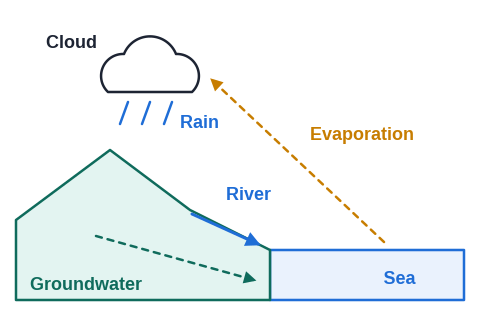
Try it: follow the water cycle
Clouds are a store too
- A cloud is a store of water in the sky.
- Clouds are made of tiny drops of liquid water, or tiny crystals of ice, or both. They are so small and light that air keeps them floating.
- High, wispy clouds are very cold, so they are made of ice crystals.
- When the drops or crystals join together and grow too heavy, they fall as rain, hail or snow.
Water vapour: the water you cannot see
- Water vapour is water as a gas. It is mixed into the air all around you, and it is invisible.
- The white cloud above a boiling jug is not vapour. It is tiny drops of liquid that formed when the vapour cooled.
- You can find the vapour by cooling it. On a humid Auckland day, a cold drink gets wet on the outside because vapour from the air condenses on the cold glass.
Try it: name the change
Most of Earth's water is salty
- Seawater holds a lot of dissolved salt. If you drink it, your body has to use even more water to get rid of the salt, so you end up thirstier.
- This table shows where Earth's water is kept. The oceans hold almost all of it.
- Groundwater is water stored underground, and you will learn more about it in part 2.
| Store | Share of all Earth's water (%) |
|---|---|
| Oceans, seas and bays | 96.54 |
| Ice caps, glaciers and permanent snow | 1.74 |
| Groundwater (fresh and salty) | 1.69 |
| Lakes | 0.013 |
| Air (vapour and clouds) | 0.001 |
Reading water level data
- Room 8 lives on a farming plain. With a farmer's help they measured the water in a bore each month, as metres below the ground, and recorded the rain from a school rain gauge. A bigger number means the water is deeper down. What happened, and why?
| Month | Rain (mm) | Water in the bore (m below ground) |
|---|---|---|
| January | 35 | 9.0 |
| February | 30 | 9.6 |
| March | 40 | 10.1 |
| April | 60 | 10.0 |
| May | 70 | 9.4 |
| June | 80 | 8.6 |
- January to March: little rain, and the water sank from 9.0 m to 10.1 m downfalling
- In summer, farms also pump groundwater out to water their cropspeople take water out
- April to June: more rain soaked in, and the water rose to 8.6 m downrising
- The groundwater fell in the dry summer, when people pumped it out, and rose again with the autumn and winter rain
How much water does a person use?
- Water from your tap is fresh water that has been collected, cleaned and piped to your home.
- Most of a home's water goes on showers, toilets and the washing machine.
- To find where to save water, list each use, work out the litres for each, and look for the biggest.
| What was measured | Result |
|---|---|
| Water a person in Auckland typically uses in a day | 140 to 170 litres |
Where could a family save water?
- Aroha in Room 8 kept a water diary for her family of four for one day. How much did each person use, and where could the family save the most?
| Use | How it adds up | Litres |
|---|---|---|
| Showers | 4 showers × 8 minutes × 9 litres a minute | 288 |
| Garden hose | 10 minutes × 12 litres a minute | 120 |
| Toilet | 18 flushes × 6 litres | 108 |
| Tap running while brushing teeth | 8 brushes × 2 minutes × 6 litres a minute | 96 |
| Washing machine | 1 load | 80 |
| Kitchen (cooking, drinking, dishes) | Measured with a jug | 27 |
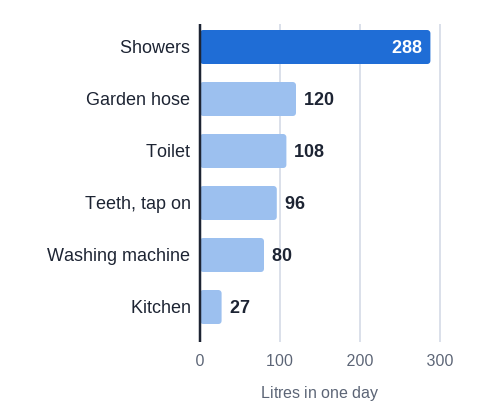
- 288 + 120 + 108 + 96 + 80 + 27 = 719 litresadd every use
- 719 ÷ 4 ≈ 180 litres eachshare between 4 people
- That is a little more than the 140 to 170 litres Watercare says is typicalcompare
- Showers are the biggest use: 4-minute showers would save 144 litres a dayhalf of 288
- Shorter showers save the most; turning the tap off while brushing saves 96 litres more
Common mistakes
- The white cloud above a boiling jug is water vapour.Water vapour is invisible; the white cloud is tiny drops of liquid that formed when the vapour cooled.
- Clouds are made of water vapour.Clouds are tiny drops of liquid water or ice crystals; the vapour itself cannot be seen.
- Most of Earth's water is fresh, because rivers and lakes are everywhere.About 96.54% of Earth's water is in the oceans, which are too salty to drink.
- In the bore table, 10.1 m means more water than 9.0 m.The numbers are metres below the ground, so 10.1 m means the water is deeper down and the level has fallen.
Catch the invisible water vapour
You need: 2 cups of the same kind, metal or plastic, ice cubes, cold tap water, a tea towel, a clock or timer
- Fill one cup with ice cubes and cold water. Fill the other with tap water only.
- Dry the outside of both cups with the tea towel and stand them side by side.
- Leave them for 10 minutes, then run a finger down the outside of each cup.
- Look for this: the ice cup is wet on the outside and the other is dry. The water did not leak through; it is vapour from the air that turned back into liquid on the cold surface.
Safety: Ask an adult to help, and wipe up drips straight away, because water on a hard floor can make someone slip.
Your turn
A shower uses 9 litres a minute. How much water does a 6-minute shower use?
Someone cuts their shower from 10 minutes to 5 minutes. With 9 litres a minute, how much water do they save each day?
What are clouds made of?
A puddle on the playground is gone by lunchtime. Where did the water go?
Why can't a shipwrecked sailor drink seawater to stay alive?
Show answer
1. 6 × 9 = 54 litres. 2. 5 fewer minutes × 9 = 45 litres. 3. Tiny drops of liquid water or tiny ice crystals, floating in the air. 4. It evaporated: it turned into invisible water vapour in the air. 5. Seawater is too salty; the body uses even more water to get rid of the salt, so the sailor gets thirstier.
Recap
- The hydrosphere is every bit of water lying on Earth's surface.
- Water moves between stores by changing place or changing state.
- Clouds are tiny water drops or ice crystals; water vapour is an invisible gas.
- Almost all of Earth's water is in the oceans and is too salty to drink.
- Data on rain and water levels shows how stores rise and fall, and a water diary shows where a home can save the most.
Challenge
Rawiri makes a solar still. He puts a bowl of seawater in full sun with an empty cup standing in the middle. He stretches cling film tightly over the bowl and puts a small stone on the film, just above the cup. By the evening there is water in the cup, and it tastes fresh. (a) Explain, step by step, how the water got into the cup, naming each change of state. (b) Why is the water in the cup fresh when the bowl held seawater? (c) Suppose one still makes 250 mL on a sunny day and a person needs 2 litres of drinking water a day. How many stills would one person need? (d) Why would each still make less on a cloudy day?
Hint
Follow one bit of water from the bowl, up into the air under the film, and back down. What leaves the bowl when water evaporates, and what stays behind?
Answer
(a) The sun warms the seawater and water evaporates into invisible water vapour; the vapour touches the cooler cling film and condenses into drops; the stone makes the film dip, so the drops run to the lowest point and drip into the cup. (b) Only the water evaporates; the salt stays behind in the bowl. (c) 8 stills. (d) Less sunshine warms the water less, so less of it evaporates.
Step by step
- Sunshine warms the seawater, and some liquid water evaporates into water vapour, a gas.
- The vapour cools when it touches the cling film, and condenses into tiny drops of liquid.
- The stone makes the lowest point of the film sit above the cup, so the drops run there and fall in.
- Salt does not evaporate with the water, so it is left in the bowl and the cup water is fresh.
- 2 litres is 2000 mL, and 2000 ÷ 250 = 8 stills.
- On a cloudy day less of the sun's energy reaches the bowl, so less water evaporates.
Full working
- liquid water → water vapourevaporation, warmed by the sun
- water vapour → liquid drops on the filmcondensation on the cooler film
- drops run to the stone's low point and drip into the cupthe cup collects them
- salt stays in the bowlonly the water evaporates
- 2000 mL ÷ 250 mL = 8stills for 2 litres
- Evaporation then condensation, the salt stays behind, 8 stills, and less evaporation on a cloudy day
A tramping club recorded the rain and snow at a mountain hut (all measured as water) and the flow of the stream below it. These are made-up readings. June: 180 mm, 400 litres per second. July: 200 mm, 350. August: 170 mm, 380. September: 140 mm, 700. October: 120 mm, 1100. November: 100 mm, 1300. (a) The most water fell in July, but the stream flowed fastest in November. Explain why, using the idea of water stores and changes of state. (b) Where was most of July's water while the stream was low? (c) A lowland stream near the coast gets the same pattern of rain, all of it as rain. Predict when its flow would be highest, and explain.
Hint
At a high, cold mountain hut, what form does much of the winter precipitation fall as, and does it flow straight away?
Answer
(a) In winter much of the water fell as snow and stayed on the mountain as ice, a store, instead of flowing away. In spring it warmed up and the snow melted into liquid water, which ran into the stream, so the flow peaked in October and November even though less fell then. (b) Frozen as snow and ice on the mountain. (c) In the wettest months, June to August, because rain arrives as liquid and soon runs off or soaks through to the stream; there is no snow store to hold it back.
Step by step
- Snow is water in a solid store. It stays where it lands until it melts.
- In June to August the hut was cold, so much of the water fell as snow and did not reach the stream.
- From September it got warmer, the snow melted into liquid water, and it flowed into the stream.
- So the stream carried spring rain plus water saved up from winter, and was highest in November.
- Near the coast the water falls as rain, so the stream rises and falls with the rain.
Full working
- most fell in July (200 mm), but July flow was lowest (350)the water did not flow away
- cold winter: water fell as snowstored as a solid on the mountain
- spring: snow melts, solid → liquidthe store empties into the stream
- November flow 1300 with only 100 mmspring rain plus melted winter snow
- Winter snow was a store that melted in spring; a lowland stream would be highest in the wettest months, June to August
A farmhouse gets all its water from rain off its roof, stored in a tank. When 1 mm of rain falls on 1 m² of roof, it gives 1 litre of water. The roof is 140 m². On 1 February 2027 the tank holds 7280 litres. In February (28 days) 52 mm of rain falls, and all of it reaches the tank. The family of four each use 150 litres a day. (a) Show that the tank runs dry before the end of February, and find how many litres short they are. (b) To make the water last exactly to the end of February, how many litres a day could each person use? (c) How many mm of rain would have had to fall in February for them to keep using 150 litres each a day?
Hint
Add the water at the start to the water the rain brings. Then compare it with what four people use in 28 days.
Answer
(a) They have 14 560 litres but would use 16 800 litres, so they are 2240 litres short. (b) 130 litres each a day. (c) 68 mm.
Step by step
- Rain brings 52 mm × 140 m² = 7280 litres.
- Water for February: 7280 + 7280 = 14 560 litres.
- Four people at 150 litres for 28 days use 4 × 150 × 28 = 16 800 litres, which is 2240 litres more than they have.
- Sharing 14 560 litres between 4 people and 28 days gives 130 litres each a day.
- The missing 2240 litres needs 2240 ÷ 140 = 16 mm more rain, so 52 + 16 = 68 mm.
Full working
- 52 × 140 = 7280 litresrain caught by the roof
- 7280 + 7280 = 14 560 litreswater for February
- 4 × 150 × 28 = 16 800 litreswater the family would use
- 16 800 − 14 560 = 2240 litres shortthe tank runs dry
- 14 560 ÷ (4 × 28) = 14 560 ÷ 112 = 130 litreseach person each day
- 2240 ÷ 140 = 16 mm, and 52 + 16 = 68 mmrain needed
- 2240 litres short; 130 litres each a day; 68 mm of rain