
Volume: 7 exam questions solved step by step
What this lesson covers
- A pyramid or cone holds one third of the prism or cylinder with the same base and height.
- The volume of a composite solid is the sum or difference of the volumes of its parts.
Volume formulas
- Prism or cylinder: base area × height.
- Pyramid or cone: ⅓ × base area × height.
- Sphere: 4/3 πr³. Hemisphere: half of that.
- Composite solid: add or take away the parts.
Question 1 · Achieved
- A triangular prism is 15 cm long.
- Its end is a right-angled triangle,
- Sides 6 cm, 8 cm and 10 cm.
- Find its volume.
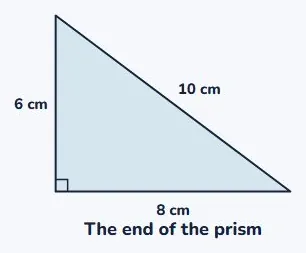
Q1: triangular prism, 15 cm
- Cross-section × length.
- Use 6 and 8, not 10.
- V = A × lcross-section × length
- A = ½ × b × h
- A = ½ × 6 × 8 = 24 cm²sides at right angle
- V = 24 × 15
- V = 360 cm³
Try it: volume of each solid
Question 2 · Achieved
- A square-based pyramid has a base
- 9 cm by 9 cm, vertical height 10 cm.
- Find its volume.
Q2: square-based pyramid
- A third of the prism.
- Base area first.
- V = ⅓ × A × ha third of the prism
- A = 9 × 9 = 81 cm²
- V = ⅓ × 81 × 10
- 81 × 10 = 810the matching prism
- 810 ÷ 3 = 270
- V = 270 cm³
- 3 × 270 = 810
Question 3 · Merit
- A cone has base radius 6 cm
- And slant height 10 cm.
- Find its volume, to 1 d.p.
- Careful: 10 is not the height you need.
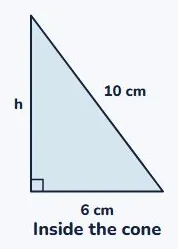
Q3: cone, r = 6, slant 10
- Height first, by Pythagoras.
- Then ⅓πr²h.
- h² + 6² = 10²Pythagoras, slant = 10
- h² = 100 − 36 = 64
- h = 8 cm
- V = ⅓πr²ha third of a cylinder
- V = ⅓ × π × 6² × 8
- = ⅓ × 288π = 96π cm³
- 96π = 301.592...
- V ≈ 301.6 cm³ (1 d.p.)
Question 4 · Merit, in context
- A marae kitchen bowl is a hemisphere,
- Inside diameter 18 cm.
- How many litres does it hold, full?
- Give your answer to 2 d.p.
Q4: the bowl, in litres
- Radius, not diameter.
- 1 L = 1000 cm³.
- r = 18 ÷ 2 = 9 cmhalf the diameter
- V = ½ × 4/3 πr³ = ⅔πr³half a sphere
- V = ⅔ × π × 9³
- 9³ = 729, ⅔ × 729 = 486
- V = 486π cm³
- 486π = 1526.81... cm³
- 486π ÷ 1000 = 1.5268... L1 L = 1000 cm³
- The bowl holds about 1.53 L
Try it: cubic centimetres and litres
Question 5 · Merit, in context
- A grain silo is a cylinder, radius 3 m,
- Height 7 m, with a hemisphere on top.
- Find its volume, to 1 d.p.
Q5: the silo
- Find each part, then add.
- Keep π in.
- V = cylinder + hemisphere
- Cylinder: π × 3² × 7πr²h
- = 63π m³
- Dome: ⅔ × π × 3³⅔πr³
- = 18π m³
- V = 63π + 18π = 81π m³
- 81π = 254.469...
- V ≈ 254.5 m³ (1 d.p.)
Question 6 · Excellence
- A cylindrical can is 10 cm tall
- And must hold exactly 1 litre.
- Find the radius it needs, to 1 d.p.
Q6: working back to r
- Units first: cm³.
- Round only at the end.
- 1 L = 1000 cm³match the cm
- V = πr²h
- πr² × 10 = 1000
- r² = 1000/(10π) = 100/π÷ 10π both sides
- r² = 31.831...
- r = ±5.6419...√ both sides
- r = −5.6419...a radius is positive
- π × 5.6419² × 10 ≈ 1000
- r ≈ 5.6 cm (1 d.p.)
Question 7 · Excellence
- A ball fits exactly inside a can,
- Touching the sides, top and bottom.
- What fraction of the can is empty?
- Show it is the same for any size ball.
Q7: the can and the ball
- No numbers: use r.
- Height = diameter = 2r.
- Ball radius = r
- Can: radius r, height 2rtouches all round
- Can: V = πr² × 2rπr²h
- = 2πr³
- Ball: V = 4/3 πr³sphere
Q7: what fraction is empty?
- Empty = can − ball.
- r cancels: any size.
- Can 2πr³, ball 4/3 πr³
- Empty = 2πr³ − 4/3 πr³
- = 6/3 πr³ − 4/3 πr³ = ⅔πr³
- Fraction = ⅔πr³ ÷ 2πr³empty ÷ whole can
- = ⅔ ÷ 2 = ⅓πr³ cancels
- r = 3: 18π ÷ 54π = ⅓
- ⅓ of the can is empty, any r
Try it: pour to see the third
Common mistakes
- Pyramid: 9 × 9 × 10 = 810 cm³A pyramid is one third of the prism: ⅓ × 81 × 10 = 270 cm³.
- Cone: V = ⅓ × π × 6² × 1010 cm is the slant height; the height is √(10² − 6²) = 8 cm, so V = ⅓ × π × 36 × 8 = 96π cm³.
- Hemisphere bowl: ⅔ × π × 18³Use the radius, half of 18: V = ⅔ × π × 9³ = 486π ≈ 1526.8 cm³.
- 1526.8 cm³ = 15.27 L1000 cm³ = 1 L, so 1526.8 cm³ is about 1.53 L.
What solved all seven
- Formula, substitute, keep π, round last.
| Step | How |
|---|---|
| Prisms | base area × height, πr²h |
| Pyramids | ⅓ × base area × height |
| Spheres | 4/3 πr³, hemisphere ⅔πr³ |
| Composite | add or take away the parts |
| Check first | radius, true height, units |
| Round last | keep π in, then cm³, m³ or L |
Challenge
A fish tank is a cuboid 60 cm long, 40 cm wide and 30 cm tall, with no lid, and it holds water 20 cm deep. Hemi lifts one end, so the tank pivots on the bottom edge at the other end, and water starts to spill over the top edge at the low end. He stops when the water surface runs exactly from that top edge to the bottom edge at the raised end. (a) Show that the tank is now exactly half full. (b) How many litres of water spilled? (c) If the tank had started with water 12 cm deep, would any water have spilled? Explain.
Hint
Look at the tank from the side: a 60 cm by 30 cm rectangle. The water surface is a diagonal of that rectangle. 1 L = 1000 cm³.
Answer
(a) Seen from the side, the water is the triangle cut off by a diagonal of the 60 by 30 rectangle, which is half of it, so the water is half the tank. (b) 12 L. (c) No: 12 cm of water is 28.8 L, less than the 36 L the tank still holds in that final position, so the water never reaches the lip.
Step by step
- From the side the tank is a 60 cm by 30 cm rectangle, and the water surface is one of its diagonals.
- A diagonal cuts a rectangle into two equal triangles, so the water is a triangular prism that is half the cuboid.
- Find the tank's full volume, halve it, and compare it with the water at the start.
- The difference is what spilled; change cm³ to litres.
- For (c), compare the smaller starting volume with what the tank can still hold when tilted that far.
Full working
- full tank: 60 × 40 × 30 = 72 000 cm³
- triangle: ½ × 60 × 30 = 900 cm²side view
- water left: 900 × 40 = 36 000 cm³ = half of 72 000triangular prism
- at the start: 60 × 40 × 20 = 48 000 cm³
- spilled: 48 000 − 36 000 = 12 000 cm³ = 12 L÷ 1000
- (c) 60 × 40 × 12 = 28 800 cm³ = 28.8 L, less than 36 L
- (b) 12 L spilled; (c) no water spills
An ice cream is a cone of base radius r and vertical height h, with a hemisphere of ice cream of radius r sitting exactly on top. The hemisphere holds the same volume as the cone. Show that h = 2r. The whole ice cream (cone plus hemisphere) has volume 36π cm³: find r and h.
Hint
Write both volumes in terms of r and h and set them equal. For the second part, the total is two equal halves, so it is twice the hemisphere.
Answer
⅓πr²h = ⅔πr³ gives h = 2r. Then r = 3 cm and h = 6 cm.
Step by step
- Cone: ⅓πr²h. Hemisphere: half of 43 πr³, which is ⅔πr³.
- Set them equal and divide both sides by ⅓πr²: h = 2r. This works for any size.
- The total is the cone plus an equal hemisphere: 2 × ⅔πr³ = 43 πr³.
- Set 43 πr³ = 36π and solve for r³, then take the cube root.
- Then h = 2r.
Full working
- ⅓πr²h = ⅔πr³cone = hemisphere
- h = ⅔πr³ ÷ ⅓πr² = 2rdivide both sides
- total = ⅔πr³ + ⅔πr³ = 43 πr³
- 43 πr³ = 36πgiven total
- r³ = 36 × 34 = 27÷ 43 π
- r = ∛27 = 3 cmcube root
- r = 3 cm, h = 2 × 3 = 6 cm
A concrete drainage pipe is a hollow cylinder 2 m long, with outside radius R m and inside radius r m. The designer wants the volume of concrete to be exactly equal to the volume of the empty space inside the pipe. (a) Show that R = r√2. (b) The wall of the pipe is to be exactly 10 cm thick. Find r and R in centimetres, to 1 decimal place. (c) How many whole pipes can be cast from 10 m³ of concrete?
Hint
Concrete = big cylinder − hole. The wall thickness is R − r, and R − r = r√2 − r = r(√2 − 1).
Answer
(a) 2πR² − 2πr² = 2πr² gives R² = 2r², so R = r√2. (b) r ≈ 24.1 cm and R ≈ 34.1 cm. (c) 27 pipes.
Step by step
- The concrete's volume is the outer cylinder take away the hole; the empty space is the hole.
- Set these equal and cancel 2π to get R² = 2r².
- The wall is 0.1 m thick, so r√2 − r = 0.1; take out r as a common factor.
- Each pipe uses the same volume of concrete as its hole, 2πr².
- Divide 10 m³ by one pipe's concrete and round down to whole pipes.
Full working
- concrete: πR² × 2 − πr² × 2; space: πr² × 2cylinder volumes
- 2πR² − 2πr² = 2πr², so R² = 2r² and R = r√2radii are positive
- (b) r√2 − r = 0.1, so r(√2 − 1) = 0.1wall 10 cm = 0.1 m
- r = 0.1 ÷ 0.41421 = 0.24142 m ≈ 24.1 cm
- R = 0.24142 × √2 = 0.34142 m ≈ 34.1 cmor r + 0.1
- (c) one pipe: 2π × 0.24142² = 0.36621 m³same as the hole
- 10 ÷ 0.36621 = 27.3, so 27 whole pipes
Practise this
Report a mistake
More in AS 91947
 Expanding, index laws and algebraic fractions8 min
 Factorising quadratics, HCF and difference of squares8 min
 Algebraic proof: even, odd and consecutive numbers8 min
 Solving linear equations and inequations8 min
 Solving quadratic equations by factorising8 min
 Simultaneous equations: elimination and substitution8 min
 Straight-line graphs, gradient and rate of change8 min
 Optimal solutions: break-even and maximum area7 min
 Pythagoras' theorem in 2D and 3D explained7 min
 Trigonometry: SOH CAH TOA, elevation and 3D7 min
 Similar shapes: scale factors, area and volume7 min
 Surface area of pyramids, cones and spheres7 min
 Volume of cones, pyramids, spheres and composite solids7 min
 Expressions: 7 exam questions solved step by step11 min
 Factorising: 7 exam questions solved step by step10 min
 Generalising: 7 exam questions solved step by step10 min
 Equations and inequations: 7 exam questions solved11 min
 Quadratic equations: 7 exam questions solved step by step11 min
 Simultaneous equations: 7 exam questions solved step by step12 min
 Straight-line graphs: 7 exam questions solved step by step11 min
 Optimal solutions: 7 exam questions solved step by step11 min
 Pythagoras: 7 exam questions solved step by step11 min
 Trigonometry: 7 exam questions solved step by step10 min
 Similar shapes: 7 exam questions solved step by step10 min
 Surface area: 7 exam questions solved step by step11 minVolume: 7 exam questions solved step by step10 min