
Quadratic equations: 7 exam questions solved step by step
What this lesson covers
- If two quantities multiply to zero, at least one of them is zero.
- A quadratic equation can have two, one or no real solutions, and the solutions are where its graph crosses the x-axis.
Solving a quadratic equation
- Rearrange so one side is 0.
- Factorise.
- Set each bracket to 0 (the null factor law).
- Check every answer in the original equation.
Question 1 · Achieved
- Solve x² + 2x − 15 = 0
Q1: x² + 2x − 15 = 0
- Multiply to −15, add to 2.
- Check both roots.
- 5 × −3 = −15, 5 + −3 = 2
- (x + 5)(x − 3) = 0factorise
- x + 5 = 0 or x − 3 = 0null factor law
- x = −5
- x = 3
- x = 3: 9 + 6 − 15 = 0
- x = −5: 25 − 10 − 15 = 0
- x = −5 or x = 3
Try it: the roots on the graph
Question 2 · Achieved
- Solve x² = 7x − 10
Q2: x² = 7x − 10
- Not 0 yet: rearrange.
- Check in the original.
- x² = 7x − 10
- x² − 7x + 10 = 0−7x, +10 both sides
- −2 × −5 = 10, −2 + −5 = −7
- (x − 2)(x − 5) = 0factorise
- x = 2 or x = 5null factor law
- x = 2: 4 = 14 − 10
- x = 5: 25 = 35 − 10
Question 3 · Merit
- Solve 3x² − 10x − 8 = 0
Q3: 3x² − 10x − 8 = 0
- a = 3: use ac.
- Split the middle term.
- ac = 3 × −8 = −24
- −12 × 2 = −24, −12 + 2 = −10
- 3x² − 12x + 2x − 8 = 0split the middle
- 3x(x − 4) + 2(x − 4) = 0factorise in pairs
- (3x + 2)(x − 4) = 0common bracket
- 3x = −2, x = −2/3
- x = 4
- x = 4: 48 − 40 − 8 = 0
- x = −2/3 or x = 4
Question 4 · Merit
- Solve (x + 2)(x − 3) = 14
- Careful: the right side is 14, not 0.
Q4: (x + 2)(x − 3) = 14
- Brackets = 14 tells you nothing.
- Expand, then get to 0.
- x² − 3x + 2x − 6 = 14expand
- x² − x − 6 = 14collect x terms
- x² − x − 20 = 0−14 both sides
- −5 × 4 = −20, −5 + 4 = −1
- (x − 5)(x + 4) = 0factorise
- x = 5 or x = −4null factor law
- x = 5: 7 × 2 = 14
- x = −4: (−2)(−7) = 14
Try it: expand, then rearrange
Question 5 · Merit, in context
- A ball is thrown up.
- Height after t seconds: h = 20t − 5t²
- When is the ball 15 m high?
Q5: when is h = 15?
- Keep t² positive.
- Two answers can both fit.
- 20t − 5t² = 15h = 15
- 0 = 5t² − 20t + 15all to the right
- 0 = t² − 4t + 3÷ 5
- 0 = (t − 1)(t − 3)−1 × −3, −1 + −3
- t = 1 or t = 3
- t = 1: 20 − 5 = 15
- t = 3: 60 − 45 = 15
- 1 s going up, 3 s coming down
Question 6 · Excellence
- Two consecutive odd numbers
- Multiply to 143.
- Find the two numbers.
Q6: odd numbers, product 143
- Define the unknown.
- Reject only with a reason.
- Let n = the smaller odd number
- next odd number = n + 2
- n(n + 2) = 143
- n² + 2n − 143 = 0expand, −143
- (n + 13)(n − 11) = 013 × −11, 13 + −11
- n = −13 or n = 11
- 11 × 13 = 143
- (−13)(−11) = 143
- 11 and 13, or −13 and −11
Question 7 · Excellence
- A right-angled triangle has sides
- x, x + 7 and hypotenuse x + 8 (cm).
- Find the three side lengths.
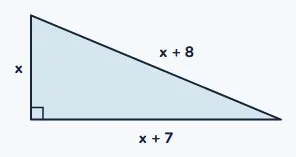
Q7: form the equation
- Pythagoras: a² + b² = c²
- Expand each square fully.
- x² + (x + 7)² = (x + 8)²Pythagoras
- (x + 7)² = x² + 14x + 49
- (x + 8)² = x² + 16x + 64
- x² + x² + 14x + 49
- = x² + 16x + 64
- 2x² + 14x + 49 = x² + 16x + 64
- x² − 2x − 15 = 0−x², −16x, −64
Q7: solve, reject, check
- A length cannot be negative.
- Answer in words, with units.
- x² − 2x − 15 = 0
- (x − 5)(x + 3) = 0−5 × 3, −5 + 3
- x = 5 or x = −3
- x = −3side would be −3 cm
- sides 5, 12, 13x, x + 7, x + 8
- 25 + 144 = 169 = 13²
- 5 cm, 12 cm and 13 cm
Try it: form it, then judge it
Common mistakes
- (x + 2)(x − 3) = 14, so x + 2 = 14 or x − 3 = 14The null factor law needs 0 on one side: expand to x² − x − 20 = 0, so (x − 5)(x + 4) = 0, x = 5 or x = −4.
- x² + 2x − 15 = (x + 5)(x − 3) = 0, so x = 5 or x = −3Set each bracket to 0: x + 5 = 0 gives x = −5 and x − 3 = 0 gives x = 3; the signs flip.
- x = 5 or x = −3, so the sides are 5, 12, 13 or −3, 4, 5.Reject x = −3 with a reason: a side of −3 cm is impossible, so the sides are 5 cm, 12 cm and 13 cm.
The method that solved all seven
- Zero, factorise, solve, check, and reason in context.
| Step | How |
|---|---|
| Get to zero | everything on one side first |
| Factorise | multiply to c, add to b |
| a is not 1 | split the middle using ac |
| Solve | each bracket equals 0 |
| Check | substitute both roots back |
| In context | reject only with a reason |
Challenge
Three consecutive integers have squares that add up to 110. Find the numbers. There are two answers.
Hint
Call the smallest number n. Write the other two in terms of n, square all three and add.
Answer
5, 6 and 7, or −7, −6 and −5
Step by step
- Let the numbers be n, n + 1 and n + 2.
- Expand and add the squares: 3n² + 6n + 5 = 110.
- Make one side 0 and divide by 3: n² + 2n − 35 = 0.
- Factorise: (n + 7)(n − 5) = 0, so n = 5 or n = −7.
- Both work, because integers can be negative and squares are positive.
Full working
- n² + (n + 1)² + (n + 2)² = 110squares add to 110
- 3n² + 6n + 5 = 110expand and collect
- n² + 2n − 35 = 0−110, ÷ 3
- (n + 7)(n − 5) = 07 × −5 = −35, 7 − 5 = 2
- n = 5 or n = −7null factor law
- 25 + 36 + 49 = 110; 49 + 36 + 25 = 110check both
- 5, 6, 7 or −7, −6, −5
Aroha cycles 60 km along the Otago Rail Trail. If she rode 5 km per hour faster, the trip would take exactly 1 hour less. Find her speed.
Hint
Time = distance ÷ speed. Write both times with v, set up their difference as 1 hour, then multiply by both denominators.
Answer
15 km per hour (4 hours, against 3 hours at 20 km per hour)
Step by step
- At v km per hour the trip takes 60v hours; at v + 5 it takes 60v + 5 hours.
- The slower time is 1 hour longer: 60v − 60v + 5 = 1.
- Multiply every term by v(v + 5) to clear the fractions: 300 = v² + 5v.
- Solve v² + 5v − 300 = 0: (v + 20)(v − 15) = 0.
- A speed cannot be negative, so v = 15 km per hour.
Full working
- 60v − 60v + 5 = 1time difference
- 60(v + 5) − 60v = v(v + 5)× v(v + 5)
- 300 = v² + 5vsimplify
- v² + 5v − 300 = 0make one side 0
- (v + 20)(v − 15) = 020 × −15 = −300, 20 − 15 = 5
- v = 15 (v = −20 rejected)speed is positive
- 60 ÷ 15 = 4 h, 60 ÷ 20 = 3 h1 hour less
- 15 km per hour
Show that x² − (k + 3)x + 3k = 0 has x = 3 as a solution whatever the number k is. Then find every value of k for which one solution is exactly twice the other, and the one value of k that gives only one solution.
Hint
Try factorising: which two numbers multiply to 3k and add to k + 3? Then think about which root could be the double of the other.
Answer
It factorises to (x − 3)(x − k) = 0; one root is twice the other when k = 6 or k = 1.5; only one solution when k = 3
Step by step
- 3 × k = 3k and 3 + k = k + 3, so the equation is (x − 3)(x − k) = 0.
- The solutions are always x = 3 and x = k, so 3 is always a solution.
- Twice: either k is double 3, so k = 6, or 3 is double k, so k = 1.5.
- Only one solution when the two roots are the same: k = 3, giving (x − 3)² = 0.
Full working
- (x − 3)(x − k) = x² − kx − 3x + 3kexpand to check
- = x² − (k + 3)x + 3kmatches
- x = 3 or x = knull factor law
- k = 2 × 3 = 6: roots 3 and 6k is double
- 3 = 2k, k = 1.5: roots 1.5 and 33 is double
- k = 3: (x − 3)² = 0, x = 3 onlyequal roots
- k = 6 or k = 1.5; one solution when k = 3
Practise this
Report a mistake
More in AS 91947
 Expanding, index laws and algebraic fractions8 min
 Factorising quadratics, HCF and difference of squares8 min
 Algebraic proof: even, odd and consecutive numbers8 min
 Solving linear equations and inequations8 min
 Solving quadratic equations by factorising8 min
 Simultaneous equations: elimination and substitution8 min
 Straight-line graphs, gradient and rate of change8 min
 Optimal solutions: break-even and maximum area7 min
 Pythagoras' theorem in 2D and 3D explained7 min
 Trigonometry: SOH CAH TOA, elevation and 3D7 min
 Similar shapes: scale factors, area and volume7 min
 Surface area of pyramids, cones and spheres7 min
 Volume of cones, pyramids, spheres and composite solids7 min
 Expressions: 7 exam questions solved step by step11 min
 Factorising: 7 exam questions solved step by step10 min
 Generalising: 7 exam questions solved step by step10 min
 Equations and inequations: 7 exam questions solved11 minQuadratic equations: 7 exam questions solved step by step11 min
 Simultaneous equations: 7 exam questions solved step by step12 min
 Straight-line graphs: 7 exam questions solved step by step11 min
 Optimal solutions: 7 exam questions solved step by step11 min
 Pythagoras: 7 exam questions solved step by step11 min
 Trigonometry: 7 exam questions solved step by step10 min
 Similar shapes: 7 exam questions solved step by step10 min
 Surface area: 7 exam questions solved step by step11 min
 Volume: 7 exam questions solved step by step10 min