
Similar shapes: 7 exam questions solved step by step
What this lesson covers
- Similar shapes have equal corresponding angles and corresponding sides in the same ratio.
- If lengths scale by k, areas scale by k squared and volumes by k cubed.
Similar shapes and the scale factor k
- Show the shapes are similar, and say why.
- Match the corresponding sides.
- Find k from a pair of sides known on both shapes.
- Lengths × k, areas × k², volumes × k³.
Question 1 · Achieved
- Rectangle A: 4 cm by 10 cm
- Rectangle B: 6 cm by 15 cm
- Rectangle C: 7 cm by 13 cm
- Which is similar to A? Why?
Q1: which rectangle is similar?
- Angles match already.
- Short ÷ short, long ÷ long.
- all angles 90°rectangles
- B: 6 ÷ 4 = 1.5, 15 ÷ 10 = 1.5
- B is similar, k = 1.5
- C: 7 ÷ 4 = 1.75, 13 ÷ 10 = 1.3
- C is not similarratios differ
- B is similar to A; C is not.
Question 2 · Achieved
- Two triangles are similar.
- Small: 6 cm, 8 cm, y
- Large, same order: 9 cm, x, 15 cm
- Find x and y.
Q2: find x and y
- k from the known pair.
- Up × k, down ÷ k.
- 6 with 9, 8 with x, y with 15
- k = 9 ÷ 6 = 1.5small to large
- x = 8 × 1.5 = 12 cmsmall to large: × k
- y = 15 ÷ 1.5 = 10 cmlarge to small: ÷ k
- 12 > 8, 10 < 15
- x = 12 cm, y = 10 cm
Try it: enlarge it
Question 3 · Merit
- Triangle PQR: angles 48° and 62°
- Triangle XYZ: angles 62° and 70°
- Similar? Give your reasoning.
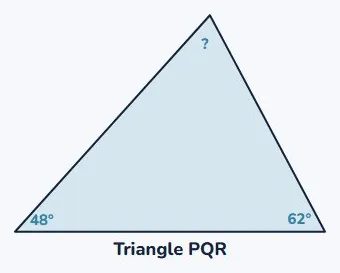
Q3: are they similar?
- Angles add to 180°.
- Equal angles: similar.
- PQR: 180 − 48 − 62 = 70°angle sum 180°
- PQR: 48°, 62°, 70°
- XYZ: 180 − 62 − 70 = 48°angle sum 180°
- XYZ: 48°, 62°, 70°
- all three angles equal
- Similar: all angles equal
Question 4 · Merit
- DE is parallel to BC.
- AD = 6 cm, DB = 4 cm, DE = 9 cm
- Find BC.
- Careful: which side of the big one?
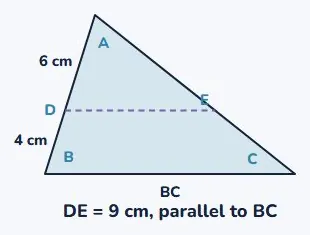
Q4: DE parallel to BC
- Prove similar first.
- Use the whole side.
- angle A sharedcommon angle
- angle D = angle Bcorresponding, DE ∥ BC
- triangles similar
- AB = 6 + 4 = 10 cmthe whole side
- k = 10 ÷ 6 = 5/3AB ÷ AD
- BC = 9 × 5/3 = 15 cm
- 9 × 4 ÷ 6 = 6 cmused the piece DB
Question 5 · Merit, in context
- A student 160 cm tall
- Casts a shadow 2 m long.
- The flagpole's shadow is 12.5 m.
- How tall is the flagpole?
Q5: the flagpole
- Reason, then units.
- Shadows give k.
- same sun angle, both 90°two equal angles
- triangles similar
- 160 cm = 1.6 msame units
- k = 12.5 ÷ 2 = 6.25shadow ÷ shadow
- h = 1.6 × 6.25 = 10 mheight × k
- The flagpole is 10 m tall.
Try it: similar or not?
Question 6 · Excellence
- Two similar triangular sails.
- Small: area 16 m², height 4.8 m
- Large: area 25 m²
- How tall is the large sail?
Q6: from areas to a height
- Area ratio is k².
- Square root for k.
- 4.8 × 25 ÷ 16 = 7.5 mareas scale by k²
- k² = 25 ÷ 16area ratio
- k = √25 ÷ √16 = 5/4 = 1.25square root
- h = 4.8 × 1.25 = 6 mlengths scale by k
- 16 × 1.25² = 16 × 1.5625 = 25
- The large sail is 6 m tall.
Try it: from areas back to lengths
Question 7 · Excellence
- Two similar paint tins.
- Surface areas: 225 cm² and 576 cm²
- The small tin holds 250 mL.
- How much does the large tin hold?
Q7: from areas to a volume
- Areas back to k.
- Then k³ for volume.
- k² = 576 ÷ 225 = 2.56areas scale by k²
- k = √2.56 = 1.6square root
- k³ = 1.6³ = 4.096volumes scale by k³
- V = 250 × 4.096small volume × k³
- = 1024 mL
- 250 × 2.56 = 640 mLk² is for areas
- The large tin holds 1024 mL.
Common mistakes
- BC = 9 × 4 ÷ 6 = 6 cmMatch whole sides: AB = 6 + 4 = 10 cm, so k = 10/6 and BC = 9 × 10 ÷ 6 = 15 cm.
- Areas 16 and 25, so the large sail is 4.8 × 25 ÷ 16 = 7.5 m tall.Areas scale by k², so k = √(25/16) = 1.25 and the height is 4.8 × 1.25 = 6 m.
- The large tin holds 250 × 2.56 = 640 mL.2.56 is k² from the areas; volumes scale by k³ = 1.6³ = 4.096, so it holds 250 × 4.096 = 1024 mL.
- k = 12.5 ÷ 2 = 6.25, so the flagpole is 160 × 6.25 = 1000 m.The 160 is in cm: change it to 1.6 m first, so the flagpole is 1.6 × 6.25 = 10 m tall.
The method that solved all seven
- Prove similar, find k, then use k, k² or k³.
| Step | How |
|---|---|
| Similar? | equal angles, sides in 1 ratio |
| Triangles | two equal angles are enough |
| Match sides | in order, by their angles |
| Scale factor | from a pair known on both |
| Lengths | × k, or ÷ k to go back |
| Whole side | never just the piece |
| Area factor | k², so k = √(area ratio) |
| Volumes | scale by k³, never k² |
Challenge
Mere is 1.8 m tall and stands 6 m from a streetlight that is 4.5 m tall, on flat ground. How long is her shadow?
Hint
The light, the top of her head and the tip of the shadow are in a straight line. Find two similar right-angled triangles that share the shadow's tip.
Answer
4 m
Step by step
- Let the shadow be s m. The small triangle is Mere and her shadow; the large one is the lamp post and the ground from it to the tip.
- They share the angle at the tip and both have a right angle, so they are similar.
- Matching sides: s ÷ 1.8 = (s + 6) ÷ 4.5.
- Cross-multiply: 4.5s = 1.8s + 10.8, so 2.7s = 10.8 and s = 4.
Full working
- shared angle at tip, both 90°similar triangles
- s ÷ 1.8 = (s + 6) ÷ 4.5base ÷ height
- 4.5s = 1.8(s + 6) = 1.8s + 10.8cross-multiply
- 2.7s = 10.8−1.8s
- s = 4÷ 2.7
- k = 4.5 ÷ 1.8 = 2.5, 4 × 2.5 = 10 = 4 + 6check
- Her shadow is 4 m long
A scale model of a yacht is similar to the real yacht. The model's sail has an area of 150 cm² and the real sail has an area of 54 m². The model's hull holds 1.5 L. (a) The real mast is 12 m tall: how tall is the model's mast? (b) How much does the real hull hold, in m³?
Hint
Put both areas in the same units before you divide. Remember 1 m² = 10 000 cm² and 1 m³ = 1000 L.
Answer
(a) 20 cm (b) 324 m³
Step by step
- Change the real sail to cm²: 54 × 10 000 = 540 000 cm².
- Area ratio k² = 540 000 ÷ 150 = 3600, so the length scale factor is k = 60.
- (a) The model mast is 12 m ÷ 60 = 0.2 m = 20 cm.
- (b) Volumes scale by k³ = 216 000, so the real hull holds 1.5 × 216 000 = 324 000 L.
- 324 000 L ÷ 1000 = 324 m³.
Full working
- 54 m² = 540 000 cm²same units
- k² = 540 000 ÷ 150 = 3600area ratio
- k = √3600 = 60length ratio
- 12 ÷ 60 = 0.2 m = 20 cm(a) mast
- k³ = 60³ = 216 000volume ratio
- 1.5 × 216 000 = 324 000 L = 324 m³(b) hull
- (a) 20 cm (b) 324 m³
Two vertical poles, 6 m and 12 m tall, stand 15 m apart on flat ground. A wire runs from the top of each pole to the foot of the other. (a) How high above the ground do the wires cross, and how far from the 6 m pole? (b) Show that the wires cross at the same height however far apart the poles are.
Hint
Drop a vertical line of height h from the crossing point. Each wire makes a small triangle with this line that is similar to a big triangle made by a pole.
Answer
(a) 4 m high, 5 m from the 6 m pole (b) h ÷ 12 + h ÷ 6 = 1 for any distance, so h = 4
Step by step
- Let the crossing be h m high, x m from the 6 m pole, with the poles d m apart.
- The wire from the 12 m top to the 6 m pole's foot: the small triangle is similar to the big one, so h ÷ 12 = x ÷ d.
- The wire from the 6 m top to the 12 m pole's foot: h ÷ 6 = (d − x) ÷ d.
- Add the two: h ÷ 12 + h ÷ 6 = (x + d − x) ÷ d = 1, and d has cancelled.
- So h ÷ 4 = 1 and h = 4 m for any d. With d = 15, x = 15 × 4 ÷ 12 = 5 m.
Full working
- h ÷ 12 = x ÷ dsimilar triangles, first wire
- h ÷ 6 = (d − x) ÷ dsimilar triangles, second wire
- h ÷ 12 + h ÷ 6 = d ÷ d = 1add: d cancels
- h ÷ 12 + 2h ÷ 12 = 3h ÷ 12 = h ÷ 4 = 1common denominator
- h = 4× 4
- x = 15 × 4 ÷ 12 = 5d = 15
- check: 4 ÷ 6 = 10 ÷ 15second wire
- (a) 4 m high, 5 m from the 6 m pole (b) h = 4 m for any distance
Practise this
Report a mistake
More in AS 91947
 Expanding, index laws and algebraic fractions8 min
 Factorising quadratics, HCF and difference of squares8 min
 Algebraic proof: even, odd and consecutive numbers8 min
 Solving linear equations and inequations8 min
 Solving quadratic equations by factorising8 min
 Simultaneous equations: elimination and substitution8 min
 Straight-line graphs, gradient and rate of change8 min
 Optimal solutions: break-even and maximum area7 min
 Pythagoras' theorem in 2D and 3D explained7 min
 Trigonometry: SOH CAH TOA, elevation and 3D7 min
 Similar shapes: scale factors, area and volume7 min
 Surface area of pyramids, cones and spheres7 min
 Volume of cones, pyramids, spheres and composite solids7 min
 Expressions: 7 exam questions solved step by step11 min
 Factorising: 7 exam questions solved step by step10 min
 Generalising: 7 exam questions solved step by step10 min
 Equations and inequations: 7 exam questions solved11 min
 Quadratic equations: 7 exam questions solved step by step11 min
 Simultaneous equations: 7 exam questions solved step by step12 min
 Straight-line graphs: 7 exam questions solved step by step11 min
 Optimal solutions: 7 exam questions solved step by step11 min
 Pythagoras: 7 exam questions solved step by step11 min
 Trigonometry: 7 exam questions solved step by step10 minSimilar shapes: 7 exam questions solved step by step10 min
 Surface area: 7 exam questions solved step by step11 min
 Volume: 7 exam questions solved step by step10 min