
Surface area: 7 exam questions solved step by step
What this lesson covers
- Surface area is the total area of every face, so a net shows exactly what to add up.
- Cones and spheres have curved surfaces with their own area formulas; the skill is knowing which pieces a solid has, and which faces are hidden.
Surface area: add up the faces
- Picture the net and list every face.
- Find any slant height with Pythagoras.
- Leave out faces hidden inside the solid.
- Add the areas, keep π, round at the end.
Question 1 · Achieved
- A triangular prism is 20 cm long.
- Its ends are right-angled triangles,
- Sides 5 cm, 12 cm and 13 cm.
- Find its total surface area.
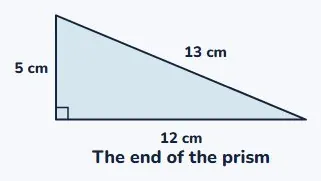
Q1: triangular prism, 20 cm
- List the five faces.
- Triangle: the right angle.
- 2 triangles, 3 rectangles
- Ends: 2 × ½ × 5 × 12 = 60sides at right angle
- 5 × 20 = 100rectangle
- 12 × 20 = 240rectangle
- 13 × 20 = 260rectangle
- SA = 60 + 100 + 240 + 260
- SA = 660 cm²
- 30 × 20 + 60 = 660perimeter × length
Try it: every face counts
Question 2 · Achieved
- A closed cylinder has radius 3 cm
- And height 10 cm.
- Find its total surface area, to 1 d.p.
Q2: cylinder, r = 3, h = 10
- Closed: two circles.
- Keep π until the end.
- SA = 2πr² + 2πrhcircles + curved side
- 2 × π × 3² = 18πtwo circles
- 2 × π × 3 × 10 = 60πcurved side
- SA = 18π + 60π = 78π cm²
- 78π = 245.044...
- SA ≈ 245.0 cm² (1 d.p.)
Try it: unroll the cylinder
Question 3 · Merit
- A square-based pyramid has a base
- 16 cm by 16 cm, vertical height 6 cm.
- Find its total surface area.
- Careful: 6 cm is not up the triangles.
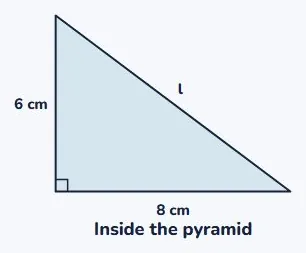
Q3: square-based pyramid
- Slant height first.
- Then base + 4 triangles.
- l² = 6² + 8²Pythagoras, half of 16
- l² = 36 + 64 = 100
- l = 10 cm
- Base: 16 × 16 = 256
- Triangle: ½ × 16 × 10 = 80
- 4 × 80 = 320four triangles
- SA = 256 + 320
- SA = 576 cm²
- Triangles with 6: SA = 448used 6, not l
Question 4 · Merit
- A solid cone has base radius 8 cm
- And vertical height 6 cm.
- Find its total surface area, to 1 d.p.
Q4: cone, r = 8, h = 6
- Πrl needs the slant l.
- Base + curved surface.
- l² = 8² + 6² = 64 + 36Pythagoras
- l = √100 = 10 cm
- SA = πr² + πrlbase + curved surface
- π × 8² = 64πbase
- π × 8 × 10 = 80πcurved surface
- SA = 64π + 80π = 144π cm²
- 144π = 452.389...
- SA ≈ 452.4 cm² (1 d.p.)
Question 5 · Merit, in context
- A climbing dome: a hemisphere, 6 m across.
- Only the curved outside is painted.
- 1 L of paint covers 8 m².
- Paint comes in 1 L tins. How many tins?
Q5: painting the dome
- 6 m is the diameter.
- Round the tins up.
- r = 6 ÷ 2 = 3 m6 m is the diameter
- Curved SA = ½ × 4πr² = 2πr²no floor
- 2 × π × 3² = 18π m²
- 18π = 56.548... m²
- 18π ÷ 8 = 7.068... L8 m² per litre
- 7 tinscover only 56 m²
- 8 tins of paintround up
Question 6 · Excellence, in context
- A water tank: a cylinder, radius 3 m,
- Height 5 m, with a cone roof on top,
- Vertical height 4 m.
- Find its total surface area, to 1 d.p.
Q6: which faces count?
- Count what paint reaches.
- Joined faces are hidden.
- Base circle: outside
- Cylinder side: outside
- Roof curve: outside
- Cylinder top, roof basejoined, inside
- l² = 3² + 4² = 9 + 16 = 25Pythagoras
- l = 5 m
Q6: add the three pieces
- Keep π in.
- Round once, in m².
- l = 5 m
- Base: π × 3² = 9ππr²
- Side: 2 × π × 3 × 5 = 30π2πrh
- Roof: π × 3 × 5 = 15ππrl
- SA = 9π + 30π + 15π
- = 54π m²
- 54π = 169.646...
- SA ≈ 169.6 m² (1 d.p.)
Question 7 · Excellence
- A closed cylinder has height = diameter.
- Its total surface area is 150π cm².
- Find its radius and its height.
Q7: form the equation
- Name the unknown: r.
- Height = diameter = 2r.
- Let radius = r, so h = 2r
- SA = 2πr² + 2πrh
- = 2πr² + 2πr(2r)h = 2r
- = 2πr² + 4πr²
- = 6πr²collect
- 6πr² = 150πthe given area
Q7: solve, reject, check
- A length cannot be negative.
- Answer in words, with units.
- 6πr² = 150π
- r² = 25÷ 6π both sides
- r = 5 or r = −5
- r = −5a radius is positive
- h = 2 × 5 = 10 cm
- 2π × 5² = 50π2πr²
- 2π × 5 × 10 = 100π2πrh
- 50π + 100π = 150π
- Radius 5 cm, height 10 cm
Try it: keep π, then work back
Common mistakes
- Each pyramid triangle is ½ × 16 × 6 = 48 cm².6 cm is the vertical height; the slant height is √(8² + 6²) = 10 cm, so each triangle is ½ × 16 × 10 = 80 cm².
- 56.5 m² ÷ 8 = 7.07, so buy 7 tins.7 tins cover only 56 m², so round up: 8 tins are needed.
- Tank: 2πr² + 2πrh + πrlThe cylinder top and the cone base are joined inside, so leave them out: πr² + 2πrh + πrl = 9π + 30π + 15π = 54π m².
The method that solved all seven
- List every face, add, then round last.
| Step | How |
|---|---|
| Every face | picture the net, list them |
| Slant height | Pythagoras, not the height |
| Hidden face | joined faces do not count |
| Keep π in | add the π terms together |
| Round last | once, in cm² or m² |
Challenge
A tent is a square-based pyramid with its apex directly above the centre of its square floor. The four triangular sides and the floor are all made of fabric. (a) A tent with a 4 m by 4 m floor uses exactly 48 m² of fabric. Find the slant height of each triangular side (from the apex to the middle of a bottom edge), and the vertical height of the tent. (b) A second tent has a square floor of side x m, its slant height is 2 m more than x, and it uses exactly 39 m² of fabric. Show that 3x² + 4x − 39 = 0, and hence find x and the vertical height of this tent, to 2 decimal places.
Hint
The vertical height, half the floor's side and the slant height make a right-angled triangle. Fabric = floor + four triangles, each ½ × base × slant height.
Answer
(a) Slant height 4 m; vertical height 2√3 ≈ 3.46 m. (b) (3x + 13)(x − 3) = 0, so x = 3 m (x must be positive); vertical height √22.75 ≈ 4.77 m.
Step by step
- In (a) the floor is 16 m², so the four triangles share the other 32 m², which fixes the slant height.
- The vertical height is a shorter side of the right-angled triangle with hypotenuse the slant height and other side half of 4 m.
- In (b) the slant height is x + 2, so each triangle is ½ × x × (x + 2); add the floor and the four triangles and set the total to 39.
- Collect terms to get a quadratic, factorise it, and reject the negative root because a length is positive.
- With x = 3 the slant height is 5 m and half the floor is 1.5 m, so Pythagoras gives the vertical height.
Full working
- (a) 16 + 4 × ½ × 4 × l = 48floor + four triangles
- 8l = 32, so l = 4 m
- h² + 2² = 4², so h = √12 = 2√3 ≈ 3.46 mhalf of 4 m is 2 m
- (b) x² + 4 × ½ × x × (x + 2) = 39floor + four triangles, slant height x + 2
- x² + 2x² + 4x = 39, so 3x² + 4x − 39 = 0expand and collect
- (3x + 13)(x − 3) = 0, so x = 3 or x = −133factorise
- x = 3 m, slant height 3 + 2 = 5 ma length is positive
- h² + 1.5² = 5², so h² = 22.75half of 3 m is 1.5 m
- (b) x = 3 m, vertical height √22.75 ≈ 4.77 m
A solid wooden cylinder 10 cm long is sawn in half along its length, through the centres of both circular ends. Together, the two halves have 100 cm² more surface area than the whole cylinder had. Find the radius of the cylinder, then the total surface area of one half, to 1 d.p.
Hint
The cut does not change the curved surface or the ends; it only creates two new flat faces. Each new face is a rectangle: how wide is it?
Answer
Radius 2.5 cm; one half has surface area 31.25π + 50 ≈ 148.2 cm².
Step by step
- Sawing creates two new flat rectangles, one on each half. Everything else was already on the outside.
- Each rectangle is as long as the cylinder (10 cm) and as wide as the diameter (2r).
- So the extra area is 2 × 2r × 10 = 40r. Set it equal to 100 and solve.
- One half has two half circles, half of the curved surface and one rectangle.
- Keep π in, add, then round once.
Full working
- new faces: 2 × (2r × 10) = 40rtwo rectangles, width = diameter
- 40r = 100the extra area
- r = 2.5 cm÷ 40
- half circles: 2 × ½ × π × 2.5² = 6.25πthe two ends
- half curved side: ½ × 2 × π × 2.5 × 10 = 25πhalf of 2πrh
- rectangle: 5 × 10 = 50diameter × length
- SA = 31.25π + 50 = 148.174...calculator
- r = 2.5 cm; one half ≈ 148.2 cm²
A solid cone is made so that its slant height is exactly equal to the diameter of its base. Its total surface area is the same as the surface area of a sphere of radius 6 cm. Find the exact vertical height of the cone.
Hint
Call the base radius r, so the slant height is 2r. Write the cone's total surface area in terms of r. You may not need r itself: Pythagoras gives h² straight from r².
Answer
The vertical height is exactly 12 cm (the radius is √48 ≈ 6.93 cm).
Step by step
- Let the base radius be r. The slant height is the diameter, so l = 2r.
- Cone surface = base + curved surface = πr² + πrl, which becomes 3πr².
- The sphere's surface is 4π × 6² = 144π. Set the two equal to get r² = 48.
- The vertical height, radius and slant height form a right-angled triangle, so h² = l² − r².
- With l = 2r, h² = 4r² − r² = 3r² = 144, so h = 12 cm.
Full working
- l = 2rslant height = diameter
- SA = πr² + πr(2r) = 3πr²base + curved surface
- sphere: 4π × 6² = 144π4πr²
- 3πr² = 144π, so r² = 48÷ 3π
- h² = (2r)² − r² = 3r²Pythagoras
- h² = 3 × 48 = 144substitute r² = 48
- h = 12 cm (a length is positive)
Practise this
Report a mistake
More in AS 91947
 Expanding, index laws and algebraic fractions8 min
 Factorising quadratics, HCF and difference of squares8 min
 Algebraic proof: even, odd and consecutive numbers8 min
 Solving linear equations and inequations8 min
 Solving quadratic equations by factorising8 min
 Simultaneous equations: elimination and substitution8 min
 Straight-line graphs, gradient and rate of change8 min
 Optimal solutions: break-even and maximum area7 min
 Pythagoras' theorem in 2D and 3D explained7 min
 Trigonometry: SOH CAH TOA, elevation and 3D7 min
 Similar shapes: scale factors, area and volume7 min
 Surface area of pyramids, cones and spheres7 min
 Volume of cones, pyramids, spheres and composite solids7 min
 Expressions: 7 exam questions solved step by step11 min
 Factorising: 7 exam questions solved step by step10 min
 Generalising: 7 exam questions solved step by step10 min
 Equations and inequations: 7 exam questions solved11 min
 Quadratic equations: 7 exam questions solved step by step11 min
 Simultaneous equations: 7 exam questions solved step by step12 min
 Straight-line graphs: 7 exam questions solved step by step11 min
 Optimal solutions: 7 exam questions solved step by step11 min
 Pythagoras: 7 exam questions solved step by step11 min
 Trigonometry: 7 exam questions solved step by step10 min
 Similar shapes: 7 exam questions solved step by step10 minSurface area: 7 exam questions solved step by step11 min
 Volume: 7 exam questions solved step by step10 min