
Algebraic proof: even, odd and consecutive numbers
What this lesson covers
- An example shows a statement can be true; only algebra shows it is always true.
- Even numbers can be written 2n, odd numbers 2n + 1, and consecutive numbers n, n + 1, n + 2.
Examples are not proof
- Three consecutive numbers, three times: a multiple of 3 each time.
- But there are infinitely many cases nobody has tried.
- Algebra checks every case at once.
| Three in a row | Sum | Multiple of 3? |
|---|---|---|
| 4 + 5 + 6 | 15 | yes, 3 × 5 |
| 10 + 11 + 12 | 33 | yes, 3 × 11 |
| 99 + 100 + 101 | 300 | yes, 3 × 100 |
| Every other case? | never checked | examples cannot say |
Writing any number with a letter
- n stands for any integer at all.
- An even number is 2n. An odd number is 2n + 1.
- Consecutive numbers go n, n + 1, n + 2.
| Kind of number | Written as | Why |
|---|---|---|
| Even | 2n | two times an integer |
| Odd | 2n + 1 | one more than an even |
| Consecutive | n, n + 1, n + 2 | each one more than the last |
| Multiple of k | kn | k times an integer |
| Consecutive even | 2n, 2n + 2 | even numbers go up in 2s |
Two numbers, two letters
- Using 2n + 1 twice means the same odd number twice.
- Two different odd numbers are 2m + 1 and 2n + 1.
- Say that m and n are integers, once, at the start.
| Writing | Means | Covers |
|---|---|---|
| 2n + 1 and 2n + 1 | one odd number, twice | only 7 + 7, 9 + 9 |
| 2m + 1 and 2n + 1 | any two odd numbers | every case |
| m and n | both integers | say so at the start |
Proof: three consecutive integers
- Let the numbers be n, n + 1 and n + 2.
- Add them and collect: 3n + 3.
- Take out the common factor: 3(n + 1).
| Step | Working | Reason |
|---|---|---|
| Define | n, n + 1, n + 2 | n is any integer |
| Add | n + (n + 1) + (n + 2) | the sum in the claim |
| Collect | 3n + 3 | like terms |
| Factorise | 3(n + 1) | take out the 3 |
Try it: three in a row
Writing the last line
- Say what the algebra shows.
- Say why that settles it: name the integer.
- Then restate the claim, in words.
| Part | Wording |
|---|---|
| The algebra | The sum is 3(n + 1). |
| Why it settles it | n + 1 is an integer, so this is a multiple of 3. |
| The claim again | Three consecutive integers add to a multiple of 3. |
| Too vague | So it works. |
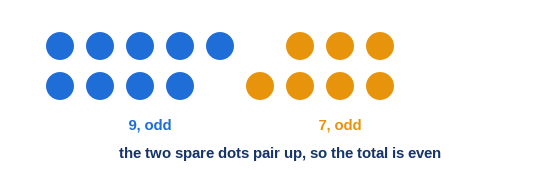
Proof: odd plus odd is even
- Two odd numbers: 2m + 1 and 2n + 1.
- The sum collects to 2m + 2n + 2.
- Factorise out 2: two times an integer is even.
| Step | Working | Reason |
|---|---|---|
| Define | 2m + 1 and 2n + 1 | m, n integers |
| Add | 2m + 2n + 2 | collect like terms |
| Factorise | 2(m + n + 1) | take out the 2 |
| Conclude | m + n + 1 is an integer | so the sum is even |
Proof: odd times odd is odd
- Expand the two brackets: four terms.
- Three of them have a factor of 2. The 1 does not.
- Two times an integer, plus one, is odd.
| Step | Working | Reason |
|---|---|---|
| Define | 2m + 1 and 2n + 1 | m, n integers |
| Expand | 4mn + 2m + 2n + 1 | every term by every |
| Group evens | 2(2mn + m + n) + 1 | take 2 out of three |
| Conclude | 2 × integer, plus 1 | so the product is odd |
Proof: consecutive squares
- The larger square take the smaller: (n + 1)² − n².
- Expand, and the n² terms cancel, leaving 2n + 1.
- n + (n + 1) is also 2n + 1. They are equal.
| Step | Working | Note |
|---|---|---|
| Define | n and n + 1 | n is any integer |
| Difference | (n + 1)² − n² | larger square first |
| Expand, n² cancels | 2n + 1 | n² − n² = 0 |
| Their sum | n + (n + 1) | also 2n + 1 |
| Check: 7 and 8 | 64 − 49 = 15 | 7 + 8 = 15 |
Try it: the next square
A number trick
- Think of a number, add 4, multiply by 3, subtract 6.
- Divide by 3, then take away the number you started with.
- Five gives 2. Twenty gives 2. Why?
| Instruction | Start with 5 | Start with 20 |
|---|---|---|
| Think of a number | 5 | 20 |
| Add 4 | 9 | 24 |
| Multiply by 3 | 27 | 72 |
| Subtract 6 | 21 | 66 |
| Divide by 3, take away start | 7, then 2 | 22, then 2 |
Proving the trick
- Call the starting number n.
- Each instruction becomes one line of algebra.
- The n cancels at the end, so the answer is always 2.
| Instruction | Algebra | Simplified |
|---|---|---|
| Think of a number | n | n |
| Add 4, times 3 | 3(n + 4) | 3n + 12 |
| Subtract 6 | 3n + 12 − 6 | 3n + 6 |
| Divide by 3 | (3n + 6) ÷ 3 | n + 2 |
| Take away n | n + 2 − n | 2, for every n |
Disproving: one counterexample
- To show a claim is always true, you need a proof.
- To show it is false, you need one case where it fails.
- Nine is odd and not prime. That one case is enough.
| Question | To show true | To show false |
|---|---|---|
| Always true? | a proof for every case | one case that fails |
| How many examples? | examples are never enough | one is enough |
| Odd means prime? | no proof exists | 9 = 3 × 3 is not |
Is n² + n + 41 always prime?
- n = 1, 2, 3 give 43, 47, 53. All prime.
- It stays prime for every n from 0 to 39.
- At n = 40 it is 1681, which is 41 × 41.
| n | n² + n + 41 | Prime? |
|---|---|---|
| 1 | 43 | yes |
| 2 | 47 | yes |
| 3 | 53 | yes |
| 0 to 39 | forty values | every one prime |
| 40 | 1600 + 40 + 41 = 1681 | no: 41 × 41 |
Try it: prove it or break it
The shape of every proof
- Define, form, simplify.
- Factorise into the form the claim needs.
- Then conclude in a sentence.
| Step | What you write |
|---|---|
| 1. Define | Let n be an integer. Write each number using it. |
| 2. Form | Write the sum, product or difference in the claim. |
| 3. Simplify | Expand and collect like terms. |
| 4. Target form | Factorise to 2( ), 2( ) + 1 or k( ). |
| 5. Conclude | Name the integer and property, restate the claim. |
What to take away
- Seven lines. The first is why the rest exist.
| Examples | show it can be true, never always |
| Even, odd | 2n and 2n + 1 |
| Consecutive | n, n + 1, n + 2 |
| Two different numbers | two different letters |
| Target form | 2( ) even, 2( ) + 1 odd, k( ) multiple of k |
| One counterexample | is enough to disprove |
| Last line | say why it is true, then restate the claim |
Common mistakes
- 4 + 5 + 6 = 15 and 10 + 11 + 12 = 33, so three consecutive numbers always add to a multiple of 3.Examples cannot check every case; write the numbers as n, n + 1, n + 2 and show the sum is 3(n + 1).
- Two odd numbers: (2n + 1) + (2n + 1) = 4n + 2That is one odd number added to itself; use 2m + 1 and 2n + 1, where m and n are integers, to cover any two.
- 3n + 3 = 3(n + 1). So it works.Say why: n + 1 is an integer, so 3(n + 1) is a multiple of 3, then restate the claim in words.
- n² + n + 41 is prime for n = 1, 2 and 3, so it is always prime.One counterexample disproves it: at n = 40 it is 1681 = 41 × 41, which is not prime.
Your turn: eight questions
- Write each one as a full proof.
- Question 1 has two different numbers: two letters.
- Every proof ends with a sentence.
Prove that an even number plus an odd number is always odd.
Prove the sum of four consecutive integers is always even.
Find a counterexample: the sum of two primes is always even.
Prove (2n + 3)² − (2n + 1)² is always a multiple of 8.
Which is the correct way to write any two different odd numbers in a proof?
Think of a number, double it, add 10, halve it, then take away the number you started with. What does the algebra show?
Three consecutive odd numbers are 2n + 1, 2n + 3 and 2n + 5. Their sum simplifies to what, and what does it show?
A two-digit number with digits a and b is 10a + b. Which line proves it plus its reverse is always a multiple of 11?
Show answer
1. Let the numbers be 2m and 2n + 1, with m and n integers. The sum is 2m + 2n + 1 = 2(m + n) + 1. Since m + n is an integer, this is one more than an even number, so the sum is always odd. 2. n + (n + 1) + (n + 2) + (n + 3) = 4n + 6 = 2(2n + 3). Since 2n + 3 is an integer, the sum is always even. 3. 2 + 3 = 5. Both are prime and 5 is odd, so the claim is false. 4. Expanding gives 4n² + 12n + 9 − 4n² − 4n − 1 = 8n + 8 = 8(n + 1). Since n + 1 is an integer, the difference is always a multiple of 8. 5. 2m + 1 and 2n + 1, with m and n integers. Two different numbers need two different letters; 2n + 1 twice is one odd number twice. 6. Always 5. Starting with n: 2n, then 2n + 10, then n + 5, then n + 5 − n = 5, so the n cancels for every n. 7. 6n + 9 = 3(2n + 3), a multiple of 3. Collect like terms, then take out the 3; 2n + 3 is an integer. 8. 11a + 11b = 11(a + b), a multiple of 11. The reverse is 10b + a, and (10a + b) + (10b + a) collects to 11a + 11b; a + b is an integer.
The answers
- 2m + 2n + 1 = 2(m + n) + 1, so odd.
- 4n + 6 = 2(2n + 3), so even.
- 2 + 3 = 5, which is odd. False.
- 8n + 8 = 8(n + 1), a multiple of 8.
Sample question: Achieved
Prove that the sum of any two consecutive odd numbers is always a multiple of 4.
Hint
Write the first odd number as 2n + 1. The next odd number is 2 more.
Answer
(2n + 1) + (2n + 3) = 4n + 4 = 4(n + 1), a multiple of 4
Step by step
- Trying 3 + 5 = 8 or 7 + 9 = 16 shows it can be true, but examples are not proof. Algebra covers every case at once.
- Let n be any integer. Any odd number can be written as 2n + 1.
- Odd numbers go up in twos, so the next odd number is 2n + 1 + 2 = 2n + 3. The classic mistake is writing 2n + 2, which is even.
- Add them: (2n + 1) + (2n + 3) = 4n + 4.
- Take out the common factor 4: 4n + 4 = 4(n + 1).
- n is an integer, so n + 1 is an integer too. 4 times an integer is a multiple of 4.
- So the sum of any two consecutive odd numbers is a multiple of 4.
- Check with 7 and 9: here n = 3, and 4(3 + 1) = 16 = 7 + 9.
Full working
- 2n + 1 and 2n + 3n is any integer
- (2n + 1) + (2n + 3) = 4n + 4collect
- = 4(n + 1)n + 1 is an integer
- The sum is always a multiple of 4
Sample questions: Merit
Prove that the sum of any three consecutive odd numbers is always an odd multiple of 3.
Hint
Write the numbers as 2n + 1, 2n + 3 and 2n + 5. Show the sum is 3 times an integer, and also 2 times an integer plus 1.
Answer
The sum is 6n + 9 = 3(2n + 3), a multiple of 3, and 6n + 9 = 2(3n + 4) + 1, which is odd
Step by step
- There are two things to prove: the sum is a multiple of 3, and the sum is odd. You need both.
- Let n be any integer. Three consecutive odd numbers are 2n + 1, 2n + 3 and 2n + 5.
- Add them: 2n + 1 + 2n + 3 + 2n + 5 = 6n + 9.
- Multiple of 3: take out 3 as a common factor. 6n + 9 = 3(2n + 3). 2n + 3 is an integer, so the sum is a multiple of 3.
- Odd: an odd number is 2 times an integer, plus 1. Split the 9 as 8 + 1: 6n + 9 = 6n + 8 + 1 = 2(3n + 4) + 1.
- 3n + 4 is an integer, so 2(3n + 4) + 1 is odd.
- Both parts are proved, so the sum is always an odd multiple of 3.
- The classic mistake is to stop after the first part. A multiple of 3 can be even, like 12.
- Check with 5, 7 and 9: the sum is 21, which is 3 × 7 and is odd. Here n = 2, and 6 × 2 + 9 = 21.
Full working
- 2n + 1, 2n + 3, 2n + 5n is any integer
- sum = 6n + 9collect
- = 3(2n + 3)a multiple of 3
- = 2(3n + 4) + 12 × integer + 1 is odd
- The sum is always an odd multiple of 3
Mele says n² − n + 11 is prime for every whole number n ≥ 1. Show that Mele is wrong. Then prove that n² − n is always even, and hence that n² − n + 11 is always odd.
Hint
One counterexample is enough to show a claim is false. Look for a value of n that makes every term a multiple of 11. For the proof, factorise n² − n.
Answer
n = 11 gives 121 = 11 × 11, not prime; n² − n = n(n − 1) is even, so n² − n + 11 is even + odd, which is odd
Step by step
- To prove a claim is false you need just one case where it fails. To prove something is always true you need algebra.
- Small values work: n = 1 gives 11, n = 2 gives 13, n = 3 gives 17. All prime. That proves nothing about every n.
- Look for an n that makes every term share a factor. If n = 11, then n² − n + 11 = 121 − 11 + 11 = 121.
- 121 = 11 × 11, so it is not prime. That one counterexample shows Mele is wrong.
- Now prove n² − n is always even. Factorise: n² − n = n(n − 1).
- n − 1 and n are consecutive whole numbers, so one of them is even. A product with an even factor is even.
- So n² − n is even for every n. Write it as 2m, where m is an integer.
- Then n² − n + 11 = 2m + 11 = 2m + 10 + 1 = 2(m + 5) + 1, which is odd.
- So the expression is always odd, but it is not always prime. Being odd is not enough to be prime.
- Check with n = 4: n² − n = 12, which is even, and 12 + 11 = 23, which is odd.
Full working
- n = 11: 121 − 11 + 11 = 121 = 11 × 11one counterexample
- n² − n = n(n − 1)factorise
- n − 1, n consecutive, so one is evenso the product is even
- n² − n = 2m, so n² − n + 11 = 2(m + 5) + 12 × integer + 1
- False at n = 11; n² − n is even, so n² − n + 11 is always odd
Sample questions: Excellence
Prove that the square of any odd number is always one more than a multiple of 8.
Hint
Expand (2n + 1)² and write 4n² + 4n as 4n(n + 1). Then think about whether n(n + 1) is odd or even.
Answer
(2n + 1)² = 4n(n + 1) + 1, and n(n + 1) is even, so (2n + 1)² = 8m + 1
Step by step
- Test first: 3² = 9 = 8 + 1, 5² = 25 = 24 + 1, 7² = 49 = 48 + 1. It looks true, so now prove it for every odd number.
- Let n be any integer. Any odd number is 2n + 1.
- Square it as two brackets: (2n + 1)² = 4n² + 4n + 1.
- Take out 4n from the first two terms: 4n² + 4n + 1 = 4n(n + 1) + 1.
- So far this shows one more than a multiple of 4. That is not enough: we need a multiple of 8.
- Look at n(n + 1). These are two consecutive integers, so one of them is even. So n(n + 1) is even.
- Write n(n + 1) = 2m, where m is an integer.
- Then 4n(n + 1) + 1 = 4 × 2m + 1 = 8m + 1.
- 8m is a multiple of 8, so the square of any odd number is one more than a multiple of 8.
- The classic mistake is to stop at 4n(n + 1) + 1. The step that makes this Excellence is explaining why n(n + 1) is even.
- Check with 9: n = 4, n(n + 1) = 20, m = 10, and 8 × 10 + 1 = 81 = 9².
Full working
- (2n + 1)² = 4n² + 4n + 1n is any integer
- = 4n(n + 1) + 1common factor 4n
- n(n + 1) = 2mconsecutive integers, one is even
- = 8m + 14 × 2m = 8m
- An odd square is always one more than a multiple of 8
Take a two-digit number with two different digits and no zero digit. Reverse its digits, and subtract the smaller number from the larger. (For example, 73 − 37 = 36.) Prove the answer is always a multiple of 9. Explain why the answer can never be 50, and find the largest answer possible.
Hint
A two-digit number with tens digit t and units digit u is 10t + u, not tu. Its reverse is 10u + t.
Answer
The difference is 9(t − u), a multiple of 9; 50 is not a multiple of 9; the largest answer is 72 (91 − 19)
Step by step
- Use letters for the digits so the proof covers every number. Let the tens digit be t and the units digit be u, each from 1 to 9.
- The number is worth 10t + u, because the tens digit counts ten each. Writing it as tu (t times u) is the classic mistake.
- Reversed, the number is 10u + t.
- Suppose t is the bigger digit, so 10t + u is the larger number. Subtract: (10t + u) − (10u + t) = 9t − 9u.
- Take out the common factor: 9t − 9u = 9(t − u). t − u is an integer, so the answer is a multiple of 9.
- If u is the bigger digit, the same steps give 9(u − t). Still a multiple of 9.
- 50 ÷ 9 = 5.55…, not a whole number, so 50 is not a multiple of 9. The answer can never be 50.
- The answer is 9 times the gap between the digits. To make it as large as possible, make the gap as large as possible.
- With no zero digit, the biggest digit is 9 and the smallest is 1, so the largest gap is 8. The largest answer is 9 × 8 = 72.
- Check: 91 − 19 = 72, and 72 = 9 × 8. The example also fits: 73 − 37 = 36 = 9 × (7 − 3).
Full working
- number = 10t + u, reverse = 10u + tt, u from 1 to 9
- (10t + u) − (10u + t) = 9t − 9ut the bigger digit
- = 9(t − u)always a multiple of 9
- 50 ÷ 9 = 5.55…, not wholeso never 50
- largest gap 9 − 1 = 8, so 9 × 8 = 7291 − 19 = 72
- Always a multiple of 9; never 50; largest 72
Challenge
Prove that n³ − n is a multiple of 6 for every whole number n.
Hint
Factorise n³ − n fully. The three factors are three consecutive integers. What must be true about three numbers in a row?
Answer
n³ − n = (n − 1)n(n + 1), a product of three consecutive integers, which always includes a multiple of 2 and a multiple of 3
Step by step
- Take out the common factor n: n³ − n = n(n² − 1).
- n² − 1 is a difference of two squares: (n − 1)(n + 1). So n³ − n = (n − 1)n(n + 1).
- These are three consecutive integers. Numbers go even, odd, even, so at least one of them is even: the product is a multiple of 2.
- Every third integer is a multiple of 3, so exactly one of three in a row is: the product is a multiple of 3.
- A multiple of both 2 and 3 is a multiple of 6. So n³ − n is always a multiple of 6.
- Check with n = 5: 125 − 5 = 120 = 6 × 20.
Full working
- n³ − n = n(n² − 1)common factor n
- = (n − 1)n(n + 1)difference of two squares
- one factor is evenevery second integer is even
- one factor is a multiple of 3every third integer is
- 2 and 3 both divide it, so 6 does6 = 2 × 3
- n³ − n is always a multiple of 6
Prove that the difference between the squares of any two odd numbers is always a multiple of 8.
Hint
Use two different letters: 2m + 1 and 2n + 1. Factorise the difference as a difference of two squares, then ask whether m − n and m + n + 1 can both be odd.
Answer
(2m + 1)² − (2n + 1)² = 4(m − n)(m + n + 1), and one of m − n and m + n + 1 is even, so it is 8 times an integer
Step by step
- Let the odd numbers be 2m + 1 and 2n + 1, where m and n are integers. Two letters, because they can be different.
- Difference of two squares: ((2m + 1) − (2n + 1))((2m + 1) + (2n + 1)) = (2m − 2n)(2m + 2n + 2).
- Take 2 out of each bracket: 4(m − n)(m + n + 1). So it is a multiple of 4.
- Now add the two brackets: (m − n) + (m + n + 1) = 2m + 1, which is odd. So one of them is even and the other is odd.
- The even one is 2 times an integer, so the whole thing is 4 × 2 × an integer = 8 × an integer.
- So the difference of the squares of any two odd numbers is a multiple of 8. Check: 11² − 5² = 121 − 25 = 96 = 8 × 12.
Full working
- (2m + 1)² − (2n + 1)²m and n integers
- = (2m − 2n)(2m + 2n + 2)difference of two squares
- = 4(m − n)(m + n + 1)take 2 out of each bracket
- (m − n) + (m + n + 1) = 2m + 1, oddso one bracket is even
- 4 × (2k) × (odd) = 8 × integerthe even bracket is 2k
- always a multiple of 8
Prove that the sum of the squares of five consecutive integers is never a perfect square.
Hint
Call the middle number n, so the numbers are n − 2 to n + 2. The sum comes out as 5 times something. Then think about the last digit of a square: which last digits are possible?
Answer
The sum is 5(n² + 2). It is a multiple of 5 but never of 25, and any square that is a multiple of 5 is a multiple of 25
Step by step
- Let the numbers be n − 2, n − 1, n, n + 1, n + 2. Putting n in the middle makes the n terms cancel.
- Squaring and adding: 5n² + (4 + 1 + 0 + 1 + 4) = 5n² + 10 = 5(n² + 2). The −4n and +4n cancel, and so do −2n and +2n.
- If a square is a multiple of 5, the number squared ends in 0 or 5, so it is 5k, and its square is 25k². So such a square must be a multiple of 25.
- For 5(n² + 2) to be a multiple of 25, n² + 2 would need to be a multiple of 5, so n² would end in 3 or 8.
- Square 0 to 9: the last digits are 0, 1, 4, 9, 6, 5, 6, 9, 4, 1. A square never ends in 3 or 8.
- So 5(n² + 2) is a multiple of 5 but not of 25, and it can never be a perfect square. Check: 1 + 4 + 9 + 16 + 25 = 55, not a square.
Full working
- (n − 2)² + (n − 1)² + n² + (n + 1)² + (n + 2)²middle number n
- = 5n² + 10 = 5(n² + 2)the n terms cancel in pairs
- square multiple of 5 means (5k)² = 25k²it must end in 0 or 5
- 25 divides 5(n² + 2) only if n² ends in 3 or 8n² + 2 a multiple of 5
- squares end in 0, 1, 4, 5, 6 or 9check 0² to 9²
- 5(n² + 2) is never a perfect square
Practise this
Report a mistake
More in AS 91947
 Expanding, index laws and algebraic fractions8 min
 Factorising quadratics, HCF and difference of squares8 minAlgebraic proof: even, odd and consecutive numbers8 min
 Solving linear equations and inequations8 min
 Solving quadratic equations by factorising8 min
 Simultaneous equations: elimination and substitution8 min
 Straight-line graphs, gradient and rate of change8 min
 Optimal solutions: break-even and maximum area7 min
 Pythagoras' theorem in 2D and 3D explained7 min
 Trigonometry: SOH CAH TOA, elevation and 3D7 min
 Similar shapes: scale factors, area and volume7 min
 Surface area of pyramids, cones and spheres7 min
 Volume of cones, pyramids, spheres and composite solids7 min
 Expressions: 7 exam questions solved step by step11 min
 Factorising: 7 exam questions solved step by step10 min
 Generalising: 7 exam questions solved step by step10 min
 Equations and inequations: 7 exam questions solved11 min
 Quadratic equations: 7 exam questions solved step by step11 min
 Simultaneous equations: 7 exam questions solved step by step12 min
 Straight-line graphs: 7 exam questions solved step by step11 min
 Optimal solutions: 7 exam questions solved step by step11 min
 Pythagoras: 7 exam questions solved step by step11 min
 Trigonometry: 7 exam questions solved step by step10 min
 Similar shapes: 7 exam questions solved step by step10 min
 Surface area: 7 exam questions solved step by step11 min
 Volume: 7 exam questions solved step by step10 min