
Similar shapes: scale factors, area and volume
What this lesson covers
- Similar shapes have equal corresponding angles and corresponding sides in the same ratio.
- If lengths scale by k, areas scale by k squared and volumes by k cubed.
Year 10 told you they were similar
- Last year the shapes came labelled as similar.
- Now you show that they are, and say why.
- Then use it for lengths, areas and volumes.
| What it asks of you | |
|---|---|
| Year 10 | enlarge by k, find one side |
| Level 1 | prove the shapes are similar first |
| Level 1 | flipped and nested triangles |
| Level 1 | areas by k², volumes by k³ |
Similar needs two things
- Every pair of corresponding angles is equal.
- Every pair of corresponding sides is in the same ratio.
- Either one alone is not enough.
| Case | What happens |
|---|---|
| Condition 1 | corresponding angles are equal |
| Condition 2 | corresponding sides in one ratio, k |
| 2 × 4 rectangle, 3 × 3 square | angles match, sides do not |
| Square, rhombus with 60° | sides match, angles do not |
Try it: enlarge it
Are these rectangles similar?
- Every angle in a rectangle is 90°, so only the sides can differ.
- Divide short by short, and long by long.
- One ratio means similar. Two different ratios means not.
| Rectangles | Ratios | Result |
|---|---|---|
| 4 × 6 and 6 × 9 | 6 ÷ 4 = 1.5, 9 ÷ 6 = 1.5 | similar |
| 4 × 6 and 5 × 7 | 1.25 and about 1.17 | not similar |
| The reason | short ÷ short, long ÷ long | one k |
For triangles, two angles are enough
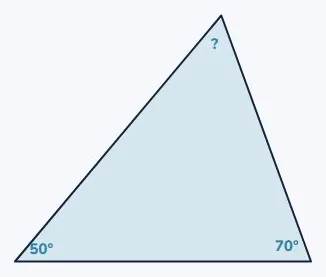
- The angles of a triangle add to 180°.
- So two angles fix the third: here it must be 60°.
- Same three angles, same shape. That is similar.
When one triangle is flipped
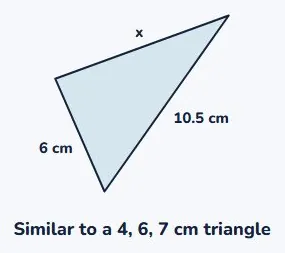
- Match sides by length, not position.
- Shortest with shortest: 6 ÷ 4 = 1.5. Longest: 10.5 ÷ 7 = 1.5.
- So the middle side is x = 6 × 1.5 = 9 cm.
The scale factor from a known pair
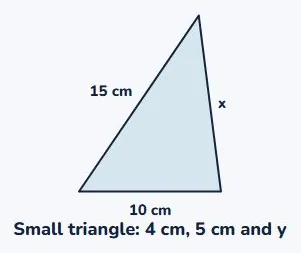
- Find one pair of sides you know on both shapes.
- Here 4 cm on the small one matches 10 cm on this one.
- k = 10 ÷ 4 = 2.5, from small to large.
Using k in both directions
- Small to large: multiply by k.
- Large to small: divide by k, or multiply by 1/k.
- Check the answer is bigger or smaller, as it should be.
| Step | Working | Why |
|---|---|---|
| Scale factor | k = 10 ÷ 4 = 2.5 | a known pair |
| Small to large | x = 5 × 2.5 = 12.5 cm | multiply by k |
| Large to small | y = 15 ÷ 2.5 = 6 cm | divide by k |
| Sense check | 12.5 is more than 5 | large is larger |
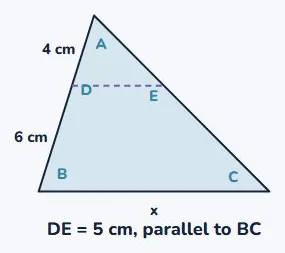
A parallel line makes two triangles
- Triangle ADE sits inside triangle ABC.
- They share angle A.
- DE is parallel to BC, so the angles at D and B are equal.
Use the whole side
- Two equal angles, so the triangles are similar.
- The large triangle's side is 4 + 6 = 10 cm, not 6.
- k = 2.5, so x = 12.5 cm.
| Step | Working | Reason |
|---|---|---|
| Angle A | in both triangles | shared |
| Angles D and B | equal | corresponding, DE ∥ BC |
| Whole side AB | 4 + 6 = 10 cm | not just 6 |
| Scale factor | k = 10 ÷ 4 = 2.5 | AB ÷ AD |
| Missing side | x = 5 × 2.5 = 12.5 cm | not 7.5 |
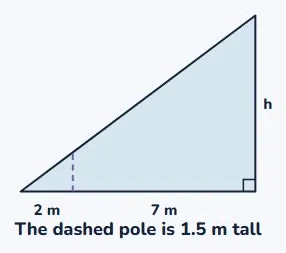
Measuring a tree with a shadow
- The sun's rays hit both at the same angle.
- Both stand upright, so each has a right angle.
- Whole ground 9 m, k = 9 ÷ 2 = 4.5, h = 1.5 × 4.5 = 6.75 m.
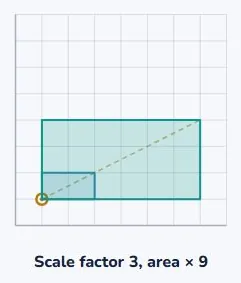
Areas scale by k squared
- Enlarge by 3: the width and the height both triple.
- 2 squares become 18. That is 9 times, and 9 is 3².
- A volume has three lengths, so it scales by k³.
Try it: k, k² and k³
Two similar cylinders
- Radius 4 cm, height 10 cm: volume 160π cm³.
- Large: radius 6 cm, height 15 cm, so k = 1.5.
- Multiply the volume by k³, then check with the formula.
| Step | Working | Note |
|---|---|---|
| Scale factor | k = 6 ÷ 4 = 1.5 | radii, or 15 ÷ 10 |
| Volume factor | k³ = 3.375 | k cubed |
| Large volume | 160π × 3.375 = 540π | exact, cm³ |
| Rounded | about 1696.5 cm³ | 1 decimal place |
| Check | π × 6² × 15 = 540π | formula agrees |
From an area ratio back to lengths
- Two similar garden beds: 20 m² and 45 m².
- The area ratio is k², so take the square root.
- A 4 m edge on the small bed is 6 m on the large one.
| Step | Working | Why |
|---|---|---|
| Area ratio | 45 ÷ 20 = 2.25 | this is k² |
| Length ratio | k = √2.25 = 1.5 | square root |
| Missing length | 4 × 1.5 = 6 m | use k |
| The trap | 4 × 2.25 = 9 m | wrong factor |
Try it: find k and use it
What to take away
- Prove it is similar, find k, then choose k, k² or k³.
| Similar | equal angles, sides in one ratio k |
| Triangles | two equal angles are enough |
| Match sides | by the angles, not the position |
| Scale factor | from a known pair, used both ways |
| Parallel line | use the whole side, not the piece |
| Areas | multiply by k² |
| Volumes | multiply by k³; from an area, take √ |
Common mistakes
- AD = 4 cm and DB = 6 cm, so k = 6 ÷ 4 = 1.5Use the whole side of the large triangle: AB = 4 + 6 = 10 cm, so k = 10 ÷ 4 = 2.5.
- Areas 20 m² and 45 m²: the 4 m edge becomes 4 × 2.25 = 9 m2.25 is k², so k = √2.25 = 1.5 and the edge is 4 × 1.5 = 6 m.
- Jars 10 cm and 15 cm tall, so the large one holds 320 × 1.5 = 480 mL.Volume scales by k³ = 1.5³ = 3.375, so the large jar holds 320 × 3.375 = 1080 mL.
- A 4 × 6 and a 5 × 7 rectangle both have 90° angles, so they are similar.Matching angles is not enough: 5 ÷ 4 = 1.25 but 7 ÷ 6 ≈ 1.17, so the sides are not in one ratio and they are not similar.
Your turn: eight questions
- Write all eight out, with reasons.
- Question 3: is DB the whole side?
- Question 4 is a volume, not a length.
One triangle has 35° and 75°, another 75° and 70°. Similar? Why?
A 6, 8, 9 cm triangle is enlarged so 6 becomes 15. Longest side?
DE ∥ BC, AD = 3 cm, DB = 9 cm, DE = 4 cm. Find BC.
Similar jars, 10 cm and 15 cm tall. Small holds 320 mL. Large?
Is a 5 cm by 8 cm rectangle similar to a 10 cm by 13 cm rectangle?
Two similar phones are 15 cm and 6 cm tall. The large one is 7.5 cm wide. How wide is the small one?
A 1.8 m tall person casts a 2.4 m shadow. At the same time a pole casts a 10 m shadow. How tall is the pole?
Two similar photos have areas 48 cm² and 108 cm². The small one is 8 cm wide. How wide is the large one?
Show answer
1. Yes. The first triangle's third angle is 180 − 35 − 75 = 70°, so both triangles have angles 35°, 70° and 75°, and two equal angles are enough. 2. 22.5 cm. Shortest matches shortest, so k = 15 ÷ 6 = 2.5, and the longest is 9 × 2.5 = 22.5 cm. 3. 16 cm. Angle A is shared and the angles at D and B are corresponding, so the triangles are similar. AB = 3 + 9 = 12, k = 12 ÷ 3 = 4, so BC = 4 × 4 = 16 cm, not 12. 4. 1080 mL. k = 15 ÷ 10 = 1.5, volumes scale by k³ = 3.375, and 320 × 3.375 = 1080 mL. 5. No: the ratios are 2 and 1.625. Short ÷ short is 10 ÷ 5 = 2 but long ÷ long is 13 ÷ 8 = 1.625, so there is no single k. 6. 3 cm. k = 15 ÷ 6 = 2.5 from small to large, so going large to small divide: 7.5 ÷ 2.5 = 3. It is smaller, as it should be. 7. 7.5 m. Same sun angle and both upright, so the triangles are similar: k = 10 ÷ 2.4, and 1.8 × 10 ÷ 2.4 = 7.5. 8. 12 cm. The area ratio 108 ÷ 48 = 2.25 is k², so k = √2.25 = 1.5 and the width is 8 × 1.5 = 12.
The answers
- Yes: the third angle is 70°, so all three match.
- k = 15 ÷ 6 = 2.5, longest 22.5 cm.
- AB = 12, k = 4, so BC = 16 cm.
- k³ = 3.375, so 1080 mL.
Sample question: Achieved
Two triangles are similar. The small one has sides 4 cm, 6 cm and 7 cm. The longest side of the large one is 17.5 cm. Find the other two sides of the large triangle.
Hint
Match the longest side with the longest side to find the scale factor k, then multiply the other sides by k.
Answer
10 cm and 15 cm
Step by step
- Similar triangles have their sides in the same ratio, so every side is multiplied by the same scale factor k.
- Match sides by size, not by position: the longest side of the small triangle (7 cm) matches the longest side of the large one (17.5 cm).
- k = 17.5 ÷ 7 = 2.5, going from small to large.
- Shortest side: 4 × 2.5 = 10 cm.
- Middle side: 6 × 2.5 = 15 cm.
- The answers are bigger than 4 and 6, which makes sense going from small to large.
- Check the ratios: 10 ÷ 4 = 2.5, 15 ÷ 6 = 2.5 and 17.5 ÷ 7 = 2.5. All the same.
Full working
- k = 17.5 ÷ 7 = 2.5longest matches longest
- 4 × 2.5 = 10multiply by k, small to large
- 6 × 2.5 = 15
- 10 cm and 15 cm
Sample questions: Merit
In triangle ABC, D is on AB and E is on AC, with DE parallel to BC. AD = 6 cm, DB = 4 cm, DE = 9 cm and AE = 7.5 cm. Explain why triangles ADE and ABC are similar, then find BC and EC.
Hint
Look for two pairs of equal angles. Then use the whole side AB = 6 + 4, not just DB.
Answer
BC = 15 cm and EC = 5 cm
Step by step
- Similar triangles: two pairs of equal angles is enough, because the third angle must then match too.
- Both triangles share angle A.
- DE is parallel to BC, so angle ADE = angle ABC (corresponding angles on parallel lines).
- Two pairs of equal angles, so triangle ADE is similar to triangle ABC.
- Matching sides: AD matches AB. AB is the whole side, AD + DB = 6 + 4 = 10 cm. Using 4 cm here is the classic mistake.
- Scale factor, small to large: k = 10 ÷ 6 = 53.
- BC matches DE: BC = 9 × 53 = 15 cm.
- AC matches AE: AC = 7.5 × 53 = 12.5 cm. EC is what is left: 12.5 − 7.5 = 5 cm.
- Check: EC ÷ AE = 5 ÷ 7.5 = 23, and DB ÷ AD = 4 ÷ 6 = 23. The parallel line cuts both sides in the same ratio.
Full working
- angle A shared, angle ADE = angle ABCcorresponding angles, DE ∥ BC
- AB = 6 + 4 = 10use the whole side
- k = 10 ÷ 6 = 53small to large
- BC = 9 × 53 = 15
- AC = 7.5 × 53 = 12.5, so EC = 12.5 − 7.5 = 5
- BC = 15 cm, EC = 5 cm
Two similar jugs are 15 cm and 24 cm tall. The small jug holds 500 mL. Its label has an area of 60 cm². Find how much the large jug holds and the area of its label.
Hint
Find the length scale factor k from the heights. Areas scale by k² and volumes by k³.
Answer
The large jug holds 2048 mL and its label is 153.6 cm²
Step by step
- The jugs are similar, so all lengths scale by the same factor k.
- k = 24 ÷ 15 = 1.6, from small to large.
- A volume uses three lengths, so it scales by k³. k³ = 1.6³ = 4.096.
- Large volume = 500 × 4.096 = 2048 mL.
- An area uses two lengths, so it scales by k². k² = 1.6² = 2.56.
- Large label = 60 × 2.56 = 153.6 cm².
- The classic mistake is to multiply the volume by k = 1.6, giving 800 mL. That treats a volume like a length.
- Check by working back: 2048 ÷ 500 = 4.096, and the cube root of 4.096 is 1.6, which is 24 ÷ 15.
Full working
- k = 24 ÷ 15 = 1.6lengths
- k³ = 4.096, so V = 500 × 4.096 = 2048 mLvolumes scale by k³
- k² = 2.56, so A = 60 × 2.56 = 153.6 cm²areas scale by k²
- 2048 mL and 153.6 cm²
Sample questions: Excellence
Two solid statues of the same material are similar. Their surface areas are 75 cm² and 192 cm². The small statue is 20 cm tall and has a mass of 1.25 kg. Find the height and the mass of the large statue.
Hint
The area ratio is k², so take a square root to get k. Mass depends on volume, which scales by k³.
Answer
Height 32 cm and mass 5.12 kg
Step by step
- Similar solids: lengths scale by k, areas by k², volumes by k³. We are given areas, so we start from k².
- k² = 192 ÷ 75 = 2.56.
- Square root: k = √2.56 = 1.6. That is the length scale factor, small to large.
- Height is a length: 20 × 1.6 = 32 cm.
- Mass: the statues are solid and the same material, so mass is in proportion to volume. Volume scales by k³.
- k³ = 1.6³ = 4.096. Mass = 1.25 × 4.096 = 5.12 kg.
- The classic mistake is to use the area ratio 2.56 for the mass. Mass is a volume quantity, so it needs k³.
- It also matters that both are solid and the same material. If one were hollow, or made of something heavier, the mass would not follow k³. That is a limitation.
- Check: 5.12 ÷ 1.25 = 4.096 = 2.56 × 1.6, so k³ = k² × k as it should.
Full working
- k² = 192 ÷ 75 = 2.56areas scale by k²
- k = √2.56 = 1.6
- height = 20 × 1.6 = 32 cmlengths scale by k
- mass = 1.25 × 1.6³ = 1.25 × 4.096 = 5.12 kgmass follows volume, k³
- 32 cm and 5.12 kg
A solid cone is 30 cm tall. It is cut by a flat cut parallel to its base, making a small cone on top. (a) Show that if the cut is halfway up, the small cone has only 18 of the volume. (b) How far above the base must the cut be so that the small cone has exactly half the volume? Give your answer to 1 decimal place.
Hint
The small cone is similar to the whole cone. The ratio of their volumes is k³, where k is the ratio of their heights.
Answer
(a) k = 12, so the volume ratio is (12)³ = 18 (b) about 6.2 cm above the base
Step by step
- The cut is parallel to the base, so the small cone on top is similar to the whole cone. They share the top point and the same slope.
- Let k be the small cone's height divided by the whole cone's height. Volumes of similar solids scale by k³.
- (a) Cut halfway up: the small cone is half as tall, so k = 12.
- Volume ratio: k³ = (12)³ = 18. So the small cone has 18 of the volume, even though it is half the height. The rest, 78, is below the cut.
- (b) Now we want the volume ratio to be 12, so k³ = 12.
- Take the cube root: k = ∛0.5 = 0.7937…
- So the small cone must be 0.7937… of the full height: 30 × 0.7937… = 23.8 cm tall.
- The cut is measured from the base: 30 − 23.81… = 6.2 cm above the base.
- This feels surprising, but the bottom of a cone is the widest part, so most of the volume is down low.
- Check: (23.81… ÷ 30)³ = 0.7937…³ = 0.5.
Full working
- small cone is similar to the whole conecut parallel to the base
- (a) k = 12, k³ = 18volumes scale by k³
- (b) k³ = 12, so k = ∛0.5 = 0.7937…
- top cone height = 30 × 0.7937… = 23.81… cm
- 30 − 23.81… = 6.19…measured from the base
- (a) 18 (b) 6.2 cm above the base
Challenge
A funnel is a cone with its point at the bottom. It is 24 cm deep and holds 1600 mL when full to the brim. (a) How much water is in it when the water is 18 cm deep? (b) How deep is the water when the funnel holds 200 mL?
Hint
The water always forms a small cone that is similar to the whole funnel. Volumes scale by k³, so to go back from a volume, take a cube root.
Answer
(a) 675 mL (b) 12 cm
Step by step
- The water sits in the point of the cone, so it is a smaller cone with the same angles: similar to the full funnel.
- (a) Length scale factor k = 18 ÷ 24 = 0.75, from full to water.
- Volume scales by k³ = 0.75³ = 0.421875, so the water is 1600 × 0.421875 = 675 mL.
- (b) Work backwards: the volume ratio is 200 ÷ 1600 = 18, which is k³.
- The cube root of 18 is 12, so the depth is 24 × 12 = 12 cm.
- Halving the depth leaves only an eighth of the water, which is why a funnel seems to empty so fast at the end.
Full working
- k = 18 ÷ 24 = 0.75depths of similar cones
- V = 1600 × 0.75³ = 675volume scales by k³
- k³ = 200 ÷ 1600 = 18work backwards
- k = 12, depth = 24 × 12 = 12cube root
- (a) 675 mL (b) 12 cm
In triangle ABC, D is on AB and E is on AC, with DE parallel to BC. Triangle ADE has area 18 cm² and the trapezium DECB has area 32 cm². AD = 6 cm. Find AB and DB.
Hint
The trapezium is not similar to anything. Find the area of the whole triangle ABC first, then compare it with triangle ADE.
Answer
AB = 10 cm and DB = 4 cm
Step by step
- Triangles ADE and ABC share angle A, and angle ADE = angle ABC because DE is parallel to BC (corresponding angles). So they are similar.
- The trapezium is the big triangle with the small one removed, so triangle ABC has area 18 + 32 = 50 cm².
- The area ratio is k² = 50 ÷ 18 = 259.
- Take the square root: k = 53, from small to large.
- AB = 6 × 53 = 10 cm, so DB = 10 − 6 = 4 cm.
- The trap is to use 32 ÷ 18 as the area ratio: the trapezium is not a similar shape.
Full working
- angle A shared, angle ADE = angle ABCDE ∥ BC, so similar
- area ABC = 18 + 32 = 50whole triangle
- k² = 50 ÷ 18 = 259area ratio
- k = 53square root
- AB = 6 × 53 = 10, DB = 10 − 6 = 4
- AB = 10 cm, DB = 4 cm
A triangular club pennant is 90 cm from its top point to its bottom edge. It is painted in three bands of equal area, separated by two lines parallel to the bottom edge. How far from the top point is each line, to 1 decimal place? Explain why the bands are not equally wide.
Hint
The top band is a small triangle similar to the whole pennant with 13 of its area. The top two bands together form a triangle with 23 of the area.
Answer
51.96… ≈ 52.0 cm and 73.48… ≈ 73.5 cm from the top point; area grows with k², so each band can be narrower than the one above
Step by step
- Each line cuts off a triangle at the top that is similar to the whole pennant, because the lines are parallel to the bottom edge.
- The first line cuts off 13 of the area, so k² = 13 and k = √(13) = 0.5773…
- Its distance from the top is 90 × 0.5773… = 51.96… ≈ 52.0 cm.
- The second line cuts off 23 of the area, so k = √(23) = 0.8164…, giving 90 × 0.8164… = 73.48… ≈ 73.5 cm.
- The bands are about 52.0, 21.5 and 16.5 cm wide. Area depends on k², so lower down, where the pennant is wider, a thinner band holds the same area.
Full working
- k² = 13, so k = √(13) = 0.5773…top triangle, a third of the area
- 90 × 0.5773… = 51.96…first line
- k² = 23, so k = √(23) = 0.8164…two thirds of the area
- 90 × 0.8164… = 73.48…second line
- band widths 51.96, 21.52, 16.52narrower lower down
- 52.0 cm and 73.5 cm from the top point
Where science uses this
Practise this
Report a mistake
More in AS 91947
 Expanding, index laws and algebraic fractions8 min
 Factorising quadratics, HCF and difference of squares8 min
 Algebraic proof: even, odd and consecutive numbers8 min
 Solving linear equations and inequations8 min
 Solving quadratic equations by factorising8 min
 Simultaneous equations: elimination and substitution8 min
 Straight-line graphs, gradient and rate of change8 min
 Optimal solutions: break-even and maximum area7 min
 Pythagoras' theorem in 2D and 3D explained7 min
 Trigonometry: SOH CAH TOA, elevation and 3D7 minSimilar shapes: scale factors, area and volume7 min
 Surface area of pyramids, cones and spheres7 min
 Volume of cones, pyramids, spheres and composite solids7 min
 Expressions: 7 exam questions solved step by step11 min
 Factorising: 7 exam questions solved step by step10 min
 Generalising: 7 exam questions solved step by step10 min
 Equations and inequations: 7 exam questions solved11 min
 Quadratic equations: 7 exam questions solved step by step11 min
 Simultaneous equations: 7 exam questions solved step by step12 min
 Straight-line graphs: 7 exam questions solved step by step11 min
 Optimal solutions: 7 exam questions solved step by step11 min
 Pythagoras: 7 exam questions solved step by step11 min
 Trigonometry: 7 exam questions solved step by step10 min
 Similar shapes: 7 exam questions solved step by step10 min
 Surface area: 7 exam questions solved step by step11 min
 Volume: 7 exam questions solved step by step10 min