Speed, distance, time, and the 2.30 trap
What this lesson covers
- There is a fixed relationship between speed, distance, and time: speed = distance/time.
- In position-time graphs, the gradient represents speed.
- Decimal measures are used for very small durations (e.g. milliseconds); the rest of time measurement uses a different system, based principally on 12 and 60.
Almost nothing in this lesson is new
- Rates, derived units, and gradient. You have all three already.
- This is where they meet.
- Plus one mistake that ruins more answers than anything else here.
The formula is written on the speedometer
- The unit is kilometres per hour. Per means divided by.
- So speed is kilometres divided by hours.
- Distance over time. You did not have to remember that.
| Step | Reasoning | Note |
|---|---|---|
| The unit is | kilometres per hour | |
| Per means | divided by | from the rates lesson |
| So speed is | kilometres ÷ hours | |
| Which is | distance ÷ time | no memorising needed |
One relationship, three questions
- 240 km in 3 hours is 80 km per hour.
- At 80 for two and a half hours, you cover 200 km.
- 300 km at 60 takes five hours. Same relationship each time.
| Finding | Working | Example |
|---|---|---|
| Speed | distance ÷ time | 240 km ÷ 3 h = 80 km/h |
| Distance | speed × time | 80 km/h × 2.5 h = 200 km |
| Time | distance ÷ speed | 300 km ÷ 60 km/h = 5 h |
You may have been shown a formula triangle
- It is a memory aid for something you can rebuild in seconds.
- And it hides the units, which is where the errors actually live.
- Read the unit instead. It never lies to you.
On a distance-time graph, the gradient is the speed
- Gradient is rise over run. You had that in algebra.
- Here the rise is distance and the run is time.
- So rise over run is distance over time, which is speed.
| Part | Meaning here | Value |
|---|---|---|
| Rise | distance travelled | 20 km |
| Run | time taken | 1 h |
| Rise over run | 20 ÷ 1 | 20 km/h |
| Which is | exactly distance over time |
So the shape of the line is a description of the journey
- Steep means a lot of distance in little time. Fast.
- Shallow means slow.
- And flat means the distance is not changing. That is a stop.
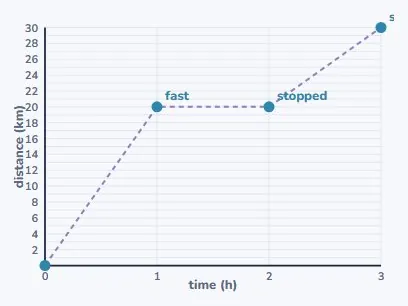
Try it: steeper is faster
A flat line is not nothing happening
- Time is still passing. The clock has not stopped.
- It is the distance that is not changing.
- Gradient zero, so speed zero. Parked.
| Line | What it means | Speed |
|---|---|---|
| Steep line | lots of distance in little time | fast |
| Shallow line | little distance in lots of time | slow |
| Flat line | time passing, distance not changing | stopped |
| Steeper again | a faster section |
Now the thing that catches everyone
- Every other measurement you have met runs on powers of ten.
- A thousand metres in a kilometre. A thousand grams in a kilogram.
- Time does not. Sixty seconds, sixty minutes, twenty-four hours.
| Measurement | Based on | Example |
|---|---|---|
| Length, mass, volume | powers of ten | 1000 m in a km |
| Time | 60 and 24 and 12 | 60 min in an hour |
| So 2 h 30 min | is not 2.30 hours | it is 2.5 hours |
Which is why 2.30 is not two and a half hours
- 180 km in 2 hours 30. Type 2.30 and you get 78.3 km/h.
- Use 2.5 and you get 72 km/h. That one is right.
- Six kilometres an hour out, and the working looks perfect.
| Step | Working | Answer |
|---|---|---|
| 180 km in 2 h 30 min | ||
| Typing 2.30 | 180 ÷ 2.30 | 78.3 km/h. Wrong |
| Using 2.5 | 180 ÷ 2.5 | 72 km/h. Right |
| The gap | over 6 km/h | and nothing looks wrong |
Try it: 2.30 hours is not 2:30
The dangerous part is that it looks fine
- Seventy-eight kilometres an hour is a perfectly normal speed.
- Nothing in your working will look wrong.
- So the only defence is converting the minutes first, every time.
Minutes into hours: divide by 60
- 15 minutes over 60 is 0.25 of an hour.
- 45 minutes is 0.75. Twenty minutes is about 0.333.
- Do that before anything goes into the calculator.
| Duration | Working | In hours |
|---|---|---|
| 15 minutes | 15 ÷ 60 | 0.25 h |
| 20 minutes | 20 ÷ 60 | about 0.333 h |
| 45 minutes | 45 ÷ 60 | 0.75 h |
| 1 h 15 min | 1 + 0.25 | 1.25 h |
And below a second, it goes decimal again
- A second is a thousand milliseconds. A clean power of ten.
- So 0.25 seconds is 250 milliseconds.
- Because there was never a unit below a second to split by 60.
| Duration | Equals | Note |
|---|---|---|
| 1 second | 1000 milliseconds | |
| 0.25 s | 250 ms | |
| A sprint of 10.34 s | 10 340 ms | |
| Why decimal here? | no unit below a second | to split by 60 |
So time runs two systems at once
- Above a second: sixties and twelves and twenty-fours.
- Below a second: straight powers of ten.
- No other measurement in this course changes its mind halfway.
What to take away
- Six things, and the last one is worth more marks than the rest.
| The unit | tells you the formula, so do not memorise one |
| Speed | is distance divided by time |
| On a position-time graph | the gradient is the speed |
| A flat line | means stopped, not means nothing |
| Time is not decimal | above a second, it runs on 60 |
| 2 h 30 min | is 2.5 hours, and never 2.30 |
Common mistakes
- 2 h 30 min = 2.30 hThere are 60 minutes in an hour, so 30 min is 0.5 h and 2 h 30 min = 2.5 h.
- 0.75 of an hour is 75 minutes.Multiply by 60, not 100: 0.75 × 60 = 45 minutes.
- 300 km at 60 km/h: time = 60 ÷ 300 = 0.2 hTime = distance ÷ speed, so 300 ÷ 60 = 5 h; the units check it, since km ÷ km/h gives hours.
- A flat line on a distance-time graph means a steady speed.Flat means the distance is not changing while time passes, so the gradient and the speed are zero: stopped.
Your turn
- Try all eight.
A car travels 150 km in 2 hours. What is its speed?
How far does a car at 60 km/h travel in 45 minutes?
How long does 200 km take at 60 km/h?
How many milliseconds is 0.4 seconds?
A snail's speed is given in metres per minute. Which calculation gives its speed?
A bus's distance-time graph is flat from 10:00 to 10:20. What was the bus doing then?
Mere's reaction time was 0.215 s and Tama's was 198 ms. How many milliseconds faster was Tama?
On a distance-time graph, line A rises 30 km in 1 hour and line B rises 50 km in 2 hours. Which shows the faster speed?
Show answer
1. 75 km/h, from 150 divided by 2. 2. 45 km. Convert first: 45 minutes is 0.75 of an hour, and 60 times 0.75 is 45. Using 0.45 would have given you 27 km. 3. 3 hours 20 minutes. The division gives 3.333 hours, and the 0.333 of an hour is 20 minutes, not 33 minutes. 4. 400 milliseconds, since a second is 1000 of them. 5. Metres travelled ÷ minutes taken. Per means divided by, so the unit itself gives the formula. 6. It was stopped, at a speed of 0 km/h. Time kept passing but the distance did not change, so the gradient is 0. 7. 17 ms. A second is 1000 ms, so 0.215 s is 215 ms, and 215 − 198 = 17. 8. Line A: 30 km/h against 25 km/h. The gradient is rise over run: 30 ÷ 1 = 30 and 50 ÷ 2 = 25.
The answers
- 45 minutes is 0.75 of an hour, not 0.45.
- The division gives 3.333 hours.
- And 0.333 of an hour is 20 minutes.
| Answer | |
|---|---|
| 1 | 75 km/h |
| 2 | 45 km |
| 3 | 3 h 20 min |
| 4 | 400 ms |
Challenge
A bus route is 54 km long. The bus drives the first 24 km at a steady 60 km per hour, stops at a town for 12 minutes, then drives the rest of the route at a different steady speed. Its average speed for the whole route, including the stop, is 45 km per hour. (a) How fast does it drive the last part? (b) The driver says that without the stop, her average speed would have been 54 km per hour. Check whether she is right. (c) Keeping both driving speeds the same, what is the longest the stop could last for the average speed over the whole route to be at least 40 km per hour?
Hint
Work in minutes. The average speed tells you the total time for the 54 km. Take away the first part and the stop to find the time left for the last part.
Answer
(a) 50 km per hour. (b) She is right: 54 km in 60 minutes of driving is 54 km per hour. (c) 21 minutes.
Step by step
- At 45 km per hour, 54 km takes 54 ÷ 45 = 1.2 h, which is 72 minutes in total.
- The first 24 km at 60 km per hour takes 24 minutes, and the stop takes 12 minutes, leaving 36 minutes.
- The last part is 30 km in 36 minutes (0.6 h), so the speed is 30 ÷ 0.6 = 50 km per hour.
- Without the stop, the driving time is 24 + 36 = 60 minutes for 54 km, which is 54 km per hour.
- An average of 40 km per hour allows 54 ÷ 40 = 1.35 h = 81 minutes in total, so the stop can last at most 81 − 60 = 21 minutes.
Full working
- 54 ÷ 45 = 1.2 h = 72 mintotal time for the route
- 24 ÷ 60 = 0.4 h = 24 minfirst part
- 72 − 24 − 12 = 36 min = 0.6 htime for the last part
- 30 ÷ 0.6 = 50 km per hour54 − 24 = 30 km left
- 54 ÷ 1 = 54 km per hourdriving time 24 + 36 = 60 min
- 54 ÷ 40 = 1.35 h = 81 minlongest total time allowed
- 81 − 60 = 21 minlongest stop
- (a) 50 km per hour (b) she is right (c) 21 minutes
Ana leaves Taupō at 8:40 am and drives south along State Highway 1 at a steady 84 km per hour. Ben leaves Taupō at 9:00 am along the same road at a steady 96 km per hour. (a) At what time does Ben catch Ana, and how far from Taupō are they? (b) On one distance-time graph with both journeys, what do the two lines look like, and what does the catching-up point look like?
Hint
Find Ana's head start in kilometres when Ben sets off. Then think about how fast the gap between them is closing. Be careful turning a decimal number of hours into hours and minutes.
Answer
(a) At 11:20 am, 224 km from Taupō. (b) Two straight lines; Ben's starts 20 minutes later and is steeper, and they cross at (11:20 am, 224 km).
Step by step
- Ana has driven for 20 minutes, which is 13 of an hour, when Ben starts, so she is 84 × 13 = 28 km ahead.
- Ben gains 96 − 84 = 12 km on her every hour.
- Closing a 28 km gap at 12 km per hour takes 28 ÷ 12 = 2 13 h, which is 2 h 20 min (not 2.33 h read as 2 h 33 min).
- 9:00 am plus 2 h 20 min is 11:20 am, and Ben has gone 96 × 2 13 = 224 km. Check: Ana has driven 2 h 40 min, and 84 × 2 23 = 224 km too.
- On the graph each journey is a straight line whose gradient is the speed. Ben's line starts later but is steeper, so it meets Ana's where they are at the same place at the same time.
Full working
- Head start = 84 × 13 = 28 km20 min = 13 h
- Closing speed = 96 − 84 = 12 km per hourgap shrinks this fast
- Time to catch = 28 ÷ 12 = 2 13 h = 2 h 20 min13 h = 20 min
- 9:00 am + 2 h 20 min = 11:20 amBen's start plus catching time
- Ben: 96 × 2 13 = 224 kmdistance = speed × time
- Ana: 84 × 2 23 = 224 kmcheck, she drove 2 h 40 min
- Ben catches Ana at 11:20 am, 224 km from Taupō
At a shopping centre, Tama can walk up the escalator when it is switched off in 1 min 30 s. When it is running, he can stand still on it and be carried to the top in 1 min. (a) How long does he take if he walks up at his usual pace while it is running? (b) For a dare, he runs down the same escalator while it is moving up, at twice his walking speed. How long does it take him to reach the bottom?
Hint
Do not add the times. Instead, find what fraction of the escalator each one covers in one second, then add or subtract those fractions.
Answer
(a) 36 s. (b) 3 min (180 s).
Step by step
- Walking alone covers 190 of the escalator each second; the moving escalator alone covers 160 each second.
- Walking up a moving escalator, the two add: 190 + 160 = 2180 + 3180 = 5180 = 136 each second, so 36 s.
- Running at twice walking speed covers 290 = 4180 of the escalator each second, going down.
- The escalator carries him back up 3180 each second, so he gains only 4180 − 3180 = 1180 each second.
- So he takes 180 s, which is 3 minutes. Sense check: walking down at his normal pace (2180 against 3180) he would never get down at all.
Full working
- Walking rate = 190 escalator per second1 min 30 s = 90 s
- Escalator rate = 160 escalator per second1 min = 60 s
- Up, walking on it: 190 + 160 = 5180 = 136rates add
- Time up = 36 sone whole escalator at 136 per second
- Running down: 290 − 160 = 4180 − 3180 = 1180escalator works against him
- Time down = 180 s = 3 minone escalator at 1180 per second
- (a) 36 s (b) 3 min