
Position-time graphs, free-body diagrams and pressure
What this lesson covers
- A bigger net force gives a bigger change in speed in the same time
- Position-time graphs: flat, straight, steep and curved lines
- Finding speed from the slope of a position-time graph
- Free-body diagrams and the net force from them
- Pressure uses the force at right angles to a surface
- Smaller area, bigger pressure, and how everyday objects use this
Building on part 1
- Part 1 showed that an unbalanced force changes motion, and that pressure is force divided by area.
- This part asks how much the motion changes, how to show motion on a graph, and why the area a force acts on matters so much.
A bigger push gives a bigger change
- Push a trolley gently for two seconds and it gains a little speed. Push it twice as hard for the same two seconds and it gains about twice as much speed.
- The rate at which speed changes is called acceleration, measured in metres per second per second (m/s²).
- For the same object, acceleration is proportional to the net force: double the force, double the acceleration.
- A heavier object needs a bigger force for the same acceleration, which is why a full trolley is harder to get moving than an empty one.
- Newton put this as F = m × a: net force (N) = mass (kg) × acceleration (m/s²).
Same trolley, two different pushes
- A loaded trolley has a mass of 20 kg. Find its acceleration with a net force of 40 N, then with 80 N, and say how much speed it gains in 3 s each time.
- a = F ÷ m = 40 N ÷ 20 kg = 2 m/s²rearrange F = m × a
- Speed gained in 3 s = 2 × 3 = 6 m/sgains 2 m/s every second
- a = 80 N ÷ 20 kg = 4 m/s²double the force
- Speed gained in 3 s = 4 × 3 = 12 m/sgains 4 m/s every second
- Double the net force, double the speed gained in the same time
Position-time graphs
- A position-time (x-t) graph has time along the bottom axis and position, the distance from a starting point, up the side.
- Each point says where the object was at that moment, and the shape of the line tells the story of the motion.
- The slope of the line is the speed: speed = change in position ÷ change in time.
- Always read the axis labels and units before reading the line.
| Shape of the line | Meaning |
|---|---|
| Flat (horizontal) | Position not changing: the object is stopped |
| Straight and sloping | Steady (constant) speed |
| Straight and steeper | A faster steady speed |
| Straight and gentler | A slower steady speed |
| Curving, getting steeper | Speeding up (accelerating) |
| Curving, getting flatter | Slowing down |
Try it: a position-time graph
Reading a cycle ride from its graph
- A cyclist's position along a Hamilton cycle path is recorded. Joined up, the points make three straight sections.
- Find the speed in each section and describe the ride.
| Time (s) | 0 | 10 | 20 | 30 |
|---|---|---|---|---|
| Position (m) | 0 | 50 | 50 | 150 |
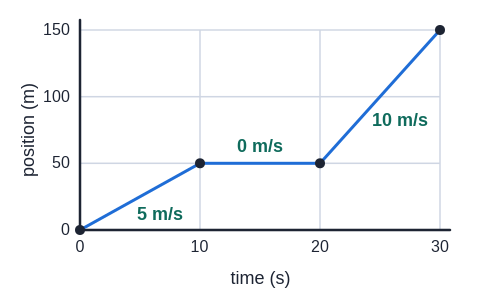
- 0 to 10 s: (50 − 0) m ÷ 10 s = 5 m/sstraight sloping line
- 10 to 20 s: (50 − 50) m ÷ 10 s = 0 m/sflat line, stopped
- 20 to 30 s: (150 − 50) m ÷ 10 s = 10 m/ssteeper straight line
- Steady 5 m/s, stops for 10 s, then a faster steady 10 m/s
Motion lab
A curved line means changing speed
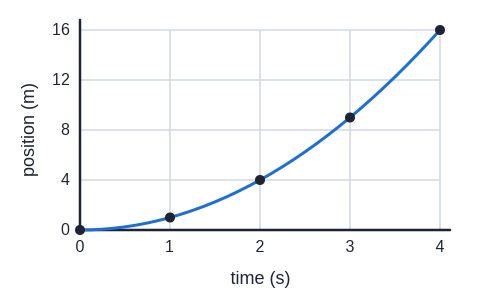
- A ball rolls from rest down a long ramp. Its position each second is in the table.
- The distance covered each second grows: 1 m, then 3 m, then 5 m, then 7 m.
- Plotted, the points do not sit on a straight line. They form a curve that gets steeper, showing the ball is speeding up.
- A ball rolling to a stop on grass makes the opposite shape: a curve that flattens until it is horizontal.
| Time (s) | 0 | 1 | 2 | 3 | 4 |
|---|---|---|---|---|---|
| Position (m) | 0 | 1 | 4 | 9 | 16 |
| Distance in that second (m) | 1 | 3 | 5 | 7 |
Free-body diagrams
- A free-body diagram shows one object as a box or a dot, with an arrow for every force acting on it.
- Each arrow starts on the object, points the way the force acts, is drawn to length by size, and is labelled with its name and value.
- Only forces on the object go in, not forces the object puts on other things.
- To find the net force, combine the up and down arrows, then the left and right arrows, separately.
- Common forces: weight (gravity pulling down), the support or normal force (a surface pushing up), friction, air resistance, thrust or a push.
Net force from a free-body diagram
- A box of feijoas is pushed across a shed floor. The diagram has four arrows, listed in the table.
- Find the net force and say how the box moves.
| Force | Direction | Size |
|---|---|---|
| Weight | Down | 100 N |
| Support from the floor | Up | 100 N |
| Push | Right | 30 N |
| Friction | Left | 12 N |
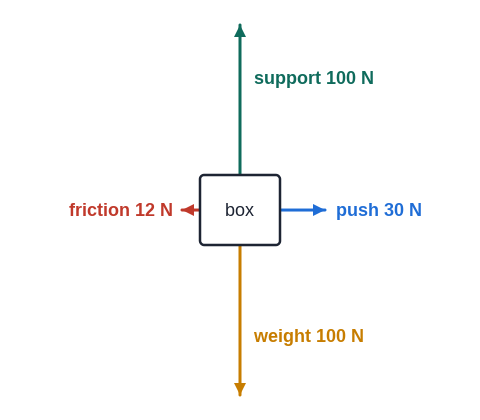
- Vertical: 100 N up − 100 N down = 0 Nbalanced, so the box does not rise or sink
- Horizontal: 30 N right − 12 N left = 18 N rightunbalanced
- Net force 18 N to the right: the box speeds up to the right
Try it: balanced and unbalanced forces
Pressure counts the force pushing straight into a surface
- To find pressure, take only the part of the force that pushes at right angles (perpendicular) into the surface, and divide it by the contact area.
- Your weight presses straight down into level ground, so all of it counts.
- A force sliding along a surface, like a hand wiping a bench, does not press into it, so it adds no pressure.
- Units are the same as in part 1: newtons, square metres, pascals.
Same force, different area
- For a fixed force, pressure and area work against each other: halve the area and the pressure doubles.
- An axe and a hammer swung with the same force show this. The axe's thin edge touches the wood over a tiny area, so the pressure is huge and the wood splits.
- The hammer's flat face spreads the same force over a bigger area, so it drives a nail without cutting.
- The nail itself works the other way round: the hammer hits a broad head, and the force comes out at a sharp point.
| Tool, 300 N force | Contact area | Pressure |
|---|---|---|
| Axe edge | 1 cm² = 0.0001 m² | 300 ÷ 0.0001 = 3 000 000 Pa |
| Hammer face | 6 cm² = 0.0006 m² | 300 ÷ 0.0006 = 500 000 Pa |
Why skiers do not sink on Ruapehu
- A skier weighs 700 N. Compare the pressure on the snow in boots, on one ski, and on two skis.
- Boots: 0.05 m² in total. One ski: 0.15 m². Two skis: 0.30 m².
- Boots: 700 N ÷ 0.05 m² = 14 000 Pasmall area, high pressure: boots sink
- One ski: 700 N ÷ 0.15 m² ≈ 4700 Pathree times the area of the boots
- Two skis: 700 N ÷ 0.30 m² ≈ 2300 Padouble the area again
- Two skis give about a sixth of the boot pressure, so the skier stays on top
Matching area to the job
- When an object needs to cut or pierce, it is designed with a small contact area for high pressure.
- When it needs to stay on top of a soft surface or avoid damage, it is given a large area for low pressure.
- A Waikato farm tractor has wide tyres so its weight is spread out, which stops it sinking in a wet paddock and squashing the soil.
- A road bike can use narrow tyres because hard tarseal does not sink, so there is no need to spread the weight.
| Object | Contact area | Why |
|---|---|---|
| Knife, axe, drawing pin | Very small | High pressure to cut or pierce |
| Tractor tyres, snowshoes, two skis | Large | Low pressure so they do not sink |
| Backpack straps | Wide | Lower pressure on the shoulders, so it hurts less |
| Stiletto heel | Tiny | High enough pressure to dent a wooden floor |
Common mistakes
- A flat line on a position-time graph means the object is moving at a steady speed.A flat line means the position is not changing, so the object is stopped; a straight sloping line is a steady speed.
- A straight line sloping upwards means the object is speeding up.A straight line has the same slope all the way, so the speed is steady; only a curve that gets steeper shows speeding up.
- The free-body diagram of a box should show the box pushing down on the floor.A free-body diagram shows only the forces acting on the box, such as its weight and the floor's support, not forces it puts on other things.
- An axe cuts wood because it pushes harder than a hammer.With the same force, the axe's thin edge has a much smaller area, so the pressure F ÷ A is far bigger.
Same push, different area
You need: kitchen scales, a lump of play dough or plasticine about 3 cm thick, a pencil, a 50c coin, a ruler
- Put the dough on the scales and set them to zero.
- Press the flat, unsharpened end of the pencil straight down into the dough until the scales read 500 g, which is a force of about 5 N, then lift it off.
- In a fresh spot, press the flat face of the coin straight down until the scales again read 500 g, then lift it off.
- Measure across the pencil end and the coin, work out each contact area in m², and calculate each pressure with P = F ÷ A.
- Look for a deep dent from the pencil and only a faint mark from the coin: the force was the same, but the pencil end's area is about ten times smaller, so its pressure is about ten times bigger.
Safety: Press gently and stay well under the scales' limit, because a glass-topped kitchen scale can crack under a hard push, and use the blunt end of the pencil, never the sharp tip.
Your turn
On a position-time graph, a line goes from 0 m at 0 s to 120 m at 20 s in a straight line. What is the speed, and is it steady?
Describe the motion shown by a position-time graph that is flat from 5 s to 12 s.
A kayak has 150 N of paddle thrust forward and 90 N of drag backward; its weight and the water's upward push are both 800 N. Find the net force.
A 60 N force pushes a drawing pin with a point of 0.000 001 m². What pressure does the point make, and why does it go into a cork board?
Explain why one wide snowboard and two skis both work on soft snow, but walking in boots does not.
A cart's position at 0, 1, 2, 3 and 4 s is 0, 6, 10, 12 and 12 m. Describe its motion.
An axe edge is sharpened so its contact area drops from 2 cm² to 0.5 cm². With the same force, how does the pressure change?
A 50 kg go-kart has a net force of 150 N on it. What is its acceleration, and how much speed does it gain in 4 s?
Show answer
1. 6 m/s, from 120 ÷ 20, and it is steady because the line is straight. 2. The object is stopped (stationary) for 7 s, because its position does not change. 3. Vertical forces cancel, so the net force is 150 − 90 = 60 N forward, and the kayak speeds up. 4. 60 ÷ 0.000 001 = 60 000 000 Pa. The tiny point concentrates the force into a huge pressure that pushes the cork apart. 5. A snowboard and two skis both spread the weight over a large area, giving a low pressure the snow can hold up. Boots put the same weight on a small area, so the pressure is high and they sink. 6. It slows down, then stops: it covers 6 m, then 4 m, then 2 m each second, and its position does not change from 3 s to 4 s. 7. It becomes 4 times bigger: the area is 4 times smaller (2 ÷ 0.5 = 4), and for a fixed force a smaller area gives a bigger pressure. 8. a = F ÷ m = 150 ÷ 50 = 3 m/s², so it gains 3 × 4 = 12 m/s in 4 s.
Recap
- A bigger net force on the same object gives a bigger change in speed in the same time: F = m × a.
- Position-time graphs: flat means stopped, straight means steady speed, steeper means faster, curved means changing speed.
- Speed is the slope: change in position ÷ change in time.
- Free-body diagrams show every force on one object; combine up-down and left-right separately to get the net force.
- Pressure is the perpendicular force ÷ area, in pascals.
- Small area means high pressure (axe, pin, knife); large area means low pressure (skis, tractor tyres).
Challenge
A garden shed weighs 18 000 N and stands on four square concrete pads, one under each corner. The soft ground under it can take a pressure of at most 30 000 Pa before the pads start to sink. (a) If the weight is shared equally, what is the smallest area each pad could have? (b) The builder uses pads 0.4 m × 0.4 m. Find the pressure under each pad when the shed is empty. (c) Later, 6000 N of firewood is stacked at one end of the shed, so the two pads at that end each carry an extra 3000 N. Find the new pressure under those pads, and say whether they sink. (d) What size of square pad would just stop them sinking?
Hint
Pressure is force ÷ area, so the area you need is force ÷ the largest pressure allowed. In (c) work out the force on one loaded pad before dividing by its area.
Answer
(a) 0.15 m² each. (b) 28 125 Pa, just under the limit. (c) 7500 N on each loaded pad gives 46 875 Pa, well over 30 000 Pa, so those pads sink. (d) 0.25 m², which is a 0.5 m × 0.5 m pad.
Step by step
- Each pad carries a quarter of the shed's weight.
- Rearrange P = F ÷ A to A = F ÷ P to find the smallest area.
- A 0.4 m square pad has an area of 0.16 m²; divide its force by that.
- With the firewood, a pad at the loaded end carries its quarter of the shed plus 3000 N.
- Use A = F ÷ P again with the bigger force to size a pad that just holds.
Full working
- force per pad = 18 000 ÷ 4 = 4500 Nweight shared equally
- A = 4500 ÷ 30 000 = 0.15 m²A = F ÷ P
- pad area = 0.4 × 0.4 = 0.16 m²square pad
- P = 4500 ÷ 0.16 = 28 125 Paunder 30 000 Pa, so it holds
- loaded pad: 4500 + 3000 = 7500 Nquarter of the shed plus firewood share
- P = 7500 ÷ 0.16 = 46 875 Paover 30 000 Pa, so it sinks
- A = 7500 ÷ 30 000 = 0.25 m² = 0.5 m × 0.5 mpad that just holds
- (c) 46 875 Pa, sinks (d) 0.5 m × 0.5 m
A 1.5 kg remote-control car starts from rest on a long, flat path. Its position is recorded each second. Time (s): 0, 1, 2, 3, 4, 5, 6. Position (m): 0, 0.5, 2, 4.5, 8, 12, 16. Its motor gives a steady forward driving force of 2.1 N for the first 4 s. (a) Describe the shape of the position-time graph from 0 to 4 s and from 4 to 6 s, and find the speed from 4 to 6 s. (b) Assuming it sped up steadily from rest over the first 4 s, find its acceleration and the net force on it. (c) Draw the horizontal forces as a free-body diagram in numbers and find the total backward force (friction plus air resistance). (d) From 4 s the speed stays steady. If the backward force stays the same, what driving force is the motor giving now?
Hint
Use the straight section of the graph to find the speed the car reached. That speed was gained from rest in 4 s, which gives the acceleration.
Answer
(a) 0 to 4 s: a curve getting steeper, so it is speeding up. 4 to 6 s: a straight line, a steady 4 m per s. (b) 1 m per s², net force 1.5 N forward. (c) 2.1 N forward and 0.6 N backward. (d) 0.6 N, because at steady speed the forces are balanced.
Step by step
- The distance covered each second grows from 0 to 4 s, so the graph curves upward: speeding up.
- From 4 to 6 s it covers 4 m each second, a straight line, so the speed is steady: the slope gives 4 m per s.
- It gained 4 m per s in 4 s, so its speed rose by 1 m per s every second.
- F = m × a gives the net force, and the backward force is the driving force minus the net force.
- At a steady speed the net force is zero, so the driving force must equal the backward force.
Full working
- 0 to 4 s: distance each second 0.5, 1.5, 2.5, 3.5 mgetting bigger, so a curve speeding up
- speed = (16 − 8) ÷ (6 − 4) = 4 m per sslope of the straight section
- a = 4 ÷ 4 = 1 m per s²4 m per s gained in 4 s
- net force = 1.5 × 1 = 1.5 NF = m × a
- backward force = 2.1 − 1.5 = 0.6 Ndriving force minus net force
- steady speed: driving force − 0.6 = 0, so driving force = 0.6 Nbalanced forces
- (b) 1 m per s², 1.5 N (c) 0.6 N backward (d) 0.6 N
Here is a simple model of a car tyre: the bottom of the tyre flattens against the road until the air pressure inside, pushing on that flat contact patch, holds up the load on the tyre. In the model, load on the tyre = air pressure × area of the contact patch. A car weighs 12 000 N, shared equally between its four tyres. (a) With the tyres at 200 000 Pa, find the area of each contact patch in m² and in cm². (b) One tyre goes soft and drops to 150 000 Pa. Find its new patch area. (c) Show that, in this model, the pressure the tyre puts on the road equals the air pressure inside it. (d) A mountain biker riding onto soft sand lets air out of her tyres, from 300 000 Pa down to 100 000 Pa. Each tyre carries 400 N. Find the patch area before and after, and use (c) to explain why this helps on sand.
Hint
The road pushes up on the patch with a force equal to the load. Rearrange load = pressure × area to find the area, and remember 1 m² = 10 000 cm².
Answer
(a) 0.015 m² = 150 cm². (b) 0.02 m² = 200 cm². (c) Pressure on the road = load ÷ patch area, and patch area = load ÷ air pressure, so pressure on the road = air pressure. (d) About 13.3 cm² before and 40 cm² after, three times bigger. The pressure on the sand falls from 300 000 Pa to 100 000 Pa, so the tyres sink in much less.
Step by step
- Each tyre carries a quarter of the car's weight.
- Rearrange the model: area = load ÷ air pressure.
- Lower air pressure means the tyre must flatten more, so the patch grows.
- The pressure on the road is the same load spread over the same patch, so it equals the air pressure.
- Letting air out spreads the bike's weight over a bigger area, giving a lower pressure that soft sand can hold up, like a wide tractor tyre.
Full working
- load per tyre = 12 000 ÷ 4 = 3000 Nshared equally
- area = 3000 ÷ 200 000 = 0.015 m² = 150 cm²area = load ÷ pressure, 1 m² = 10 000 cm²
- soft tyre: 3000 ÷ 150 000 = 0.02 m² = 200 cm²lower pressure, bigger patch
- P on road = load ÷ area = load ÷ (load ÷ air pressure) = air pressurethe model
- bike before: 400 ÷ 300 000 ≈ 0.00133 m² ≈ 13.3 cm²hard tyres
- bike after: 400 ÷ 100 000 = 0.004 m² = 40 cm²soft tyres, three times the area
- (a) 150 cm² (b) 200 cm² (d) 13.3 cm² → 40 cm², pressure on sand down to a third