
Circles, parallel lines, and moving shapes about
What this lesson covers
- A circle is the path traced out by a point moving in a plane and always a fixed distance (the radius) from a central point.
- Angles between parallel lines and a transversal can be corresponding, co-interior, or alternate; corresponding angles are equal, and alternate angles are equal.
- A set of points in a plane can be transformed by translation, reflection about a line, and rotation about a fixed point.
Four topics, and one question for all of them
- Circles, angles, moving shapes, and folding up nets.
- They are genuinely four different things.
- Ask the same question of each: what is staying the same?
A circle is defined by what does not change
- Pick a point, and pick a distance.
- Mark every place that is exactly that far from the point.
- That set of places is a circle. The distance is the radius.
| Step | Detail | |
|---|---|---|
| Pick a centre | and a fixed distance | |
| Mark every point | exactly that far away | |
| What you get | is a circle | |
| The fixed distance | is the radius |
The parts, and how they relate
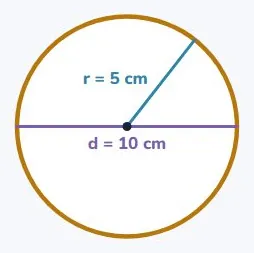
- Radius to the edge, diameter all the way across.
- A chord joins two edge points but need not pass the centre.
- Which makes the diameter the longest chord there is.
Try it: grow the circle
All four, written down
- The diameter is always twice the radius.
- The circumference is 2 pi r, from the measuring lesson.
- Every one of them is measured from that same fixed centre.
| Part | What it is | Size |
|---|---|---|
| Radius | centre to the edge | r |
| Diameter | right across, through the centre | 2r |
| Chord | joins two points on the edge | need not pass the centre |
| Circumference | the distance all the way round | 2πr |
| So the diameter | is the longest chord there is |
Angles: start with one crossing
- Two lines cross. Angles on a straight line add to 180.
- So 70 on one side means 110 on the other.
- And the angle opposite is equal. One angle gives you all four.
| Rule | Why | Example |
|---|---|---|
| On a straight line | angles add to 180 | 180 − 70 = 110 |
| Vertically opposite | always equal | 70 and 70 |
| So one angle | gives you all four |
Now a line crossing two parallel lines
- That crossing line is called a transversal.
- Three relationships worth knowing, and they make shapes.
- F is corresponding, Z is alternate, C is co-interior.
| Name | Shape it makes | Relationship |
|---|---|---|
| Corresponding | an F shape | equal |
| Alternate | a Z shape | equal |
| Co-interior | a C shape | add to 180 |
Try it: F, Z and C angles
Two of those are equal. One is not
- Corresponding and alternate angles are equal to each other.
- Co-interior angles add to 180. They are not equal.
- Look at the C: both angles are on the same side. That is why.
One given angle unlocks the diagram
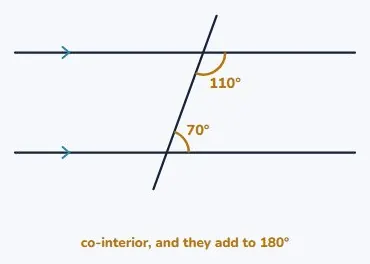
- The transversal makes 70 degrees. Corresponding angle: 70.
- Alternate angle: also 70.
- Co-interior: 180 minus 70, which is 110.
| Angle wanted | Reasoning | Size |
|---|---|---|
| Given | the transversal makes 70° | |
| Corresponding angle | equal | 70° |
| Alternate angle | equal | 70° |
| Co-interior angle | 180 − 70 | 110° |
Now run it backwards: are they parallel?
- Usually you are told the lines are parallel and find an angle.
- Here you get the angles and have to decide about the lines.
- 70 and 110 add to 180, so yes. 70 and 105 do not, so no.
| Given | Check | Verdict |
|---|---|---|
| Angles of 70 and 110 | co-interior, so check the sum | 180. Parallel |
| Angles of 70 and 105 | the sum is 175 | not 180. Not parallel |
| The point | do not assume parallel | the angles prove it |
A diagram that looks parallel is not evidence
- Drawings are not to scale, and 105 looks a lot like 110.
- The angles are the proof. Nothing else is.
- That is what the word verifying is doing in the question.
Three ways to move a shape
- Translation slides it. Reflection flips it over a line.
- Rotation turns it about a point.
- And in all three the shape itself does not change at all.
| Transformation | What it does | Note |
|---|---|---|
| Translation | slide it | no turning, no flipping |
| Reflection | flip it over a line | like a mirror |
| Rotation | turn it about a point | by a given angle |
| In all three | the shape is unchanged | only its position moves |
Try it: three ways to move a shape
Geometry board
What happens to an actual point
- Start at (2, 3). Slide 4 right and 2 down: (6, 1).
- Reflect in the y-axis and the x flips sign: (−2, 3).
- Reflect in the x-axis and the y flips instead: (2, −3).
| Transformation | What changes | Result |
|---|---|---|
| Start at (2, 3) | ||
| Translate 4 right, 2 down | add 4, subtract 2 | (6, 1) |
| Reflect in the y-axis | the x flips sign | (−2, 3) |
| Reflect in the x-axis | the y flips sign | (2, −3) |
| Rotate 90° clockwise about O | (3, −2) |
Which coordinate flips, and why it feels backwards
- Reflecting in the y-axis changes x, not y.
- The axis you reflect in is the one that stays put.
- Points on that axis do not move at all. That is the test.
Nets: a solid, unfolded
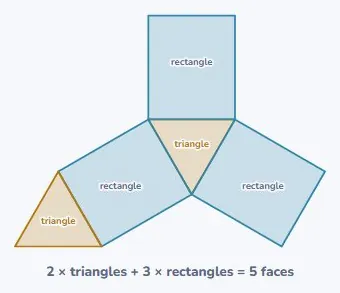
- A net is every face of a solid, laid out flat.
- A triangular prism: two triangle ends and three rectangles.
- Folding it up moves the faces. It does not change them.
Counting faces, edges and vertices
- A rectangular prism has 6 faces, 12 edges, 8 vertices.
- A triangular prism has 5, 9 and 6.
- A square-based pyramid has 5, 8 and 5.
| Solid | Faces | Edges and vertices |
|---|---|---|
| Rectangular prism | 6 faces | 12 edges, 8 vertices |
| Triangular prism | 5 faces | 9 edges, 6 vertices |
| Square-based pyramid | 5 faces | 8 edges, 5 vertices |
| Folding | does not change the faces | only where they sit |
What to take away
- Six things, and the fourth is the one people get wrong.
| A circle | is every point a fixed distance from the centre |
| The diameter | is twice the radius, and the longest chord |
| Corresponding and alternate | angles are equal. F and Z |
| Co-interior | angles add to 180. C |
| To prove lines parallel | check the angles, do not assume |
| Translate, reflect, rotate | move a shape without changing it |
Common mistakes
- Co-interior angles are equal, like the F and Z ones.Co-interior (C-shape) angles add to 180°; only corresponding and alternate angles are equal.
- The lines look parallel, so the alternate angles are equal.You cannot assume parallel; show a pair of corresponding or alternate angles is equal, then conclude the lines are parallel.
- Reflecting (3, 1) in the x-axis gives (−3, 1).Reflecting in the x-axis changes the sign of the y-coordinate, so (3, 1) goes to (3, −1).
- Any chord across a circle is a diameter.A chord is a diameter only if it passes through the centre; the diameter, 2r, is the longest chord.
Your turn
- Try all eight.
A transversal cuts parallels at 65°. Co-interior?
Reflect the point (4, 1) in the y-axis.
How many faces does a triangular prism have?
Two co-interior angles are 60° and 120°. Are the lines parallel?
A circle has a radius of 6 cm. How long is the longest chord you can draw in it?
A transversal crosses two parallel lines. Which statement is true?
A point slides from (−1, 4) to (3, 1). Describe the translation.
Rotate the point (3, −1) by 180° about the origin. Where does it land?
Show answer
1. 115°, because co-interior angles add to 180 rather than being equal. 2. (−4, 1). Reflecting in the y-axis changes the sign of the x coordinate and leaves y alone. 3. Five. Two triangular ends and three rectangles. 4. Yes. They add to 180, which is exactly the condition for parallel. 5. 12 cm. The longest chord is the diameter, which is twice the radius: 2 × 6 = 12. 6. Alternate (Z) angles are always equal. Corresponding angles are equal too, co-interior angles add to 180° and vertically opposite angles are equal. 7. 4 right and 3 down. x goes from −1 to 3, which is 4 more, and y goes from 4 to 1, which is 3 less. 8. (−3, 1). A half turn about the origin changes the sign of both coordinates.
The answers
- Co-interior angles add to 180, not equal.
- Reflecting in the y-axis flips the x.
- 60 and 120 add to 180, so parallel.
| Answer | |
|---|---|
| 1 | 115° |
| 2 | (−4, 1) |
| 3 | Five |
| 4 | Yes |
Challenge
A long strip of paper has straight, parallel edges and lies flat with its edges running left to right. Q is a point on the bottom edge and P is a point on the top edge, to the right of Q. The angle between QP and the bottom edge, on the right of Q, is 65°. The strip is folded flat along the crease QP, so that the part to the right of the crease flips over onto the left part. The folded-over piece of the bottom edge now starts at Q and crosses the top edge at a point R. (a) Find the three angles of triangle PQR. (b) Show that triangle PQR is isosceles, and say which two sides are equal. (c) At what angle to the bottom edge should the crease be made so that the folded bottom edge crosses the top edge at right angles?
Hint
Folding is a reflection in the crease, and a reflection keeps every angle the same size. Then look for alternate angles between the two parallel edges.
Answer
(a) Angle PQR = 65°, angle QPR = 65° and angle PRQ = 50°. (b) The angles at P and Q are equal, so the sides opposite them are equal: QR = PR. (c) 45°.
Step by step
- Folding along QP is a reflection in the line QP. Before the fold the bottom edge made 65° with QP, so after the fold the folded edge QR makes 65° with QP on the other side: angle PQR = 65°.
- The top and bottom edges are parallel and QP crosses both, so angle QPR, between PQ and the top edge on the left of P, is alternate to the 65° at Q: angle QPR = 65°.
- The angles of a triangle add to 180°, so angle PRQ = 180° − 65° − 65° = 50°.
- Two equal angles make the triangle isosceles. PR is opposite the angle at Q and QR is opposite the angle at P, so QR = PR.
- With a crease at x° the same steps give angle PRQ = 180° − 2x. For a right angle 180 − 2x = 90, so x = 45.
Full working
- Angle PQR = 65°the fold is a reflection in QP, so it copies the 65°
- Angle QPR = 65°alternate to the 65° at Q, the edges are parallel
- Angle PRQ = 180° − 65° − 65° = 50°angles in a triangle
- QR = PRthe equal angles at P and Q face these two sides
- Crease at x°: angle PRQ = 180° − 2xsame steps with x in place of 65
- 180 − 2x = 90, so x = 45right angle at R
- Angles 65°, 65°, 50°; QR = PR; crease at 45°
Tia starts with the point (5, 2). She reflects it in the line y = x, then reflects the new point in the x-axis, then in the line y = x again, then in the x-axis again, and so on, always taking turns between the two mirror lines. (a) Show that each pair of reflections (y = x, then the x-axis) has the same effect as one rotation, and describe the rotation. (b) Where is the point after 2027 reflections in total?
Hint
Reflecting in the line y = x swaps the two coordinates. Follow the general point (a, b) through one pair of reflections and compare with what a 90° turn about the origin does.
Answer
(a) (a, b) goes to (b, a) and then to (b, −a), which is a rotation of 90° clockwise about the origin. (b) (−5, 2).
Step by step
- Reflect (a, b) in y = x: the coordinates swap, giving (b, a).
- Reflect that in the x-axis: the y-coordinate changes sign, giving (b, −a).
- That is exactly the rule for a 90° clockwise rotation about the origin, so each pair is a quarter turn.
- Four quarter turns bring the point back to the start, so only the remainder after dividing by 4 matters.
- 2027 reflections are 1013 pairs plus one extra reflection in y = x. 1013 pairs leave remainder 1, so one quarter turn, then one more swap.
Full working
- (a, b) → (b, a)reflect in y = x, swap the coordinates
- (b, a) → (b, −a)reflect in the x-axis, y changes sign
- (a, b) → (b, −a) is a 90° clockwise turn about Osame as the lesson's rule (2, 3) → (3, −2)
- 2027 = 2 × 10¹³ + 11013 pairs, then one reflection in y = x
- 1013 = 4 × 253 + 1full turns cancel, one quarter turn is left
- (5, 2) → (2, −5)one quarter turn clockwise
- (2, −5) → (−5, 2)the last reflection in y = x swaps the coordinates
- Final point (−5, 2)
A goat is tied to one corner of a shed by a 10 m rope. The shed is a rectangle 6 m by 4 m, and the goat cannot go through it, but the rope can bend around the shed's other corners. A farmer will build a fence along the outer edge of everywhere the goat can reach. (a) Describe the shape of that edge, and find the length of the fence as a multiple of π and to the nearest 0.1 m. (b) Mere says the fence is exactly as long as a full circle of radius 10 m. Is she right, and why does it work out that way?
Hint
A circle is every point a fixed distance from a centre. Where the rope is free, the goat traces part of a circle around the corner it is tied to. When the rope wraps around another corner of the shed, that corner becomes a new centre, with a shorter radius. The circumference of a circle is 2πr.
Answer
(a) Three arcs: three quarters of a circle of radius 10 m, a quarter circle of radius 4 m and a quarter circle of radius 6 m. Fence = 20π m, about 62.8 m. (b) Yes: 15π + 2π + 3π = 20π, which is 2π × 10, because the two short radii, 4 and 6, add up to 10.
Step by step
- The shed fills one quarter of the space around the tied corner, so with the rope straight the goat traces three quarters of a circle of radius 10 m.
- Along the 6 m wall the rope reaches the next corner with 4 m left, so it swings a quarter circle of radius 4 m behind the shed.
- Along the 4 m wall it reaches the other corner with 6 m left, so it swings a quarter circle of radius 6 m.
- Both small arcs end exactly at the far corner of the shed, so the three arcs join up into one closed fence.
- Add the arc lengths. The two quarter circles together are a quarter of 2π × (4 + 6), and 4 + 6 = 10, which is why the total matches a full circle of radius 10.
Full working
- Big arc = 34 × 2π × 10 = 15πthree quarters of a circle of radius 10
- Arc round the end of the 6 m wall = 14 × 2π × 4 = 2π10 − 6 = 4 m of rope left
- Arc round the end of the 4 m wall = 14 × 2π × 6 = 3π10 − 4 = 6 m of rope left
- Both small arcs end at the far corner4 m is the short wall and 6 m is the long wall
- Fence = 15π + 2π + 3π = 20πadd the three arcs
- 20π ≈ 62.8 mto the nearest 0.1 m
- 2π × 10 = 20π, so Mere is rightthe short radii 4 + 6 add to the rope length
- Fence = 20π m ≈ 62.8 m