Circles, and every area formula as a rectangle
What this lesson covers
- The constant π is found by dividing a circle’s circumference by its diameter.
- For a circle of radius r, the circumference is 2πr.
Two halves, and one idea holding them together
- Circles first, then the area of some awkward shapes.
- Every area formula here comes back to a rectangle.
- So there is a lot less to remember than it looks.
Pi is something you can measure
- Take any circle. Measure around it, and measure across it.
- Divide the first by the second. You get 3.14.
- Do it with a different circle. Still 3.14. Every time.
| Circle | Measurements | Around ÷ across |
|---|---|---|
| Circle A | around 31.4 cm, across 10 cm | 3.14 |
| Circle B | around 15.7 cm, across 5 cm | 3.14 |
| Any circle | around ÷ across | always 3.14... |
Try it: roll it one turn
That number is pi, and it is a fact about circles
- Nobody chose it. It is what circles do.
- Pi is the circumference divided by the diameter.
- Which means the circumference is pi times the diameter.
Try it: grow the circle
Two ways to write the same formula
- C = pi d if you were given the diameter.
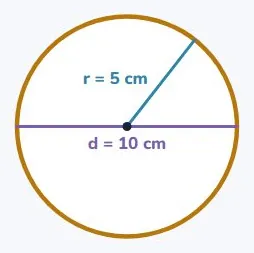
- The diameter is twice the radius, so C = 2 pi r.
- Same formula. Use whichever matches what you were told.
| Version | Formula | Why |
|---|---|---|
| Using the diameter | C = πd | because π is C ÷ d |
| Using the radius | C = 2πr | because d = 2r |
| They are the same | pick whichever you were given |
Two quick ones
- Radius 5: two times pi times five, about 31.4 cm.
- Diameter 12: pi times twelve, about 37.7 cm.
- Watch which one you were given. That is the only trap.
| Given | Working | Answer |
|---|---|---|
| r = 5 cm | 2 × π × 5 | about 31.4 cm |
| d = 12 cm | π × 12 | about 37.7 cm |
Now walk around a semicircle
- Radius 6. Start at one corner and go round the curve.
- That is half the circumference, about 18.85 cm.
- But you are not home yet. You have to walk back along the flat.
| Step | Working | Distance |
|---|---|---|
| Radius 6 cm | ||
| Round the curve | half of 2πr, so π × 6 | about 18.85 cm |
| Back along the flat | the diameter, 12 cm | |
| Total perimeter | 18.85 + 12 | about 30.85 cm |
So it is not half the circumference
- Half the circumference is 18.85, and that is only the curve.
- Cutting the circle in half created an edge that was not there.
- Perimeter means all the way round. Add the diameter.
| Claim | Value | Verdict |
|---|---|---|
| Half the circumference | 18.85 cm | only the curve |
| The cut made a new edge | the straight 12 cm | |
| Perimeter means | all the way round | so both |
A quarter circle gets two straight edges
- Radius 4. The curve is a quarter of the circumference, 6.28.
- Then back along one radius, and up the other. Four each.
- About 14.28 cm. Walk the outline and count what you cross.
| Step | Working | Distance |
|---|---|---|
| Radius 4 cm | ||
| The curve | a quarter of 2πr | about 6.28 cm |
| Two straight edges | both radii, 4 cm each | 8 cm |
| Total | 6.28 + 8 | about 14.28 cm |
Second half. Start with the easiest shape there is
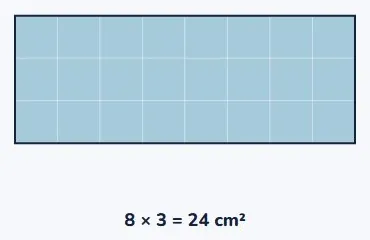
- A rectangle 8 by 3. Area is base times height. 24.
- You have known that for years.
- Every formula in the rest of this lesson comes back to it.
A parallelogram is a rectangle, pushed over
- Cut the triangle off one end and slide it to the other.
- What you are left with is a rectangle. Same base, same height.
- So the area is base times height. Nothing new.
| Step | What happens | Result |
|---|---|---|
| Cut the triangle off one end | slide it to the other | |
| You now have a rectangle | same base, same height | |
| So the area | base × height | 8 × 3 = 24 cm² |
| Careful | height means perpendicular height | not the slanted side |
Try it: every area is a rectangle
One warning about that height
- The height is the perpendicular height. Straight up.
- Not the slanted side, which is longer.
- Using the slant is the most common error in the topic.
A trapezium is a rectangle whose width is the average
- Parallel sides of 10 and 6. It is wide at one end, narrow at the other.
- On average, it is 8 wide. And the height is 4.
- So the area is 8 times 4, which is 32.
| Step | Reasoning | Result |
|---|---|---|
| Parallel sides 10 and 6 | the average is 8 | |
| Height 4 | ||
| Area | 8 × 4 | 32 cm² |
| Written as a formula | (a + b)/2 × h | the average, times the height |
And a kite fills half its rectangle
- Draw the rectangle that just encloses the kite.
- Its sides are the two diagonals: 10 and 6, so 60.
- The kite is exactly half of it. Thirty.
| Step | Reasoning | Result |
|---|---|---|
| Diagonals 10 and 6 | draw the rectangle round it | 60 cm² |
| The kite fills | exactly half of it | |
| Area | (10 × 6)/2 | 30 cm² |
And when there is no formula at all
- An L-shaped room is not any of these shapes.
- For perimeter, it does not matter. Add up every side.
- Perimeter never needs a formula. It is just the walk.
| Shape | Method | Answer |
|---|---|---|
| An L-shaped room | sides 10, 4, 6, 3, 4, 7 | |
| Perimeter | add every side | 34 m |
| No formula needed | just walk all the way round |
What to take away
- Seven things, and the third one is the mark people drop.
| π | is circumference divided by diameter, for every circle |
| Circumference | is πd, which is the same as 2πr |
| A semicircle perimeter | is the curve plus the diameter |
| A quarter circle | is the curve plus two radii |
| Parallelogram | base × perpendicular height, like a rectangle |
| Trapezium | the average of the parallel sides, times the height |
| Kite | half of the rectangle that encloses it |
Common mistakes
- The perimeter of a semicircle of radius 6 is π × 6 ≈ 18.85 cm.That is only the curve; add the 12 cm diameter, so the perimeter is about 30.85 cm.
- Radius 5, so C = π × 5 ≈ 15.7 cm.C = πd uses the diameter; with r = 5 use C = 2πr ≈ 31.4 cm.
- A quarter circle of radius 4 has perimeter 6.28 + 4 = 10.28 cm.A quarter circle has two straight edges, both radii, so it is 6.28 + 8 ≈ 14.28 cm.
- Area of a trapezium = (a + b) × hIt is half of that: ½(a + b) × h, the average of the parallel sides times the perpendicular height.
Your turn
- Try all eight.
Find the circumference of a circle with radius 7 cm.
Find the perimeter of a semicircle with radius 5 cm.
Trapezium: parallel sides 9 and 5, height 6. Area?
A parallelogram has base 12 cm and height 5 cm. Area?
A kite has diagonals of 14 cm and 9 cm. What is its area?
Find the perimeter of a quarter circle with radius 10 cm.
A round garden bed in Christchurch has a circumference of 50 m. What is its diameter?
A trapezium has area 45 cm² and parallel sides of 7 cm and 11 cm. What is its height?
Show answer
1. About 44.0 cm, from 2 × π × 7. 2. About 25.7 cm. The curve is π × 5, which is about 15.7, and then add the diameter of 10. If you answered 15.7 you forgot the straight edge. 3. 42 cm². The average of 9 and 5 is 7, and 7 × 6 is 42. 4. 60 cm². Base times perpendicular height, exactly like a rectangle. 5. 63 cm². The enclosing rectangle is 14 × 9 = 126 cm², and the kite fills half of it. 6. About 35.7 cm. The curve is 2 × π × 10 ÷ 4, about 15.7 cm, plus two radii of 10 cm. 7. About 15.9 m. C = πd, so d = C ÷ π = 50 ÷ π, which is about 15.9 m. 8. 5 cm. The average width is (7 + 11)/2 = 9, and 9 × height = 45, so the height is 5 cm.
The answers
- Two pi r, with r as seven.
- On the semicircle, add the diameter.
- Average 9 and 5 to get 7, then times 6.
| Answer | |
|---|---|
| 1 | About 44.0 cm |
| 2 | About 25.7 cm |
| 3 | 42 cm² |
| 4 | 60 cm² |
Challenge
ABCD is a rectangle with AB = 12 cm and BC = 8 cm, so AB and CD are the long sides. A point P is chosen anywhere inside the rectangle, and the triangles PAB and PCD are shaded. (a) Show that the total shaded area is the same wherever P is, and find it. (b) Where must P be if triangle PAB has three times the area of triangle PCD?
Hint
Both triangles have a base of 12 cm. Their heights are the distances from P to the two long sides. What do those two heights always add up to?
Answer
(a) Always 48 cm², half the rectangle. (b) P must be 6 cm from AB (and 2 cm from CD), anywhere along that line inside the rectangle.
Step by step
- Triangle PAB has base AB = 12 and height h, the perpendicular distance from P to AB.
- Triangle PCD has base CD = 12 and height k, the distance from P to CD.
- The two distances stack up to the full width of the rectangle, so h + k = 8 wherever P is.
- Total shaded area = ½ × 12 × h + ½ × 12 × k = 6 × (h + k) = 6 × 8 = 48 cm².
- For (b), area PAB = 3 × area PCD means h = 3k. Since h + k = 8, k = 2 and h = 6.
Full working
- Area PAB = ½ × 12 × h = 6hbase AB, perpendicular height h
- Area PCD = ½ × 12 × k = 6kbase CD, perpendicular height k
- h + k = 8the two heights fill the width BC
- Total = 6h + 6k = 6 × 8 = 48 cm²does not depend on where P is
- 6h = 3 × 6k, so h = 3kthree times the area
- 3k + k = 8, so k = 2 and h = 6share 8 in the ratio 3 : 1
- 48 cm²; P is 6 cm from AB
An old tractor has back wheels 1.5 m across and front wheels 0.6 m across. It drives in a straight line across a paddock, and the front wheels turn exactly 150 more times than the back wheels. How far did it drive? Give the exact distance as a multiple of π, then to the nearest metre.
Hint
Find the distance for one turn of each wheel. Then look for a distance where both wheels make a whole number of turns, and see how many extra turns the front wheel makes in that distance.
Answer
150π m, about 471 m (the back wheels turn 100 times and the front wheels 250 times).
Step by step
- One turn of a back wheel covers its circumference, π × 1.5 = 1.5π m. One turn of a front wheel covers π × 0.6 = 0.6π m.
- In 3π m the back wheel turns 3π ÷ 1.5π = 2 times and the front wheel turns 3π ÷ 0.6π = 5 times.
- So every 3π m, the front wheel gains 3 turns on the back wheel.
- To gain 150 turns takes 150 ÷ 3 = 50 of those stretches: 50 × 3π = 150π m.
- Check: 150π ÷ 1.5π = 100 turns and 150π ÷ 0.6π = 250 turns, which differ by 150.
Full working
- Back wheel: C = π × 1.5 = 1.5π mC = πd
- Front wheel: C = π × 0.6 = 0.6π mC = πd
- In 3π m: back turns 2, front turns 53π ÷ 1.5π and 3π ÷ 0.6π
- Front gains 5 − 2 = 3 turns every 3π mdifference per stretch
- 150 ÷ 3 = 50 stretches, distance = 50 × 3π = 150π mscale up
- Check: 250 − 100 = 150 turns150π ÷ 0.6π and 150π ÷ 1.5π
- Distance = 150π m ≈ 471 m
A running track has two straights joined by two semicircular bends. Each lane is 1.2 m wide, and every runner runs along the inside edge of their own lane. In a 400 m race each runner goes round both bends once and stays in their lane, so the outer lanes start further forward (the stagger) to make every runner's distance the same. (a) How far ahead of the lane 1 runner does the lane 2 runner start? (b) How far ahead of lane 1 does lane 8 start? (c) Explain why you did not need to know the length of the straights or the radius of the bends.
Hint
Two semicircles make a full circle. If the inside edge of lane 1 has radius r, what is the radius for lane 2? Compare 2πr with the circumference for the bigger radius.
Answer
(a) 2.4π m, about 7.54 m. (b) 16.8π m, about 52.78 m. (c) The straights are the same length in every lane, and the extra distance on the bends is 2π × (r + extra) − 2πr = 2π × extra, so r cancels out.
Step by step
- The two bends together make one full circle, so a lane with radius r has 2πr of bend.
- Lane 2 has radius r + 1.2, so its bends total 2π(r + 1.2) = 2πr + 2.4π.
- The extra is 2.4π ≈ 7.54 m, whatever r is, so lane 2 starts that far ahead.
- Lane 8 is 7 lanes out, so its radius is r + 8.4 and the extra is 2π × 8.4 = 16.8π ≈ 52.78 m.
- The straights are identical in every lane, and the 2πr part is in every lane too, so only the gap between the lanes matters.
Full working
- Lane 1 bends: 2 × ½ × 2πr = 2πrtwo semicircles make a circle
- Lane 2 bends: 2π(r + 1.2) = 2πr + 2.4πradius is one lane width bigger
- Stagger lane 2 = 2.4π ≈ 7.54 mthe 2πr cancels
- Lane 8 radius = r + 7 × 1.2 = r + 8.4seven lanes out
- Stagger lane 8 = 2π × 8.4 = 16.8π ≈ 52.78 magain the 2πr cancels
- Straights equal in every lane, and r cancelsso neither is needed
- Lane 2: about 7.54 m; lane 8: about 52.78 m