Pythagoras: the squares are actual squares
What this lesson covers
- For right-angled triangles, Pythagoras’ theorem states that the square of the hypotenuse (longest side) is equal to the sum of the squares of the other two sides.
- If (a,b,c) is a Pythagorean triple, then so is (ka,kb,kc), where k is a positive integer.
The most famous equation in school maths
- A squared plus b squared equals c squared.
- Almost everyone can say it. Fewer know what it means.
- It is not really an equation. It is a fact about area.
Build a square on each side
- Take a right-angled triangle with sides 3, 4 and 5.
- The square on the 3 holds 9. The square on the 4 holds 16.
- Nine and sixteen make twenty-five. And the big square is 25.
| Side | Square on it | Area |
|---|---|---|
| Side of 3 | square on it | 9 squares of area |
| Side of 4 | square on it | 16 squares of area |
| Together | 9 + 16 | 25 |
| Side of 5 | square on it | 25. The same. |
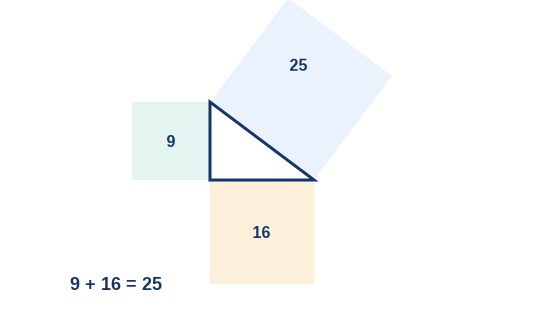
Try it: the squares are real squares
The two small squares fill the big one
- Exactly. Not approximately. For every right-angled triangle.
- That is the theorem, and it is a statement about area.
- The equation is just a short way of writing it down.
Try it: change the triangle
Naming the sides, so the equation reads
- The hypotenuse is the side opposite the right angle.
- It is always the longest one. That is worth holding on to.
- In a² + b² = c², c is always the hypotenuse.
| Part | Where it is | Note |
|---|---|---|
| The hypotenuse | opposite the right angle | always the longest |
| The two legs | the sides making the right angle | |
| The theorem | a² + b² = c² | c is the hypotenuse |
First use: is this triangle right-angled?
- Square the two shorter sides, add them.
- Square the longest. Do they match?
- Six, eight, ten: thirty-six plus sixty-four is a hundred. Yes.
| Sides | Check | Verdict |
|---|---|---|
| 6, 8, 10 | 36 + 64 = 100 | and 10² = 100. Yes |
| 5, 12, 13 | 25 + 144 = 169 | and 13² = 169. Yes |
| 8, 15, 17 | 64 + 225 = 289 | and 17² = 289. Yes |
Second use: finding the hypotenuse
- Legs of 9 and 12. Square both: 81 and 144.
- Add them: 225. That is c squared, not c.
- Square root it. Fifteen.
| Step | Working | Result |
|---|---|---|
| Legs 9 and 12 | 81 + 144 | 225 |
| So c² | 225 | |
| c | √225 | 15 |
It usually does not come out whole
- Legs of 5 and 7 give 25 plus 49, which is 74.
- Root 74 is about 8.6, and that is a perfectly good answer.
- Check it: bigger than 7, and not absurdly big. Sensible.
| Step | Working | Result |
|---|---|---|
| Legs 5 and 7 | 25 + 49 | 74 |
| c | √74 | about 8.60 |
| Sanity check | bigger than 7, smaller than 12 | reasonable |
Third use, and the one people get wrong
- Hypotenuse 13, one leg 5. Find the other leg.
- Add the squares and you get 13.9, which is longer than 13.
- A side longer than the hypotenuse is impossible. So subtract.
| Step | What happens | Value |
|---|---|---|
| Hypotenuse 13, one leg 5 | the wrong move | 169 + 25 = 194 |
| That gives | √194 ≈ 13.9 | longer than the hypotenuse |
| Impossible | so it cannot be adding | |
| The right move | 169 − 25 | 144 |
| The other leg | √144 | 12 |
Now, why is any of this true?
- Take a big square with sides a plus b.
- Fit four copies of the triangle inside, round the edges.
- The gap left in the middle is a square of side c.
| Step | What you do | Result |
|---|---|---|
| A big square | side a + b | |
| Put 4 triangles inside | around the edges | |
| The gap in the middle | a square of side c | area c² |
Now move the same four triangles
- Same big square. Same four triangles. Just rearranged.
- Push them into two corners instead of round the edges.
- Now the gaps are two squares: one of a, one of b.
| Step | What you do | Result |
|---|---|---|
| Same big square | side a + b | |
| Same 4 triangles | rearranged into two corners | |
| The gaps now | a square of a, and a square of b | area a² + b² |
| Same square, same triangles | so the gaps are equal | a² + b² = c² |
And that is the whole proof
- Same big square both times. Same four triangles both times.
- So the leftover space has to be the same both times.
- One time it was c². The other, a² + b². They are equal.
Some side lengths come out whole
- 3, 4, 5 works. So does anything you get by scaling it.
- Double it: 6, 8, 10. Triple it: 9, 12, 15. Both work.
- One triple gives you infinitely many.
| Triple | Scaled | Check |
|---|---|---|
| 3, 4, 5 | the original | 9 + 16 = 25 |
| × 2 | 6, 8, 10 | 36 + 64 = 100 |
| × 3 | 9, 12, 15 | 81 + 144 = 225 |
| × 10 | 30, 40, 50 | still works |
Worth recognising, but do not rely on them
- Three, four, five. Five, twelve, thirteen. Eight, fifteen, seventeen.
- Spotting one saves you a calculation.
- But most triangles are not triples. Know the method.
| Triple | Multiples | Note |
|---|---|---|
| 3, 4, 5 | and all its multiples | |
| 5, 12, 13 | 10, 24, 26 and so on | |
| 8, 15, 17 | ||
| Warning | most triangles are not triples | know the method too |
What it is actually for
- A five metre ladder, with its base three metres from the wall.
- How far up does it reach? The ladder is the hypotenuse.
- Twenty-five minus nine is sixteen. Four metres.
| Step | Working | Result |
|---|---|---|
| A 5 m ladder | base 3 m from the wall | |
| How high? | 25 − 9 | 16 |
| Height | √16 | 4 m |
What to take away
- Six things, and the fourth one is the classic lost mark.
| The theorem | is about areas of squares, not just an equation |
| c | is the hypotenuse, opposite the right angle, always longest |
| Finding the hypotenuse | add the two squares, then square root |
| Finding a shorter side | subtract, do not add |
| A sanity check | the hypotenuse must be the longest side |
| Scaling a triple | gives another triple, every time |
Common mistakes
- Hypotenuse 13, one leg 5, so the other leg is √(169 + 25) ≈ 13.9.For a shorter side, subtract: √(169 − 25) = √144 = 12. A leg can never be longer than the hypotenuse.
- 9² + 12² = 225, so c = 225.225 is c²; take the square root: c = √225 = 15.
- √(5² + 7²) = 5 + 7 = 12You cannot square-root term by term: √(25 + 49) = √74 ≈ 8.60.
- 6, 8, 10 is a triple, so 7, 9, 11 is one too.Multiply every side by the same number, do not add: 7² + 9² = 130, but 11² = 121.
Your turn
- Try all eight.
Legs of 8 and 6. Find the hypotenuse.
The hypotenuse is 25 and one leg is 7. Find the other leg.
Is 9, 12, 15 a Pythagorean triple?
Scale the triple 5, 12, 13 by 4.
24, 45, 51 is a Pythagorean triple made by scaling another triple by 3. Which triple was scaled?
Aroha says a right-angled triangle with legs of 5 cm and 12 cm has a hypotenuse of 11 cm. Why must she be wrong?
Which three side lengths could not be the sides of a right-angled triangle?
In the four-triangle proof, why must the gap c² have the same area as the two gaps a² + b²?
Show answer
1. 10. Sixty-four plus thirty-six is a hundred, and the root of that is ten. 2. 24. This one is a subtraction, because the unknown is a shorter side. Six hundred and twenty-five minus forty-nine is five hundred and seventy-six, and its root is twenty-four. 3. Yes. Eighty-one plus a hundred and forty-four is two hundred and twenty-five, which is fifteen squared. It is 3, 4, 5 scaled by three. 4. 20, 48, 52. 5. 8, 15, 17. Divide each number by 3: 24 ÷ 3 = 8, 45 ÷ 3 = 15 and 51 ÷ 3 = 17. 6. The hypotenuse must be longer than 12 cm, because it is always the longest side. It is actually 13 cm, since 25 + 144 = 169. 7. 5, 6, 8. 25 + 36 = 61, but 8² = 64, so the squares do not match. The other three sets all match. 8. Both are the same big square minus the same four triangles, so the space left over must be equal.
The answers
- 64 plus 36 is 100.
- Question 2 subtracts, because it wants a short side.
- 9, 12, 15 is 3, 4, 5 scaled by three.
| Answer | |
|---|---|
| 1 | 10 |
| 2 | 24 |
| 3 | Yes |
| 4 | 20, 48, 52 |
Challenge
A right-angled triangle has whole-number sides (in cm) that go up in equal steps: the middle side is as much bigger than the shortest as the longest is bigger than the middle. Its perimeter is 84 cm. (a) Show that any right-angled triangle whose sides go up in equal steps must be a scaled 3, 4, 5 triangle. (b) Find the three sides and the area of this triangle.
Hint
Call the middle side m and the step d, so the sides are m − d, m and m + d. The longest one is the hypotenuse. Write Pythagoras out and expand the brackets.
Answer
(a) The sides are 3d, 4d and 5d. (b) 21 cm, 28 cm and 35 cm, with area 294 cm².
Step by step
- The hypotenuse is the longest side, m + d, so (m − d)² + m² = (m + d)².
- Expanding: m² − 2md + d² + m² = m² + 2md + d².
- Cancel to get m² = 4md, and since m is not zero, m = 4d.
- So the sides are 3d, 4d and 5d: the 3, 4, 5 triangle scaled by d.
- The perimeter is 12d = 84, so d = 7 and the sides are 21, 28 and 35.
- The two legs make the right angle, so the area is ½ × 21 × 28 = 294 cm².
Full working
- (m − d)² + m² = (m + d)²Pythagoras with the longest side as c
- m² − 2md + d² + m² = m² + 2md + d²expand the brackets
- m² = 4md, so m = 4dsubtract m² + 2md + d² from both sides, divide by m
- Sides 3d, 4d, 5dm − d, m, m + d
- 3d + 4d + 5d = 12d = 84, so d = 7perimeter
- Sides 21, 28, 35. Check: 441 + 784 = 1225 = 35²Pythagoras holds
- Area = ½ × 21 × 28 = 294 cm²half the product of the legs
- 21 cm, 28 cm, 35 cm; area 294 cm²
A pole is 18 cm tall and its circumference is 8 cm. A ribbon is wound around it from the bottom to the top, rising evenly, so that it goes exactly 3 times round. (a) How long is the ribbon? (b) A longer ribbon is wound evenly from bottom to top of the same pole, and it is 82 cm long. How many times does it go round?
Hint
Imagine slitting the pole straight down and unrolling its surface into a flat rectangle. What does the ribbon become, and what are the sides of the right-angled triangle it makes?
Answer
(a) 30 cm. (b) 10 times.
Step by step
- Unroll the pole's surface into a flat rectangle 18 cm tall. For each turn the ribbon goes 8 cm across.
- Lay the unrolled turns side by side and the ribbon is one straight line across a rectangle that is 3 × 8 = 24 cm wide and 18 cm tall.
- That line is a hypotenuse: √(24² + 18²) = √900 = 30 cm (it is the 3, 4, 5 triangle scaled by 6).
- For n turns the rectangle is 8n wide, so the ribbon length is √((8n)² + 18²).
- If that is 82, then (8n)² = 82² − 18² = 6400, so 8n = 80 and n = 10.
Full working
- Unrolled width = 3 × 8 = 24 cm, height 18 cmone circumference per turn
- Ribbon² = 24² + 18² = 576 + 324 = 900Pythagoras
- Ribbon = √900 = 30 cm6 × (3, 4, 5)
- (8n)² + 18² = 82²n turns, 82 cm ribbon is the hypotenuse
- (8n)² = 6724 − 324 = 6400subtract to find a leg
- 8n = 80, so n = 10√6400 = 80
- (a) 30 cm (b) 10 times round
A raupō stem grows straight up from the muddy floor of a pond, and its tip sticks 40 cm out of the water. A strong wind pushes it over, pivoting about its root, until the tip just touches the surface of the water 1.2 m from where the stem first came out of the water. The stem stays straight. (a) How deep is the pond there? (b) How long is the stem?
Hint
Let the depth be d metres. Then the stem is d + 0.4 m long. When it is pushed over, the stem is the hypotenuse of a right-angled triangle whose legs are the depth and the 1.2 m along the surface.
Answer
(a) 1.6 m deep. (b) The stem is 2.0 m long.
Step by step
- Upright, the stem reaches from the root to 0.4 m above the surface, so it is d + 0.4 m long.
- Pushed over, the same stem runs from the root to a point on the surface 1.2 m across, so (d + 0.4)² = d² + 1.2².
- Expanding: d² + 0.8d + 0.16 = d² + 1.44.
- The d² cancels, leaving 0.8d = 1.28, so d = 1.6 m.
- The stem is 1.6 + 0.4 = 2.0 m. Check: 1.2, 1.6, 2.0 is the 3, 4, 5 triangle scaled by 0.4.
Full working
- Stem = d + 0.4depth plus the part above the water
- (d + 0.4)² = d² + 1.2²the leaning stem is the hypotenuse
- d² + 0.8d + 0.16 = d² + 1.44expand
- 0.8d = 1.28cancel d², subtract 0.16
- d = 1.6 mdivide by 0.8
- Stem = 1.6 + 0.4 = 2.0 m. Check: 1.44 + 2.56 = 4 = 2.0²Pythagoras holds
- Depth 1.6 m, stem 2.0 m