
Percentages as multipliers, and working backwards
What this lesson covers
- Percentages are a way of expressing a fraction of 100.
- Percentages can be used to proportionally increase or decrease a quantity by multiplication and can be presented as decimal multipliers. A percentage increase can be described by the additional percentage or the percentage of the final amount compared to the original amount (e.g. a 20% increase represents 120% of the original amount). A percentage decrease can be described by the percentage lost or the percentage of the final amount compared to the original amount (e.g. a 20% decrease represents 80% of the original amount).
- Ratios show part-to-part or part-to-whole comparisons of two or more quantities.
A percentage change is one multiplication
- Most people do a rise of 20% in two steps: find it, then add it.
- It works, and it is why they cannot do the reverse.
- One multiplication does the whole thing.
Percent means per hundred
- That is not a memory aid. It is the definition.
- 20% is twenty per hundred, which is 20/100, which is 0.2.
- So every percentage is already a decimal you can multiply by.
| Percentage | Reading | As a decimal |
|---|---|---|
| 20% | 20 per hundred | 20/100 = 0.2 |
| 75% | 75 per hundred | 75/100 = 0.75 |
| 5% | 5 per hundred | 5/100 = 0.05 |
| 150% | 150 per hundred | 150/100 = 1.5 |
Finding a part: just multiply
- 15% of 60 is 0.15 times 60, which is 9.
- No formula, no method. One multiplication.
- A fraction works the same way: three eighths of 64 is 24.
| Question | Working | Answer |
|---|---|---|
| 15% of 60 | 0.15 × 60 | 9 |
| 40% of 250 | 0.4 × 250 | 100 |
| 3/8 of 64 | 0.375 × 64 | 24 |
Try it: change a percentage
Try it: two scales side by side
Raising by 20%, both ways
- The long way: 20% of 80 is 16, and 80 plus 16 is 96.
- The short way: 80 times 1.2 is 96. Same answer.
- 1.2 because you keep all of it and add a fifth more. 120%.
| Question | Method | Result |
|---|---|---|
| 80 raised by 20% | the long way | 80 + 16 = 96 |
| 80 raised by 20% | the multiplier | 80 × 1.2 = 96 |
| Why 1.2? | the original plus a fifth of it | 100% + 20% = 120% |
And cutting by 12%
- If you lose 12%, what is left is 88% of what you had.
- So multiply by 0.88. 250 becomes 220.
- Not subtract 0.12. Multiply by 0.88.
| Question | Method | Result |
|---|---|---|
| 250 cut by 12% | the long way | 250 − 30 = 220 |
| 250 cut by 12% | the multiplier | 250 × 0.88 = 220 |
| Why 0.88? | what is left after losing 12% | 100% − 12% = 88% |
The ones worth recognising instantly
- Up 10% is times 1.1. Up 5% is times 1.05.
- Down 25% is times 0.75. Down 8% is times 0.92.
- Rises go above 1. Falls go below it. Always.
| Change | Multiplier | Which is |
|---|---|---|
| Up 10% | × 1.1 | 110% of it |
| Up 5% | × 1.05 | 105% of it |
| Down 25% | × 0.75 | 75% of it |
| Down 8% | × 0.92 | 92% of it |
Now the question that catches everyone
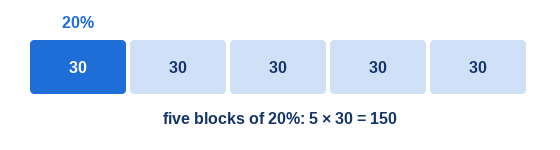
- 20% of an amount is 30. What was the amount?
- Most people answer 36. Thirty, plus 20% of thirty.
- That is wrong, and here is the way to see why.
| Step | What is happening | Value |
|---|---|---|
| 20% of an amount is 30 | the common wrong answer | 30 + 6 = 36 |
| What actually happened | × 0.2 took us to 30 | |
| So undo it | 30 ÷ 0.2 | 150 |
| Check forwards | 0.2 × 150 | 30, correct |
The same thing with a price tag
- A jacket costs $69 after a 15% rise. What was it before?
- Multiplying by 1.15 got us to 69, so divide by 1.15 to get back.
- Sixty dollars. And check it: 60 times 1.15 is 69.
| Step | What is happening | |
|---|---|---|
| A price is $69 after a 15% rise | so × 1.15 gave 69 | |
| Undo it | 69 ÷ 1.15 | $60 |
| Check forwards | 60 × 1.15 | $69, correct |
Always run it forwards afterwards
- A reversed calculation is easy to get backwards.
- So take your answer and do the original change to it.
- If you do not land on the number you started with, try again.
Turning one number into a percentage of another
- 18 out of 24. Divide the part by the whole: 0.75.
- Then multiply by a hundred. Seventy-five percent.
- The part goes on top. That is the only thing to get right.
| Question | Working | Answer |
|---|---|---|
| 18 out of 24 | 18 ÷ 24 = 0.75 | 75% |
| 7 out of 20 | 7 ÷ 20 = 0.35 | 35% |
| The rule | divide the part by the whole | then × 100 |
Why the part goes on top
- A percentage answers: how much of the whole is this?
- So the whole is what you are dividing by.
- Get it upside down and you will get an answer over 100%.
One last idea: what a ratio compares
- A class of 30: eighteen boys, twelve girls.
- Boys to girls is 18 to 12, which is 3 to 2. Part to part.
- Boys to the class is 18 to 30, which is 3 to 5. Part to whole.
| Comparison | Kind | Ratio |
|---|---|---|
| 18 boys, 12 girls | part to part | 18:12 = 3:2 |
| 18 boys in a class of 30 | part to whole | 18:30 = 3:5 |
| Same class | different question | check which is asked |
Which one a question wants is not always said
- Both of those describe the same class truthfully.
- They are different numbers because they answer different questions.
- Next lesson is entirely about working with these.
What to take away
- Six things, and the fourth one is where the marks are.
| Percent | means per hundred, so it is a fraction of 100 |
| A rise of 20% | is one multiplication by 1.2 |
| A fall of 20% | is one multiplication by 0.8 |
| To go backwards | divide by the multiplier, do not subtract |
| Always check | by running your answer forwards |
| A ratio | compares part to part, or part to whole |
Common mistakes
- 20% of an amount is 30, so the amount is 30 + 6 = 36.30 is the 20%, so 1% is 1.5 and 100% is 150; check: 20% of 150 = 30.
- After a 20% rise the price is $96, so the original was 96 × 0.8 = $76.80.The rise was × 1.2, so undo it by dividing: 96 ÷ 1.2 = $80.
- Cutting 250 by 12%: 250 × 0.12 = 30.30 is the amount lost; what is left is 88%, so multiply by 0.88: 250 × 0.88 = 220.
- A 20% rise is × 0.2.You keep all 100% and add 20%, so the multiplier is 1.2; rises are always above 1.
Your turn
- Try all eight.
Find 35% of 80.
Increase 45 by 20%.
30% of an amount is 21. What is the amount?
What percentage of 48 is 12?
Which single multiplier decreases an amount by 15%?
A $64 jacket is reduced by 25% in a sale. What is the sale price?
A netball team of 7 has 3 Year 9 players and 4 Year 10 players. What fraction of the team is Year 9?
After a 20% discount, a pair of shoes costs $96. What was the original price?
Show answer
1. 28, from 0.35 × 80. 2. 54, from 45 × 1.2. 3. 70, from 21 ÷ 0.3. Check it forwards: 0.3 × 70 is 21. If you got 27.3 you added 30% of 21 instead of undoing the multiplication. 4. 25%, from 12 ÷ 48 = 0.25. 5. × 0.85. Losing 15% leaves 85% of the amount, and 85% is 0.85. 6. $48. A 25% cut leaves 75%, and 64 × 0.75 = 48. 7. 3/7. This is part to whole: 3 of the 7 players, so 3:7, not the part-to-part 3:4. 8. $120. A 20% cut is × 0.8, so undo it: 96 ÷ 0.8 = 120. Check: 120 × 0.8 = 96.
The answers
- 0.35 × 80, then 45 × 1.2.
- Question 3 is 21 ÷ 0.3, not 21 plus 30%.
- Check forwards: 0.3 × 70 is 21.
| Answer | |
|---|---|
| 1 | 28 |
| 2 | 54 |
| 3 | 70 |
| 4 | 25% |
Challenge
Mere's café sells mince pies for $7.50 each. Her profit on each pie is 20% of the selling price. (a) How much does each pie cost her to make, and what is her profit as a percentage of that cost? (b) Her costs then go up by 10%, and she decides her profit should now be 25% of the selling price. What should the new selling price be? (c) By what percentage has the selling price gone up, to 1 decimal place?
Hint
If the profit is 20% of the price, the cost is the other 80% of the price. For (b), work out the new cost first, then ask: the cost is what percentage of the new price?
Answer
(a) Each pie costs $6.00 to make, and the $1.50 profit is 25% of the cost. (b) $8.80. (c) The price has gone up by about 17.3%.
Step by step
- Profit is 20% of the price, so the cost is 80% of the price: 0.8 × $7.50 = $6.00.
- The profit is $1.50, and $1.50 out of a cost of $6.00 is 25%: the same profit is a bigger percentage of the smaller amount.
- A 10% rise in cost is × 1.1, so the new cost is $6.60.
- If the profit is 25% of the new price, the cost is the other 75%, so the new price × 0.75 = $6.60.
- Work backwards by dividing: $6.60 ÷ 0.75 = $8.80. Check: $8.80 − $6.60 = $2.20, which is 25% of $8.80.
- The price multiplier is $8.80 ÷ $7.50 = 1.1733..., a rise of about 17.3%.
Full working
- cost = 80% of price: 0.8 × 7.50 = 6.00profit is the other 20%
- profit = 7.50 − 6.00 = 1.50price take away cost
- 1.50 ÷ 6.00 = 0.25 = 25% of the costa different whole, a different percentage
- new cost: 6.00 × 1.1 = 6.60up 10% is × 1.1
- new price × 0.75 = 6.60cost is the 75% that is not profit
- new price = 6.60 ÷ 0.75 = 8.80undo × 0.75 by dividing
- check: 8.80 − 6.60 = 2.20 and 2.20 ÷ 8.80 = 0.25profit is 25% of the price
- 8.80 ÷ 7.50 = 1.1733..., so up about 17.3%the multiplier minus 1
- (a) $6.00 and 25%, (b) $8.80, (c) about 17.3%
A sports shop puts all its prices up by 20%. Rawiri wants the old price of a rugby jersey, so he takes 20% off its new price. His answer is $5 less than the true old price. What is the new price, and what was the true old price?
Hint
Call the new price P. The true old price is P ÷ 1.2, and Rawiri's answer is P × 0.8. Write each as a fraction of P.
Answer
The new price is $150 and the true old price was $125. Rawiri got $120.
Step by step
- The rise was × 1.2, so the true old price is the new price ÷ 1.2, which is 56 of it.
- Taking 20% off is × 0.8, which is 45 of the new price.
- The gap between 56 and 45 of the price is 130 of the price.
- That gap is $5, so the new price is 30 × $5 = $150.
- Check: $125 × 1.2 = $150, and $150 × 0.8 = $120, which is $5 less than $125.
Full working
- true old price = P ÷ 1.2 = 56 of Pundo × 1.2 by dividing
- Rawiri's answer = P × 0.8 = 45 of Pthe common mistake
- 56 − 45 = 2530 − 2430 = 130the gap as a fraction of P
- 130 of P = 5, so P = 150the gap is $5
- true old price = 150 ÷ 1.2 = 125divide by the multiplier
- check: 125 × 1.2 = 150 and 150 × 0.8 = 120125 − 120 = 5
- new price $150, true old price $125
The ferry from Auckland to Waiheke Island normally takes 45 minutes. (a) A new ferry travels the same route 25% faster. By what percentage is the trip time cut, and how long does the trip now take? (b) The company wants a ferry that cuts the old 45-minute trip time by 40%. By what percentage must the speed of the old ferry go up? (c) Mere says that going 100% faster would cut the trip time by 100%. What would it really do?
Hint
The distance stays the same, so speed × time stays the same. If the speed is multiplied by 1.25, the time must be multiplied by 1 ÷ 1.25.
Answer
(a) The time is cut by 20%, to 36 minutes. (b) The speed must go up by 66⅔%. (c) Going 100% faster doubles the speed, which halves the time: a 50% cut, to 22.5 minutes, not 100%.
Step by step
- For a fixed distance, speed × time is always the same, so if one is multiplied by a number, the other is divided by it.
- 25% faster is speed × 1.25, so the time is × 1 ÷ 1.25 = × 0.8. That is a 20% cut, and 45 × 0.8 = 36 minutes.
- Cutting the time by 40% is time × 0.6, which is 27 minutes.
- So the speed must be × 1 ÷ 0.6 = × 53 = × 1.666..., a rise of 66⅔%.
- Check: 45 ÷ 27 = 53, so the new ferry is 53 as fast as the old one.
- 100% faster is × 2, so the time is × 12: a 50% cut. A 100% cut would mean a trip taking no time at all, which no speed can give.
Full working
- speed × time = distance, which stays the sameso the multipliers undo each other
- 25% faster: speed × 1.25up 25%
- time × 1 ÷ 1.25 = time × 0.8a 20% cut
- 45 × 0.8 = 36 minutesthe new trip
- 40% cut: time × 0.6, so 45 × 0.6 = 27 minutesdown 40% leaves 60%
- speed × 1 ÷ 0.6 = × 53 = × 1.666...up 66⅔%
- check: 45 ÷ 27 = 53old time over new time
- 100% faster: speed × 2, so time × 12a 50% cut, 22.5 minutes
- (a) 20% cut, 36 minutes, (b) up 66⅔%, (c) a 50% cut, not 100%
Where science uses this
Practise this
Report a mistake
More in Number
 Scientific notation, and three names for one number8 min
 Powers of two, unit fractions, and roots on the line7 min
 Order of operations, integers, and a sensible estimate8 min
 Reciprocals, and why decimal rules are fraction rules7 minPercentages as multipliers, and working backwards7 min
 Ratios you can scale, and rates that carry units7 min
 Mark-ups, discounts, GST and interest7 min