
The planets in order, dwarf planets and how we explore space
What this lesson covers
- The eight planets in order from the Sun, in their three groups
- What a dwarf planet is, and why Pluto was moved into that group
- How distance from the Sun controls the sunlight a planet receives
- How ideas about space changed as tools improved and scientists came to agree
- How analysing light reveals what distant surfaces and atmospheres are made of
- What landers and sample missions add that telescopes cannot
- The strengths and limits of the models we use for the Solar System
The planets in order
- Part 2 sorted the planets by what they are made of inside. Here is the order they come in, going outwards from the Sun.
- First come the four rocky planets: Mercury, Venus, Earth and Mars.
- After the asteroid belt come the two gas giants, Jupiter and Saturn, and then the two ice giants, Uranus and Neptune.
- One way to remember the order is the sentence My Very Easy Method Just Speeds Up Naming, where each first letter is a planet.
- The gaps grow quickly: the four rocky planets fit inside 1.5 AU, while Neptune is 30 AU out.
| Order | Planet | Group | Moons (known) |
|---|---|---|---|
| 1 | Mercury | Rocky | 0 |
| 2 | Venus | Rocky | 0 |
| 3 | Earth | Rocky | 1 |
| 4 | Mars | Rocky | 2 |
| 5 | Jupiter | Gas giant | about 95 |
| 6 | Saturn | Gas giant | well over 100 |
| 7 | Uranus | Ice giant | about 28 |
| 8 | Neptune | Ice giant | about 16 |
Dwarf planets
- A dwarf planet orbits the Sun and has enough gravity to pull itself into a roughly round shape, but not enough to clear its orbit of other objects.
- Pluto was called the ninth planet from its discovery in 1930, but it shares its region beyond Neptune with thousands of other icy bodies.
- In 2005 astronomers found Eris, an icy world about the same size as Pluto and slightly more massive, which forced a decision: either both were planets, or neither was.
- In 2006 the International Astronomical Union agreed the definition of a planet, and Pluto, Eris and Ceres became dwarf planets.
- Five dwarf planets are officially recognised: Ceres, Pluto, Eris, Haumea and Makemake, and more candidates are being studied.
| Object | Orbits the Sun? | Round? | Cleared its orbit? | Group |
|---|---|---|---|---|
| Earth | Yes | Yes | Yes | Planet |
| Pluto | Yes | Yes | No | Dwarf planet |
| Ceres | Yes | Yes | No | Dwarf planet |
| Vesta | Yes | No, slightly lumpy | No | Asteroid |
| Charon | No, it orbits Pluto | Yes | Not relevant | Moon |
Further out, weaker sunlight
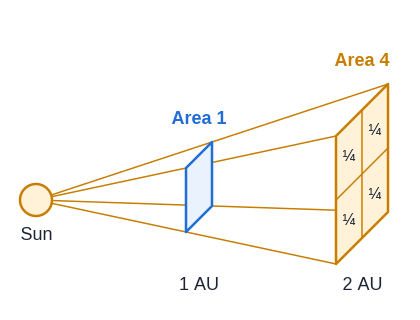
- Sunlight spreads out in every direction, so the further it travels, the larger the area the same energy is shared over.
- Double the distance and the light covers four times the area, so each square metre gets a quarter as much. This is called an inverse square pattern.
- Just above its atmosphere Earth receives about 1,360 watts of solar energy on each square metre facing the Sun.
- Less sunlight generally means a colder planet, which is why Neptune's cloud tops sit near −200 °C.
- Distance is not the only factor for temperature: Venus is further out than Mercury but hotter, about 465 °C, because its thick carbon dioxide atmosphere traps heat.
Try it: weaker sunlight further out
How much sunlight reaches Mars and Jupiter?
- Mars is 1.52 AU from the Sun and Jupiter is 5.2 AU. Compared with Earth at 1 AU, what fraction of Earth's sunlight does each receive?
- Use fraction = 1 ÷ (distance in AU)².
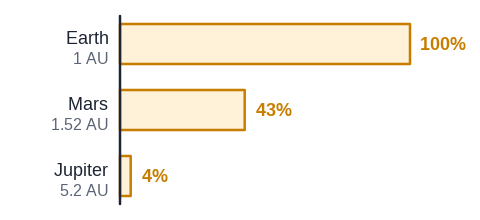
- Mars: 1.52² = 2.31square the distance
- 1 ÷ 2.31 = 0.43inverse square
- Mars gets about 43% of Earth's sunlight, roughly 590 W per m²
- Jupiter: 5.2² = 27square the distance
- 1 ÷ 27 = 0.037inverse square
- Jupiter gets about 4% of Earth's sunlight, about 1/27
- Mercury at 0.39 AU: 1 ÷ 0.152 = 6.6 times Earth'scloser than 1 AU gives more than Earth
How the picture changed
- For about 1,400 years most European and Middle Eastern astronomers used a model with Earth fixed at the centre and everything circling it.
- In 1543 Copernicus published a model with the Sun at the centre, but it did not win agreement straight away because there was little direct evidence for it.
- Telescope observations by Galileo from 1610, such as the full set of phases of Venus, could only be explained if Venus orbits the Sun.
- Kepler showed that orbits are ellipses, slightly stretched circles, and his model predicted planet positions far better than any before.
- Agreement among scientists, called consensus, built up over decades as evidence from many observers pointed the same way. That is how science usually changes.
Reading a world from its light
- Light and other electromagnetic radiation, such as infrared and radio waves, carry information about whatever gave them out or reflected them.
- Splitting light into a spectrum shows dark or bright lines at particular colours, and each element produces its own set, like a barcode.
- In 1868 a new set of lines in the Sun's spectrum revealed an unknown element, named helium after the Greek word for Sun, years before helium was found on Earth.
- Infrared cameras measure how warm a surface is, and radio waves bounced off Venus let the Magellan probe map its whole surface through clouds that light cannot pass.
- Using these methods, scientists have found methane on Titan, water ice in craters on the Moon and carbon dioxide in the air of Mars without ever touching them.
Flybys, orbiters, landers and samples
- Flyby probes pass a world once and photograph it; Voyager 2, launched in 1977, is still the only spacecraft to have visited Uranus and Neptune.
- Orbiters circle a world for years, mapping the whole surface and watching it change.
- Landers and rovers touch down and show detail no telescope can, such as individual pebbles, layered rocks once laid down by water on Mars, and the soil's chemistry.
- Sample return missions bring material home, where laboratories with equipment far too big to launch can study it.
- Human-crewed missions are rare and costly, but the six Apollo landings brought back about 382 kg of Moon rock that scientists still study today.
| Mission | Year | Type | What it showed |
|---|---|---|---|
| Apollo 11 to 17 | 1969 to 1972 | crewed landings | Moon rocks up to about 4.5 billion years old |
| Venera 13 | 1982 | lander (Venus) | colour photos of a rocky surface hot enough to melt lead |
| Huygens | 2005 | lander (Titan) | rounded pebbles of ice, likely worn smooth by flowing liquid |
| Hayabusa2 | 2020 | sample return (asteroid Ryugu) | rock containing water-bearing minerals and carbon compounds |
| Perseverance | 2021 on | rover (Mars) | an old river delta; rock cores sealed for a future trip home |
Every model gets something wrong
- A model is a simpler version of something real, used to explain or predict it, and no model of the Solar System can show everything at once.
- The trick is to know what each model is good for and where it misleads, so you use the right one for the question.
- A model is useful when it explains what we observe and lets us predict something new, even if parts of it are deliberately unrealistic.
| Model | Strength | Limitation |
|---|---|---|
| Textbook diagram | shows the order and groups at a glance | sizes and gaps are not to scale; planets shown in a straight line |
| Orrery (geared desk model) | shows the planets moving at different speeds | orbits are perfect circles and distances are squashed |
| Scale model on a field | shows the true emptiness between planets | planets too small to see, and nothing moves |
| Computer simulation | can show true scale, motion and time sped up | only as good as the data and rules put into it |
Judging a poster model
- A poster shows the Sun as a half circle on the left, then the eight planets in a straight row, evenly spaced, with Jupiter about half the width of the Sun.
- A student uses it to say that Mars is about halfway between the Sun and Neptune. Check the claim and the poster.
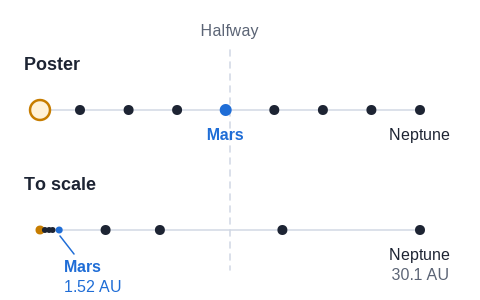
- Order: Mercury to Neptune left to rightcorrect, so the poster is good for learning the order
- Mars is 1.52 AU, Neptune is 30.1 AUfrom the distance table in part 2
- 1.52 ÷ 30.1 = 0.05Mars is only 5% of the way out
- Halfway claim rejectedeven spacing hides how far apart the outer planets are
- Sun 1,392,000 km ÷ Jupiter 143,000 km ≈ 10the Sun is about 10 times Jupiter's width, not 2
- Use the poster for order and groups only, not for distances or sizes
Common mistakes
- Pluto stopped being a planet because it is too small.Pluto is round and orbits the Sun, but it has not cleared its orbit of other icy bodies, which is the test it fails.
- At twice the distance from the Sun, a planet gets half the sunlight.It gets a quarter, because the same light spreads over four times the area; always square the distance before dividing.
- Mercury is closest to the Sun, so it must be the hottest planet.Venus is hotter, about 465 °C, because its thick carbon dioxide atmosphere traps heat, so distance is not the only factor.
- Scientists switched to a Sun-centred model as soon as Copernicus published it in 1543.Agreement took decades, building up as telescope evidence such as the phases of Venus and Kepler's accurate predictions piled up.
See the inverse square pattern with a phone torch
You need: a phone with a torch, a piece of thin card, such as a cereal box, scissors, a ruler, a sheet of white paper, a pile of books, a pencil
- Fold the card in half and cut a rectangle 2 cm long and 1 cm deep out of the middle of the fold, so that, opened out, it has a 2 cm by 2 cm square hole.
- In a dark room, stand the phone on its edge against the books with the torch shining sideways along the table, and prop the card upright 10 cm in front of the torch so the light shines through the hole.
- Hold the white paper upright 20 cm from the torch, trace the square patch of light and measure its width.
- Move the paper to 30 cm from the torch and trace and measure the patch again.
- Look for: at twice the distance the patch is about 4 cm wide, four times the area of the hole, and at three times the distance about 6 cm wide, nine times the area, and it looks dimmer each time because the same light is spread more thinly, just as sunlight is at Mars or Jupiter.
Safety: Keep the phone torch pointed away from everyone's eyes, since it is uncomfortably bright this close, and cut the hole by snipping at the fold rather than stabbing the scissors through the card.
Your turn
List the planets in order from the Sun and mark which are rocky, gas giants and ice giants.
Eris is round, orbits the Sun and lies among many other icy bodies beyond Neptune. Why is it not a planet?
Saturn is about 9.5 AU from the Sun. Roughly what fraction of Earth's sunlight does it receive?
A telescope cannot touch Mars, yet scientists know its air is mostly carbon dioxide. How?
Give one thing an orrery shows well and one thing it gets wrong.
Venus is further from the Sun than Mercury, yet Venus is the hotter planet. Why?
Which telescope observation by Galileo could only be explained if Venus orbits the Sun?
Earth gets about 1,360 W per m² of sunlight. How much does a spacecraft at 2 AU from the Sun receive?
Show answer
1. Mercury, Venus, Earth, Mars (rocky); Jupiter, Saturn (gas giants); Uranus, Neptune (ice giants). 2. It has not cleared its orbit of other objects, so it is a dwarf planet. 3. 9.5² = 90, so about 1/90, roughly 1%. 4. By analysing the light that passes through or reflects off its atmosphere: carbon dioxide absorbs particular colours, and those gaps show up in the spectrum. Landers have since confirmed it. 5. It shows planets moving at different speeds, with the outer ones slower. It gets the distances and sizes badly wrong and makes orbits perfect circles. 6. Its thick carbon dioxide atmosphere traps heat, so its surface reaches about 465 °C; distance is not the only factor. 7. Venus shows a full set of phases, like the Moon, which only works if it goes around the Sun. 8. About 340 W per m²: double the distance spreads the light over four times the area, so 1,360 ÷ 4 = 340.
My Solar System
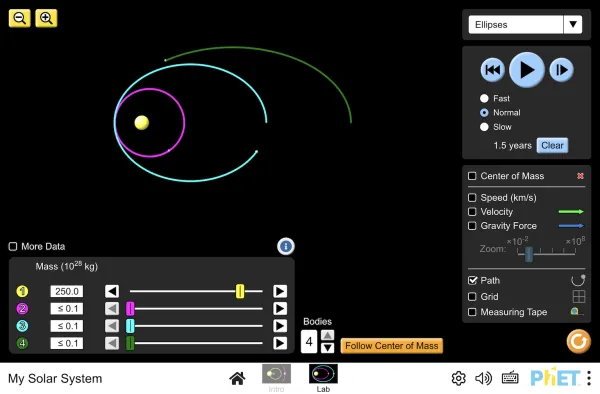
Full screen · PhET Interactive Simulations, University of Colorado Boulder, CC BY 4.0
What to take away
- In order: Mercury, Venus, Earth, Mars (rocky), Jupiter, Saturn (gas giants), Uranus, Neptune (ice giants).
- A dwarf planet is round and orbits the Sun but has not cleared its path; Pluto joined Ceres and Eris in that group in 2006.
- Sunlight falls with the square of distance, so at 2 AU a planet gets a quarter of Earth's share; atmospheres can still change the temperature.
- Our picture of space shifted from an Earth-centred model to a Sun-centred one as better tools produced evidence that convinced scientists.
- Analysing light tells us what distant worlds are made of, and landers and returned samples show detail no telescope can.
- Every model has strengths and limitations, so match the model to the question you are asking.
Challenge
An engineer designs a solar-powered probe whose panels give 15,000 W (15 kW) in sunlight at Earth's distance, 1 AU. The probe's instruments and radio need at least 600 W to work. (a) How much power would the panels give at Mars, 1.52 AU? (b) What is the furthest distance from the Sun, in AU, at which the probe still gets 600 W? (c) Could it work at Jupiter, 5.2 AU? (d) Could it work at Saturn, 9.5 AU? Explain why probes sent to Saturn and beyond have usually carried a power source that does not need sunlight.
Hint
Power falls as 1 ÷ (distance in AU)². For part (b), work backwards: by what factor may the power drop, and what distance squared gives that factor?
Answer
(a) About 6,500 W. (b) 5 AU. (c) No, only about 555 W, just short of 600 W. (d) No, only about 166 W. Sunlight beyond Jupiter is too weak for panels of a sensible size, so outer-planet probes need another power source.
Step by step
- Divide the power at Earth by the distance squared to get the power further out.
- To find the limit, ask how many times smaller 600 W is than 15,000 W.
- That factor must equal the distance squared, so the distance is its square root.
- Jupiter is just beyond the 5 AU limit, so the probe falls short there, and much further short at Saturn.
- Bigger panels would help, but at Saturn they would need to be about 3.6 times bigger and the power would keep falling further out.
Full working
- Mars: 15,000 ÷ 1.52² = 15,000 ÷ 2.31 = 6,490 Winverse square
- limit factor = 15,000 ÷ 600 = 25allowed drop
- distance² = 25, distance = √25 = 5 AUwork backwards
- Jupiter: 15,000 ÷ 5.2² = 15,000 ÷ 27.04 = 555 Wbelow 600 W
- Saturn: 15,000 ÷ 9.5² = 15,000 ÷ 90.25 = 166 Wfar below 600 W
- 600 ÷ 166 = 3.6 times the panel area neededat Saturn
- about 6,500 W at Mars; works out to 5 AU; fails at Jupiter (555 W) and Saturn (166 W)
Each element absorbs light at its own set of wavelengths, measured in nanometres (nm). Reference lines: hydrogen 410.2, 434.0, 486.1, 656.3; helium 447.1, 501.6, 587.6, 667.8; sodium 589.0, 589.6; calcium 393.4, 396.8. (a) A star's spectrum shows dark lines at 393.4, 396.8, 410.2, 434.0, 486.1, 589.0, 589.6 and 656.3 nm. Which elements does the star's outer layer contain? (b) A student with a cheap spectroscope that can only read to the nearest 5 nm says the star has helium as well. Why might she think so, and why is she wrong? (c) In 1869, during an eclipse, astronomers saw a bright green line at 530.3 nm in the Sun's corona that matched no known element, and named the cause coronium. Seventy years later it was shown to come from iron, made extremely hot. What does this tell you about claiming a new element from one unmatched line?
Hint
An element is like a barcode: it shows its whole set of lines, not just one. Check every line of each element, not just the first match you find.
Answer
(a) Calcium, hydrogen and sodium. (b) At the nearest 5 nm, sodium's lines near 589 look the same as helium's 587.6 line, but helium would also show lines at 447.1, 501.6 and 667.8, which are missing, so there is no evidence for helium. (c) An unmatched line may come from a known element in conditions not tested on Earth, so a claim of a new element needs more evidence; helium in 1868 turned out right, but coronium turned out wrong.
Step by step
- Tick off each observed line against the reference sets.
- Calcium's two lines, hydrogen's four lines and sodium's two lines are all there, and every observed line is used up.
- At low precision, 587.6, 589.0 and 589.6 all round to about 590, so one line can seem to match two elements.
- An element must show its whole pattern; helium's other three lines are absent, so helium is not shown.
- Matching depends on the reference table being complete for every condition, and a very hot gas can give lines that cooler lab samples do not.
Full working
- 393.4, 396.8 presentcalcium, both lines
- 410.2, 434.0, 486.1, 656.3 presenthydrogen, all four lines
- 589.0, 589.6 presentsodium, both lines
- 447.1, 501.6, 587.6, 667.8 not presentno helium
- 587.6 and 589.0 both round to 590 at 5 nm precisionwhy the student was fooled
- coronium line 530.3 nm later matched very hot ironone line is not proof of a new element
- calcium, hydrogen and sodium; no helium; an unmatched line needs more evidence
Through his telescope from 1610, Galileo saw Venus go through a full set of phases, and saw it look much bigger when it was a thin crescent than when it was nearly full. Venus orbits the Sun at 0.72 AU and Earth at 1 AU; treat both orbits as circles. (a) What are the closest and furthest that Venus can be from Earth? (b) An object twice as far away looks half as wide. How many times wider does Venus look at its closest than at its furthest? (c) Explain why Venus is a thin crescent when near its closest and nearly full when near its furthest. (d) In the Earth-centred model, Venus always stayed between Earth and the Sun. Explain why that model could never show a nearly full Venus.
Hint
Draw the Sun, Earth's orbit and Venus's orbit. Mark Venus when it is between Earth and the Sun, and when it is on the far side of the Sun. Which side of Venus is lit in each case, and which side faces us?
Answer
(a) Closest 0.28 AU, furthest 1.72 AU. (b) About 6 times wider (1.72 ÷ 0.28 ≈ 6.1). (c) When closest, Venus is between Earth and the Sun, so its lit side faces mostly away from us and we see a thin crescent; when furthest, it is beyond the Sun, so its lit side faces us and it looks nearly full, but small. (d) If Venus were always between Earth and the Sun, its sunlit half would always face mostly away from us, so we would only ever see crescents or a dark Venus, never nearly full. Only a Venus that orbits the Sun can go round to the far side.
Step by step
- Closest is when Venus and Earth are lined up on the same side of the Sun: subtract the orbit sizes. Furthest is on opposite sides: add them.
- Apparent width shrinks in step with distance, so the width ratio is the distance ratio turned upside down.
- The half of Venus facing the Sun is always lit; what we see depends on how much of that lit half faces Earth.
- Big and thin crescent go together, small and nearly full go together, exactly as Galileo saw.
- A model that keeps Venus between Earth and the Sun cannot produce that pairing, which counted as evidence for the Sun-centred model.
Full working
- closest = 1 − 0.72 = 0.28 AUsame side of the Sun
- furthest = 1 + 0.72 = 1.72 AUfar side of the Sun
- width ratio = 1.72 ÷ 0.28 = 6.1width goes down as distance goes up
- closest: lit side faces awaythin crescent, large
- furthest: lit side faces Earthnearly full, small
- Earth-centred: Venus never beyond the Sunnever nearly full
- 0.28 AU to 1.72 AU; about 6 times wider at closest; full phases need Venus to orbit the Sun