
Reciprocals, and why decimal rules are fraction rules
What this lesson covers
- Every non-zero number has a multiplicative inverse (reciprocal), and their product is 1 (e.g. 5 and 1/5 are reciprocals, so 5 × 1/5 = 1/5 × 5 = 1).
Two topics that are secretly one topic
- You were taught fraction arithmetic and decimal arithmetic separately.
- They are the same arithmetic. Every decimal is a fraction.
- Which means the decimal rules you half-remember have reasons.
The number that cancels another one out
- Every number except zero has a partner called its reciprocal.
- Multiply the two together and you always get exactly 1.
- Five and a fifth. Two thirds and three halves.
| Number | Reciprocal | Product |
|---|---|---|
| 5 | 1/5 | 5 × 1/5 = 1 |
| 2/3 | 3/2 | 6/6 = 1 |
| 1/4 | 4 | 4/4 = 1 |
| 7/8 | 8/7 | 56/56 = 1 |
| 0 | none | nothing times 0 gives 1 |
Except zero, and it is worth knowing why
- What would you multiply zero by to get 1?
- Nothing works. Zero times anything is zero.
- That is the same reason you cannot divide by zero.
So that is why flipping works
- Last lesson: dividing by 2/3 gave the same answer as times 3/2.
- Dividing by a number undoes multiplying by it.
- The reciprocal is the thing that undoes it, because together they make 1.
Try it: how many halves fit?
Adding: make the pieces the same size
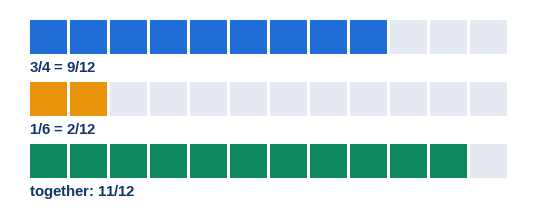
- Three quarters plus one sixth. Quarters and sixths do not line up.
- Rewrite both in twelfths: nine twelfths and two twelfths.
- Now they are the same kind of thing, so just add the tops.
| Step | Why | |
|---|---|---|
| 3/4 + 1/6 | quarters and sixths differ | |
| 9/12 + 2/12 | both in twelfths now | |
| 11/12 | add the tops, keep the bottom |
Try it: make the pieces match
Subtracting: exactly the same move
- Two thirds minus a quarter. Twelfths again.
- Eight twelfths minus three twelfths.
- Five twelfths. Nothing new to learn here.
| Step | Why | |
|---|---|---|
| 2/3 − 1/4 | thirds and quarters | |
| 8/12 − 3/12 | both in twelfths | |
| 5/12 | subtract the tops |
Multiplying needs no lining up at all
- This is the one people overcomplicate, having just done adding.
- Two fifths times three sevenths. No common denominator needed.
- Straight across the top, straight across the bottom.
| Step | What happens | |
|---|---|---|
| 2/5 × 3/7 | no lining up needed | |
| 2 × 3 = 6 | across the top | |
| 5 × 7 = 35 | across the bottom | |
| 6/35 | done |
Dividing: flip the second one
- Three quarters divided by two fifths.
- Flip the second fraction and multiply instead.
- Fifteen eighths, which is one and seven eighths.
| Step | What happens | |
|---|---|---|
| 3/4 ÷ 2/5 | how many two-fifths fit? | |
| 3/4 × 5/2 | multiply by the reciprocal | |
| 15/8 | across the top, across the bottom | |
| 1 7/8 | as a mixed number |
Now decimals, which are already fractions
- Nought point three is three tenths. Written differently, same number.
- Nought point one five is fifteen hundredths.
- So every decimal calculation is a fraction calculation.
| Decimal | As a fraction | Reading |
|---|---|---|
| 0.3 | 3/10 | tenths |
| 0.15 | 15/100 | hundredths |
| 0.045 | 45/1000 | thousandths |
Where the count-the-places rule comes from
- Nought point three times nought point one five.
- As fractions: three tenths times fifteen hundredths.
- Tenths times hundredths is thousandths. Hence three places.
| Line | What it is | |
|---|---|---|
| 0.3 × 0.15 | the decimal version | |
| 3/10 × 15/100 | the same thing as fractions | |
| 45/1000 | tenths × hundredths = thousandths | |
| 0.045 | 1 place plus 2 places makes 3 |
And why you can move both decimal points
- Nought point eight divided by nought point two.
- Eight tenths divided by two tenths. The tenths cancel.
- Eight divided by two is four. That is the whole trick.
| Line | What it is | |
|---|---|---|
| 0.8 ÷ 0.2 | the decimal version | |
| 8/10 ÷ 2/10 | the same thing as fractions | |
| 8 ÷ 2 | the tenths cancel | |
| 4 | so moving both points works |
Last thing: which of these are the same number?
- Four pairs of expressions, all with minus signs in them.
- Three pairs are equal. One pair is not.
- Work out which before the answer comes up.
Three equal, one not
- Order does not matter for adding or multiplying. Those are fine.
- A minus sign on top or in front of a fraction is the same place.
- But minus three squared depends entirely on the brackets.
| Pair | Values | Verdict |
|---|---|---|
| (−3)² and −3² | 9 and −9 | NOT equal |
| −2 + 3 and 3 + (−2) | 1 and 1 | equal |
| 2 × (−3) and (−2) × 3 | −6 and −6 | equal |
| 2/(−3) and (−2)/3 | −2/3 and −2/3 | equal |
What to take away
- Seven things, and the sixth one is the big idea.
| Reciprocal | the number that multiplies with it to give 1 |
| Zero | is the one number without one |
| Adding fractions | needs a common denominator first |
| Multiplying | does not. Straight across |
| Dividing | is multiplying by the reciprocal |
| Decimal rules | are fraction rules underneath |
| (−3)² and −3² | are different numbers |
Common mistakes
- 3/4 + 1/6 = 4/10Make the pieces the same size first: 9/12 + 2/12 = 11/12.
- 3/4 ÷ 2/5 = 6/20Multiply by the reciprocal of the second fraction: 3/4 × 5/2 = 15/8 = 1 7/8.
- 0.3 × 0.15 = 0.450.3 × 0.15 = 3/10 × 15/100 = 45/1000 = 0.045, three decimal places.
- (−3)² and −3² are both 9.(−3)² = 9, but in −3² only the 3 is squared, so −3² = −9; they are not equivalent.
Your turn
- Try all eight.
What is the reciprocal of 3/8, and what do they multiply to?
Work out 3/4 ÷ 2/5.
Work out 0.4 × 0.07 without a calculator.
True or false: (−5)² = −5².
Work out 5/6 − 1/4.
Which expression has the same value as 4 × (−3)?
Work out 4/9 × 3/8 and give it in simplest form.
Work out 0.6 ÷ 0.03 without a calculator.
Show answer
1. 8/3, and they multiply to 1. That is what makes it the reciprocal. 2. 15/8, or 1 7/8. Flip the second fraction and multiply. 3. 0.028. Tenths times hundredths gives thousandths, so three decimal places, and 4 × 7 = 28. 4. False. (−5)² is 25 and −5² is −25. The brackets decide what gets squared. 5. 7/12. In twelfths it is 10/12 − 3/12, which leaves 7/12. 6. (−4) × 3. Both have one negative sign, so both are −12; order and which number carries the minus do not change a product. 7. 1/6. Across the top 4 × 3 = 12, across the bottom 9 × 8 = 72, and 12/72 simplifies to 1/6. 8. 20. As fractions it is 60/100 ÷ 3/100, the hundredths cancel, and 60 ÷ 3 = 20.
The answers
- Flip it, and the pair multiplies to one.
- Tenths times hundredths is thousandths.
- Minus five squared is 25 or −25, by brackets.
| Answer | |
|---|---|
| 1 | 8/3, and they make 1 |
| 2 | 15/8, or 1 7/8 |
| 3 | 0.028 |
| 4 | False |
Challenge
Kiri and Mere start with the same number. Kiri multiplies it by 0.25. Mere divides it by 0.25. Mere's answer is 45 more than Kiri's. What number did they start with?
Hint
0.25 is a fraction you know well. Dividing by it is the same as multiplying by its reciprocal.
Answer
12
Step by step
- 0.25 is 14, so Kiri finds a quarter of the number.
- The reciprocal of 14 is 4, so dividing by 0.25 is multiplying by 4. Mere finds four times the number.
- Four times the number minus a quarter of it is 3 34 times the number, or 154 of it.
- 154 of the number is 45, so 14 of it is 3, and the number is 12.
- Check: Kiri gets 3, Mere gets 48, and 48 − 3 = 45.
Full working
- 0.25 = 14the decimal as a fraction
- ÷ 14 = × 4multiply by the reciprocal
- 4 − 14 = 154Mere's multiplier minus Kiri's
- 45 ÷ 15 = 3one quarter of the number
- 3 × 4 = 12the whole number
- 12 × 0.25 = 3 and 12 ÷ 0.25 = 48check: 48 − 3 = 45
- 12
Aroha thinks of a positive number, adds it to its reciprocal, and gets 2 16. (a) Show that her number could be 23. (b) Without any new trial and error, find a different number that also gives 2 16, and explain why it must work. (c) Aroha adds that her number is bigger than 1. What is her number, and what is her number multiplied by its reciprocal?
Hint
For (b), think about what the reciprocal of 23 would have as its own reciprocal. Adding two numbers in the other order gives the same total.
Answer
(a) 23 + 32 = 46 + 96 = 136 = 2 16. (b) 32, because its reciprocal is 23, so the sum is 32 + 23, the same two numbers. (c) Her number is 32 (or 1 12), and 32 × 23 = 1.
Step by step
- The reciprocal of 23 is 32, so the sum is 23 + 32.
- Over a common bottom of 6 this is 46 + 96 = 136, which is 2 16. So 23 works.
- Now try the reciprocal of 23, which is 32. Its own reciprocal is 23, because flipping twice gets you back where you started.
- So 32 plus its reciprocal is 32 + 23: the same two numbers added in the other order, so the total is 2 16 again.
- 23 is less than 1 and 32 is more than 1, so Aroha's number is 32. Any number times its reciprocal is 1.
Full working
- reciprocal of 23 = 32flip the fraction
- 23 + 32 = 46 + 96 = 136common bottom of 6
- 136 = 2 16so 23 works
- reciprocal of 32 = 23flipping twice gets back to the start
- 32 + 23 = 23 + 32 = 2 16same two numbers, other order
- 32 > 1so Aroha's number is 32
- 32 × 23 = 66 = 1a number times its reciprocal
- (a) 136 = 2 16; (b) 32; (c) 32, and the product is 1
Find every pair of different whole numbers a and b, with a smaller than b, so that 1a + 1b = 16.
Hint
Each fraction must be smaller than 16, so a is more than 6. Also the smaller number's fraction is the bigger one, so 1a is more than half of 16. That traps a between two values. Test each one.
Answer
Four pairs: (7, 42), (8, 24), (9, 18) and (10, 15).
Step by step
- Both fractions are positive and add to 16, so each is less than 16. That means a is more than 6.
- Since a is smaller than b, 1a is the bigger fraction, so it is more than half of 16, which is 112. That means a is less than 12.
- So a can only be 7, 8, 9, 10 or 11. For each, work out 16 − 1a and see if it is a unit fraction.
- a = 7, 8, 9 and 10 give 142, 124, 118 and 115, all unit fractions.
- a = 11 gives 566, which is not a unit fraction, so it fails.
Full working
- 1a < 16, so a > 6each part is less than the total
- 1a > 112, so a < 12the bigger fraction is more than half of 16
- 16 − 17 = 742 − 642 = 142a = 7 works, b = 42
- 16 − 18 = 424 − 324 = 124a = 8 works, b = 24
- 16 − 19 = 318 − 218 = 118a = 9 works, b = 18
- 16 − 110 = 530 − 330 = 230 = 115a = 10 works, b = 15
- 16 − 111 = 1166 − 666 = 566not a unit fraction, so a = 11 fails
- (7, 42), (8, 24), (9, 18), (10, 15)
Report a mistake
More in Number
 Scientific notation, and three names for one number8 min
 Powers of two, unit fractions, and roots on the line7 min
 Order of operations, integers, and a sensible estimate8 minReciprocals, and why decimal rules are fraction rules7 min
 Percentages as multipliers, and working backwards7 min
 Ratios you can scale, and rates that carry units7 min
 Mark-ups, discounts, GST and interest7 min