
Order of operations, integers, and a sensible estimate
What this lesson covers
- Rounding and estimation support efficiently predicting results and checking the reasonableness of calculations.
- The order of operations is important when evaluating or forming expressions. Operations are done as follows: grouped operations (e.g. expressions under a square root, involving the numerator of a fraction, or inside brackets) exponents or powers multiplication and division, from left to right addition and subtraction, from left to right.
- A mnemonic can be used to remember the order of operations, such as GEMA: Grouped (e.g. √(3²+ 4²)), Exponents (e.g. (−2)³), Multiplicative (× and ÷), Additive (+ and −).
Two questions, every single time
- What does this expression actually mean?
- And roughly what should the answer come out as?
- Get both and a slip has nowhere to hide.
The same expression, two answers
- Three plus four times two. Work left to right and you get 14.
- Do the multiply first and you get 11.
- Both are reasonable readings. That is the problem.
| Expression | Read as | Gives |
|---|---|---|
| 3 + 4 × 2 | left to right | 7 × 2 = 14 |
| 3 + 4 × 2 | multiply first | 3 + 8 = 11 |
| Which one? | the convention decides | 11 |
So there is a convention: GEMA
- Four tiers, done strictly in this order.
- Grouped, exponents, multiplicative, additive.
- It is not a law of maths. It is an agreement about reading.
| Tier | What counts | |
|---|---|---|
| G | Grouped | brackets, roots, fraction tops |
| E | Exponents | powers and roots |
| M | Multiplicative | × and ÷, left to right |
| A | Additive | + and −, left to right |
Grouped means more than brackets
- Brackets, obviously. But also anything under a square root.
- And the whole top of a fraction, even with no brackets drawn.
- A fraction bar is a grouping symbol. It is easy to miss.
| Expression | What is grouped | Value |
|---|---|---|
| (8 − 6) | brackets | the obvious one |
| √(3² + 4²) | under the root | √25 = 5 |
| (7 + 5)/3 | the top of a fraction | 12/3 = 4 |
Minus two squared is not what you think
- Minus two, in brackets, squared, is positive four.
- Minus two squared, with no brackets, is negative four.
- The question is what the power is attached to.
| Written | Where the minus is | Value |
|---|---|---|
| (−2)² | the minus is inside | (−2) × (−2) = 4 |
| −2² | the minus is outside | the negative of 2² = −4 |
Multiplication does not beat division
- BEDMAS puts the D before the M and people read that as an order.
- It is not. They share a tier, and you work left to right.
- 20 ÷ 5 × 2 is 8. It is not 2.
| Expression | Working | Gives |
|---|---|---|
| 20 ÷ 5 × 2 | divide first, it is on the left | 4 × 2 = 8 |
| 20 ÷ 5 × 2 | the wrong way | 20 ÷ 10 = 2 |
| 10 − 4 + 3 | subtract first, it is on the left | 6 + 3 = 9 |
| 10 − 4 + 3 | the wrong way | 10 − 7 = 3 |
And addition does not beat subtraction
- Same tier, same rule. Left to right.
- 10 − 4 + 3 is 9, because the subtraction is on the left.
- Doing the addition first gives 3, and that is the classic error.
All four tiers in one expression
- Two plus three times, bracket, eight minus six, squared.
- Bracket first, then the power, then the multiply, then the add.
- One tier at a time and it never gets complicated.
| Line | Step | |
|---|---|---|
| 2 + 3 × (8 − 6)² | start | |
| 2 + 3 × 2² | G: the bracket | |
| 2 + 3 × 4 | E: the power | |
| 2 + 12 | M: the multiply | |
| 14 | A: the add |
Try it: all four tiers
Two exponents worth knowing on sight
- Anything to the power of one is just itself.
- Anything to the power of zero is one.
- Not zero. One. The pattern of dividing by the base gets you there.
| Written | Meaning | Value |
|---|---|---|
| 5¹ | one 5 | 5 |
| 5⁰ | no 5s at all | 1 |
| Any a | a⁰ = 1 and a¹ = a | as long as a is not 0 |
Negative numbers, all four operations
- Adding and subtracting: move up or down the line from where you are.
- Multiplying and dividing: count the negative signs.
- One negative gives a negative. Two cancel out.
| Calculation | Reading | Answer |
|---|---|---|
| −3 + 7 | up seven from minus three | 4 |
| −3 − 7 | down seven from minus three | −10 |
| −3 × 7 | one negative | −21 |
| −3 × −7 | two negatives | 21 |
| −21 ÷ 7 | one negative | −3 |
| −21 ÷ −7 | two negatives | 3 |
Why subtracting feels harder than it is
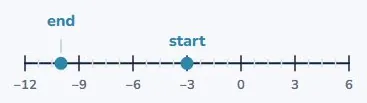
- Minus three, take away seven. Start at minus three.
- Go down seven. You land on minus ten.
- Every one of these is a walk along the line.
Try it: integers on the line
How many halves fit in six?
- That question is what six divided by a half is asking.
- Twelve. And notice the answer got bigger than what we started with.
- Do three of these and the shortcut becomes obvious.
| Calculation | The question it asks | Answer |
|---|---|---|
| 6 ÷ 1/2 | how many halves fit in 6? | 12 |
| 6 ÷ 1/3 | how many thirds fit in 6? | 18 |
| 6 ÷ 2/3 | how many two-thirds fit in 6? | 9 |
| 6 × 3/2 | the same answer | 9 |
Now the second question
- You can evaluate an expression. Should you trust your answer?
- An estimate is a cheap prediction you make before calculating.
- Its whole job is to disagree with you when you slip.
Round to what the situation needs
- Money goes to the cent. Heights go to the centimetre.
- People come in whole numbers, and you round up, not down.
- There is no universal number of decimal places. Context decides.
| Value | Context | Rounded |
|---|---|---|
| $12.4567 | money | $12.46 |
| 2.7 people | people come whole | 3 |
| 147.3 cm | height, to the centimetre | 147 cm |
Estimates that catch mistakes
- 48 times 21. Round to 50 times 20 and you predict about 1000.
- The real answer is 1008, so the prediction was close.
- If you had got 208, the estimate would have caught it instantly.
| Calculation | Rounded to | Estimate, and the truth |
|---|---|---|
| 48 × 21 | about 50 × 20 | 1000, and it is 1008 |
| 297 + 412 | about 300 + 400 | 700, and it is 709 |
| 19.6 × 4.9 | about 20 × 5 | 100, and it is 96.04 |
What to take away
- Seven things, and two of them are mistakes to stop making.
| GEMA | grouped, exponents, multiplicative, additive |
| Within a tier | work left to right, always |
| Not a rule | multiplication before division |
| −2² and (−2)² | are different numbers |
| Two negatives | multiply or divide to a positive |
| Dividing by a fraction | asks how many of them fit |
| Estimate first | so a wrong answer has something to fail against |
Common mistakes
- −2² = 4, like any square.The power belongs to the 2 only, so −2² = −(2²) = −4; only (−2)² = 4.
- 20 ÷ 5 × 2 = 2× and ÷ share a tier, so go left to right: 20 ÷ 5 = 4, then 4 × 2 = 8.
- (7 + 5)/3 typed as 7 + 5 ÷ 3 = 8.67The fraction bar groups the whole top, so 7 + 5 = 12 first, then 12 ÷ 3 = 4.
- 6 ÷ ½ = 3, halving the 6.Dividing by a half asks how many halves fit into 6, which is 12; it is the same as 6 × 2.
Your turn
- Try all eight.
Work out 5 + 3 × 2².
Estimate 39 × 51 without calculating it.
Work out −4 × −6 ÷ 3.
Work out 8 ÷ 2/5.
Work out 7⁰ + 7¹.
Work out −8 − (−3).
Work out −3² + 10.
Mere's calculator shows 19.8 × 3.1 = 613.8. Which estimate shows whether she slipped?
Show answer
1. 17. The power first, giving 4, then 3 × 4 = 12, then 5 + 12. 2. About 2000, from 40 × 50. The true value is 1989, so the estimate is within about half a percent. 3. 8. Two negatives multiply to 24, then divide by 3. Left to right. 4. 20. How many two-fifths fit in 8? Twenty of them, which is 8 × 5/2. 5. 8. Any number to the power 0 is 1, and to the power 1 is itself, so 1 + 7 = 8. 6. −5. Subtracting −3 is the same as adding 3, so start at −8 and go up 3 to −5. 7. 1. With no brackets the power is on the 3 only, so −3² is −9, and −9 + 10 = 1. 8. About 60, so 613.8 is about ten times too big. 20 × 3 = 60; the true answer is 61.38, so a decimal point was missed.
The answers
- Power first: three fours is twelve, plus five.
- 40 × 50 is 2000. The true value is 1989.
- Two negatives give 24, then divide by 3.
| Answer | |
|---|---|
| 1 | 17 |
| 2 | About 2000 |
| 3 | 8 |
| 4 | 20 |
Number Line: Operations
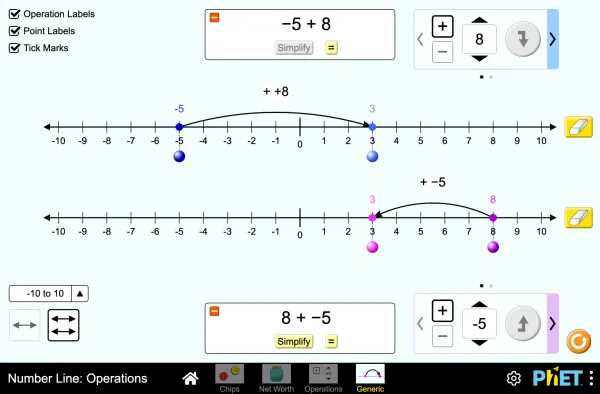
Full screen · PhET Interactive Simulations, University of Colorado Boulder, CC BY 4.0
Challenge
Hemi works out 0.49 × 4030.0198 on his calculator and writes down 997.3. (a) Without a calculator, estimate the answer and show that Hemi must have made a slip. (b) He typed 0.49 and 403 correctly. What did he most likely type instead of 0.0198, and what is the true answer to 1 decimal place?
Hint
Round each number to one useful digit. Dividing by 0.02 asks how many lots of 0.02 fit, which is the same as multiplying by 50.
Answer
(a) About 10 000, so 997.3 is ten times too small. (b) He most likely typed 0.198 instead of 0.0198. The true answer is about 9973.2.
Step by step
- Round: 0.49 is about 0.5, 403 is about 400, 0.0198 is about 0.02.
- The top is about 0.5 × 400 = 200.
- 200 ÷ 0.02 asks how many 0.02s fit in 200. There are 50 in each 1, so 200 × 50 = 10 000.
- 997.3 is about one tenth of the estimate, so one number was out by a factor of ten.
- 0.49 and 403 were right, so the slip was in 0.0198. Dividing by 0.198 instead of 0.0198 makes the answer exactly ten times smaller, which matches. The true answer is 9973.2.
Full working
- 0.49 × 403 ≈ 0.5 × 400 = 200estimate the top
- 200 ÷ 0.02 = 200 × 50 = 10 00050 lots of 0.02 fit in each 1
- 997.3 ≈ 10 000 ÷ 10Hemi is ten times too small
- 0.49 × 403 = 197.47the true top
- 197.47 ÷ 0.198 ≈ 997.3what Hemi actually typed
- 197.47 ÷ 0.0198 ≈ 9973.2the true answer
- Estimate about 10 000; he typed 0.198 for 0.0198; true answer 9973.2
Put the four signs +, −, × and ÷ into the gaps of 8 _ 4 _ 2 _ 6 _ 3, using each sign exactly once, and work out the answer using the usual order of operations. (a) What is the largest answer you can get? (b) What is the smallest?
Hint
× and ÷ are done first. Sort the 24 ways by which gap the × goes in: that gives four groups of six. To make it big, multiply two big neighbours; to make it small, multiply the two numbers straight after the minus.
Answer
(a) 34 23, from 8 × 4 − 2 ÷ 6 + 3. (b) −14, from 8 ÷ 4 + 2 − 6 × 3.
Step by step
- The multiply and divide happen first, so they decide how big each piece is. Group the 24 ways by where the × goes, then the +, − and ÷ fill the other three gaps in 6 ways.
- With × in the first gap, 8 × 4 = 32 starts the sum. The six answers are 13, 19, 29 13, 32, 32 and 34 23. The best is 8 × 4 − 2 ÷ 6 + 3: the minus takes away only 2 ÷ 6 = 13.
- With × anywhere else, every product is 18 or less (4 × 2, 2 × 6 or 6 × 3), and the best answers in those groups are 14, 17 and 24. So 34 23 is the largest.
- For the smallest, the minus should take away a big product. With × in the last gap, 8 ÷ 4 + 2 − 6 × 3 = 2 + 2 − 18 = −14, the lowest of its six.
- The lowest answers in the other three groups are 13, 1 and −7, all above −14. So −14 is the smallest.
Full working
- × in gap 1: 13, 19, 29 13, 32, 32, 34 238 × 4 starts the sum
- × in gap 2: 1, 2, 6 13, 7, 9 23, 144 × 2 is only 8
- × in gap 3: −7, −1, 8, 8, 11, 172 × 6 is 12
- × in gap 4: −14, −8, 5, 11, 18, 246 × 3 is 18
- 8 × 4 − 2 ÷ 6 + 3 = 32 − 13 + 3 = 34 23the largest of all 24
- 8 ÷ 4 + 2 − 6 × 3 = 2 + 2 − 18 = −14the smallest of all 24
- Largest 34 23, smallest −14
Work out −1² + (−2)² − 3² + (−4)² − 5² + (−6)² − … − 99² + (−100)². The odd numbers are squared without brackets and the even numbers are squared inside brackets, all the way to 100.
Hint
First decide the sign of each term: is −3² the same as (−3)²? Then pair the terms up two at a time and look for a pattern in each pair.
Answer
5050
Step by step
- −1², −3², −5² and so on are negative, because only the number is squared, not the minus.
- (−2)², (−4)², (−6)² and so on are positive, because the minus is inside the brackets.
- So the sum is −1 + 4 − 9 + 16 − 25 + 36 − … Pair them: −1 + 4 = 3, −9 + 16 = 7, −25 + 36 = 11.
- Each pair is 4 more than the last: 3, 7, 11, 15, …, and there are 50 pairs, ending with 100² − 99² = 199.
- Add the pairs by matching first with last: 3 + 199 = 202, and there are 25 such matches, so 25 × 202 = 5050.
Full working
- −3² = −9 but (−4)² = 16the power is attached to the number only
- −1 + 4 = 3first pair
- −9 + 16 = 7second pair
- −25 + 36 = 11third pair, going up by 4 each time
- −99² + (−100)² = −9801 + 10 000 = 199the 50th pair
- 3 + 199 = 202, 7 + 195 = 202, …match first and last pairs
- 25 × 202 = 505025 matches of 202
- 5050
Where science uses this
Practise this
Report a mistake
More in Number
 Scientific notation, and three names for one number8 min
 Powers of two, unit fractions, and roots on the line7 minOrder of operations, integers, and a sensible estimate8 min
 Reciprocals, and why decimal rules are fraction rules7 min
 Percentages as multipliers, and working backwards7 min
 Ratios you can scale, and rates that carry units7 min
 Mark-ups, discounts, GST and interest7 min