
Atomic theory: Rutherford, Bohr and the parts of an atom
What this lesson covers
- How the model of the atom changed as new evidence arrived
- What Rutherford's gold foil experiment showed about the nucleus
- The Bohr model: a nucleus of protons and neutrons with electrons in shells
- The charge on protons, neutrons and electrons
- Atomic number, and why it decides which element an atom is
- Why a neutral atom has equal numbers of protons and electrons
A model that keeps getting better
- Nobody has ever looked inside an atom the way you look inside a box, so our picture of it is a model built from evidence.
- Each time an experiment produced a result the old model could not explain, scientists argued about it, tested it again, and changed the model.
- A new model is accepted only when most scientists agree it fits all the evidence better than the old one.
- This is still happening: today's model is more detailed than the one in this lesson, but the simple version explains most of Year 9 chemistry.
From solid balls to shells
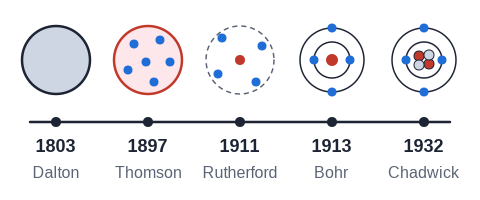
- The idea of atoms is ancient, but John Dalton made it scientific around 1803 by explaining how elements combine in fixed ratios.
- J. J. Thomson found the electron in 1897, which proved atoms have smaller parts inside them.
- Each later scientist kept what still worked from the earlier model and replaced what the new evidence ruled out.
| Year | Scientist | Evidence | Model |
|---|---|---|---|
| 1803 | John Dalton | Elements combine in fixed mass ratios | Tiny solid balls that cannot be split |
| 1897 | J. J. Thomson | Cathode rays are made of tiny negative particles | Plum pudding: electrons dotted through a spread of positive charge |
| 1911 | Ernest Rutherford | A few alpha particles bounce back off gold foil | Tiny dense positive nucleus with electrons around it |
| 1913 | Niels Bohr | Elements give off light only at certain colours | Electrons in fixed energy levels (shells) |
| 1932 | James Chadwick | Radiation that carried no charge but had mass | Nucleus holds neutrons as well as protons |
Rutherford's gold foil experiment
- Ernest Rutherford grew up near Nelson and studied at Canterbury College in Christchurch before moving to England; he is on the New Zealand $100 note.
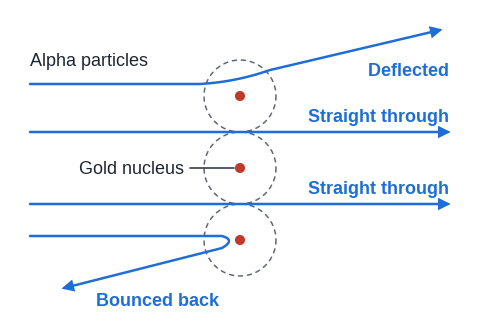
- His team, Hans Geiger and Ernest Marsden, fired fast, positively charged alpha particles at gold foil only about a thousand atoms thick.
- If Thomson's plum pudding model were right, every particle should have passed straight through with only tiny wobbles.
- Most did go straight through, but a few were bent sharply and about 1 in 8000 bounced almost straight back.
- Rutherford concluded that nearly all of an atom's mass and all of its positive charge sit in a tiny core, the nucleus, with mostly empty space around it.
| Observation | What it means |
|---|---|
| Most alpha particles pass straight through | An atom is mostly empty space |
| Some are deflected at an angle | There is something positive in the atom that repels them |
| A very few bounce back | That positive part is very small, very dense and holds most of the mass |
Try it: fire at the gold foil
How small the nucleus is
- The nucleus is roughly 100 000 times narrower than the whole atom.
- If an atom were blown up to the size of Eden Park, the nucleus would be about the size of a sesame seed on the centre of the pitch.
- Yet that seed would carry more than 99.9 percent of the atom's mass.
The Bohr model and the three particles
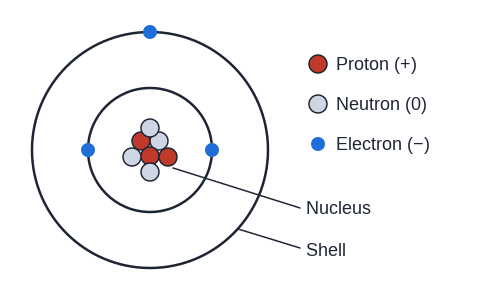
- In the Bohr model the nucleus sits in the centre and contains protons and neutrons.
- Electrons move around the nucleus in shells, which are fixed energy levels at set distances from the centre.
- Electrons fill the shell closest to the nucleus first, then the next one out. Part 2 covers how many fit in each shell.
- Opposite charges attract, so the negative electrons are held to the positive nucleus.
| Particle | Charge | Where it is |
|---|---|---|
| Proton | Positive (+1) | In the nucleus |
| Neutron | None (0) | In the nucleus |
| Electron | Negative (−1) | In shells around the nucleus |
Atomic number decides the element
- The atomic number is how many protons are in the nucleus.
- Every atom with 6 protons is carbon and every atom with 8 protons is oxygen; change the proton count and you have a different element.
- The periodic table is laid out in order of atomic number, so each step to the right adds one proton.
- On most tables the atomic number is the whole number printed above or beside the symbol.
Try it: protons decide the element
Why a neutral atom has no overall charge
- A proton and an electron carry charges of the same size but opposite sign.
- If an atom has the same number of electrons as protons, the charges cancel and the atom is neutral.
- So for any neutral atom, the number of electrons equals the atomic number.
- If an atom gains or loses electrons it becomes charged, and is then called an ion.
Counting particles in a neutral oxygen atom
- Oxygen has atomic number 8. Work out its protons and electrons.
- Atomic number = 8read from the periodic table
- Protons = 8atomic number counts the protons
- Electrons = protons = 8the atom is neutral, so the charges must balance
- Oxygen: 8 protons and 8 electrons
Identifying a particle from its counts
- A particle has 11 protons and 10 electrons. Which element is it, and what is its overall charge?
- 11 protons, so atomic number 11protons fix the element
- Element 11 is sodium, Nafind 11 on the periodic table
- Charge = (+11) + (−10) = +1add the proton and electron charges
- A sodium ion with a charge of +1it has lost one electron
Finding the pattern across a period
- Take period 2, from lithium to neon, and fill a table with each element's atomic number, protons and electrons.
- The pattern is that each element has exactly one more proton and one more electron than the one to its left.
- Now compare elements in the same column, such as lithium (3) and sodium (11): sodium has eight more of each, one full period later.
- That jump of eight is a clue that electrons are arranged in layers, which Part 2 explains.
| Element | Symbol | Atomic number | Protons | Electrons (neutral) |
|---|---|---|---|---|
| Lithium | Li | 3 | 3 | 3 |
| Beryllium | Be | 4 | 4 | 4 |
| Boron | B | 5 | 5 | 5 |
| Carbon | C | 6 | 6 | 6 |
| Nitrogen | N | 7 | 7 | 7 |
| Oxygen | O | 8 | 8 | 8 |
| Fluorine | F | 9 | 9 | 9 |
| Neon | Ne | 10 | 10 | 10 |
Common mistakes
- Some alpha particles bounced back, so the gold foil experiment showed atoms are solid.Most particles went straight through, so atoms are mostly empty space; the rare bounce-backs showed a tiny, dense, positive nucleus.
- Electrons sit in the nucleus with the protons.Only protons and neutrons are in the nucleus; electrons are in shells around it, held by the attraction of opposite charges.
- Neutrons are the negative particles.Neutrons have no charge; electrons are negative and protons are positive.
- Atomic number means protons plus neutrons added together.The atomic number counts only the protons; protons plus neutrons is the mass number, which Part 2 covers.
Find a hidden nucleus with marbles
You need: a large flattened cardboard box, 4 mugs, a full food can, a dice, 10 marbles, a pen and paper
- On a smooth floor, ask someone to put the can somewhere in the middle while you look away, then rest the cardboard on the four mugs over it so you cannot see underneath.
- Kneel about a metre away and roll marbles one at a time straight under the cardboard, aiming at a different spot along the edge each time, until you have made 20 rolls.
- For each roll, tally whether the marble came out the far side, came out at an angle, or rolled back towards you.
- Ask your helper to swap the can for the dice and hide it somewhere new, then make another 20 rolls and tally them the same way.
- Look for the pattern: most marbles pass straight through and only a few bounce back, and with the smaller dice even fewer do, just as Rutherford's rare bounce-backs showed the nucleus is tiny.
Safety: Marbles are a choking risk for small children and a slipping risk underfoot, so keep little ones away and count every marble back in when you finish.
Your turn
How many protons and electrons are in a neutral atom of magnesium, atomic number 12?
An atom has 7 protons. Name the element.
In the gold foil experiment, why did most alpha particles pass straight through the foil?
Which particle did Thomson's plum pudding model include, and which part did Rutherford add?
A particle has 17 protons and 18 electrons. What is its overall charge?
If an atom were blown up to the size of Eden Park, what would its nucleus be like?
In 1932 Chadwick found radiation that had mass but carried no charge. Which particle was it, and where is it found in an atom?
Lithium is element 3. Sodium is in the same group, one period lower. How many electrons does a neutral sodium atom have?
Show answer
1. 12 protons and 12 electrons, because the atomic number gives the protons and a neutral atom has equal numbers. 2. Nitrogen, element 7. 3. Atoms are mostly empty space, so most particles never came near a nucleus. 4. Thomson's model included the electron; Rutherford added a small, dense, positive nucleus. 5. −1, because 17 positive charges and 18 negative charges leave one extra negative (it is a chloride ion). 6. A sesame seed on the centre of the pitch, yet it would hold almost all of the atom's mass (more than 99.9 percent). 7. The neutron, which has no charge and sits in the nucleus with the protons. 8. 11. One period later in the same group means 8 more protons and electrons: 3 + 8 = 11, and sodium is element 11.
Rutherford Scattering
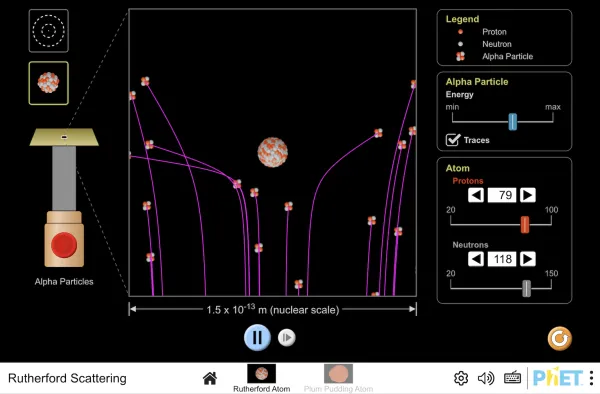
Full screen · PhET Interactive Simulations, University of Colorado Boulder, CC BY 4.0
Recap
- The model of the atom changed from Dalton's solid balls to Thomson's plum pudding, Rutherford's nucleus and Bohr's shells as evidence built up.
- Rutherford's gold foil results showed that almost all of an atom's mass is in a tiny positive nucleus.
- In the Bohr model, protons and neutrons are in the nucleus and electrons sit in shells around it.
- Protons are positive, electrons are negative and neutrons have no charge.
- The atomic number counts the protons, and that count decides which element the atom is.
- A neutral atom has as many electrons as protons.
Challenge
Particle X contains 38 charged particles in total (protons plus electrons; neutrons are not counted) and has an overall charge of +2. Particle Y contains 34 charged particles in total and has an overall charge of −2. (a) Find the number of protons and electrons in X and in Y, and name the element each is made from. (b) Show that X and Y have the same number of electrons, and name the neutral atom that also has this many electrons.
Hint
In X there are 2 more protons than electrons. Take those 2 extra protons away first: what is left is made of equal numbers of protons and electrons.
Answer
(a) X: 20 protons and 18 electrons, so it is a calcium ion, Ca²⁺. Y: 16 protons and 18 electrons, so it is a sulfur ion, S²⁻. (b) Both have 18 electrons, the same as a neutral argon atom (atomic number 18).
Step by step
- A charge of +2 means 2 more protons than electrons, because each proton and electron cancel in pairs.
- Remove the 2 extra protons from 38 to leave 36, split equally into 18 protons and 18 electrons, then add the 2 back to the protons: 20 protons.
- For Y, a charge of −2 means 2 more electrons than protons: 34 − 2 = 32, half is 16, so 16 protons and 18 electrons.
- The proton count is the atomic number, so X is calcium (20) and Y is sulfur (16).
- Both have 18 electrons, and the neutral atom with 18 electrons has 18 protons: argon.
Full working
- X: protons − electrons = 2, protons + electrons = 38charge +2 means 2 extra protons
- 38 − 2 = 36, 36 ÷ 2 = 18equal shares once the extras are removed
- X: 18 + 2 = 20 protons, 18 electronsatomic number 20 is calcium
- Check: (+20) + (−18) = +2 and 20 + 18 = 38both clues fit
- Y: electrons − protons = 2, protons + electrons = 34charge −2 means 2 extra electrons
- 34 − 2 = 32, 32 ÷ 2 = 16so 16 protons, 16 + 2 = 18 electrons
- Y: atomic number 16 is sulfurcheck: (+16) + (−18) = −2
- X has 18 electrons, Y has 18 electronssame count
- Neutral atom with 18 electrons has 18 protonsatomic number 18 is argon
- X = Ca²⁺ (20 p, 18 e), Y = S²⁻ (16 p, 18 e); both have 18 electrons, like argon
A typical atom is about 1 × 10⁻¹⁰ m across. Use the lesson's figure that the nucleus is about 100 000 times narrower than the whole atom. (a) About how wide is the nucleus? (b) A science centre wants a scale model with a 1 cm marble as the nucleus. How wide must the model atom be, in km? (c) Treat the atom and the nucleus as cubes of those widths. What fraction of the atom's volume does the nucleus fill? (d) The nucleus holds more than 99.9 percent of the atom's mass. Use your answer to (c) to show that matter in the nucleus is about 10¹⁵ times as dense as the atom as a whole, and explain what this says about the rest of the atom.
Hint
If a cube is 10 times wider, it is 10 times longer, 10 times taller and 10 times deeper. Density is mass ÷ volume: what happens when you squash almost the same mass into a far smaller volume?
Answer
(a) About 1 × 10⁻¹⁵ m. (b) About 1 km wide. (c) About 110¹⁵, one millionth of a billionth. (d) Nearly all the mass sits in 10⁻¹⁵ of the volume, so the nucleus is about 10¹⁵ times as dense as the atom on average; the rest of the atom is almost empty space with hardly any mass.
Step by step
- Divide the atom's width by 100 000 to get the nucleus width.
- In the model every length is scaled by the same factor, so the atom is 100 000 times wider than the 1 cm marble.
- Volume depends on width × width × width, so a width ratio of 100 000 becomes a volume ratio of 100 000³ = 10¹⁵.
- Almost the whole mass is packed into a volume 10¹⁵ times smaller than the atom, so its density is about 10¹⁵ times the atom's average density.
- That leaves the electrons spread through a huge space with almost no mass, which is why most alpha particles passed straight through Rutherford's foil.
Full working
- nucleus = 1 × 10⁻¹⁰ m ÷ 100 000100 000 = 10⁵
- = 1 × 10⁻¹⁵ m(a)
- model atom = 1 cm × 100 000 = 100 000 cmsame scale for every length
- 100 000 cm = 1000 m = 1 km100 cm in a metre, 1000 m in a km
- volume ratio = (1100 000)³ = 110¹⁵width cubed
- atom density = M ÷ V, nucleus density ≈ M ÷ (V ÷ 10¹⁵)more than 99.9% of mass M in the nucleus
- nucleus density ≈ 10¹⁵ × M ÷ Vabout 10¹⁵ times denser
- (a) 1 × 10⁻¹⁵ m, (b) 1 km, (c) 110¹⁵, (d) about 10¹⁵ times as dense; the rest of the atom is nearly empty space
Before 1932 scientists knew two facts about nuclei. A helium nucleus has a charge of +2 but a mass about 4 times a hydrogen nucleus (1 proton). A carbon nucleus has a charge of +6 but a mass about 12 times a hydrogen nucleus. One popular idea was that a nucleus held only protons and electrons, since those were the only particles known. (a) In this proton-electron idea, how many protons and how many electrons would the helium nucleus need to have the right mass and charge? Do the same for carbon. (b) In the model you learned, with neutrons, how many protons and neutrons do these two nuclei have? (c) Explain why both ideas give the same atomic number for carbon, and why the mass and charge data alone could not decide between them. (d) How many electrons would a neutral carbon atom contain in total under the proton-electron idea? What kind of evidence did Chadwick provide that settled the question?
Hint
An electron has almost no mass (about 11836 of a proton) but a charge of −1. So in the proton-electron idea the mass sets the number of protons, and the electrons are then needed to bring the charge down.
Answer
(a) Helium: 4 protons and 2 electrons. Carbon: 12 protons and 6 electrons. (b) Helium: 2 protons and 2 neutrons. Carbon: 6 protons and 6 neutrons. (c) In both, the nucleus has a net charge of +6, so the atomic number is 6; both also give a mass of about 12, so both fit the data. (d) 12 electrons: 6 inside the nucleus and 6 in the shells. Chadwick detected radiation made of particles with no charge but a mass about the same as a proton, which is exactly the neutron the second model needs.
Step by step
- In the proton-electron idea the electrons add nothing to the mass, so a mass of 4 needs 4 protons, and 2 electrons cancel 2 of the 4 positive charges to leave +2.
- In the same way carbon needs 12 protons for the mass and 6 electrons to bring the charge down to +6.
- With neutrons, the charge gives the protons (2 and 6), and the rest of the mass is neutrons (2 and 6).
- Both models give the same total mass and the same net charge, and the atomic number is set by the nuclear charge, so the data cannot tell them apart.
- A neutral carbon atom needs 6 shell electrons to cancel the net +6, so the proton-electron idea has 12 electrons in total.
- Only new evidence could decide: Chadwick found a neutral particle with mass about 1, and the neutron model became accepted.
Full working
- Helium (p-e idea): mass 4 → 4 protonselectron mass taken as 0
- charge: (+4) + (−2) = +2 → 2 electrons in nucleusmatches +2
- Carbon (p-e idea): 12 protons, (+12) + (−6) = +6 → 6 electronsmatches mass 12 and charge +6
- Helium (neutron model): 2 protons, 4 − 2 = 2 neutronscharge gives protons
- Carbon (neutron model): 6 protons, 12 − 6 = 6 neutronsrest of the mass is neutral
- Both carbon nuclei: net charge +6, mass about 12atomic number 6 either way
- p-e idea, neutral carbon: 6 in nucleus + 6 in shells = 12 electronsshells cancel the net +6
- (a) He 4 p + 2 e, C 12 p + 6 e; (b) He 2 p + 2 n, C 6 p + 6 n; (c) both give charge +6 and mass 12; (d) 12 electrons; Chadwick found a neutral particle of mass about 1