
Multiplying and dividing bigger numbers
What this lesson covers
- Division may result in a whole number quotient or a quotient with a remainder, represented as a whole number.
- Division can be represented as grouping, sharing, or an area model and larger numbers can be divided using a standard written algorithm, where appropriate.
- Standard written algorithms for multiplication and division rely on place value, regrouping, and renaming.
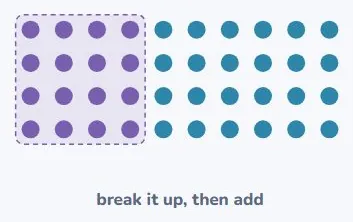
Every big one is small ones added up
- 243 × 4 looks like a new kind of problem.
- It is three small multiplications, then an addition.
- That is the whole idea, and it works for division too.
The tables are the toolkit
- Everything here assumes the tables from 2 to 12.
- A video cannot make you memorise them. Practice can.
- Every minute spent on them is repaid in every lesson after.
| worth knowing cold | why |
|---|---|
| 2s, 5s, 10s | they appear in everything |
| 3s, 4s, 6s | they carry most word problems |
| 7s, 8s, 12s | the ones people skip |
One fact gives you many
- You know 6 × 4 = 24. That reaches further than it looks.
- 6 × 40 is ten times bigger, so 240.
- And 24 ÷ 6 = 4 is the same fact read backwards.
| from | you get | how |
|---|---|---|
| 6 × 4 = 24 | 6 × 40 = 240 | ten times bigger |
| 6 × 4 = 24 | 6 × 8 = 48 | double it |
| 6 × 4 = 24 | 24 ÷ 6 = 4 | the same fact backwards |
Factor pairs make hard ones easy
- 15 × 12 is awkward straight off.
- 12 is 4 × 3, so multiply by 4, then by 3.
- 15 × 4 = 60, and 60 × 3 = 180.
| step | running total |
|---|---|
| start | 15 |
| × 4 | 60 |
| × 3 | 180 |
Three digits by one digit
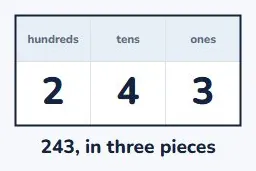
- 243 × 4. Split 243 by place value.
- 200, then 40, then 3.
- Multiply each by 4 and add the three answers.
Work it and add it
- 200 × 4 = 800. 40 × 4 = 160. 3 × 4 = 12.
- 800 + 160 + 12 = 972.
- Every step used a fact you already knew.
| part | value |
|---|---|
| 200 × 4 | 800 |
| 40 × 4 | 160 |
| 3 × 4 | 12 |
| add them | 972 |
Two digits by two digits
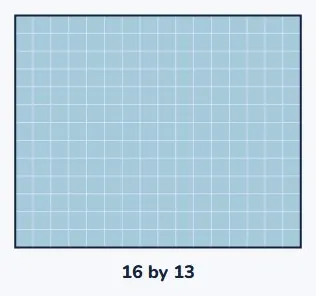
- 16 × 13. Now both numbers split.
- Draw it as a rectangle 16 wide and 13 tall.
- Cut it into four smaller rectangles.
Try it: four pieces, then add
Four pieces, then add
- 10 × 10 = 100. 10 × 3 = 30.
- 6 × 10 = 60. 6 × 3 = 18.
- 100 + 30 + 60 + 18 = 208.
| piece | value |
|---|---|
| 10 × 10 | 100 |
| 10 × 3 | 30 |
| 6 × 10 | 60 |
| 6 × 3 | 18 |
| add them | 208 |
Division is sharing or grouping
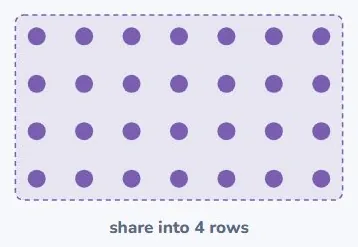
- 278 ÷ 4 can be read two ways.
- Share 278 between 4, or make groups of 4 from 278.
- Both give the same answer, and both may leave something over.
Work down the places
- 2 hundreds shared by 4 will not give a whole hundred.
- So carry them: 27 tens shared by 4 is 6 tens, 3 tens over.
- 38 ones shared by 4 is 9, with 2 left. So 69 remainder 2.
| place | share by 4 | carry |
|---|---|---|
| 2 hundreds | 0 | 2 hundreds |
| 27 tens | 6 tens | 3 tens |
| 38 ones | 9 ones | 2 left |
The remainder is a whole number
- The 2 left over is written as a whole number, not a fraction.
- Sometimes it matters: 278 people, 4 to a van, needs 70 vans.
- The maths says 69 and a bit. The situation says round up.
| question | answer |
|---|---|
| 278 ÷ 4 | 69 remainder 2 |
| vans needed | 70 |
| full vans | 69 |
Try it: what is left over
Multiply back to check
- 69 × 4 = 276, and 276 + 2 = 278.
- Quotient times divisor, plus remainder, gives you back the start.
- If it does not, something slipped a place.
| check | result |
|---|---|
| 69 × 4 | 276 |
| + remainder 2 | 278 |
| matches? | yes |
Common mistakes
- 243 × 4: 2 × 4 = 8, 4 × 4 = 16, 3 × 4 = 12, so the answer is 8 + 16 + 12 = 36.The 2 is really 200 and the 4 is really 40, so it is 800 + 160 + 12 = 972.
- 16 × 13 = 10 × 10 + 6 × 3 = 118.You need all four pieces of the rectangle: 100 + 30 + 60 + 18 = 208.
- 278 people go 4 to a van. 278 ÷ 4 = 69 remainder 2, so we need 69 vans.69 vans would leave 2 people behind, so you need 70 vans. The story tells you to round up.
- 278 ÷ 4 = 69 remainder 2, so I write 69.2.A remainder of 2 is not two tenths. Write 69 remainder 2 (as a decimal it would be 69.5).
Your turn
Use 8 × 3 = 24 to work out 8 × 30 and 8 × 6.
316 × 5, by splitting 316 into places.
32 × 14, using eight pieces.
195 ÷ 6, and check it by multiplying back.
You know 9 × 6 = 54. Use it to work out 540 ÷ 6.
Work out 25 × 12 by multiplying by 4, then by 3.
A school takes 138 students to a kapa haka festival in vans that hold 8 each. How many vans are needed?
A number divided by 6 gives 47 remainder 3. What was the number?
Show answer
1. 240 and 48. 2. 1,500 + 50 + 30 = 1,580. 3. 300 + 120 + 20 + 8 = 448. 4. 32 remainder 3, and 32 × 6 = 192, plus 3 is 195. 5. 90. 540 is ten times 54, so the answer is ten times 9, which is 90. 6. 300. 12 is 4 × 3, so 25 × 4 = 100, and 100 × 3 = 300. 7. 18 vans. 138 ÷ 8 = 17 remainder 2, so 17 vans are full and the 2 left over need one more van. 8. 285. Multiply back and add the remainder: 47 × 6 = 282, and 282 + 3 = 285.
Area Model Multiplication
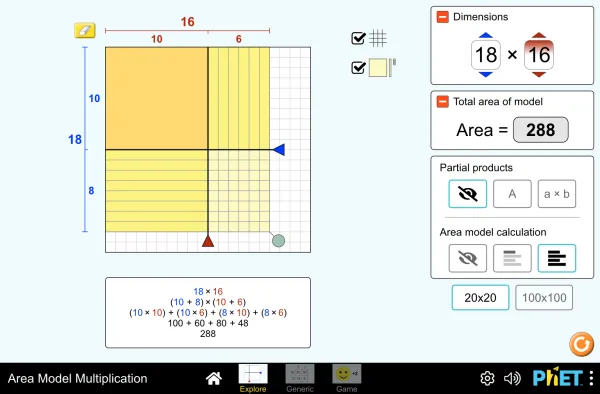
Full screen · PhET Interactive Simulations, University of Colorado Boulder, CC BY 4.0
What to take away
- Split by place value, multiply the pieces, add them up.
- A division may leave a remainder, written as a whole number.
- Multiply back, add the remainder, and you should be home.
| problem | answer |
|---|---|
| 243 × 4 | 972 |
| 16 × 13 | 208 |
| 278 ÷ 4 | 69 r 2 |
Challenge
Ana divides a secret number by 8 and gets 47 remainder 5. Sione divides the same secret number by 9. What answer and remainder does Sione get?
Hint
First find the secret number by multiplying back and adding the remainder.
Answer
The secret number is 381, and Sione gets 42 remainder 3.
Step by step
- Multiply back: 47 × 8 = 376.
- Add the remainder: 376 + 5 = 381. That is the secret number.
- Now divide 381 by 9: 38 tens shared by 9 is 4 tens, with 2 tens over.
- 21 ones shared by 9 is 2, with 3 left.
- Check: 42 × 9 = 378, and 378 + 3 = 381.
Full working
- 47 × 8 = 376multiply back
- 376 + 5 = 381add the remainder
- 38 tens ÷ 9 = 4 tens, 2 tens overtens
- 21 ones ÷ 9 = 2, 3 leftones
- 42 × 9 + 3 = 378 + 3 = 381check
- 42 remainder 3
A sports club needs to take exactly 100 people to a tournament. It can hire minibuses that seat 12 and vans that seat 8, and every seat must be filled. What is the smallest number of vehicles they can use, and how many of each?
Hint
Bigger vehicles mean fewer of them. Try as many minibuses as you can, then check whether the people left fill vans exactly.
Answer
9 vehicles: 7 minibuses and 2 vans.
Step by step
- To use as few vehicles as possible, use as many 12-seat minibuses as you can.
- 8 minibuses carry 96, leaving 4. 4 people cannot fill an 8-seat van, so 8 does not work.
- 7 minibuses carry 84, leaving 16. 16 ÷ 8 = 2 vans exactly.
- That is 7 + 2 = 9 vehicles. Fewer minibuses means more vans, and more vehicles, so 9 is the smallest.
Full working
- 8 × 12 = 96, 100 − 96 = 44 is not a multiple of 8
- 7 × 12 = 84, 100 − 84 = 1616 is a multiple of 8
- 16 ÷ 8 = 2two vans
- 7 + 2 = 9vehicles
- 7 minibuses and 2 vans, 9 vehicles
37 × 3 = 111. Find every two-digit number that, multiplied by 37, gives a three-digit answer with all three digits the same (like 222 or 777).
Hint
222 is 2 lots of 111, and 111 is 37 × 3. So 222 is 37 times what?
Answer
12, 15, 18, 21, 24 and 27 (giving 444, 555, 666, 777, 888 and 999).
Step by step
- Every number like 222 or 777 is a number of lots of 111: 777 is 7 × 111.
- 111 is 37 × 3, so 777 is 37 × 3 × 7, which is 37 × 21.
- So the number to multiply by is always 3 times the repeated digit.
- Repeated digits 1, 2 and 3 give 3, 6 and 9, which are not two-digit numbers.
- Repeated digits 4 to 9 give 12, 15, 18, 21, 24 and 27. Check one: 37 × 24 = 888.
Full working
- 777 = 7 × 111each one is lots of 111
- 111 = 37 × 3given
- 7 × 111 = 7 × 3 × 37 = 21 × 37multiply by 3 times the digit
- 3 × 1, 3 × 2, 3 × 3 = 3, 6, 9only one digit
- 3 × 4 up to 3 × 9 = 12, 15, 18, 21, 24, 27two digits
- 12, 15, 18, 21, 24 and 27
Where science uses this
Practise this
Report a mistake
More in Number
 Big numbers, factors and rounding5 min
 Negative numbers and counting on5 min
 Adding and subtracting big numbers5 minMultiplying and dividing bigger numbers6 min
 Tenths, hundredths and comparing decimals6 min
 Multiplying and dividing by 10 and 1006 min
 Adding fractions and decimals, and fractions of amounts5 min
 Money: totals, change and rounding5 min