
Multiplying and dividing by 10 and 100
What this lesson covers
- Percentages are decimal fractions with denominators of 100; they are represented using the percent (%) symbol.
The point does not move
- 7 ÷ 10 = 0.7. And 0.36 × 100 = 36.
- You were probably told to move the decimal point.
- It does not move. The digits do. Here is why that matters.
| what you were told | what actually happens |
|---|---|
| move the point | move the digits |
Divide by 10: one place right
- 7 ÷ 10. The 7 is worth ten times less than it was.
- So it moves out of the ones and into the tenths.
- The answer is 0.7. Seven ones became seven tenths.
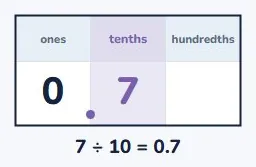
Try it: the digits move, the point stays
Divide by 100: two places right
- 7 ÷ 100 moves the 7 two columns instead of one.
- Out of the ones, past the tenths, into the hundredths.
- So 7 ÷ 100 = 0.07, and 45 ÷ 100 = 0.45.
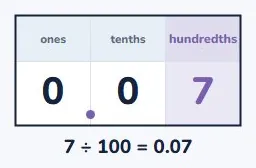
Why the point is nailed down
- The point marks where ones stop and tenths start.
- That boundary is a fact about the number system.
- It is not a thing that slides about. The digits travel.
| calculation | answer | what moved |
|---|---|---|
| 7 ÷ 10 | 0.7 | 7 ones become 7 tenths |
| 7 ÷ 100 | 0.07 | 7 ones become 7 hundredths |
| 45 ÷ 100 | 0.45 | each digit moves two places |
Multiply: the same rule, leftwards
- × 10 makes every digit worth ten times more.
- So each digit shifts one column left. 0.36 × 10 = 3.6.
- × 100 shifts them two. 0.36 × 100 = 36.
| calculation | answer | shift |
|---|---|---|
| 0.36 × 10 | 3.6 | one place left |
| 0.36 × 100 | 36 | two places left |
| 2.05 × 10 | 20.5 | one place left |
This is where "add a zero" breaks
- 36 × 10 = 360, and a zero appears. That is luck.
- 0.36 × 10 = 3.6, and no zero appears anywhere.
- Both are one shift left. Only one grows a zero.
| start | × 10 | a zero? |
|---|---|---|
| 36 | 360 | yes |
| 0.36 | 3.6 | no |
| 2.05 | 20.5 | no |
A percentage is a hundredth
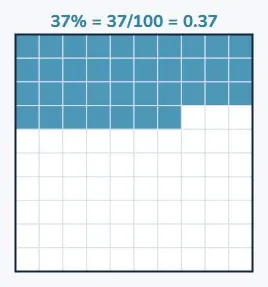
- Percentages are decimal fractions with denominator 100.
- The % symbol is shorthand for "out of a hundred".
- So 37% = 37/100 = 0.37. Any number works, not just the tidy ones.
Watch the small ones
- 7% is 7 hundredths, so it is 0.07.
- Not 0.7. That would be 70%, ten times bigger.
- Count the places, do not count the digits.
| percent | fraction | decimal |
|---|---|---|
| 7% | 7/100 | 0.07 |
| 70% | 70/100 | 0.7 |
Families of equivalent fractions
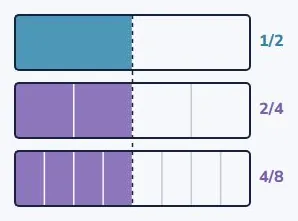
- Multiply the top and the bottom by the same number.
- The fraction looks different and the amount does not change.
- 1/2 = 2/4 = 3/6 = 4/8 = 5/10. One family, one amount.
Comparing when one bottom is a multiple
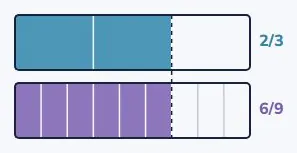
- 2/3 against 5/9. Thirds and ninths.
- 9 is a multiple of 3, so rewrite the thirds as ninths.
- Multiply top and bottom by 3: 2/3 = 6/9.
Try it: compare two fractions
Now it is just counting
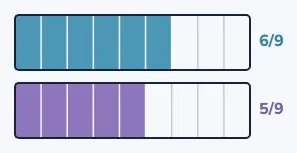
- 6/9 against 5/9.
- Same size pieces, so count them: 6 beats 5.
- So 2/3 is bigger than 5/9.
More than a whole
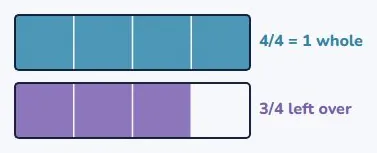
- 7/4 means seven quarters. But four make a whole.
- So it is one whole bar and three quarters of a second.
- 7/4 and 1 3/4 are the same number.
Converting, both directions
- 7/4: how many 4s in 7? One, with 3 left. So 1 3/4.
- Back again: 1 whole is 4 quarters, plus 3 more is 7.
- Multiply the whole by the bottom, then add the top.
| improper | working | mixed |
|---|---|---|
| 7/4 | 7 ÷ 4 = 1 r 3 | 1 3/4 |
| 11/3 | 11 ÷ 3 = 3 r 2 | 3 2/3 |
| 9/2 | 9 ÷ 2 = 4 r 1 | 4 1/2 |
Try it: one amount, many names
Common mistakes
- 0.36 × 10 = 0.360, because times 10 adds a zero.× 10 moves every digit one place left, so 0.36 × 10 = 3.6. Adding a zero on the end changes nothing here.
- 7% as a decimal is 0.77% is 7 hundredths, so 7% = 0.07. 0.7 would be 70%.
- 5/9 is bigger than 2/3, because 5 is bigger than 2.Make the bottoms match first: 2/3 = 6/9, and 6/9 is bigger than 5/9.
- 13/5 = 3 2/513 ÷ 5 is 2 remainder 3, so 13/5 = 2 3/5. The answer is the wholes, and the remainder goes on top.
Your turn
Work out 8 ÷ 10, then 8 ÷ 100, then 62 ÷ 100.
Work out 0.42 × 10, then 0.42 × 100.
Which is bigger, 3/4 or 5/8?
Write 13/5 as a mixed number.
Write 9% as a fraction and as a decimal.
Ana says 3.4 × 10 = 3.40, because times ten adds a zero. What is the right answer?
Which fraction is not in the same family as 2/3?
Write 3 2/5 as an improper fraction.
Show answer
1. 0.8, 0.08, 0.62. 2. 4.2 and 42. 3. 3/4 = 6/8, and 6 beats 5, so 3/4. 4. 13 ÷ 5 = 2 r 3, so 2 3/5. 5. 9/100 and 0.09. A percentage counts hundredths, so 9% is 9 hundredths. 6. 34. × 10 moves every digit one place left, so 3 ones become 3 tens and 4 tenths become 4 ones. 3.40 is just 3.4 again. 7. 5/6. Adding 3 to top and bottom changes the amount; 4/6, 6/9 and 10/15 all multiply 2/3 top and bottom by the same number. 8. 17/5. Multiply the whole by the bottom, then add the top: 3 × 5 = 15, and 15 + 2 = 17.
What to take away
- Digits move, the point stays. Left for ×, right for ÷.
- A percentage is a number of hundredths, and % says so.
- Match the bottoms before comparing. Then just count.
| job | what to do |
|---|---|
| ÷ 10 or ÷ 100 | digits right 1 or 2 places |
| × 10 or × 100 | digits left 1 or 2 places |
| compare fractions | rewrite so the bottoms match |
| improper to mixed | divide, keep the remainder |
Challenge
A fraction is equal to 34. Its top number and bottom number add up to 63. What is the fraction?
Hint
In 34, the top and bottom add up to 7. What happens to that total when you multiply top and bottom by the same number?
Answer
2736
Step by step
- Every fraction in the 34 family is 3 lots of something over 4 lots of the same thing.
- So top plus bottom is always 7 lots of that thing.
- 63 is 7 lots of 9.
- So multiply top and bottom of 34 by 9: 2736.
- Check: 27 + 36 = 63, and 2736 divides by 9 back to 34.
Full working
- 3 + 4 = 7top plus bottom in 34
- 63 ÷ 7 = 9how many times bigger
- 3 × 9 = 27, 4 × 9 = 36multiply top and bottom by 9
- 27 + 36 = 63check
- 2736
A bakery packs muffins in boxes of 7. One morning it bakes between 30 and 40 muffins. When they are packed, the number of full boxes is 3 more than the number of muffins left over in the part box. How many muffins were baked? Write the number of boxes as a mixed number.
Hint
Try each possible number left over (1 to 6). The full boxes are 3 more than that. Then count the muffins.
Answer
37 muffins, which is 377 = 5 27 boxes.
Step by step
- If 1 muffin is left over, there are 4 full boxes: 4 × 7 + 1 = 29. Too few.
- If 2 are left over, there are 5 full boxes: 5 × 7 + 2 = 37. That is between 30 and 40.
- If 3 are left over, there are 6 full boxes: 6 × 7 + 3 = 45. Too many, and it only gets bigger.
- So 37 muffins. 37 ÷ 7 = 5 remainder 2, so 377 = 5 27 boxes.
Full working
- 4 × 7 + 1 = 291 left over: too few
- 5 × 7 + 2 = 372 left over: fits
- 6 × 7 + 3 = 453 left over: too many
- 37 ÷ 7 = 5 r 2improper to mixed
- 37 muffins = 377 = 5 27 boxes
Ana and Ben start with the same number. Ana multiplies it by 10. Ben divides it by 10. Ana's answer is 69.3 more than Ben's. What number did they start with?
Hint
How many times bigger is Ana's answer than Ben's? So the gap between them is how many lots of Ben's answer?
Answer
7 (Ana gets 70 and Ben gets 0.7).
Step by step
- Going from Ben's answer to Ana's, the digits move one place left and then one more. So Ana's answer is 100 times Ben's.
- 100 lots of Ben's answer, take away 1 lot, leaves 99 lots. So 69.3 is 99 lots of Ben's answer.
- 693 ÷ 99 = 7, so 69.3 ÷ 99 = 0.7. Ben's answer is 0.7.
- Ben divided by 10, so the start is 0.7 × 10 = 7.
- Check: 7 × 10 = 70 and 7 ÷ 10 = 0.7. 70 − 0.7 = 69.3.
Full working
- Ana = Ben × 100×10 then ×10 again
- gap = 99 × Ben100 lots take away 1 lot
- 99 × 7 = 693, so 99 × 0.7 = 69.3Ben's answer is 0.7
- 0.7 × 10 = 7undo Ben's ÷ 10
- 70 − 0.7 = 69.3check
- 7
Practise this
Report a mistake
More in Number
 Big numbers, factors and rounding5 min
 Negative numbers and counting on5 min
 Adding and subtracting big numbers5 min
 Multiplying and dividing bigger numbers6 min
 Tenths, hundredths and comparing decimals6 minMultiplying and dividing by 10 and 1006 min
 Adding fractions and decimals, and fractions of amounts5 min
 Money: totals, change and rounding5 min