
Big numbers, factors and rounding
What this lesson covers
- The base 10 number system extends to millions (1,000,000).
- Factors are whole numbers that divide another number exactly.
- Factor pairs are two whole numbers that multiply together to give another whole number (e.g. 3 and 4 are a factor pair of 12).
- Rounding can support predicting or estimating the result of a calculation.
- Rounding is based on identifying the nearest place value or unit (ten, hundred, thousand) for a given number; a number line supports this.
Nobody says the exact number
- A library counts its books. There are 648,357 of them.
- Ask how many books it has and nobody says that.
- They say "about six hundred and fifty thousand".
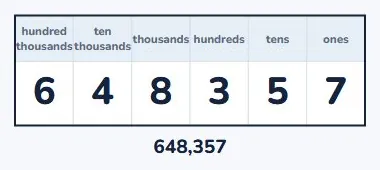
| thousands | ones |
|---|---|
| 648 | 357 |
Digits come in groups of three
- Count from the right and group the digits in threes.
- The last three are the ones. The next three are the thousands.
- The comma is not decoration. It marks where a group ends.
| thousands | ones |
|---|---|
| 648 | 357 |
Try it: build a number
Read the group, then say its name
- Read 648, then say "thousand".
- Then read 357.
- Six hundred and forty eight thousand, three hundred and fifty seven.
Try it: round a number
One more group and you have a million
- The biggest number here has six digits.
- Add one more and you reach 1,000,000.
- A million is a thousand thousands. The pattern just keeps going.
| millions | thousands | ones |
|---|---|---|
| 1 | 000 | 000 |
Compare from the left
- Which is bigger: 648,357 or 648,375?
- Start at the left and find the first digit that differs.
- Both have 648,3. Then 5 against 7. So 648,375 is bigger.
Try it: commas and bigger numbers
A factor divides exactly
- A factor of a number divides it with nothing left over.
- 4 is a factor of 36, because 36 ÷ 4 = 9.
- 5 is not, because 36 ÷ 5 leaves 1 behind.
Factors come in pairs
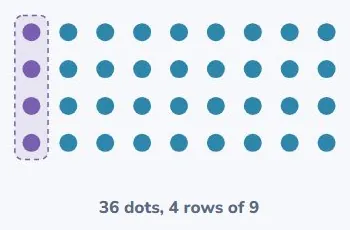
- Factors arrive two at a time, because 4 × 9 = 36.
- So 4 and 9 are a factor pair of 36.
- Every rectangle you can build from 36 dots is a pair.
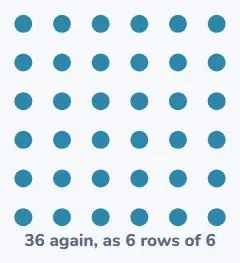
Try it: find every factor pair
Find them in order and you find them all
- Start at 1 and work up. 1 × 36, 2 × 18, 3 × 12, 4 × 9.
- 5 does not divide 36, so there is no pair with 5.
- Then 6 × 6. The two sides have met, so you are done.
| first | second |
|---|---|
| 1 | 36 |
| 2 | 18 |
| 3 | 12 |
| 4 | 9 |
| 6 | 6 |
Rounding is picking the nearest
- Rounding is not making a number shorter. It is choosing the nearest one.
- Nearest what? That has to be said, or the answer means nothing.
- Nearest ten, nearest hundred, nearest thousand.
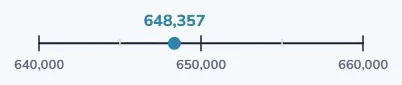
The number line settles it
- To the nearest ten thousand, 648,357 sits between 640,000 and 650,000.
- It is much closer to 650,000.
- Halfway is 645,000, and it is past that.
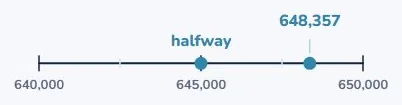
Same number, five answers
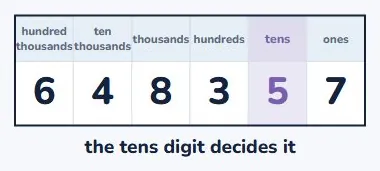
- Look at the digit to the RIGHT of the place you are rounding to.
- 5 or more rounds up. Less than 5 rounds down.
- One number, five different right answers.
| to the nearest | 648,357 becomes |
|---|---|
| hundred thousand | 600,000 |
| ten thousand | 650,000 |
| thousand | 648,000 |
| hundred | 648,400 |
| ten | 648,360 |
Decimals round the same way
- 3.7 is past halfway to 4, so it rounds to 4.
- 12.42 has not reached halfway, so it rounds to 12.
- The rule did not change. Only the size of the step did.
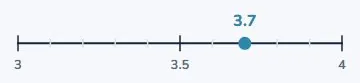
Common mistakes
- 648,357 to the nearest ten thousand is 640,000.It is past the halfway point, 645,000, so it rounds up to 650,000.
- 648,357 to the nearest thousand is 648.Rounding picks the nearest thousand, not a shorter number, so the answer is 648,000.
- The factor pairs of 36 are 1 × 36, 2 × 18, 3 × 12 and 4 × 9.Keep going until the two sides meet: 6 × 6 is a factor pair too.
- 648,357 and 648,375 use the same digits, so they are equal.Compare from the left: both start 648,3, then 7 tens beats 5 tens, so 648,375 is bigger.
Your turn
Write 205,060 in words.
Find every factor pair of 24.
Round 481,629 to the nearest thousand, and to the nearest ten thousand.
Round 9.6 and 40.31 to the nearest whole number.
Write eight hundred and seven thousand, and thirty in digits.
Order 306,450, 360,045 and 306,504 from smallest to largest.
Mere says the factor pairs of 30 are 1 and 30, 2 and 15, 3 and 10. Which pair has she missed?
Eden Park's crowd, rounded to the nearest thousand, was 50,000. Which could the real crowd have been?
Show answer
1. Two hundred and five thousand, and sixty. 2. 1 and 24, 2 and 12, 3 and 8, 4 and 6. 3. 482,000 and 480,000. 4. 10 and 40. 5. 407,030. The thousands group is 407 and the ones group is 030, because there are no hundreds. 6. 306,450, 306,504, 360,045. Compare from the left: 360,045 has a 6 in the ten thousands place, so it is largest, and 450 is less than 504. 7. 5 and 6, because 5 × 6 = 30. Working up from 1, 4 does not divide 30, then 5 does. 8. 49,850. It is between 49,000 and 50,000 and past halfway (49,500), so it rounds up to 50,000.
What to take away
- Group digits in threes from the right, and read a group at a time.
- Factors divide exactly, and they come in pairs.
- "Round it" is not a question until you say nearest what.
| to the nearest | 648,357 becomes |
|---|---|
| hundred thousand | 600,000 |
| ten thousand | 650,000 |
| thousand | 648,000 |
| hundred | 648,400 |
| ten | 648,360 |
| 3.7 to a whole | 4 |
Challenge
Mrs Ngata has 60 chairs to set out in equal rows. She wants at least 3 rows and at least 3 chairs in each row. How many different ways can she do it? (5 rows of 12 is different from 12 rows of 5.) The next day she has 61 chairs. Explain why there is now no way to do it.
Hint
The number of rows times the chairs in a row must be 60. List the factor pairs of 60 in order.
Answer
8 ways (3, 4, 5, 6, 10, 12, 15 or 20 rows). 61 has only one factor pair, 1 × 61, so it can only be 1 row or 61 rows of 1.
Step by step
- Rows × chairs in a row = 60, so the rows and the row length are a factor pair of 60.
- The factor pairs of 60 are 1 × 60, 2 × 30, 3 × 20, 4 × 15, 5 × 12 and 6 × 10.
- Each pair gives two ways, one each way round, but any pair with a 1 or a 2 is not allowed.
- That leaves 4 pairs, which is 8 ways: 3, 4, 5, 6, 10, 12, 15 or 20 rows.
- 61 cannot be split into equal groups except 1 × 61, so every layout has 1 row or 1 chair per row.
Full working
- 60 = 1 × 60 = 2 × 30 = 3 × 20 = 4 × 15 = 5 × 12 = 6 × 10every factor pair of 60
- drop 1 × 60 and 2 × 30rows and row lengths must be 3 or more
- 4 pairs × 2 ways round = 8rows: 3, 4, 5, 6, 10, 12, 15, 20
- 61 = 1 × 61 only61 ÷ 2, 3, 4, 5, 6 and 7 all leave a remainder, and 8 × 8 is already 64
- 8 ways for 60 chairs, none for 61
Kiri says: "If 4 and 6 are both factors of a number, then 24 must be a factor too, because 4 × 6 = 24." Find the smallest number that proves Kiri wrong. Then find the smallest number that has 4, 6 and 10 all as factors, and the smallest number that has 4, 6, 10 and 24 all as factors.
Hint
List the multiples of 6 and stop at the first one that 4 also divides. For the next parts, list multiples of the biggest number and test the others.
Answer
12 proves her wrong (4 and 6 divide it, 24 does not). The smallest with 4, 6 and 10 is 60. The smallest with 4, 6, 10 and 24 is 120.
Step by step
- Multiples of 6 are 6, 12, 18, 24 and so on. 4 does not divide 6, but it does divide 12.
- So 4 and 6 are both factors of 12, but 24 is bigger than 12, so it cannot be a factor. Kiri is wrong.
- A number with 4, 6 and 10 as factors is a multiple of 10 and of 12. Multiples of 10: 10, 20, 30, 40, 50, 60. The first one 12 divides is 60.
- Adding 24: multiples of 24 are 24, 48, 72, 96, 120. The first one that 10 also divides is 120, and 4 and 6 divide it too.
Full working
- 12 ÷ 4 = 3 and 12 ÷ 6 = 2both factors of 12
- 24 > 1224 cannot divide 12
- 10, 20, 30, 40, 50 are not multiples of 12; 60 = 5 × 124, 6 and 10 all divide 60
- 24, 48, 72, 96 do not end in 0; 120 = 5 × 24the first multiple of 24 that 10 divides
- 120 ÷ 4 = 30, 120 ÷ 6 = 20, 120 ÷ 10 = 12check
- 12 proves Kiri wrong; 60; 120
A whole number rounds to 360,000 to the nearest ten thousand, but to 365,000 to the nearest thousand, and to 364,800 to the nearest hundred. What are the smallest and the largest it could be, and how many whole numbers fit all three clues?
Hint
Turn each clue into a range of numbers using halfway points on a number line. The answer is the part where all three ranges overlap.
Answer
Smallest 364,750, largest 364,849, and 100 numbers fit.
Step by step
- Nearest hundred 364,800: from halfway below, 364,750, up to just under halfway above, 364,849.
- Nearest thousand 365,000: from 364,500 up to 365,499. The whole first range sits inside this.
- Nearest ten thousand 360,000: from 355,000 up to 364,999. The first range sits inside this too.
- So the number is anything from 364,750 to 364,849.
- Counting them: 364,849 − 364,750 + 1 = 100 numbers.
Full working
- 364,750 to 364,849round to 364,800 to the nearest hundred
- 364,500 to 365,499round to 365,000 to the nearest thousand
- 355,000 to 364,999round to 360,000 to the nearest ten thousand
- overlap: 364,750 to 364,849inside all three ranges
- 364,849 − 364,750 + 1 = 100count both ends
- Smallest 364,750, largest 364,849, 100 numbers
Practise this
Report a mistake
More in Number
Big numbers, factors and rounding5 min Negative numbers and counting on5 min
 Adding and subtracting big numbers5 min
 Multiplying and dividing bigger numbers6 min
 Tenths, hundredths and comparing decimals6 min
 Multiplying and dividing by 10 and 1006 min
 Adding fractions and decimals, and fractions of amounts5 min
 Money: totals, change and rounding5 min