
Cells: the building blocks of life
What this lesson covers
- How microscopes, and the work of Hooke and van Leeuwenhoek, revealed cells
- Cells are the basic units that all living things are made of
- The main organelles and what each one does
- How plant cells and animal cells compare
- Specialised cells shaped for jobs such as movement or storage
- How cells build tissues, organs and organ systems
- Microorganisms: single-celled life such as bacteria, yeast and some algae
Seeing cells for the first time
- Cells are far too small to see with your eyes alone, so nobody knew they existed until microscopes were invented.
- In 1665 the English scientist Robert Hooke published drawings of a thin slice of cork seen through his microscope. It was full of tiny empty boxes, which he named cells because they reminded him of small rooms.
- In the 1670s the Dutch lens-maker Antonie van Leeuwenhoek built simple microscopes with a single tiny lens that magnified over 200 times.
- He was the first to see living single-celled organisms, which he called animalcules, swimming in pond water and in scrapings from his own teeth, as well as blood cells.
- Later scientists, with better microscopes, showed that every living thing is made of cells and that new cells come only from existing cells.
Using a light microscope
- A school light microscope shines light up through a thin specimen on a glass slide.
- You look through the eyepiece lens, and an objective lens close to the slide makes the image bigger.
- Total magnification = eyepiece magnification × objective magnification.
- Always start with the lowest-power objective, focus with the coarse focus knob, then switch to a higher power and use only the fine focus knob.
Example: working out magnification
- A microscope has a 10× eyepiece and objective lenses of 4×, 10× and 40×. What is the highest total magnification?
- Highest objective = 40×pick the strongest lens
- 10 × 40 = 400eyepiece × objective
- 400×: the image is 400 times wider than the real thing
Try it: change the objective lens
Inside a cell
- A cell is the smallest unit that can carry out all the processes of life. It contains tiny structures called organelles, each with a job.
- Every animal and plant cell has a nucleus, cytoplasm, a cell membrane and mitochondria.
- Plant cells also have a cell wall, chloroplasts and usually a large vacuole.
| Part | Job | Animal cell | Plant cell |
|---|---|---|---|
| Nucleus | Holds the instructions (DNA) and controls the cell | Yes | Yes |
| Cytoplasm | Jelly where most chemical reactions happen | Yes | Yes |
| Cell membrane | Thin skin that controls what goes in and out | Yes | Yes |
| Mitochondria | Release energy from food (respiration) | Yes | Yes |
| Cell wall | Stiff outer layer that supports the cell | No | Yes |
| Chloroplasts | Use light to make food (photosynthesis) | No | Yes, in green parts |
| Large vacuole | Stores water and keeps the cell firm | No | Yes |
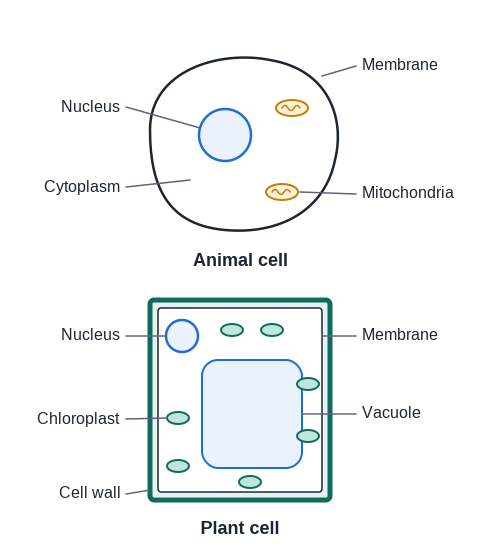
Example: plant or animal?
- A student draws two cells seen under a microscope. Cell A is a neat rectangle in a row of others, with a thick outline and a large clear space in the middle. Cell B is an irregular rounded shape with a thin outline and no clear space. Which is a plant cell?
- Regular box shape, thick outlinea cell wall gives a fixed shape
- Large clear spacea vacuole
- B: irregular, thin outlineonly a membrane, no wall
- A is a plant cell (like onion skin); B is an animal cell (like a cheek cell)
Try it: animal or plant cell
Specialised cells
- In a living thing made of many cells (a multicellular organism), cells divide the work between them.
- A specialised cell has a shape and set of parts that suit one job.
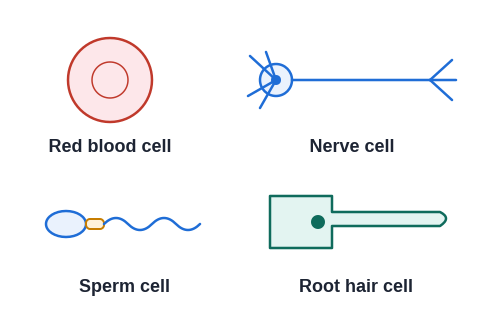
- Some cells are built for movement: a sperm cell swims with its tail, and muscle cells shorten to move bones.
- Some cells are built for storage: potato cells are packed with grains of starch, and fat cells store energy as oil.
- The shape of a cell is often the biggest clue to its job.
| Cell | Special feature | Job |
|---|---|---|
| Red blood cell | Disc shape, no nucleus | Carries oxygen around the body |
| Nerve cell | Very long, with branches | Carries messages quickly |
| Sperm cell | Long tail, lots of mitochondria | Swims to the egg (movement) |
| Root hair cell | Long thin extension | Takes in water from the soil |
| Potato cell | Filled with starch grains | Stores food (storage) |
From cells to systems
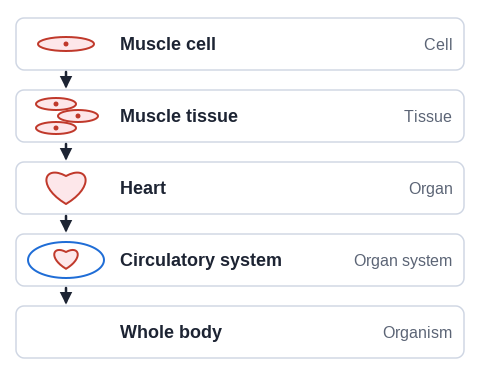
- Similar cells working together form a tissue, such as muscle tissue.
- Several tissues working together form an organ, such as the heart, which has muscle, nerve and lining tissues.
- Organs working together form an organ system, such as the circulatory system (heart, blood vessels and blood).
- Organ systems working together make up a whole organism.
- Plants are organised the same way: leaf cells, leaf tissues, the leaf as an organ, and the shoot system.
Example: putting levels in order
- Put these in order from smallest to largest: stomach, digestive system, stomach lining cell, stomach lining tissue, human.
- Cell: stomach lining cellthe smallest unit
- Tissue: stomach lining tissuemany similar cells
- Organ: stomachseveral tissues together
- Cell, tissue, stomach, digestive system, human
Try it: cell, tissue, organ or system?
Life in a single cell
- Microorganisms (microbes) are living things too small to see without a microscope. Many are made of just one cell, which does every job of life on its own.
- Bacteria are single cells with no nucleus. Some cause disease, but many are helpful, such as the bacteria that turn milk into yoghurt.
- Yeast is a single-celled fungus. Bakers use it to make bread rise, because it gives off carbon dioxide gas.
- Some algae are single cells, floating in ponds and the sea. The tiny algae in the ocean around New Zealand make food by photosynthesis and feed huge food webs.
- Not all fungi and algae are single-celled: a mushroom and a kelp forest are made of many cells.
Common mistakes
- Plant cells have a cell wall instead of a cell membrane.Plant cells have both: the membrane sits just inside the cell wall.
- Every plant cell has chloroplasts.Only cells in the green parts have chloroplasts; root cells, for example, have none.
- An organ is made of just one kind of cell.An organ is made of several tissues, such as the muscle, nerve and lining tissues in the heart.
- Magnification is eyepiece plus objective, so 10× and 40× gives 50×.Multiply the two: 10 × 40 = 400×.
Wake up some yeast
You need: 1 teaspoon of dried yeast, 2 teaspoons of sugar, warm tap water, a small plastic drink bottle, a balloon, a funnel or rolled-up paper
- Fill the bottle about a quarter full with warm (not hot) tap water.
- Use the funnel to add the sugar and the yeast, then swirl gently to mix.
- Stretch the balloon over the neck of the bottle and stand it somewhere warm.
- Check it every 10 minutes for half an hour and note any bubbles, froth and the size of the balloon.
- Look for the pattern: the mixture froths and the balloon slowly fills, because millions of single yeast cells are alive, feeding on the sugar and giving off carbon dioxide gas.
Safety: Use warm tap water only, ask an adult before using the kitchen, and do not drink the mixture; pour it down the sink when you finish.
Your turn
Which organelle controls the cell and holds its instructions?
Name two parts found in plant cells but not animal cells.
A microscope has a 10× eyepiece and a 10× objective. What is the total magnification?
Is the lung a cell, a tissue, an organ or an organ system?
A cell has a long tail and many mitochondria. What is it specialised for?
Show answer
1. The nucleus. 2. Any two of: cell wall, chloroplasts, large vacuole. 3. 10 × 10 = 100×. 4. An organ, because it is made of several tissues working together. 5. Movement: the tail swims and the mitochondria release the energy it needs, as in a sperm cell.
Recap
- Microscopes revealed cells: Hooke named them, and van Leeuwenhoek first saw living single-celled organisms.
- Cells are the basic units of life, with organelles that each do a job.
- Plant and animal cells share a nucleus, cytoplasm, membrane and mitochondria; plant cells also have a wall, chloroplasts and a large vacuole.
- Specialised cells have shapes that suit jobs such as movement or storage.
- Cells form tissues, tissues form organs, and organs form organ systems.
- Microorganisms such as bacteria, yeast and some algae are made of just one cell.
Challenge
Aroha's microscope has a 10× eyepiece and objectives of 4× and 40×. With the 4× objective, the circle she sees on a millimetre ruler is 4.5 mm wide. She swaps the ruler for onion skin and switches to the 40× objective. Exactly 3 onion cells, lying end to end, stretch across the circle. How long is one onion cell, in millimetres and in micrometres (1 mm = 1000 micrometres)? How long does one cell look in her image?
Hint
Work out both total magnifications first. If the image becomes 10 times bigger, the circle can only fit a part of the slide 10 times narrower.
Answer
One cell is 0.15 mm, or 150 micrometres, long; in the image it looks 60 mm (6 cm) long.
Step by step
- Total magnification is eyepiece × objective: 10 × 4 = 40× with the low objective, and 10 × 40 = 400× with the high one.
- 400× is 10 times the magnification of 40×, so the circle now shows a strip of slide 10 times narrower: 4.5 ÷ 10 = 0.45 mm.
- Three cells fill 0.45 mm, so one cell is 0.45 ÷ 3 = 0.15 mm long.
- 0.15 mm × 1000 = 150 micrometres.
- At 400× the image is 400 times the real size: 0.15 × 400 = 60 mm.
Full working
- Low power: 10 × 4 = 40×eyepiece × objective
- High power: 10 × 40 = 400×eyepiece × objective
- 400 ÷ 40 = 10magnification is 10 times bigger
- Field width = 4.5 ÷ 10 = 0.45 mm10 times narrower
- One cell = 0.45 ÷ 3 = 0.15 mmthree cells across
- 0.15 × 1000 = 150 micrometres1 mm = 1000 micrometres
- Image = 0.15 × 400 = 60 mmreal size × magnification
- 0.15 mm (150 micrometres) long; it looks 60 mm long
A scientist finds an unknown microbe in a jar of fruit juice that has started to fizz. Under the microscope each microbe is a single cell, alone, with a nucleus, a cell wall and no chloroplasts. When she puts some in warm sugary water in a bottle with a balloon on top, the balloon slowly fills with gas. Is the microbe a bacterium, a single-celled alga, an animal cell or yeast? Use each piece of evidence to rule out the wrong answers.
Hint
Take each choice in turn and look for one observation that it cannot explain. Which kinds of cell lack a nucleus? Which make their own food from light? Which have no cell wall?
Answer
Yeast (a single-celled fungus). It has a nucleus, so it is not a bacterium; no chloroplasts, so it is not an alga; a cell wall, so it is not an animal cell; and yeast gives off carbon dioxide from sugar, which fills the balloon.
Step by step
- Bacteria are single cells with no nucleus. This cell has a nucleus, so it is not a bacterium.
- Algae make their own food by photosynthesis, which happens in chloroplasts. This cell has none, so it is not an alga.
- Animal cells have a cell membrane but no cell wall. This cell has a wall, so it is not an animal cell.
- Yeast is a single-celled fungus with a nucleus and a cell wall but no chloroplasts, and it gives off carbon dioxide when it uses sugar.
- Every observation fits yeast, including the fizzing juice and the filling balloon.
Full working
- Has a nucleusrules out bacteria (no nucleus)
- No chloroplastsrules out algae (they photosynthesise)
- Has a cell wallrules out animal cells (membrane only)
- Single cell living alonenot a cell from a plant or animal body
- Uses sugar and gives off gasyeast releases carbon dioxide
- The microbe is yeast, a single-celled fungus
A root hair cell lives underground in the dark and has no chloroplasts, yet it is alive and uses energy all the time. Explain where its energy comes from, which part of the cell releases that energy, and what the root hair cell does for the rest of the plant in return. Use the ideas of specialised cells and of cells, tissues, organs and systems.
Hint
Which cells in the plant can make food, and where are they? The food has to travel to the root, so think about what links one organ of a plant to another. Then think about what the root hair cell's long thin shape is for.
Answer
Its food (sugar) is made by photosynthesis in the chloroplasts of green leaf cells and carried down to the root in the plant's transport tissue. The root hair cell's mitochondria release energy from that sugar by respiration. In return, the root hair cell takes in water (with dissolved minerals) from the soil, which is carried up to the leaves. Leaf and root are organs that depend on each other as parts of one organism.
Step by step
- Chloroplasts would be useless underground, because photosynthesis needs light, so root cells do not have them.
- Food is made in the green leaf cells, which are specialised for photosynthesis and packed with chloroplasts.
- Transport tissue running through the stem carries that sugar from the leaves (one organ) down to the roots (another organ).
- Like other plant cells, the root hair cell has mitochondria, and its mitochondria release energy from the sugar by respiration.
- The root hair cell is specialised the other way: its long thin extension reaches between soil particles to take in water and minerals, which travel up to the leaves.
- So no cell works alone: the leaf feeds the root and the root waters the leaf, as organs of one plant.
Full working
- Underground: no lightchloroplasts would be no use there
- Leaf cells: chloroplasts make sugarphotosynthesis needs light
- Transport tissue carries sugar down the stemlinks leaf and root organs
- Root hair cell: mitochondria release energyrespiration of that sugar
- Root hair extension takes in water and mineralsspecialised shape
- Water travels up to the leavesneeded for photosynthesis
- Energy from leaf-made sugar, released by its mitochondria; it supplies water to the leaves