
Populations, communities and ecosystems
What this lesson covers
- A population: one kind of organism living in one place at one time
- A community: all the populations in a place, interacting with each other
- An ecosystem: the community together with the non-living parts of its environment
- Biotic (living) and abiotic (non-living) factors
- Producers, consumers and decomposers, and how food webs show who eats whom
- Patterns in how many organisms fill each role
- How species depend on one another, from pollinators to shelter
From one organism to an ecosystem
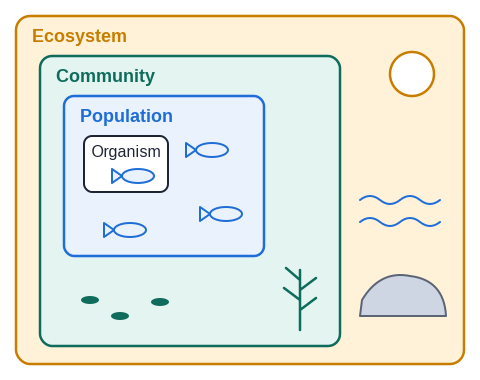
- An organism is a single living thing, such as one banded kōkopu (a native fish) in a stream.
- A population is all the members of one species found in one area during one period: all the banded kōkopu in that stream this year.
- A community is all the different populations living in that place and interacting: the kōkopu, mayfly larvae, koura (freshwater crayfish), ferns on the bank, algae on the rocks and many more.
- An ecosystem is the community plus the non-living parts of the environment it interacts with: the water, rocks, soil, air, sunlight and temperature.
Populations change
- A population always has a time and a place attached. The tūī in a city park this summer is one population; the tūī in another park is a different one.
- Populations grow when births and arrivals outnumber deaths and departures, and shrink the other way.
- Scientists track populations by counting or estimating them, for example in bird counts or by checking tracking tunnels for footprints.
Living and non-living parts
- Biotic factors are the living parts of an ecosystem, and the effects living things have on each other: food, predators, competitors, disease.
- Abiotic factors are the non-living parts: water, temperature, light, soil, rock, air and salt.
- Both kinds affect which organisms can live there. Kōkopu need cool, clear, well-oxygenated water, and shade from bank plants keeps the water cool.
| Bush stream | Examples |
|---|---|
| Biotic | Kōkopu, koura, mayfly larvae, algae, ferns, fungi, bacteria |
| Abiotic | Water flow, water temperature, sunlight, rocks, oxygen in the water |
Example: biotic or abiotic?
- Sort these parts of a rocky shore ecosystem: seaweed, waves, a sea star, sand, a fungus on driftwood, salt in the water, sunlight, a gull.
- Living, or made by something living now?the test to apply
- Biotic: seaweed, sea star, fungus, gullall living things
- Abiotic: waves, sand, salt, sunlightnone are alive
- Biotic: seaweed, sea star, fungus, gull; abiotic: waves, sand, salt, sunlight
Try it: biotic or abiotic?
Roles in an ecosystem
- Producers make their own food from sunlight by photosynthesis. Plants and algae are producers.
- Consumers eat other organisms. Herbivores eat producers; carnivores eat other animals; omnivores eat both.
- A top predator is a carnivore that nothing else in the web normally eats.
- Decomposers, such as fungi, bacteria and many worms, break down dead organisms and waste and return nutrients to the soil or water for producers to use again.
Try it: what role does it play?
Reading a food web
- A food chain shows one line of feeding. A food web joins many food chains together.
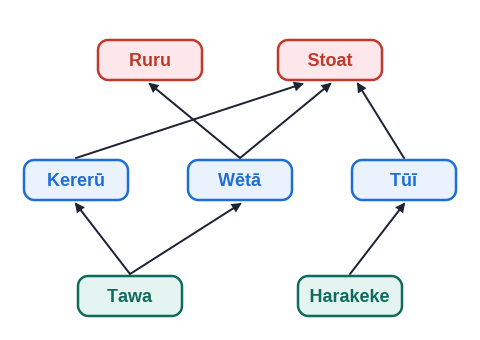
- Each arrow points from the food to the organism that eats it, so arrows show the direction energy moves.
- In this bush food web, tawa and harakeke are producers. Kererū eat tawa fruit, wētā eat leaves, and tūī drink harakeke nectar.
- Ruru (moreporks) eat wētā. Stoats, a pest brought to New Zealand, eat wētā, birds and eggs.
- Decomposers are not usually drawn, but they feed on every organism in the web once it dies.
Try it: a forest food web
Example: counting the roles
- A Year 7 class in Tauranga counted the organisms in four 1 m² squares of their school garden and sorted them by role.
- What pattern do the totals show, and why might it happen?
| Role | Organisms found | Total |
|---|---|---|
| Producers | Grass plants, clover, dandelions | 184 |
| Herbivores | Aphids, snails, slugs, caterpillars | 63 |
| Carnivores | Spiders, ladybirds, centipedes | 11 |
- 184 > 63 > 11compare the totals
- 63 ÷ 184 ≈ 0.34; 11 ÷ 63 ≈ 0.17each level is a fraction of the one below
- Each animal eats many organisms below it, and energy is used up at every stepa likely reason
- Numbers fall at each step up: most producers, fewer herbivores, fewest carnivores
- Food webs from other places show the same pattern: few top predators, many producers
Species depend on each other
- Interdependence means species in an ecosystem rely on each other, so a change to one affects others.
- Food: every consumer depends on what it eats, and in the end on producers.
- Pollination: many native flowers, including harakeke and kōwhai, are pollinated by nectar-feeding birds such as tūī and korimako (bellbirds), which carry pollen from flower to flower.
- Seed dispersal: kererū swallow large fruit and drop the seeds far away, helping trees such as tawa and taraire spread.
- Shelter: tree wētā hide in holes in tree trunks by day, and many insects live in leaf litter under the trees.
Example: when a species disappears
- Use the bush food web. Suppose trapping removes all the stoats from a reserve. Predict what happens to the wētā, the tūī and the harakeke.
- Stoats eat wētā, tūī and kererūfrom the arrows
- No stoats: more wētā, tūī and kererū surviveless predation
- More tūī: more harakeke flowers pollinatedtūī carry pollen
- Wētā, tūī and kererū increase, and harakeke may set more seed
- More wētā could also mean more food for ruru, so ruru may increase too
Common mistakes
- In a food web, the arrow points from the eater to its food.The arrow points from the food to the eater, showing the way energy flows.
- A population is all the animals living in an area.A population is just one species; all the species together make a community.
- An ecosystem is only the living things in a place.An ecosystem includes the non-living parts too, such as water, soil, light and temperature.
- Removing a predator only affects the animals it eats.The change spreads through the web, reaching plants, other predators and the species that depend on them.
Survey a square of garden
You need: 4 sticks or pegs, string about 4 m long, a ruler or tape measure, a magnifying glass if you have one, a notebook and pencil
- Mark out a 1 m by 1 m square on a lawn or garden bed with the pegs and string.
- Count or estimate the plants in your square, and write down any animals you find, gently lifting leaves and looking under stones.
- Sort what you found into producers, herbivores, carnivores and decomposers (such as fungi or worms).
- Note the abiotic factors too: is the soil wet or dry, is the square sunny or shady, and how warm is it?
- Look for the pattern: you will almost always find far more producers than herbivores, and fewest carnivores.
Safety: Ask an adult where you may survey, wash your hands afterwards, and do not pick up spiders, bees or wasps; put any stones back where they were.
Your turn
All the pōhutukawa trees on one headland this year form a what?
Is the temperature of a rock pool a biotic or an abiotic factor?
In the bush food web, name one producer and one top predator.
Which way does an arrow point in a food web: from the food or from the eater?
Fungi on a fallen log break it down. What role do the fungi have, and why does the ecosystem need them?
Show answer
1. A population, because it is one species in one place at one time. 2. Abiotic, because temperature is not living. 3. Producer: tawa or harakeke; top predator: the stoat or the ruru, since nothing in the web eats them. 4. From the food to the eater. 5. They are decomposers; they return nutrients from dead material to the soil so producers can use them again.
Recap
- A population is one species in one place at one time; a community is all the populations there, interacting.
- An ecosystem is a community together with the non-living parts of its environment.
- Biotic factors are living; abiotic factors are non-living, such as water, light and temperature.
- Producers, consumers and decomposers each have a role, and food web arrows point from food to eater.
- Surveys and food webs show a pattern: many producers, fewer herbivores, and fewest predators.
- Species depend on each other for food, pollination, seed dispersal and shelter.
Challenge
On a forest island, possums and rats are controlled, but the last kererū died out 20 years ago. The old tawa trees there still look healthy and still drop plenty of fruit every year. A visitor says, 'Losing the kererū made no difference to this forest.' Explain why the forest will still change over the next hundred years, and predict which kinds of trees will become more common.
Hint
Kererū are the bird that swallows large fruit and drops the seeds far away. A tree can live for hundreds of years, so look past the trees standing now: what happens to the next generation?
Answer
Without kererū, almost no large tawa seeds are carried away from the parent trees, so few young tawa grow in new places. As the old trees die, they are not replaced across the forest, so tawa slowly becomes rarer. Trees with small fruit, whose seeds smaller birds like tūī and silvereyes can still carry, fill the gaps and become more common.
Step by step
- The adult trees are alive now, but a forest depends on new young trees growing to replace the old ones.
- Kererū swallow large fruit, such as tawa, and drop the seeds far from the parent. Few other birds can swallow fruit that big.
- Without kererū, the seeds mostly fall under the parent tree, where they crowd and shade each other, so few new tawa grow out in the rest of the forest.
- When old tawa die and leave gaps, there are few young tawa nearby to take their place.
- Trees with small fruit still have their seeds spread by smaller birds, so they fill the gaps and become more common.
- The change is slow because trees live so long, which is why the forest looks fine for now.
Full working
- Old tawa alive and fruitingthe change is not visible yet
- Kererū gonelarge seeds are no longer spread far
- Seeds fall under the parent treefew new tawa elsewhere
- Old tawa die over timenot replaced across the forest
- Small-fruited trees still spread by small birdsthey fill the gaps
- Tawa slowly becomes rarer; trees with small fruit become more common
In a simple stream food chain, algae → mayfly larvae → kōkopu → shag, the algae store 200,000 kJ of energy in a year. Assume about 110 of the energy at each level passes on to the next. How much energy reaches the shags in a year? In this model each kōkopu needs 50 kJ a year and one shag needs 4000 kJ a year. How many kōkopu can the stream feed, and what does that tell you about where the shags must feed? Where does the other 910 of the energy go at each step?
Hint
Divide by 10 once for each arrow. Then compare what reaches each level with what one animal needs.
Answer
200 kJ reaches the shags. The stream can feed about 40 kōkopu but only 120 of one shag, so shags must feed across many streams and lakes. Most energy at each step is used by the organism to live (moving, growing, keeping warm, released as heat in respiration) or is in parts that are never eaten, which pass to decomposers.
Step by step
- This is a model: in real food chains the share passed on varies, but about 110 is a common rule of thumb. In the model, divide by 10 at each step.
- Mayfly larvae get 20,000 kJ, kōkopu get 2000 kJ and shags get 200 kJ.
- 2000 kJ shared by kōkopu needing 50 kJ each feeds about 40 kōkopu.
- 200 kJ is only 120 of the 4000 kJ one shag needs, so one stream cannot even feed one shag. Shags must hunt over a large area.
- The missing energy is used by each organism to stay alive and is lost as heat, or is in bones, shells and waste that the next level does not eat, which decomposers use.
- This is why food chains rarely have more than four or five links: there is too little energy left at the top.
Full working
- Algae: 200,000 kJgiven
- Mayfly larvae: 200,000 ÷ 10 = 20,000 kJone tenth passes on
- Kōkopu: 20,000 ÷ 10 = 2000 kJone tenth again
- Shags: 2000 ÷ 10 = 200 kJone tenth again
- 2000 ÷ 50 = 40 kōkopuenergy over need
- 200 ÷ 4000 = 120 of a shagfar less than one bird needs
- 200 kJ reaches the shags; about 40 kōkopu; shags must feed over many streams
A Rotorua school field is 30 m long and 20 m wide. A quarter of it lies in deep shade under a row of trees; the rest is in full sun. Students count clover plants in four 1 m by 1 m squares in the sun (12, 16, 14, 18) and four in the shade (3, 5, 4, 4). One student averages all eight counts and multiplies by the area of the field. Find her estimate and a better one, and explain why hers is wrong.
Hint
Find the area of the sunny part and the shaded part separately. Each part needs its own average. Why should the two parts not count equally?
Answer
Her estimate is 5700 plants; a better estimate is 7350 plants. She gave the shade squares the same weight as the sun squares, but the shade covers only a quarter of the field. Light is an abiotic factor that clearly changes how many clover grow, so each part must be estimated on its own.
Step by step
- The field is 30 × 20 = 600 m². A quarter, 150 m², is shaded, and 450 m² is sunny.
- Average in the sun: (12 + 16 + 14 + 18) ÷ 4 = 15 plants per m². Average in the shade: (3 + 5 + 4 + 4) ÷ 4 = 4 plants per m².
- Sunny part: 450 × 15 = 6750. Shaded part: 150 × 4 = 600. Total about 7350 plants.
- Her way: (60 + 16) ÷ 8 = 9.5 per m², and 9.5 × 600 = 5700, which is far too low.
- Her mistake treats half the field as shady when only a quarter is. Clover is a producer that needs light, so the shade (an abiotic factor) lowers its numbers and the two areas must be handled separately.
Full working
- 30 × 20 = 600 m²whole field
- 600 ÷ 4 = 150 m² shaded; 600 − 150 = 450 m² sunnya quarter in shade
- Sun: (12 + 16 + 14 + 18) ÷ 4 = 15 per m²sunny average
- Shade: (3 + 5 + 4 + 4) ÷ 4 = 4 per m²shady average
- 450 × 15 + 150 × 4 = 6750 + 600 = 7350each part on its own
- Her estimate: 76 ÷ 8 = 9.5, and 9.5 × 600 = 5700shade counted as half the field
- Better estimate about 7350 clover plants (hers, 5700, is too low)