Measuring accurately, and converting units
What this lesson covers
- Different measurement tools and scales use different-sized units; the unit must be recorded with the measurement amount.
- Measurements can be communicated using mixed or decimal units.
- There are 1000 millimetres in a metre, 10 millimetres in a centimetre, 100 centimetres in a metre, and 1000 metres in a kilometre.
Five what?
- How long is this line? Suppose you answer "five".
- Five millimetres, or five metres? They differ by a thousand.
- A number on its own is not a measurement at all.
| answer | is it a measurement? |
|---|---|
| 5 | no, five of what? |
| 5 cm | yes |
| 5 m | yes, and 100 times longer |
Always write the unit
- Different tools and scales use different-sized units.
- So the unit has to be recorded with the amount, every time.
- Leaving it off is not untidy. It makes the answer meaningless.
| written | roughly |
|---|---|
| 5 mm | across a match head |
| 5 cm | across a plum |
| 5 m | across a classroom |
| 5 km | a long walk |
Five tools, five quantities
- Each tool measures one kind of thing, in its own units.
- Pick the tool for the quantity, then the unit for the size.
- You would not weigh a truck in grams.
| tool | measures | units |
|---|---|---|
| ruler | length | mm, cm, m |
| scales | mass | g, kg |
| measuring jug | capacity | mL, L |
| thermometer | temperature | °C |
| timer | duration | s, min, h |
Measuring with a ruler
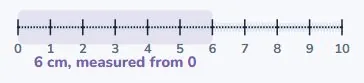
- Line the object up with the 0 mark, not the end of the ruler.
- The end is often plastic before the scale even starts.
- Then read the mark the object finishes at. This is 6 cm.
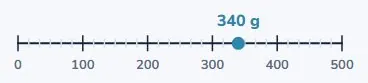
What is one mark worth?
- Before reading any scale, work out one small mark.
- Here the labels are 100 g apart with 5 gaps between them.
- So one mark is 20 g. Assume 1 g and you are out by twenty times.
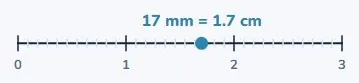
Millimetres inside centimetres
- There are 10 millimetres in every centimetre.
- So the little marks on a ruler are the tenths.
- 17 small marks is 17 mm, which is 1.7 cm.
The four facts to know
- These are worth memorising, because everything else follows.
- Notice they are all 10s, 100s and 1000s.
- Which is why converting is only ever moving digits.
| this many | make |
|---|---|
| 1000 mm | 1 m |
| 10 mm | 1 cm |
| 100 cm | 1 m |
| 1000 m | 1 km |
Metres into centimetres
- 100 cm make a metre, so a metre is 100 centimetres.
- Going m to cm: multiply by 100, so digits two places left.
- Going cm to m: divide by 100, so two places right.
| hundreds | tens | ones | tenths | |
|---|---|---|---|---|
| 2.5 m | 2 | 5 | ||
| 250 cm | 2 | 5 | 0 |
Three conversions
- 2.5 m × 100 = 250 cm.
- 340 cm ÷ 100 = 3.4 m.
- 0.07 m × 100 = 7 cm. Small numbers work the same way.
| from | to | how |
|---|---|---|
| 2.5 m | 250 cm | × 100 |
| 340 cm | 3.4 m | ÷ 100 |
| 0.07 m | 7 cm | × 100 |
Try it: one length, every unit
Mixed units or decimal units
- A measurement can be written either way.
- 1 m 45 cm and 1.45 m are the same length.
- Mixed is easier to say. Decimal is easier to calculate with.
| mixed units | decimal units |
|---|---|
| 1 m 45 cm | 1.45 m |
| 2 km 300 m | 2.3 km |
| 3 cm 8 mm | 3.8 cm |
Time is the exception
- Money is in 100s, so $2.50 really is two and a half dollars.
- Time is in 60s. 2 hours 30 minutes is 2.5 hours.
- It is never 2.30 hours. That is not two and a half of anything.
| written | means | because |
|---|---|---|
| $2.50 | two and a half dollars | 50 of 100 cents |
| 2.5 hours | 2 hours 30 minutes | 30 of 60 minutes |
| 2.30 hours | not 2 h 30 min | nobody means this |
Try it: time counts in sixties
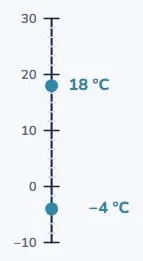
A thermometer is a number line
- Same vertical line you used for negative numbers.
- The unit is degrees Celsius, written °C.
- And it reads below zero without anything changing.
Common mistakes
- 2 hours 30 minutes is 2.30 hours.Time counts in 60s, so 30 minutes is half an hour: 2 hours 30 minutes is 2.5 hours.
- 340 cm = 34,000 mGoing from cm to m divides by 100, because 100 cm make 1 m: 340 cm ÷ 100 = 3.4 m.
- I lined the end of the ruler up with the pencil, and it reads 6 cm.Line the object up with the 0 mark, not the end of the ruler, because the scale often starts a little way in.
- The labels are 100 g apart, so each small mark is 1 g.Work out one mark first: 100 g split into 5 gaps makes each mark 20 g.
Your turn
A scale is labelled every 50 g with 5 gaps. One mark?
Convert 4.2 m to cm, and 65 cm to m.
Write 2 m 7 cm in decimal metres.
Write 3 hours 15 minutes as a decimal number of hours.
Which tool and unit would you use to measure the water in a kettle?
A pencil is 143 mm long. How long is that in centimetres?
A feather lies on a ruler from the 2 cm mark to the 9.5 cm mark. How long is the feather?
On Ruapehu it is −3 °C at dawn and 5 °C at noon. By how many degrees did it rise?
Show answer
1. 10 g a mark. 2. 420 cm, and 0.65 m. 3. 2.07 m: the 7 is in the hundredths, because 7 cm is 7/100 of a metre. 4. 3.25 hours, because 15 minutes is a quarter of 60. 5. Measuring jug, mL. Water in a kettle is a capacity, and capacity is measured with a jug in mL or L. 6. 14.3 cm. There are 10 mm in every centimetre, so 143 ÷ 10 = 14.3. 7. 7.5 cm. It does not start at 0, so take the start from the end: 9.5 − 2 = 7.5. 8. 8 degrees. On the thermometer it is 3 degrees up from −3 °C to 0 °C, then 5 more to 5 °C, so 3 + 5 = 8.
What to take away
- Every measurement needs a unit, or it is not a measurement.
- Before reading a scale, work out what one mark is worth.
- Converting metres and centimetres is × 100 and ÷ 100.
| job | the move |
|---|---|
| give an answer | number and unit, always |
| read a scale | find one mark first |
| m to cm | × 100 |
| cm to m | ÷ 100 |
Challenge
Tia has a ribbon 2.5 m long. She cuts off 3 pieces that are each 48 cm long. From the rest she cuts as many bows as she can, each 65 mm long. (a) How many bows does she get, and how much ribbon is left over, in centimetres? (b) Tia starts again with the ribbon left after the 3 pieces. This time she wants to cut it all into equal bows, each a whole number of millimetres, with nothing left over. Each bow must be shorter than 65 mm but as long as possible. How long is each bow, and how many does she get?
Hint
Change every length into millimetres before you do anything else. For (b), the number of bows times the length of one bow must make exactly the ribbon that is left.
Answer
(a) 16 bows, with 2 cm left over. (b) Each bow is 53 mm long, and she gets 20 bows.
Step by step
- 2.5 m is 2500 mm, and 3 pieces of 48 cm are 3 × 480 = 1440 mm.
- That leaves 2500 − 1440 = 1060 mm.
- 1060 ÷ 65 = 16 remainder 20, so 16 bows and 20 mm (2 cm) left over.
- For (b), the bow length must divide 1060 exactly. Trying lengths down from 64 mm, the first that works is 53 mm.
- 1060 ÷ 53 = 20, so she gets 20 bows.
Full working
- 2.5 m = 2500 mm, 48 cm = 480 mmsame unit
- 2500 − 3 × 480 = 1060 mmribbon left
- 1060 ÷ 65 = 16 remainder 2016 × 65 = 1040
- 20 mm = 2 cmleftover
- 1060 = 53 × 2054 to 64 do not divide 1060 exactly
- (a) 16 bows, 2 cm left (b) 20 bows of 53 mm
A snail crawls 6 mm every minute along a garden path that is 1.35 m long. It sets off at 10:30 am. How long does it take to reach the end? Give the time in hours and minutes, and also as a decimal number of hours. At what time does it arrive?
Hint
Change the path length into millimetres so it matches the snail's speed. Then remember that time counts in sixties.
Answer
225 minutes, which is 3 hours 45 minutes or 3.75 hours. It arrives at 2:15 pm.
Step by step
- The speed is in millimetres, so change 1.35 m into millimetres: 1.35 × 1000 = 1350 mm.
- Each minute covers 6 mm, so the number of minutes is 1350 ÷ 6 = 225.
- 225 minutes is 3 lots of 60 (180 minutes) with 45 left over: 3 hours 45 minutes.
- 45 minutes is three quarters of an hour, so as a decimal it is 3.75 hours, not 3.45 hours.
- 10:30 am plus 3 hours is 1:30 pm, and 45 minutes more is 2:15 pm.
Full working
- 1.35 m × 1000 = 1350 mm1000 mm in a metre
- 1350 ÷ 6 = 225 minutes6 mm each minute
- 225 = 3 × 60 + 4560 minutes in an hour
- 225 minutes = 3 h 45 min
- 45 min = 45 of 60 = 0.75 hthree quarters of an hour
- 10:30 am + 3 h = 1:30 pm, then + 45 min = 2:15 pm
- 3 h 45 min = 3.75 hours, arriving at 2:15 pm
A farmer builds a straight fence 1.2 km long, with a post at the very start, a post at the very end, and a post every 2.5 m in between. How many posts does she need? Her neighbour builds a fence around a closed loop that is also 1.2 km long, with posts 2.5 m apart all the way round. Why does the neighbour need a different number of posts, and how many?
Hint
Find how many 2.5 m gaps fit into 1.2 km first. Then draw a short fence with 3 gaps and count its posts. What happens when the two ends of the fence meet?
Answer
The straight fence needs 481 posts. The loop needs 480 posts, because its start and end are the same post.
Step by step
- 1.2 km is 1200 m.
- In every 10 m there are 4 gaps of 2.5 m, and 1200 m is 120 lots of 10 m, so there are 120 × 4 = 480 gaps.
- On a straight fence there is always one more post than gaps (3 gaps need 4 posts), so 481 posts.
- On a closed loop the last gap ends back at the first post, so posts and gaps are equal: 480 posts.
Full working
- 1.2 km × 1000 = 1200 m1000 m in a kilometre
- 10 m ÷ 2.5 m = 4 gaps4 gaps in every 10 m
- 1200 m = 120 × 10 m120 lots of 10 m
- 120 × 4 = 480 gapsnumber of 2.5 m gaps
- straight fence: 480 + 1 = 481 postsa post at both ends
- loop: 480 poststhe end post is the start post
- 481 posts for the straight fence, 480 for the loop