
The equals sign, inequalities and growing patterns
What this lesson covers
- The relative size of expressions involving numbers can be communicated using “greater than” (>), “less than” (<), and equals (=).
- Growing patterns can increase or decrease by the addition or subtraction of a constant (arithmetically) or multiplication or division by a constant (geometrically).
You can answer this without adding
- Is 2,456 + 203,938 bigger or smaller than 3,456 + 231,930?
- Both parts on the right are bigger than both on the left.
- So the left is smaller, and you added nothing. Read, do not calculate.
| left | right | bigger? |
|---|---|---|
| 2,456 | 3,456 | right |
| 203,938 | 231,930 | right |
What the equals sign actually means
- Equals does not mean "here comes the answer".
- It means the two sides are the same. It balances.
- Which is why it reads in both directions.
| reading "=" as | what that costs you |
|---|---|
| "here comes the answer" | you reject 7 + 5 = 6 + 6 |
| "the same as" | you accept it: both sides are 12 |
Try it: make it balance
All three of these are true
- 7 + 5 = 12. Nobody argues with that one.
- 12 = 7 + 5 is equally true. The sign is not an arrow.
- 7 + 5 = 6 + 6 is true too. No single answer in sight.
| sentence | is it true? |
|---|---|
| 7 + 5 = 12 | true |
| 12 = 7 + 5 | true: it reads both ways |
| 7 + 5 = 6 + 6 | true: both sides are 12 |
When it does not balance
- Then one side is greater than the other, and you say so.
- > is greater than. < is less than.
- The pointed end always aims at the smaller number.
| symbol | means | example |
|---|---|---|
| = | the same as | 6 + 6 = 12 |
| > | greater than | 13 > 12 |
| < | less than | 11 < 12 |
Now check the opening question
- 2,456 + 203,938 is 206,394.
- 3,456 + 231,930 is 235,386.
- So the symbol is <, exactly as the comparison said.
| side | total |
|---|---|
| 2,456 + 203,938 | 206,394 |
| 3,456 + 231,930 | 235,386 |
A harder one, still no calculating
- 2,456 × 2 against 1,228 × 4.
- 2,456 is double 1,228. And 2 is half of 4.
- Double one, halve the other, and the product does not move.
| first number | second number | |
|---|---|---|
| left | 2,456 | 2 |
| right | 1,228 | 4 |
| change | halved | doubled |
Check it, once
- 2,456 × 2 = 4,912.
- 1,228 × 4 = 4,912.
- Equal. The reasoning was right, and it was quicker.
| side | value |
|---|---|
| 2,456 × 2 | 4,912 |
| 1,228 × 4 | 4,912 |
Is this sentence true?
- Work out each side separately, then compare them.
- 60 − 15 = 40 is false, because the left side is 45.
- 9 × 4 = 40 − 4 is true. Both sides come to 36.
| sentence | true or false |
|---|---|
| 45 + 30 = 75 | true |
| 60 − 15 = 40 | false: it is 45 |
| 9 × 4 = 40 − 4 | true: both are 36 |
An open sentence has something hidden
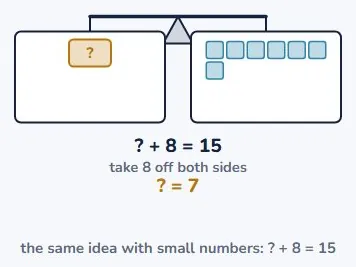
- 999,999 − ⬚ = 899,999. What is in the box?
- The balance has to stay level, so ask what was taken away.
- 999,999 down to 899,999 is a drop of 100,000.
A pattern that adds a constant
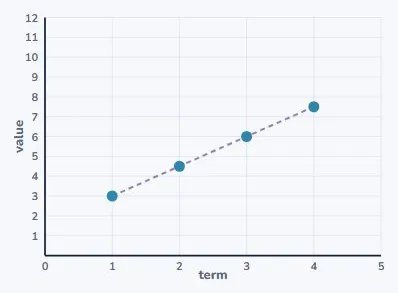
- 3, 4.5, 6, 7.5 and so on.
- Each term is 1.5 more than the one before it.
- Plot it and the points sit on a straight line.
Try it: grow the pattern
A pattern that multiplies
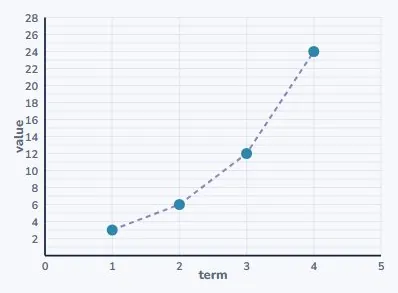
- 3, 6, 12, 24 and so on.
- Each term is double the one before, not 3 more.
- Plot that and it curves, getting steeper as it goes.
Both kinds run downhill too
- A pattern can shrink by a constant: subtract 3 each time.
- Or shrink by a constant multiple: halve it each time.
- To describe any pattern, give the first term and the rule.
| pattern | the rule |
|---|---|
| 20, 17, 14, 11 ... | subtract 3 |
| 80, 40, 20, 10 ... | divide by 2 |
Common mistakes
- 7 + 5 = 6 + 6 is false, because the answer should be 12.Equals means both sides are the same, not here comes the answer; both sides are 12, so it is true.
- 206,394 > 235,386The pointed end aims at the smaller number, so write 206,394 < 235,386.
- 999,999 − ⬚ = 899,999, so the box is 1.999,999 down to 899,999 is a drop of 100,000, so the box is 100,000.
- 3, 6, 12, 24: it goes up by 3, so next is 27.The gaps are 3, 6, 12, so it is not adding a constant; each term doubles, so next is 48.
Your turn
Put in <, > or =: 4,000 + 500 and 4,500 + 1.
Put in <, > or =: 6 × 8 and 12 × 4.
Fill the box: 450 + ⬚ = 1,000.
Continue and describe: 2, 5, 8, 11 ... and 1, 3, 9, 27 ...
Fill the box so both sides balance: 9 + 6 = ⬚ + 8.
Which number sentence is true?
Continue the pattern and give its rule: 64, 32, 16, 8 ...
A pattern starts at 3 and adds 1.5 each time. What is the 6th term?
Show answer
1. < (the right is one more). 2. = (halve 12 and double 4 gives 6 and 8, so both are 48). 3. 550. 4. 14, 17: start at 2, add 3. Then 81, 243: start at 1, multiply by 3. 5. 7. The left side is 15, so the right side must be 15 too, and 7 + 8 = 15. The box is not just the answer to 9 + 6. 6. 8 × 5 = 50 − 10. Work out each side: 8 × 5 is 40 and 50 − 10 is 40, so both sides are the same. 7. 4, 2 (divide by 2). Each term is half the one before: 8 ÷ 2 = 4 and 4 ÷ 2 = 2. 8. 10.5. The terms are 3, 4.5, 6, 7.5, 9, 10.5, so the 6th term is 10.5 (five jumps of 1.5 after the first term).
Equality Explorer: Basics
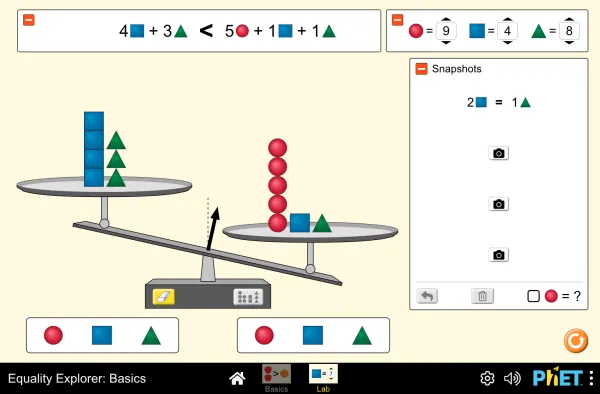
Full screen · PhET Interactive Simulations, University of Colorado Boulder, CC BY 4.0
What to take away
- Equals means balance, and it reads in both directions.
- Often you can decide a sentence by comparing, not calculating.
- Describe a pattern with its first term and its rule.
| job | the move |
|---|---|
| = | both sides the same |
| > or < | the point aims at the smaller side |
| a hidden number | ask what keeps it balanced |
| a growing pattern | find what is done each time |
Challenge
Without working out any of them in full, put these three in order from smallest to largest: A = 498 × 25, B = 500 × 24, C = 250 × 49.
Hint
Compare each one with 500 × 25. How far short of it does each one fall?
Answer
B < C < A, that is 500 × 24 < 250 × 49 < 498 × 25.
Step by step
- 500 × 25 = 12,500 is easy, so measure each one against it.
- A is 2 lots of 25 fewer than 500 × 25, so it is 50 short.
- B is one lot of 500 fewer, so it is 500 short.
- C is 250 × 50 take away one 250, and 250 × 50 is also 12,500, so C is 250 short.
- The one that falls shortest is biggest: A, then C, then B.
Full working
- 500 × 25 = 12,500the benchmark
- A = 12,500 − 2 × 25 = 12,500 − 50498 is 2 less than 500
- B = 12,500 − 50024 is 1 less than 25
- C = 250 × 50 − 250 = 12,500 − 25049 is 1 less than 50
- 500 > 250 > 50B is furthest short, A is closest
- B < C < A (12,000 < 12,250 < 12,450)
A pattern of whole numbers grows by multiplying by the same whole number each time. The 2nd number is 12 and the 5th number is 324. What is the 1st number, and what is the 4th number?
Hint
Going from the 2nd number to the 5th number takes three steps, each with the same multiplier.
Answer
The 1st number is 4 and the 4th number is 108 (the pattern is 4, 12, 36, 108, 324).
Step by step
- From the 2nd number to the 5th there are three multiplying steps.
- So 12 is multiplied by the same number three times to reach 324.
- 324 ÷ 12 = 27, and 3 × 3 × 3 = 27, so the multiplier is 3.
- Go back one step from 12: 12 ÷ 3 = 4.
- Go forward: 12, 36, 108, so the 4th number is 108.
Full working
- 324 ÷ 12 = 27the effect of three steps
- 3 × 3 × 3 = 27so each step is × 3
- 12 ÷ 3 = 4back one step to the 1st number
- 12 × 3 = 36, 36 × 3 = 1083rd and 4th numbers
- 108 × 3 = 324check the 5th number
- 1st number 4, 4th number 108
Five whole numbers are in a row, and each one is bigger than the one before: 2, □, □, □, 162. The first three numbers make an adding pattern (the same amount is added each time). The last three numbers make a multiplying pattern (multiply by the same whole number each time). Fill in the boxes, and explain why there is only one answer.
Hint
Call the middle number M. It is reached from 2 by adding twice, and it reaches 162 by multiplying twice. What could the multiplier be?
Answer
2, 10, 18, 54, 162. It is the only answer because the multiplier must be 3.
Step by step
- The middle number is multiplied by the same number twice to make 162.
- 162 = 2 × 9 × 9, so the multiplier times itself must divide 162: the multiplier can only be 1, 3 or 9.
- A multiplier of 1 would make the numbers equal, not bigger, so that is out.
- A multiplier of 9 makes the middle number 2, the same as the first number, so that is out.
- A multiplier of 3 makes the middle number 18 and the 4th number 54.
- From 2 to 18 is two equal jumps of 8, so the 2nd number is 10.
Full working
- M × r × r = 162middle number times the multiplier twice
- r × r = 1, 9 or 81the square numbers that divide 162
- r = 1: 162, 162, 162not getting bigger
- r = 9: M = 162 ÷ 81 = 2same as the first number
- r = 3: M = 162 ÷ 9 = 18, 4th number 18 × 3 = 54works
- 18 − 2 = 16, 16 ÷ 2 = 8, 2nd number 2 + 8 = 10the adding pattern
- 2, 10, 18, 54, 162