Area, perimeter and volume
What this lesson covers
- Volume is a measure of regions in three-dimensional space.
- The areas of rectangles (including squares) can be calculated by multiplication of side lengths.
Same paper, different fence
- Two rectangles can cover exactly the same amount of paper.
- And still need different lengths of fence around them.
- Area and perimeter measure different things. Here is the difference.
| rectangle | covers | fence needed |
|---|---|---|
| 6 by 2 | 12 cm² | 16 cm |
| 4 by 3 | 12 cm² | 14 cm |
Perimeter is the distance around
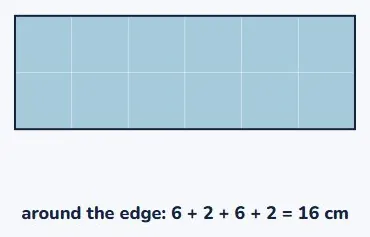
- Walk all the way round the edge and measure how far you went.
- For a 6 by 2 rectangle: 6 + 2 + 6 + 2.
- That is 16 cm. A perimeter is a length, so the unit is cm.
A regular polygon is quicker
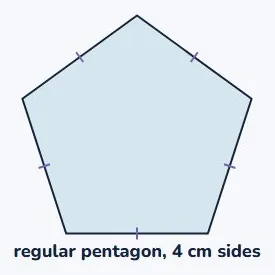
- Regular means every side is the same length.
- So you do not add five numbers. You multiply one.
- A pentagon with 4 cm sides: 5 × 4 = 20 cm.
An awkward shape, and a surprise
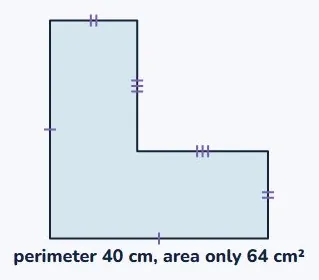
- Take a 10 by 10 square and cut a 6 by 6 corner out of it.
- Add the six sides: 10 + 4 + 6 + 6 + 4 + 10 = 40 cm.
- The square was also 40 cm. The fence did not change.
Area is the covering
- Area is how much surface the shape covers.
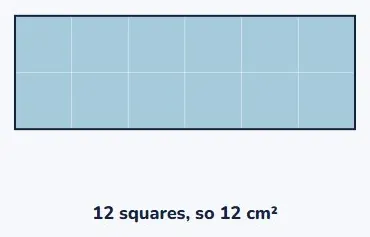
- Measure it in squares. A square 1 cm each way is 1 cm².
- Count them: this rectangle covers 12 squares, so 12 cm².
Why you can just multiply
- You do not have to count 12 squares one at a time.
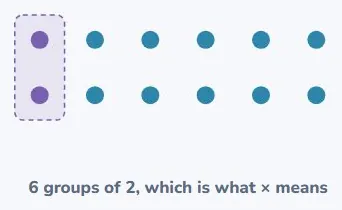
- It is 6 columns with 2 squares in each: 6 groups of 2.
- Groups of something is multiplication. So area is 6 × 2.
The units keep them apart
- Perimeter is a length, so centimetres.
- Area is a covering, so square centimetres, written cm².
- Writing cm² for a perimeter means you measured the wrong thing.
| measurement | what it is | unit |
|---|---|---|
| perimeter | distance around | cm |
| area | surface covered | cm² |
| volume | space filled | cm³ |
Same area, different perimeter
- 6 by 2 covers 12 squares. So does 4 by 3.
- But 6 + 2 + 6 + 2 is 16, and 4 + 3 + 4 + 3 is 14.
- Squarer shapes need less fence for the same area.
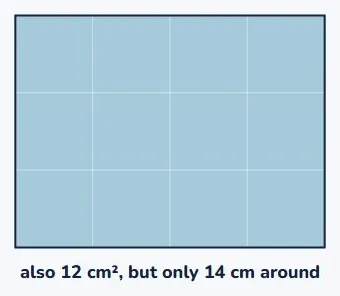
Try it: same area, different perimeter
And the other way round
- 5 by 1 and 3 by 3 both have a perimeter of 12 cm.
- But 5 by 1 covers 5 squares and 3 by 3 covers 9.
- Knowing one of the two tells you nothing about the other.
| rectangle | perimeter | area |
|---|---|---|
| 5 by 1 | 12 cm | 5 cm² |
| 3 by 3 | 12 cm | 9 cm² |
An area you cannot multiply
- For a curved shape, cover it in squares and count.
- Full squares count 1. Two halves make 1.
- More than half counts as 1, less than half counts as 0.
| squares | how many | worth |
|---|---|---|
| full squares | 9 | 9 |
| about half | 4 | 2 |
| more than half | 3 | 3 |
| less than half | 5 | 0 |
Volume is space, not surface
- Volume measures a region of three-dimensional space.
- Measure it in cubes 1 cm each way: 1 cm³.
- Fill the box with centicubes and count them.
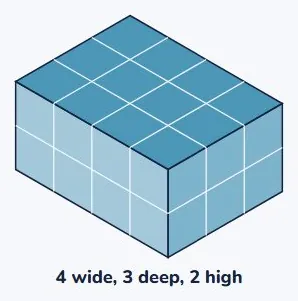
Count a layer, then count the layers
- The bottom layer is a 4 by 3 rectangle, so 12 cubes.
- There are 2 layers, so 12 × 2 = 24 cubes.
- The volume is 24 cm³. It was an area problem twice over.
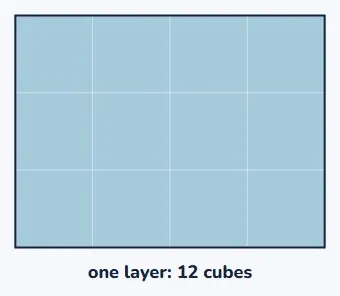
Try it: count a layer, then the layers
Common mistakes
- The perimeter of a 6 by 2 rectangle is 6 × 2 = 12 cm.6 × 2 = 12 is the area, in cm²; the perimeter is the distance round: 6 + 2 + 6 + 2 = 16 cm.
- Area = 12 cmArea is a covering of squares, so its unit is cm²: the area is 12 cm².
- 6 by 2 and 4 by 3 both cover 12 squares, so they need the same fence.Same area does not mean same perimeter: 6 by 2 needs 16 cm of fence and 4 by 3 needs only 14 cm.
- The bottom layer of the box has 12 cubes, so the volume is 12 cm³.Count the layers too: 12 cubes in a layer and 2 layers makes 12 × 2 = 24 cm³.
Your turn
Find the area and perimeter of an 8 by 3 rectangle.
A regular hexagon has 5 cm sides. Perimeter?
Find another rectangle with area 24 cm² and its perimeter.
A box is 5 by 2 by 3 cubes. How many cubes?
A rectangle is 5 cm by 4 cm. Its perimeter is 18 and its area is 20. Which units are right?
A leaf covers 11 full squares, 4 halves, 3 more than half and 6 less than half. About what is its area?
A rectangle has an area of 36 cm² and one side 4 cm long. What is its perimeter?
Two rectangles have exactly the same area. Which statement is true?
Show answer
1. 24 cm² and 22 cm. 2. 6 × 5 = 30 cm. 3. 12 by 2 gives perimeter 28 cm; 6 by 4 gives 20 cm; 8 by 3 gives 22 cm. 4. One layer is 5 × 2 = 10, times 3 layers, so 30 cubes or 30 cm³. 5. 18 cm and 20 cm². Perimeter is a length around the edge, so cm; area is a covering, so cm². 6. 16 cm². Full squares count 11, the 4 halves make 2, more than half counts 3, less than half counts 0: 11 + 2 + 3 = 16. 7. 26 cm. The other side is 36 ÷ 4 = 9 cm, so the perimeter is 9 + 4 + 9 + 4 = 26. 8. Their perimeters can be different. 6 by 2 and 4 by 3 both cover 12 cm², but need 16 cm and 14 cm of fence.
Area Builder
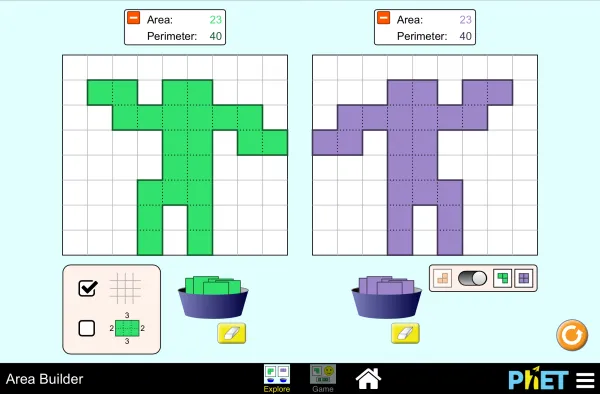
Full screen · PhET Interactive Simulations, University of Colorado Boulder, CC BY 4.0
What to take away
- Perimeter goes around and is measured in cm.
- Area covers, is measured in cm², and for a rectangle is × .
- Volume is layers of area, and is measured in cm³.
| job | the move | unit |
|---|---|---|
| perimeter | add every side | cm |
| area of a rectangle | multiply the sides | cm² |
| area of an odd shape | count squares, round the parts | cm² |
| volume of a cuboid | one layer × number of layers | cm³ |
Challenge
Three identical rectangles are placed with their long sides touching, and together they make a square. The perimeter of the square is 36 cm. Find the perimeter and the area of one small rectangle. Then the three rectangles are laid end to end in one long strip. What is the perimeter of the strip, and has its area changed?
Hint
Find the side of the square first. Then think about how the three rectangles share that side.
Answer
One rectangle is 9 cm by 3 cm: perimeter 24 cm, area 27 cm². The strip is 27 cm by 3 cm: perimeter 60 cm, and the area is still 81 cm².
Step by step
- A square has four equal sides, so each side is 36 ÷ 4 = 9 cm.
- Each rectangle is as long as the square, 9 cm, and three of them stack to make 9 cm, so each is 3 cm wide.
- One rectangle: perimeter 9 + 3 + 9 + 3 = 24 cm, area 9 × 3 = 27 cm².
- End to end, the strip is 3 × 9 = 27 cm long and 3 cm wide, so its perimeter is 27 + 3 + 27 + 3 = 60 cm.
- The same three rectangles cover the same paper, so the area stays 3 × 27 = 81 cm². Only the fence changed.
Full working
- 36 ÷ 4 = 9 cmside of the square
- 9 ÷ 3 = 3 cmthree equal widths make one side
- 9 + 3 + 9 + 3 = 24 cmperimeter of one rectangle
- 9 × 3 = 27 cm²area of one rectangle
- 3 × 9 = 27 cmlength of the strip
- 27 + 3 + 27 + 3 = 60 cmperimeter of the strip
- 3 × 27 = 81 cm² = 9 × 9same area as the square
- Rectangle: 24 cm and 27 cm². Strip: 60 cm, area still 81 cm²
Ana has 36 centicubes. She uses all of them to build a solid cuboid, and every edge of the cuboid must be at least 2 cubes long. How many different cuboids can she build? (Turning a cuboid round does not make a new one.) She wants to wrap one of them in paper with no overlaps. Which cuboid needs the least paper, and how many cm² is that?
Hint
List three numbers, each 2 or more, that multiply to 36. Start with the smallest edge as 2, then 3. For the paper, add up the areas of all six faces of the cuboid. They come in three matching pairs, so find three face areas and double the total.
Answer
Three cuboids: 2 by 2 by 9, 2 by 3 by 6 and 3 by 3 by 4. The 3 by 3 by 4 needs the least paper: 66 cm².
Step by step
- Volume is length × width × height, so the three edges must multiply to 36.
- Smallest edge 2: the other two multiply to 18, giving 2 by 9 or 3 by 6. Smallest edge 3: the other two multiply to 12, giving 3 by 4.
- A smallest edge of 4 would need two edges of at least 4 multiplying to 9, which is impossible. So there are 3 cuboids.
- The paper is the area of the six faces: two of each different face.
- 2 by 2 by 9 needs 80 cm², 2 by 3 by 6 needs 72 cm², and 3 by 3 by 4 needs 66 cm².
- The most cube-like box needs the least paper, just as the squarest rectangle needs the least fence.
Full working
- 2 × 2 × 9 = 36, 2 × 3 × 6 = 36, 3 × 3 × 4 = 36the only ways with every edge 2 or more
- 2 × (2×2 + 2×9 + 2×9) = 2 × 40 = 80 cm²2 by 2 by 9
- 2 × (2×3 + 3×6 + 2×6) = 2 × 36 = 72 cm²2 by 3 by 6
- 2 × (3×3 + 3×4 + 3×4) = 2 × 33 = 66 cm²3 by 3 by 4
- 3 cuboids; the 3 by 3 by 4 needs the least paper, 66 cm²
A rectangle has sides that are whole numbers of centimetres. Its area in cm² and its perimeter in cm are the same number. Find every rectangle like this, and explain why there are no others.
Hint
Call the shorter side the width and try widths 1, 2, 3 and 4 in turn. For a width of 5 or more, compare 5 × length with the perimeter when the width is no bigger than the length.
Answer
Only two: 3 cm by 6 cm (area 18 cm², perimeter 18 cm) and 4 cm by 4 cm (area 16 cm², perimeter 16 cm).
Step by step
- Width 1: the perimeter is the length twice plus 2, always more than the area, which is just the length.
- Width 2: the perimeter is twice the length plus 4, always more than the area, which is twice the length.
- Width 3: area is 3 lengths, perimeter is 2 lengths plus 6. They match when one length is 6, so 3 by 6.
- Width 4: area is 4 lengths, perimeter is 2 lengths plus 8. They match when two lengths make 8, so 4 by 4.
- Width 5 or more: the area is at least 5 lengths, but each side is at most the length, so the perimeter is at most 4 lengths. The area always wins.
Full working
- width 1: perimeter = 2 × length + 2 > length = areanever equal
- width 2: perimeter = 2 × length + 4 > 2 × length = areanever equal
- width 3: 3 × length = 2 × length + 6, so length = 63 by 6
- 3 × 6 = 18 and 3 + 6 + 3 + 6 = 18check
- width 4: 4 × length = 2 × length + 8, so length = 44 by 4
- 4 × 4 = 16 and 4 + 4 + 4 + 4 = 16check
- width 5 or more: area ≥ 5 × length, perimeter ≤ 4 × lengtharea is always bigger
- Only 3 cm by 6 cm and 4 cm by 4 cm