
Weight, friction, and air and water resistance
What this lesson covers
- Weight as the pull of gravity on an object's mass
- Why objects with more mass need a bigger force to speed up, slow down, turn or change shape
- Friction between touching surfaces, and how the surfaces change it
- Fluids, and how air and water push against things moving through them
- Planning fair tests of these forces and checking how consistent the results are
- Where people make use of friction and where they reduce it
Forces, gravity and weight
- A force is a push or a pull.
- Gravity is a pull that Earth puts on everything, towards the ground.
- Weight is the force of gravity pulling on an object's mass. The more mass something has, the bigger its weight.
- Mass is measured in kilograms (kg). Very large masses, like a truck or a whale, are measured in tonnes. 1 tonne = 1000 kg.
More mass needs a bigger force
- An empty supermarket trolley is easy to push. A full one takes a much harder push to get moving.
- The full trolley is also harder to stop and harder to steer round a corner.
- This is true of every object: the more mass it has, the bigger the force needed to change its speed or its direction.
- It also takes a bigger force to change the shape of a big lump of clay than a small one.
- That is why a loaded truck needs much stronger brakes than a bike.
Try it: push against friction
Friction
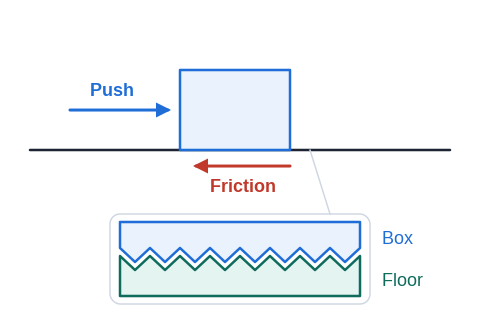
- Friction is a force between two surfaces that are touching. It pushes against one surface sliding over the other.
- Friction always acts in the opposite direction to the movement.
- Even surfaces that feel smooth have tiny bumps. The bumps catch on each other, and that makes friction.
- Rough surfaces, like carpet or sandpaper, give more friction than smooth ones, like ice or a polished floor.
- Friction is why a toy car rolling along the floor slows down and stops without anyone touching it.
Variables in a friction test
- A variable is anything that can change in a test.
- To test friction on different surfaces, change only the surface. Keep everything else the same, so the test is fair.
| Kind of variable | In this test |
|---|---|
| Change | The floor surface after the ramp |
| Measure | How far the car rolls after the ramp, in cm |
| Keep the same | The car, its mass, the ramp height, the start line, letting go without a push |
Example: testing surfaces with a toy car
- Room 4 rolled a toy car down the same ramp three times onto each floor and measured how far it went.
- Which surface had the most friction? Which results were the least consistent, and why?
| Surface | Try 1 (cm) | Try 2 (cm) | Try 3 (cm) |
|---|---|---|---|
| Lino | 182 | 176 | 185 |
| Carpet | 61 | 58 | 60 |
| Towel | 35 | 50 | 22 |
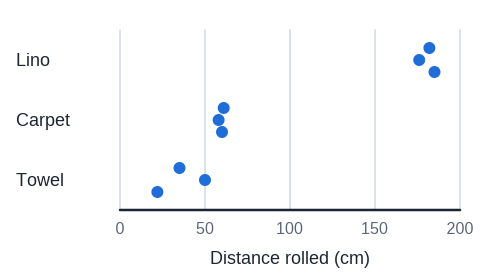
- The car went shortest on the towel, then carpet, then linomore friction stops it sooner
- Lino tries are within 9 cm and carpet within 3 cmconsistent, well controlled
- Towel tries range from 22 to 50 cmnot consistent
- The towel had the most friction, but its results spread out, probably because it wrinkled differently each time
Are the results consistent?
- Doing each test three times lets you check your results.
- If the three results are close together, the variables were probably well controlled.
- If they are spread out, something changed that should have stayed the same, such as a towel wrinkling or someone pushing the car.
- When results are spread out, find the cause, fix it, and test again.
Fluids push back too
- A fluid is a liquid or a gas, something that can flow. Air and water are both fluids.
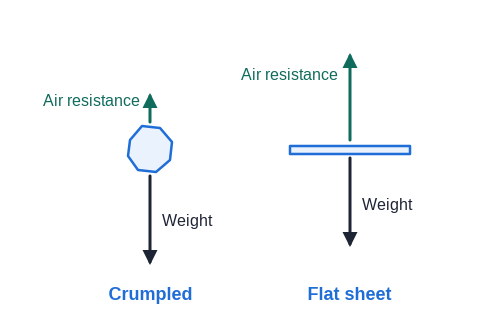
- Anything moving through air or water gets pushed against by it. In air this push is called air resistance. In water it is called water resistance.
- A wide, flat shape meets more air or water than a narrow, pointed one, so it gets a bigger push back.
- Drop a flat sheet of paper and a crumpled one: they have the same weight, but the flat sheet drifts down slowly because of air resistance.
Example: shapes falling through water
- Room 4 made three shapes from the same 20 g of plasticine and dropped each into a tall jar of water. They timed how long each took to reach the bottom, three times.
- Which shape met the most water resistance?
| Shape | Try 1 (s) | Try 2 (s) | Try 3 (s) |
|---|---|---|---|
| Pointed | 0.9 | 0.9 | 1.0 |
| Ball | 1.0 | 1.1 | 1.0 |
| Flat disc | 2.6 | 2.4 | 2.5 |
- Same mass, same jar, same drop heightonly the shape changed
- The flat disc took about 2.5 s, more than twice as long as the othersread the table
- The flat disc met the most water resistance, because its wide face pushes against more water
Using friction, and reducing it
- Sometimes we want lots of friction, so things grip. Sometimes we want very little, so things slide or turn easily.
| Friction helps | Friction is reduced |
|---|---|
| Knobbly tractor tyres grip a muddy paddock | A playground slide is smooth and polished |
| Bike brakes rub on the wheel to slow it | Grease on swing hinges lets them turn freely |
| Rugby boot sprigs stop players slipping | Ice skates glide on smooth ice |
| Wax on a surfboard stops your feet sliding | A swimmer's smooth cap and suit cut water resistance |
Try it: more friction or less?
Common mistakes
- A rolling ball stops because it runs out of force.It stops because friction and air resistance push against its motion; without them it would keep rolling.
- Mass and weight are the same thing.Mass is how much matter there is, in kg; weight is the pull of gravity on that mass.
- Smooth surfaces have no friction at all.Smooth surfaces still have tiny bumps, so there is some friction, just less than on rough surfaces.
- Air does not push on anything, because you cannot see it.Air is a fluid, and it pushes against anything moving through it; that push is air resistance.
Find the slipperiest object with a tilting board
You need: a chopping board or a large hardback book, a ruler, a coin, a rubber eraser, a plastic bottle lid, a toy block, paper and a pencil
- Lay the board flat on the floor and put all four objects in a row at one end.
- Slowly lift that end of the board, a little at a time.
- The moment an object starts to slide, hold the board still and measure how high the raised end is with the ruler.
- Do it three times for each object and write down the heights.
- Look at your results: the object that slid at the lowest height has the least friction with the board, and the one that needed the steepest slope has the most.
Safety: Ask an adult which board you can use, and do it on the floor so nothing heavy can fall onto your feet or break.
Your turn
Why is it harder to push a full supermarket trolley than an empty one?
A toy car is rolled onto ice, lino and carpet. On which surface will friction stop it soonest?
Group A's three results were 40 cm, 42 cm and 41 cm. Group B's were 20 cm, 55 cm and 38 cm. Which group controlled its variables better?
What force slows down a swimmer moving through the pool?
Why do mountain bike tyres have big knobbly treads?
Show answer
1. The full trolley has more mass, so it needs a bigger force to change its speed. 2. Carpet, because its rough surface gives the most friction. 3. Group A, because its results are close together; Group B's spread from 20 cm to 55 cm, so something was not kept the same. 4. Water resistance, the push of the water against the swimmer. 5. The knobbly treads increase friction, so the tyres grip on mud and loose dirt.
Forces and Motion: Basics
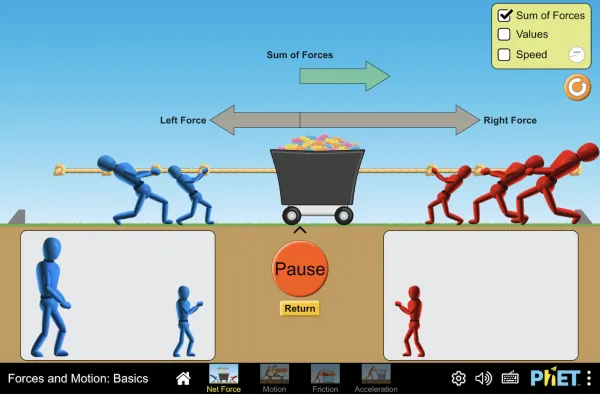
Full screen · PhET Interactive Simulations, University of Colorado Boulder, CC BY 4.0
Recap
- Weight is gravity pulling on an object's mass. Mass is measured in kg and tonnes.
- More mass means a bigger force is needed to change speed, direction or shape.
- Friction acts between touching surfaces, against the movement. Rough surfaces give more.
- Air and water are fluids, and they push against things moving through them.
- In a fair test change one variable; repeat it and check the results are close together.
- We increase friction for grip and reduce it for smooth sliding.
Challenge
Room 6 put objects on a board and slowly lifted one end until each object began to slide. They wrote down how high the raised end was, three times each. Coin: 9, 10, 9 cm. Eraser: 22, 21, 23 cm. Bottle lid: 14, 15, 25 cm. Toy block: 17, 18, 17 cm. Sam works out the average of each and says the lid has more friction than the block. Is his conclusion safe? Rank the four objects from least to most friction, and say what Room 6 should do next.
Hint
An object that slides at a lower height has less friction. Before you average, check whether each set of three tries is close together.
Answer
Not safe. The lid's 25 cm is far from its other two tries, so that try went wrong; it pulls the lid's average up to 18 cm. Leaving it out, the lid slides at about 14 to 15 cm. Order from least to most friction: coin, lid, block, eraser. Room 6 should find what went wrong and repeat the lid tests.
Step by step
- Lower slide height means less friction holding the object still.
- The coin, eraser and block each have tries within 1 or 2 cm, so they are consistent.
- The lid's tries are 14, 15 and 25 cm: the 25 is 10 cm away from the others, so something changed in that try.
- With the 25 included, the lid's average is 18 cm, just above the block's 17.3 cm, which is where Sam's idea comes from.
- Without it, the lid slides at about 14.5 cm, lower than the block, so the lid has less friction.
- The fix is to find the cause (such as a bump or a push) and test the lid again.
Full working
- coin 9, 10, 9spread 1 cm, consistent
- eraser 22, 21, 23spread 2 cm, consistent
- block 17, 18, 17spread 1 cm, average about 17.3 cm
- lid 14, 15, 25spread 11 cm, not consistent
- (14 + 15 + 25) ÷ 3 = 18the odd try makes the lid look higher than the block
- (14 + 15) ÷ 2 = 14.5the two matching tries
- Not safe. Least to most friction: coin, lid, block, eraser; repeat the lid tests
A flat sheet of paper drifts slowly to the floor when dropped, but a heavy hardcover book falls fast. Now Mere lays the paper flat on top of the book (the paper is smaller than the book's cover) and drops them together, cover facing up. The paper stays on the book and lands at the same moment. Explain why. What does this show about why the paper falls slowly on its own?
Hint
Air resistance comes from air pushing on the face that meets the air first. Which face meets the air on the way down, and what is sitting in front of the paper?
Answer
The book falls first through the air, so the air pushes on the book's underside, not on the paper. With no air pushing up on it, the paper falls just as fast as the book. This shows the paper drifts on its own because of air resistance on its wide flat face, not because it is light.
Step by step
- On its own, the flat paper's wide face meets lots of air, so a big upward push slows it.
- The book has a much bigger weight, so the air's push on it hardly slows it down.
- When the paper sits on top, the book goes first and pushes the air aside.
- The paper is in the book's shelter, so almost no air pushes up on it.
- With the air resistance taken away, the paper falls as fast as the book, so it was the air, not the paper's small weight, that slowed it.
Full working
- paper alone: wide face meets airbig air resistance, slow fall
- book: large weightair resistance small compared with weight
- paper on top: book meets the air firstair pushes on the book, not the paper
- no push up on the paperit keeps up with the book
- They land together because the book shields the paper from air resistance; air resistance, not lightness, slows the paper
Room 6 made parachutes from the same plastic bag and hung metal washers under them (the plastic weighs almost nothing compared with a washer). Each was dropped from the same balcony and timed. A: 20 cm canopy, 1 washer, 3.1 s. B: 40 cm canopy, 1 washer, 5.8 s. C: 40 cm canopy, 3 washers, 3.4 s. D: 20 cm canopy, 3 washers, 1.9 s. Kahu compares A and C and says, "The big canopy is no better than the small one." Why is that comparison unfair? Find all the fair comparisons and say what they show.
Hint
A fair comparison changes only one thing. List what is different between each pair of parachutes.
Answer
A and C differ in canopy size and number of washers, so you cannot tell which one caused the result. Fair pairs: A and B, D and C (only the canopy changes): the big canopy falls more slowly. A and D, B and C (only the washers change): more washers fall faster. A bigger canopy meets more air resistance, and more washers mean more weight.
Step by step
- Between A and C, two variables change: the canopy and the washers.
- C's extra weight speeds it up while its bigger canopy slows it down, so the two effects get mixed together.
- Pairs that change only the canopy: A with B (3.1 s and 5.8 s) and D with C (1.9 s and 3.4 s). The big canopy is slower both times.
- Pairs that change only the washers: A with D (3.1 s and 1.9 s) and B with C (5.8 s and 3.4 s). More washers are faster both times.
- A wide canopy meets more air, so it gets more air resistance; more washers give a bigger weight pulling down against that push.
Full working
- A vs C: canopy changed and washers changedtwo variables, not fair
- A vs B: 3.1 s → 5.8 sonly canopy changed, big canopy slower
- D vs C: 1.9 s → 3.4 sonly canopy changed, big canopy slower
- A vs D: 3.1 s → 1.9 sonly washers changed, more washers faster
- B vs C: 5.8 s → 3.4 sonly washers changed, more washers faster
- B vs Dboth changed, not fair either
- A vs C is unfair; the fair pairs show a bigger canopy falls slower and more weight falls faster