
Complex loci, purely real conditions and proofs
What this lesson covers
- A locus condition on z becomes an equation in x and y once z = x + iy is substituted.
- Purely real means the imaginary part is zero; purely imaginary means the real part is zero.
A locus on the Argand diagram
- z = x + iy is the point (x, y).
- |z − w| is the distance from z to w.
- Substitute x + iy to get x and y.
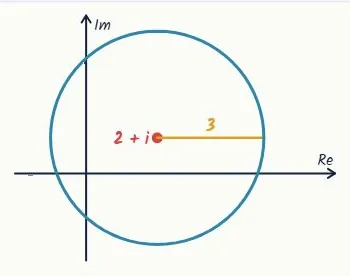
|z − 2 − i| = 3
- Every z is 3 from 2 + i.
- Centre 2 + i, the point (2, 1).
- A circle of radius 3.
Try it: drag z onto the locus
Into Cartesian form
- Group the two parts
- |a + bi|² = a² + b², no i
- z − (2 + i) = (x + iy) − (2 + i)
- = (x − 2) + (y − 1)igroup the parts
- (x − 2)² + (y − 1)² = 9modulus squared = 3²
- x² − 4x + 4 + y² − 2y + 1 = 9
- x² + y² − 4x − 2y = 4expanded form
Try it: drag a complex number
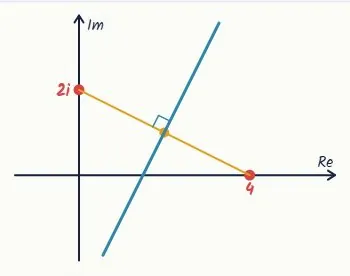
|z − 4| = |z − 2i|
- Equally far from 4 and from 2i.
- Join them and find the midpoint.
- The perpendicular bisector.
Square both sides
- x² and y² cancel
- Check with the midpoint
- |z − 4|² = |z − 2i|²square both sides
- (x − 4)² + y² = x² + (y − 2)²
- x² − 8x + 16 + y²expand
- = x² + y² − 4y + 4
- −8x + 16 = −4y + 4x² and y² cancel
- 4y = 8x − 12rearrange
- y = 2x − 3
- at (2, 1): 2(2) − 3 = 1midpoint lies on it
- gradients 2 × (−1/2) = −1perpendicular
Purely real, purely imaginary
- Complex numbers include the reals.
- Purely real: imaginary part 0.
- Purely imaginary: real part 0.
| Condition | |
|---|---|
| purely real | Im(w) = 0 |
| purely imaginary | Re(w) = 0 |
| arg w = π/4 | Re(w) = Im(w) > 0 |
w = (k + 2i)/(1 + i)
- Conjugate first
- Real: Im(w) = 0
- Imaginary: Re(w) = 0
- w = (k + 2i)/(1 + i)k real
- × (1 − i)/(1 − i)conjugate
- bottom: (1 + i)(1 − i) = 21 − i² = 2
- top: (k + 2i)(1 − i)
- = k − ki + 2i − 2i²expand
- = (k + 2) + (2 − k)ii² = −1, group
- w = ((k + 2) + (2 − k)i)/2
- Im = 0: 2 − k = 0, so k = 2real: w = 2
- Re = 0: k + 2 = 0, so k = −2imaginary: w = 2i
z + 4/z is purely real
- Write 4/z in x + iy form
- Take the imaginary part
- w = z + 4/z, z = x + iy
- 4/(x + iy) × (x − iy)/(x − iy)
- = 4(x − iy)/(x² + y²)bottom x² + y²
- w = x + iy + 4(x − iy)/(x² + y²)
- Im(w) = y − 4y/(x² + y²)imaginary parts
- y − 4y/(x² + y²) = 0purely real
Clear the fraction, factorise
- x² + y² is never 0 here
- Never divide by y
- y − 4y/(x² + y²) = 0
- y(x² + y²) − 4y = 0× (x² + y²)
- y(x² + y² − 4) = 0factorise
- y = 0 or x² + y² = 4
- y = 0, z ≠ 0the real axis
- x² + y² = 4, so |z| = 2circle, radius 2
Try it: make w purely real
What a proof needs: the 2025 error
- Prove: real roots for every real k.
- Trying some k is not a proof.
- It must work for any k.
| Proof? | |
|---|---|
| try k = 1, 2, 3 | examples only |
| find some k | not what was asked |
| any real k | a proof |
x² + kx + (k − 1) = 0
- Write the discriminant
- A square is never negative
- End with the conclusion
- a = 1, b = k, c = k − 1
- b² − 4ac = k² − 4(1)(k − 1)
- = k² − 4k + 4expand
- = (k − 2)²factorise
- (k − 2)² ≥ 0 for all real ka square is never < 0
- so b² − 4ac ≥ 0
- real roots for every real k
Prove: z is purely imaginary
- Substitute x + iy, square
- End with the sentence
- |z − 1| = |z + 1|, z = x + iy
- (x − 1)² + y² = (x + 1)² + y²
- x² − 2x + 1 + y²expand
- = x² + 2x + 1 + y²
- −2x = 2xx², y² and 1 cancel
- −4x = 0, so x = 0
- Re(z) = 0the real part
- so z is purely imaginary
Where the marks are
- Achieved: modulus, real and imaginary parts.
- Merit: purely real conditions, proofs.
- Excellence: quotients, harder proofs.
What to take away
- Substitute x + iy, set the right part to zero, and prove for every value.
| |z − a| = r | circle, centre a |
| Equal distances | perpendicular bisector |
| Purely real | Im = 0 |
| Purely imaginary | Re = 0 |
| Proof | general, with a reason |
| Finish | a concluding sentence |
Common mistakes
- |z − 2 − i| = 3 is a circle with centre (−2, −1).|z − w| is the distance from w = 2 + i, so the centre is (2, 1) and the radius is 3.
- y − 4y/(x² + y²) = 0, divide by y: x² + y² = 4.Factorise instead: y(x² + y² − 4) = 0 also gives y = 0 (z ≠ 0), the real axis, which dividing by y loses.
- k = 0, 1 and 2 all give real roots, so it is true for every k.Trying values is not a proof; show b² − 4ac = (k − 2)² ≥ 0 for all real k, then write the conclusion.
- w = ((k + 2) + (2 − k)i)/2 is purely real when k + 2 = 0.Purely real means the imaginary part is 0, so 2 − k = 0 and k = 2.
Your turn: eight questions
- Questions 1 and 2: substitute x + iy.
- Question 4: k is not zero.
| Given | Find | |
|---|---|---|
| 1 | |z − 3i| = 2 | Cartesian equation |
| 2 | |z + 2| = |z − 4| | Cartesian equation |
| 3 | (3 + i)(k + 2i), k real | k, if purely real |
| 4 | kx² + (k + 1)x + 1 = 0 | prove: real roots |
| 5 | x² + y² − 6x + 2y = 15 | the locus as |z − a| = r |
| 6 | (k + 2i)(2 + i), k real | k, if the argument is π/4 |
| 7 | (k + 4i)/(2 − i), k real | k, if purely imaginary |
| 8 | z + 9/z, z = x + iy | locus, if purely real |
Show answer
1. x² + (y − 3)² = 4: circle, centre 3i, radius 2. 2. (x + 2)² + y² = (x − 4)² + y² gives 12x = 12, so x = 1. 3. (3k − 2) + (k + 6)i; imaginary part zero gives k = −6 (the number is −20). 4. Discriminant (k + 1)² − 4k = (k − 1)², a square, so never negative: real roots for every real k ≠ 0. 5. |z − 3 + i| = 5. Completing the square gives (x − 3)² + (y + 1)² = 25: centre 3 − i, radius 5. 6. k = 6. (k + 2i)(2 + i) = (2k − 2) + (k + 4)i; arg π/4 needs Re = Im > 0, so 2k − 2 = k + 4, k = 6 (the number is 10 + 10i). 7. k = 2. Multiply by the conjugate 2 + i: (2k − 4)/5 + (k + 8)i/5. Purely imaginary means the real part is zero, so k = 2. 8. y = 0 or x² + y² = 9 (z ≠ 0). Im = y − 9y/(x² + y²) = y(x² + y² − 9)/(x² + y²) = 0; never divide by y.
The answers: questions 1 and 2
- 1. z − 3i = x + (y − 3)isubstitute x + iy
- x² + (y − 3)² = 2² = 4centre 3i, radius 2
- 2. (x + 2)² + y² = (x − 4)² + y²square both sides
- x² + 4x + 4 = x² − 8x + 16y² cancels, expand
- 12x = 12x² cancels
- x = 1a vertical line
The answers: questions 3 and 4
- 3. (3 + i)(k + 2i)
- = 3k + 6i + ki + 2i²expand
- = (3k − 2) + (k + 6)ii² = −1, group
- k + 6 = 0, so k = −6purely real: Im = 0
- 3(−6) − 2 = −20the real number
- 4. b² − 4ac = (k + 1)² − 4(k)(1)
- = k² + 2k + 1 − 4kexpand
- = k² − 2k + 1 = (k − 1)²factorise
- (k − 1)² ≥ 0: real rootsa square is never < 0
Sample question: Achieved
Find the Cartesian equation of the locus |z + 1 − 2i| = 4, and describe it.
Hint
Write z + 1 − 2i as z − (−1 + 2i): every point is 4 from −1 + 2i. Then substitute z = x + iy.
Answer
(x + 1)² + (y − 2)² = 16, a circle with centre (−1, 2) and radius 4
Step by step
- |z − w| is the distance from z to w. So first write the condition as |z − (−1 + 2i)| = 4.
- That says every point z is 4 units from −1 + 2i, the point (−1, 2). So the locus is a circle with radius 4.
- For the equation, substitute z = x + iy: z + 1 − 2i = (x + 1) + (y − 2)i.
- |a + bi| = √(a² + b²), so √((x + 1)² + (y − 2)²) = 4.
- Square both sides: (x + 1)² + (y − 2)² = 16.
- Watch the signs: the centre is (−1, 2), not (1, −2).
- Check: z = 3 + 2i is 4 to the right of the centre. (3 + 1)² + 0² = 16. Correct.
Full working
- z + 1 − 2i = (x + 1) + (y − 2)iz = x + iy
- √((x + 1)² + (y − 2)²) = 4modulus
- (x + 1)² + (y − 2)² = 16square both sides
- (x + 1)² + (y − 2)² = 16: circle, centre (−1, 2), radius 4
Sample questions: Merit
Find the Cartesian equation of the locus |z − 2| = |z + 4i|. Describe the locus and check your answer with the midpoint.
Hint
Square both sides first, so there are no square roots. The x² and y² terms will cancel.
Answer
y = −x2 − 32 (or x + 2y + 3 = 0), the perpendicular bisector of the points 2 and −4i
Step by step
- |z − 2| is the distance from z to 2, and |z + 4i| = |z − (−4i)| is the distance from z to −4i.
- So z is equally far from (2, 0) and (0, −4). That is the perpendicular bisector of the line joining them, a straight line.
- Substitute z = x + iy and square both sides: (x − 2)² + y² = x² + (y + 4)².
- Expand: x² − 4x + 4 + y² = x² + y² + 8y + 16.
- The x² and y² cancel, leaving −4x + 4 = 8y + 16.
- Rearrange: 8y = −4x − 12, so y = −x2 − 32. Multiplied by 2 and tidied, x + 2y + 3 = 0.
- Check with the midpoint of (2, 0) and (0, −4), which is (1, −2). It must lie on the line: −12 − 32 = −2. Correct.
- Also, the line from (2, 0) to (0, −4) has gradient 2, and −12 × 2 = −1, so our line is perpendicular to it.
Full working
- (x − 2)² + y² = x² + (y + 4)²square both sides
- x² − 4x + 4 + y² = x² + y² + 8y + 16expand
- −4x + 4 = 8y + 16x² and y² cancel
- y = −x2 − 32
- midpoint (1, −2): −12 − 32 = −2check
- y = −x2 − 32, the perpendicular bisector of 2 and −4i
w = 3 + ki1 − 2i, where k is real. Find k if w is purely imaginary, and state w.
Hint
Multiply top and bottom by the conjugate 1 + 2i. Purely imaginary means the real part is zero.
Answer
k = 32 and w = (32)i
Step by step
- Purely imaginary means Re(w) = 0. To see the real part, w must be in the form a + bi.
- Multiply top and bottom by the conjugate of the bottom, 1 + 2i. The bottom becomes 1 + 4 = 5.
- Top: (3 + ki)(1 + 2i) = 3 + 6i + ki + 2ki² = (3 − 2k) + (6 + k)i.
- So w = 3 − 2k5 + (6 + k5)i.
- Set the real part to zero: 3 − 2k = 0, so k = 32.
- Then the imaginary part is (6 + 32)/5 = (152)/5 = 32. So w = (32)i.
- The imaginary part is not zero, so w really is a nonzero imaginary number.
- Check: (1 − 2i)(32)i = (32)i − 3i² = 3 + (32)i, which is 3 + ki with k = 32. Correct.
Full working
- × 1 + 2i1 + 2iconjugate, bottom 1 + 4 = 5
- top: (3 − 2k) + (6 + k)ii² = −1
- 3 − 2k = 0, so k = 32purely imaginary: Re(w) = 0
- Im(w) = (6 + 32) ÷ 5 = 32
- k = 32, w = (32)i
Sample questions: Excellence
Show that the locus |z − 3| = 2|z| is a circle, and find its centre and radius.
Hint
Substitute z = x + iy and square both sides. Collect terms, divide by the coefficient of x², then complete the square.
Answer
(x + 1)² + y² = 4: a circle with centre −1 (the point (−1, 0)) and radius 2
Step by step
- This is not a perpendicular bisector, because the 2 makes the distances unequal. We find the shape from the algebra.
- Substitute z = x + iy: |z − 3| = √((x − 3)² + y²) and |z| = √(x² + y²).
- Square both sides. Square the 2 as well: (x − 3)² + y² = 4(x² + y²).
- Expand: x² − 6x + 9 + y² = 4x² + 4y².
- Collect on one side: 3x² + 3y² + 6x − 9 = 0. Divide by 3: x² + y² + 2x − 3 = 0.
- The x² and y² terms have the same coefficient, which is the sign of a circle. Complete the square in x: (x + 1)² − 1 + y² − 3 = 0.
- So (x + 1)² + y² = 4. This is a circle with centre (−1, 0) and radius 2.
- Check two points on the real axis. z = 1: |1 − 3| = 2 and 2|1| = 2. z = −3: |−6| = 6 and 2|−3| = 6. Both work, and both are 2 from −1.
Full working
- (x − 3)² + y² = 4(x² + y²)z = x + iy, square both sides
- 3x² + 3y² + 6x − 9 = 0expand and collect
- x² + y² + 2x − 3 = 0divide by 3
- (x + 1)² + y² = 4complete the square
- z = 1 and z = −3 satisfy |z − 3| = 2|z|check
- circle, centre (−1, 0), radius 2
Prove that if z − 2iz + 2 is purely imaginary, then z lies on a circle. Find the centre and radius of the circle.
Hint
Write z = x + iy, multiply top and bottom by the conjugate of the bottom, and set the real part of the top to zero.
Answer
x² + y² + 2x − 2y = 0, which is (x + 1)² + (y − 1)² = 2: centre −1 + i, radius √2 (z ≠ −2)
Step by step
- Let z = x + iy. The top is x + (y − 2)i and the bottom is (x + 2) + yi.
- z = −2 must be left out, because then the bottom is zero.
- Multiply top and bottom by the conjugate of the bottom, (x + 2) − yi. The new bottom is (x + 2)² + y², which is real and positive.
- So the real part of the fraction has the same sign as the real part of the new top. We only need the top.
- Top: (x + (y − 2)i)((x + 2) − yi). Its real part is x(x + 2) + (y − 2)y, because (y − 2)i × (−yi) = −(y − 2)y i² = (y − 2)y.
- Purely imaginary means the real part is 0: x² + 2x + y² − 2y = 0.
- Complete the square in x and in y: (x + 1)² − 1 + (y − 1)² − 1 = 0, so (x + 1)² + (y − 1)² = 2.
- That is a circle with centre (−1, 1), which is −1 + i, and radius √2. This holds for every such z, so it is proved.
- Check z = 0, which is on the circle: 0 − 2i0 + 2 = −i, purely imaginary. Correct.
Full working
- z = x + iy, z ≠ −2the bottom cannot be zero
- × (x + 2) − yi(x + 2) − yibottom (x + 2)² + y² > 0
- Re(top) = x(x + 2) + y(y − 2)
- x² + y² + 2x − 2y = 0purely imaginary: Re = 0
- (x + 1)² + (y − 1)² = 2complete the square
- z = 0: −2i ÷ 2 = −icheck
- circle, centre −1 + i, radius √2
Challenge
Find every complex number z for which z² is purely imaginary and |z − 2| = 2. (Purely imaginary means the real part is 0 and the imaginary part is not 0.)
Hint
With z = x + iy, write down the real and imaginary parts of z². The first condition gives two lines; meet each line with the circle, then check that the imaginary part of z² is not 0.
Answer
z = 2 + 2i and z = 2 − 2i. The origin lies on both loci too, but 0² = 0 is not purely imaginary.
Step by step
- Square x + iy: the real part is x² − y² and the imaginary part is 2xy.
- Real part 0 means y = x or y = −x: two lines through the origin.
- |z − 2| = 2 is the circle with centre 2 and radius 2, which passes through the origin.
- Each line meets the circle at the origin and at one other point.
- The origin must be thrown out, because there z² = 0 has imaginary part 0.
Full working
- z² = (x + iy)² = x² − y² + 2xyii² = −1
- Re(z²) = 0: x² − y² = 0, so y = x or y = −xtwo lines through 0
- Im(z²) ≠ 0: 2xy ≠ 0so z ≠ 0
- (x − 2)² + y² = 4the circle |z − 2| = 2
- y = ±x: (x − 2)² + x² = 4, so 2x² − 4x = 0substitute
- 2x(x − 2) = 0, so x = 0 or x = 2factorise
- x = 0 gives z = 0, and 0² = 0rejected: not purely imaginary
- x = 2: z = 2 + 2i or 2 − 2i, with z² = 8i and −8iboth purely imaginary
- z = 2 + 2i or z = 2 − 2i
(a) Prove that if |z| = 1 and z ≠ 1, then 1 + z1 − z is either purely imaginary or 0. Which z on the circle gives 0? (b) Find the complex number z for which 1 + z1 − z = 2i, and check that it lies on the circle |z| = 1.
Hint
Multiply the top and bottom by the conjugate of the bottom, 1 − z̄. When you expand the top, use z z̄ = |z|² = 1.
Answer
(a) 1 + z1 − z = z − z̄|1 − z|² = 2yi|1 − z|², whose real part is 0. It is 0 only when y = 0, that is at z = −1. (b) z = 35 + (45)i, and |z|² = 925 + 1625 = 1.
Step by step
- Multiplying by 1 − z̄1 − z̄ makes the bottom |1 − z|², a positive real number because z ≠ 1.
- Expanding the top gives 1 − z̄ + z − z z̄, and z z̄ = 1 on the circle, so the 1s cancel.
- What is left on top is z − z̄ = 2yi, which has no real part.
- So the whole fraction has real part 0; it is 0 itself only when y = 0, and the only such point left on the circle is −1.
- For (b), clear the fraction and solve the linear equation for z, then check its modulus.
Full working
- 1 + z1 − z × 1 − z̄1 − z̄conjugate of the bottom
- bottom: (1 − z)(1 − z̄) = |1 − z|², real and positivez ≠ 1
- top: (1 + z)(1 − z̄) = 1 − z̄ + z − z z̄expand
- = 1 + (z − z̄) − 1 = z − z̄z z̄ = |z|² = 1
- z − z̄ = (x + iy) − (x − iy) = 2yiz = x + iy
- 1 + z1 − z = 2yi|1 − z|²real part 0
- y = 0 on the circle, z ≠ 1: z = −1, giving 02 = 0the only zero
- 1 + z = 2i(1 − z), so z(1 + 2i) = −1 + 2iclear the fraction
- z = (−1 + 2i)(1 − 2i)(1 + 2i)(1 − 2i) = 3 + 4i5realise the denominator
- |z|² = 925 + 1625 = 1on the circle
- z = 35 + (45)i
z lies on the circle |z − 2√3 − 2i| = 2. Find the least and greatest values of |z|, and the least and greatest values of arg z. Give the z with the greatest argument in the form a + bi.
Hint
Draw it. The centre C = 2√3 + 2i is 4 from the origin. |z| is least and greatest on the line through O and C. arg z is greatest and least where a line from O just touches the circle, and a tangent meets the radius at a right angle.
Answer
2 ≤ |z| ≤ 6 and 0 ≤ arg z ≤ π3. The greatest argument is at z = √3 + 3i (the least is at z = 2√3).
Step by step
- The centre is C = 2√3 + 2i, with |C| = 4 and arg C = π6.
- The nearest and farthest points of the circle lie on the line OC, at 4 − 2 and 4 + 2 from O.
- For the argument, draw the two tangents from O. At a touching point T, the radius CT is at right angles to OT.
- In the right-angled triangle OTC, sin(angle TOC) = 24, so each tangent is π6 either side of OC.
- So arg z runs from 0 to π3, and the touching point has OT = √(16 − 4) = 2√3.
Full working
- |C| = √(12 + 4) = 4, arg C = tan⁻¹(22√3) = π6the centre
- least |z| = 4 − 2 = 2, greatest |z| = 4 + 2 = 6along the line OC
- sin(angle TOC) = CT ÷ OC = 24 = 12, so angle TOC = π6tangent at right angles to radius
- arg z from π6 − π6 = 0 to π6 + π6 = π3either side of OC
- OT = √(4² − 2²) = √12 = 2√3Pythagoras
- T = 2√3 cis(π3) = 2√3(12 + (√32)i) = √3 + 3igreatest argument
- check: |√3 + 3i − 2√3 − 2i| = |−√3 + i| = √(3 + 1) = 2on the circle
- 2 ≤ |z| ≤ 6, 0 ≤ arg z ≤ π3, greatest argument at z = √3 + 3i
Practise this
Report a mistake
More in AS 91577
 Complex arithmetic, conjugates and equating parts9 min
 Polar form by hand: modulus, argument and quadrants10 min
 De Moivre's theorem: powers and roots of complex numbers11 min
 Complex roots of polynomials: factor theorem and conjugates11 min
 Algebra with k: quadratics, discriminants and surd equations10 minComplex loci, purely real conditions and proofs11 min
 Complex arithmetic: 7 exam questions solved step by step11 min
 Polar form: 7 exam questions solved step by step11 min
 De Moivre's theorem: 7 exam questions solved step by step12 min
 Complex polynomials: 7 exam questions solved step by step12 min
 Algebra with constants: 7 exam questions solved step by step12 min
 Complex loci and proof: 7 exam questions solved step by step12 min