
De Moivre's theorem: 7 exam questions solved step by step
What this lesson covers
- Raising r cis θ to the power n raises the modulus to n and multiplies the argument by n.
- The n roots of a complex number are equally spaced around a circle, so one wrong starting argument makes every root wrong.
De Moivre's theorem
- Write the number in polar form; sketch it.
- Powers: (r cis θ)ⁿ = rⁿ cis(nθ).
- nth roots: modulus ⁿ√r, arguments (θ + 2πk)/n.
- Bring every argument into −π < θ ≤ π.
Question 1 · Achieved
- Write (3 cis(π/12))⁴
- In the form a + bi, exactly.
Q1: (3 cis(π/12))⁴
- Raise r, multiply θ.
- Then exact values.
- (3 cis(π/12))⁴
- = 3⁴ cis(4 × π/12)de Moivre
- = 81 cis(π/3)
- cos(π/3) = 1/2, sin(π/3) = √3/2
- 81(1/2) + 81(√3/2)i
- = 81/2 + (81√3/2)i
Try it: powers spiral
Question 2 · Achieved
- Use de Moivre to write (√3 − i)⁴
- In the form a + bi, exactly.
Q2: (√3 − i)⁴
- Below the axis: θ < 0.
- Exact cos and sin.
- √3 − i: x > 0, y < 0fourth quadrant
- r = √(3 + 1) = 2modulus
- θ = −tan⁻¹(1/√3) = −π/6below the axis
- (2 cis(−π/6))⁴ = 2⁴ cis(−4π/6)
- = 16 cis(−2π/3)
- cos(−2π/3) = −1/2
- sin(−2π/3) = −√3/2
- 16(−1/2) + 16(−√3/2)i
- = −8 − 8√3i
Question 3 · Merit
- Use de Moivre to write (−2 + 2i)⁵
- In the form a + bi.
Q3: (−2 + 2i)⁵
- Second quadrant.
- Subtract 2π twice.
- −2 + 2i: x < 0, y > 0second quadrant
- r = √(4 + 4) = √8 = 2√2modulus
- θ = π − π/4 = 3π/4reference π/4
- (2√2)⁵ = 32 × 4√2 = 128√2
- arg: 5 × 3π/4 = 15π/4de Moivre
- 15π/4 − 4π = −π/4subtract 2π twice
- = 128√2 cis(−π/4)
- 128√2(√2/2) − 128√2(√2/2)i
- = 128 − 128i
Question 4 · Merit
- Solve z⁴ = −16.
- Give the roots in the form a + bi,
- Plot them, and find the side of
- The shape they make.
Q4: the four arguments
- Let z = s cis α.
- Four values of k.
- −16 = 16 cis πnegative real axis
- s⁴ = 16, so s = 2modulus
- 4α = π + 2πk
- α = π/4 + πk/2divide by 4
- k = 0: π/4, k = 1: 3π/4
- k = 2: 5π/4 − 2π = −3π/4into range
- k = 3: 7π/4 − 2π = −π/4into range
- z = 2 cis α, all four α
Q4: check on the Argand diagram
- All on the circle |z| = 2.
- A quarter turn apart.
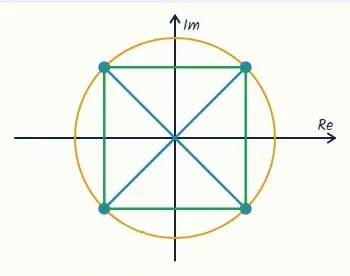
Q4: a + bi, and the square
- Exact cos and sin.
- Answer with units.
- 2 cis(π/4) = √2 + √2i
- 2 cis(3π/4) = −√2 + √2i
- 2 cis(−3π/4) = −√2 − √2i
- 2 cis(−π/4) = √2 − √2i
- (√2 + √2i)² = 2 + 4i − 2 = 4i
- (4i)² = 16i² = −16
- side: √2 − (−√2) = 2√2top two roots
- a square of side 2√2 units
Question 5 · Merit
- Solve z³ = −4√3 + 4i.
- Give every root in polar form.
- Careful: sketch before tan⁻¹.
Q5: the starting argument
- Second quadrant.
- Not the calculator angle.
- −4√3 + 4i: x < 0, y > 0second quadrant
- r = √(48 + 16) = √64 = 8modulus
- tan⁻¹(4/(−4√3)) = −π/6fourth quadrant
- reference: tan⁻¹(1/√3) = π/6
- θ = π − π/6 = 5π/6second quadrant
- z³ = 8 cis(5π/6)
Q5: the three roots
- Cube root of 8.
- 2π/3 = 12π/18 apart.
- z³ = 8 cis(5π/6)
- s³ = 8, so s = 2modulus
- 3α = 5π/6 + 2πk
- α = 5π/18 + 2πk/3divide by 3
- k = 0: α = 5π/18
- k = 1: 5π/18 + 12π/18 = 17π/18
- k = −1: 5π/18 − 12π/18 = −7π/18
- z = 2 cis(5π/18), 2 cis(17π/18)
- or z = 2 cis(−7π/18)
Try it: the three roots
Question 6 · Excellence
- Find the smallest positive integer n
- For which (−√3 + i)ⁿ is real.
- Give the value of that power.
Q6: when is it real?
- Real: imaginary part 0.
- Reason, do not guess.
- −√3 + i: x < 0, y > 0second quadrant
- r = √(3 + 1) = 2modulus
- θ = π − π/6 = 5π/6reference π/6
- (2 cis(5π/6))ⁿ = 2ⁿ cis(5nπ/6)
- sin(5nπ/6) = 0imaginary part 0
- 5nπ/6 = kπ, so 5n = 6k
- 6 divides 5n, so 6 divides n5 and 6: no common factor
- smallest n = 6
Q6: the value
- n = 6 in de Moivre.
- Smaller n: not real.
- 2⁶ cis(6 × 5π/6) = 64 cis(5π)
- 5π − 4π = πsubtract 2π twice
- 64 cis π = 64(−1 + 0i) = −64
- n = 3: 8 cis(5π/2) = 8iimaginary, not real
Question 7 · Excellence
- Solve (z + 2i)³ = −27i.
- Give every solution in the form a + bi.
Q7: substitute, then roots
- Let w = z + 2i.
- Cube roots of −27i.
- w = z + 2i: w³ = −27i
- −27i = 27 cis(−π/2)negative Im axis
- s³ = 27, so s = 3modulus
- 3α = −π/2 + 2πk
- α = −π/6 + 2πk/3divide by 3
- k = 0: α = −π/6
- k = 1: −π/6 + 4π/6 = π/2
- k = −1: −π/6 − 4π/6 = −5π/6
Q7: back to z
- w first, in a + bi.
- Then z = w − 2i.
- w = 3 cis(−π/6) = 3√3/2 − (3/2)i
- w = 3 cis(π/2) = 3i
- w = 3 cis(−5π/6) = −3√3/2 − (3/2)i
- z = w − 2iundo the substitution
- z = 3√3/2 − (7/2)i
- z = i
- z = −3√3/2 − (7/2)i
- z = i: (3i)³ = 27i³ = −27i
Try it: range, real, shift
Common mistakes
- (r cis θ)ⁿ = r cis(nθ)The modulus is raised to the power too: rⁿ cis(nθ).
- arg(−2 + 2i) = tan⁻¹(−1) = −π/4Sketch it first. The point is in the second quadrant, so the argument is 3π/4.
- z³ = w has one root, the cube root of its modulus at a third of the argument.There are three roots, spaced 2π/3 apart.
The method that solved all seven
- Polar form from a sketch, de Moivre, every k, into range.
| Step | How |
|---|---|
| Polar form | sketch, then r and θ |
| Power | rⁿ cis(nθ) |
| Into range | ± 2π until −π < θ ≤ π |
| Roots | nth root of r |
| Arguments | (θ + 2πk)/n, all n |
| Check | circle, equal spacing |
Challenge
One solution of z⁴ = w is z = √3 + i. Find w in the form a + bi, and then write down the other three solutions of z⁴ = w in the form a + bi, without solving the equation again.
Hint
Find w with de Moivre. The four solutions are a quarter turn apart on the same circle, and a quarter turn anticlockwise is the same as multiplying by i.
Answer
w = −8 + 8√3i. The other solutions are −1 + √3i, −√3 − i and 1 − √3i.
Step by step
- Write √3 + i in polar form: modulus 2, argument π6.
- Raise it to the power 4 with de Moivre to get w = 16 cis(2π3) = −8 + 8√3i.
- The four fourth roots of w all have modulus 2 and are spaced 2π4 = π2 apart.
- Turning a point a quarter turn about the origin is the same as multiplying it by i, because i = cis(π2).
- So multiply √3 + i by i, then by i again, then once more, to get the other three roots.
Full working
- √3 + i: r = √(3 + 1) = 2, θ = tan⁻¹(1√3) = π6first quadrant
- w = (2 cis(π6))⁴ = 16 cis(4π6) = 16 cis(2π3)de Moivre
- w = 16(−12) + 16(√32)i = −8 + 8√3iexact values
- i(√3 + i) = √3i + i² = −1 + √3iquarter turn
- i(−1 + √3i) = −i + √3i² = −√3 − ianother quarter turn
- i(−√3 − i) = −√3i − i² = 1 − √3ianother quarter turn
- check: (−1 + √3i)⁴ = (2 cis(2π3))⁴ = 16 cis(8π3) = 16 cis(2π3) = w8π3 − 2π = 2π3
- w = −8 + 8√3i; other roots −1 + √3i, −√3 − i, 1 − √3i
Solve z⁶ + 7z³ − 8 = 0, giving all six solutions in polar form. Joining the solutions in order of argument gives a hexagon on the Argand diagram. Show that all six sides are the same length, and find the exact area of the hexagon.
Hint
Let u = z³. The equation becomes a quadratic in u. Solve it, then find the three cube roots of each answer.
Answer
z = 1, cis(2π3), cis(−2π3), 2 cis(π3), 2 cis(π), 2 cis(−π3). Every side is √3 long and the area is 3√3 square units.
Step by step
- Put u = z³, so u² + 7u − 8 = 0, which factorises to (u + 8)(u − 1) = 0.
- z³ = 1 gives three roots on the circle |z| = 1, at arguments 0, 2π3 and −2π3.
- z³ = −8 = 8 cis π gives three roots on the circle |z| = 2, at arguments π3, π and −π3.
- In order of argument the roots alternate between the two circles, each π3 further round. So every side joins a point 1 from O to a point 2 from O, with an angle of π3 at O between them, and the cosine rule gives the same length every time.
- Split the hexagon into six triangles from the origin, each with sides 1 and 2 and an angle π3 between them.
Full working
- u = z³: u² + 7u − 8 = 0a quadratic in u
- (u + 8)(u − 1) = 0, so z³ = 1 or z³ = −8factorise
- z³ = 1 = cis 0: z = cis(2πk3), k = 0, 1, −1modulus 1
- z = 1, cis(2π3), cis(−2π3)
- z³ = 8 cis π: z = 2 cis(π3 + 2πk3), k = 0, 1, −1modulus 2
- z = 2 cis(π3), 2 cis(π), 2 cis(−π3)
- side² = 1² + 2² − 2(1)(2)cos(π3) = 5 − 2 = 3cosine rule
- each side = √3all six sides the same
- triangle area = ½(1)(2)sin(π3) = √32½ab sin C
- hexagon area = 6 × √32 = 3√3six triangles
- sides all √3; area = 3√3 square units
Let ω = cis(2π5). (a) Show that 1 + ω + ω² + ω³ + ω⁴ = 0. (b) Hence find the exact value of cos(2π5) + cos(4π5).
Hint
Use de Moivre to find ω⁵. Then expand (z − 1)(z⁴ + z³ + z² + z + 1) and think about which factor can be zero when z = ω. For (b), write ω³ and ω⁴ with arguments in −π < θ ≤ π and look at real parts.
Answer
(a) ω⁵ = 1 and ω ≠ 1, so the second factor is 0. (b) cos(2π5) + cos(4π5) = −12.
Step by step
- By de Moivre, ω⁵ = cis(2π) = 1, so ω is a root of z⁵ − 1 = 0.
- Expanding shows z⁵ − 1 = (z − 1)(z⁴ + z³ + z² + z + 1).
- ω is not 1, so the first factor is not zero. The second factor must be zero, which is the result in (a).
- Bring the arguments into range: ω³ = cis(−4π5) and ω⁴ = cis(−2π5). Cosine is even, so these have the same real parts as ω² and ω.
- Taking the real part of the sum in (a) gives 1 + 2cos(2π5) + 2cos(4π5) = 0.
Full working
- ω⁵ = cis(5 × 2π5) = cis 2π = 1de Moivre
- (z − 1)(z⁴ + z³ + z² + z + 1) = z⁵ − 1expand: middle terms cancel
- (ω − 1)(ω⁴ + ω³ + ω² + ω + 1) = ω⁵ − 1 = 0put z = ω
- ω ≠ 1, so ω − 1 ≠ 0arg ω = 2π5, not 0
- 1 + ω + ω² + ω³ + ω⁴ = 0(a) shown
- ω³ = cis(6π5) = cis(−4π5), ω⁴ = cis(8π5) = cis(−2π5)subtract 2π
- Re: 1 + cos(2π5) + cos(4π5) + cos(−4π5) + cos(−2π5) = 0real parts
- 1 + 2cos(2π5) + 2cos(4π5) = 0cos(−θ) = cos θ
- cos(2π5) + cos(4π5) = −12
Practise this
Report a mistake
More in AS 91577
 Complex arithmetic, conjugates and equating parts9 min
 Polar form by hand: modulus, argument and quadrants10 min
 De Moivre's theorem: powers and roots of complex numbers11 min
 Complex roots of polynomials: factor theorem and conjugates11 min
 Algebra with k: quadratics, discriminants and surd equations10 min
 Complex loci, purely real conditions and proofs11 min
 Complex arithmetic: 7 exam questions solved step by step11 min
 Polar form: 7 exam questions solved step by step11 minDe Moivre's theorem: 7 exam questions solved step by step12 min
 Complex polynomials: 7 exam questions solved step by step12 min
 Algebra with constants: 7 exam questions solved step by step12 min
 Complex loci and proof: 7 exam questions solved step by step12 min