
Polar form: 7 exam questions solved step by step
What this lesson covers
- Modulus is a distance, so it is never negative; argument is an angle measured from the positive real axis.
- The quadrant decides the argument, so a sketch comes before the calculator.
Converting to polar form
- Sketch the number and name its quadrant.
- Modulus r = √(x² + y²), never negative.
- Find the reference angle, then adjust it.
- Keep the argument in −π < θ ≤ π.
Question 1 · Achieved
- Write 8 cis(−5π/6)
- In the form a + bi, exactly.
Q1: 8 cis(−5π/6)
- x = r cos θ, y = r sin θ.
- Exact values only.
- x = r cos θ, y = r sin θ
- −5π/6: third quadrantreference π/6
- cos(−5π/6) = −√3/2
- sin(−5π/6) = −1/2
- x = 8(−√3/2) = −4√3
- y = 8(−1/2) = −4
- 8 cis(−5π/6) = −4√3 − 4i
- √(48 + 16) = √64 = 8modulus
Question 2 · Achieved
- Write z = 3 + 3√3i
- In polar form, exactly.
Q2: z = 3 + 3√3i
- Quadrant first.
- Check by converting back.
- x > 0, y > 0first quadrant
- r = √(3² + (3√3)²)modulus
- = √(9 + 27) = √36 = 6
- θ = tan⁻¹(3√3/3) = tan⁻¹(√3)
- = π/3first quadrant: keep
- z = 6 cis(π/3)
- 6(1/2) + 6(√3/2)i = 3 + 3√3i
Try it: modulus and argument
Question 3 · Merit
- Write w = −√2 − √6i
- In polar form, exactly.
- Careful: sketch it before tan⁻¹.
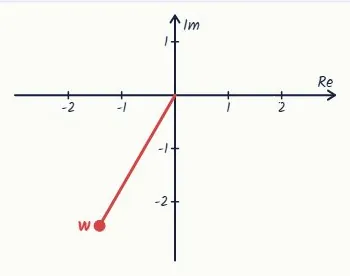
Q3: w = −√2 − √6i
- The calculator gives π/3.
- The sketch says no.
- x < 0, y < 0third quadrant
- r = √((−√2)² + (−√6)²)modulus
- = √(2 + 6) = √8 = 2√2
- tan⁻¹(−√6/−√2) = π/3first quadrant
- reference angle π/3
- θ = −(π − π/3) = −2π/3below the real axis
- w = 2√2 cis(−2π/3)
- 2√2(−1/2) = −√2, 2√2(−√3/2) = −√6
Question 4 · Merit
- u = 4 cis(2π/3), v = 2 cis(−3π/4)
- Find uv and u/v in polar form,
- With −π < θ ≤ π.
Q4: uv and u/v
- × moduli, + arguments.
- ÷ moduli, − arguments.
- |uv| = 4 × 2 = 8multiply moduli
- arg = 2π/3 + (−3π/4)add arguments
- = 8π/12 − 9π/12 = −π/12in range
- uv = 8 cis(−π/12)
- |u/v| = 4 ÷ 2 = 2divide moduli
- arg = 2π/3 − (−3π/4)subtract arguments
- = 8π/12 + 9π/12 = 17π/12more than π
- 17π/12 − 24π/12 = −7π/12subtract 2π
- u/v = 2 cis(−7π/12)
Try it: multiply and divide in polar form
Try it: beat the quadrant trap
Question 5 · Merit, in context
- A kayaker leaves a jetty. East is real,
- North is imaginary, in km.
- She is at −5√3 + 5i.
- How far away is she, and which way?
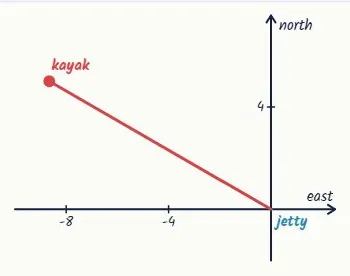
Q5: distance and direction
- Modulus: the distance.
- Argument: the direction.
- x < 0, y > 0second quadrant
- r = √((−5√3)² + 5²)modulus
- = √(75 + 25) = √100 = 10
- reference: tan⁻¹(5/(5√3)) = π/6
- θ = π − π/6 = 5π/6second quadrant
- z = 10 cis(5π/6)
- 5π/6 = 150°: 30° north of west
- 10 km away, 30° north of west
Question 6 · Excellence
- z = (−1 + i)/(√3 + i)
- a) Write z in polar form.
- b) Write z in the form a + bi.
- c) Hence find cos(7π/12) exactly.
Q6 a): z in polar form
- Top and bottom separately.
- ÷ moduli, − arguments.
- −1 + i: r = √(1 + 1) = √2
- θ = π − π/4 = 3π/4second quadrant
- √3 + i: r = √(3 + 1) = 2
- θ = tan⁻¹(1/√3) = π/6first quadrant
- |z| = √2 ÷ 2 = √2/2divide moduli
- arg z = 3π/4 − π/6subtract arguments
- = 9π/12 − 2π/12 = 7π/12
- z = (√2/2) cis(7π/12)
Q6 b): z in the form a + bi
- Conjugate of the bottom.
- Group, then split.
- × (√3 − i)/(√3 − i)conjugate of the bottom
- bottom: 3 + 1 = 4
- top: (−1 + i)(√3 − i)
- = −√3 + i + √3i − i²expand
- = (1 − √3) + (1 + √3)ii² = −1, group
- z = (1 − √3)/4 + ((1 + √3)/4)i
Q6 c): cos(7π/12)
- Same z, two forms.
- Equate the real parts.
- z = (√2/2) cis(7π/12)
- z = (1 − √3)/4 + ((1 + √3)/4)i
- (√2/2) cos(7π/12) = (1 − √3)/4
- cos(7π/12) = (1 − √3)/(2√2)divide by √2/2
- = (√2 − √6)/4rationalise
- cos(7π/12) = (√2 − √6)/4
- 7π/12 > π/2, so cos < 0
- (√2 − √6)/4 ≈ −0.2588
Question 7 · Excellence
- w = (a + i)/(1 + i), where a is real.
- Arg w = π/3.
- Find the exact value of a.
Q7: w in the form x + iy
- Conjugate of the bottom.
- Keep a in each part.
- × (1 − i)/(1 − i)conjugate of the bottom
- bottom: 1 + 1 = 2
- top: (a + i)(1 − i)
- = a − ai + i − i²expand
- = (a + 1) + (1 − a)ii² = −1, group
- w = (a + 1)/2 + ((1 − a)/2)i
Q7: use the argument
- Tan θ = y/x.
- Check the quadrant.
- w = (a + 1)/2 + ((1 − a)/2)i
- arg w = π/3: x > 0, y > 0first quadrant
- tan(π/3) = y/x = (1 − a)/(a + 1)
- √3(a + 1) = 1 − atan(π/3) = √3
- √3a + a = 1 − √3collect a terms
- a = (1 − √3)/(1 + √3)
- = (4 − 2√3)/(−2)× (1 − √3) top, bottom
- = √3 − 2
- a + 1 > 0 and 1 − a > 0first quadrant
Common mistakes
- tan⁻¹(√6/√2) gives the argument of −√2 − √6i.tan⁻¹ only gives the reference angle. Sketch first: this point is in the third quadrant.
- u/v = 2 cis(17π/12) is finished.Bring the argument into −π < θ ≤ π by subtracting 2π.
- Multiplying in polar form multiplies the arguments.Multiply the moduli and add the arguments.
The method that solved all seven
- Sketch, find r, find θ from the quadrant, keep it in range.
| Step | How |
|---|---|
| Sketch | name the quadrant first |
| Modulus | √(x² + y²), never negative |
| Argument | reference angle, adjust |
| Below axis | negative argument |
| × and ÷ | × or ÷ r, + or − θ |
| Range | −π < θ ≤ π |
Challenge
On the Argand diagram, a square has one vertex at the origin O and the opposite vertex at C = 4 + 2i. Find the other two vertices in the form a + bi.
Hint
From O, each missing vertex is at 45° to the diagonal OC, and a side of a square is the diagonal divided by √2. In polar form, what number does that turn and that shrink?
Answer
1 + 3i and 3 − i.
Step by step
- The diagonal OC makes an angle of π4 with each side at O, and each side is |OC| ÷ √2.
- So a missing vertex is C turned through π4 one way or the other and multiplied by 1√2 in length.
- That means multiplying C by (1√2) cis(π4) or (1√2) cis(−π4), which are 1 + i2 and 1 − i2.
- Multiply out, then check that all four sides are the same length.
Full working
- (1√2) cis(π4) = (1√2)(√22 + (√22)i) = 1 + i2turn π4, shrink by √2
- (1√2) cis(−π4) = 1 − i2turn the other way
- (4 + 2i)(1 + i)2 = 4 + 6i + 2i²2 = 2 + 6i2 = 1 + 3ifirst vertex
- (4 + 2i)(1 − i)2 = 4 − 2i − 2i²2 = 6 − 2i2 = 3 − isecond vertex
- |1 + 3i| = |3 − i| = √10, |C − (1 + 3i)| = |3 − i| = √10, |C − (3 − i)| = |1 + 3i| = √10four equal sides
- |C| = √20 = √2 × √10diagonal = √2 × side
- the other vertices are 1 + 3i and 3 − i
Two complex numbers z and w satisfy zw = 8i and zw = 2 cis(−π3). The real part of z is positive. Find z and w in polar form, with −π < θ ≤ π.
Hint
Multiply the two equations together. What is left on the left-hand side? Then think about which number, squared, gives your answer: halve the argument, and remember there are two choices.
Answer
z = 4 cis(π12) and w = 2 cis(5π12).
Step by step
- Write 8i in polar form: 8 cis(π2).
- Multiplying zw by zw gives z², so multiply the moduli and add the arguments.
- z² = 16 cis(π6). A number squared doubles its argument and squares its modulus, so z = 4 cis(π12), or the opposite point 4 cis(π12 − π).
- Only 4 cis(π12) has a positive real part.
- Then w = 8i ÷ z: divide the moduli and subtract the arguments. Check with zw.
Full working
- zw = 8 cis(π2)8i on the positive Im axis
- z² = (zw)(zw) = 8 cis(π2) × 2 cis(−π3)multiply the equations
- = 16 cis(π2 − π3) = 16 cis(π6)× moduli, + arguments
- z = 4 cis(π12) or z = 4 cis(−11π12)square: modulus 16, argument π6
- Re: 4cos(π12) > 0 but 4cos(−11π12) < 0, so z = 4 cis(π12)real part positive
- w = 8 cis(π2) ÷ 4 cis(π12) = 2 cis(π2 − π12)÷ moduli, − arguments
- = 2 cis(5π12)
- check: zw = 2 cis(π12 − 5π12) = 2 cis(−π3)as given
- z = 4 cis(π12), w = 2 cis(5π12)
θ is an angle with 0 < θ < π. (a) Show that 1 + cis θ = 2cos(θ2) cis(θ2), so |1 + cis θ| = 2cos(θ2) and arg(1 + cis θ) = θ2. (b) Hence write 1 + cis(π3) in polar form, and find (1 + cis(π3))³ exactly.
Hint
Write 1 + cis θ as (1 + cos θ) + i sin θ. Then use the double angle formulas with θ = 2 × (θ2): 1 + cos θ = 2cos²(θ2) and sin θ = 2sin(θ2)cos(θ2). Take out a common factor.
Answer
(a) 1 + cis θ = 2cos(θ2)(cos(θ2) + i sin(θ2)), and 2cos(θ2) > 0. (b) 1 + cis(π3) = √3 cis(π6), and (1 + cis(π3))³ = 3√3i.
Step by step
- Split 1 + cis θ into its real part 1 + cos θ and imaginary part sin θ.
- Rewrite both parts with half angles using the double angle formulas.
- Both parts now share the factor 2cos(θ2), so take it out. What is left is cis(θ2).
- Because 0 < θ < π, θ2 is between 0 and π2, so 2cos(θ2) is positive. A polar form needs a positive modulus, so this really is the modulus, and θ2 is the argument.
- Put θ = π3, then cube by cubing the modulus and tripling the argument (multiply the number by itself three times).
Full working
- 1 + cis θ = (1 + cos θ) + i sin θreal and imaginary parts
- 1 + cos θ = 2cos²(θ2)cos 2A = 2cos²A − 1
- sin θ = 2sin(θ2)cos(θ2)sin 2A = 2sin A cos A
- 1 + cis θ = 2cos(θ2)(cos(θ2) + i sin(θ2))common factor
- = 2cos(θ2) cis(θ2), with 2cos(θ2) > 00 < θ2 < π2
- θ = π3: 1 + cis(π3) = 2cos(π6) cis(π6) = √3 cis(π6)2 × √32 = √3
- check: 1 + 12 + (√32)i = 32 + (√32)i, and √3(√32) + √3(12)i = 32 + (√32)isame number
- (√3 cis(π6))³ = (√3)³ cis(3 × π6) = 3√3 cis(π2)× moduli, + arguments
- (1 + cis(π3))³ = 3√3i
Practise this
Report a mistake
More in AS 91577
 Complex arithmetic, conjugates and equating parts9 min
 Polar form by hand: modulus, argument and quadrants10 min
 De Moivre's theorem: powers and roots of complex numbers11 min
 Complex roots of polynomials: factor theorem and conjugates11 min
 Algebra with k: quadratics, discriminants and surd equations10 min
 Complex loci, purely real conditions and proofs11 min
 Complex arithmetic: 7 exam questions solved step by step11 minPolar form: 7 exam questions solved step by step11 min
 De Moivre's theorem: 7 exam questions solved step by step12 min
 Complex polynomials: 7 exam questions solved step by step12 min
 Algebra with constants: 7 exam questions solved step by step12 min
 Complex loci and proof: 7 exam questions solved step by step12 min