
De Moivre's theorem: powers and roots of complex numbers
What this lesson covers
- Raising r cis θ to the power n raises the modulus to n and multiplies the argument by n.
- The n roots of a complex number are equally spaced around a circle, so one wrong starting argument makes every root wrong.
De Moivre's theorem
- (r cis θ)ⁿ = rⁿ cis(nθ).
- Raise the modulus, multiply the argument.
- It is in the formula booklet.
(1 + √3i)⁵
- Polar form first.
- Raise r, multiply θ.
- Bring θ into range.
- 1 + √3i: x > 0, y > 0first quadrant
- r = √(1 + 3) = 2modulus
- θ = tan⁻¹(√3/1) = π/3argument
- (2 cis(π/3))⁵ = 2⁵ cis(5π/3)
- = 32 cis(5π/3)
- 5π/3 − 2π = −π/3more than π
- = 32 cis(−π/3)
Back to a + bi
- Exact cos and sin.
- Check the modulus.
- (1 + √3i)⁵ = 32 cis(−π/3)
- cos(−π/3) = 1/2
- sin(−π/3) = −√3/2below the axis
- 32(1/2) + 32(−√3/2)i
- = 16 − 16√3i
- 16² + (16√3)² = 256 + 768check
- √1024 = 32
Try it: drag a complex number
Solving zⁿ = r cis θ
- Let z = s cis α.
- s is the positive nth root of r.
- nα = θ + 2πk: n roots, 2π/n apart.
z³ = 8i
- Polar form of 8i.
- Modulus: the cube root.
- Arguments 2π/3 apart.
- 8i = 8 cis(π/2)positive Im axis
- s³ = 8, so s = ∛8 = 2modulus
- 3α = π/2 + 2πk
- α = π/6 + 2πk/3divide by 3
- k = 0: α = π/6
- k = 1: π/6 + 2π/3 = 5π/6
- k = 2: π/6 + 4π/3 = 3π/2
- 3π/2 − 2π = −π/2more than π
- 2cis(π/6), 2cis(5π/6), 2cis(−π/2)
The cube roots of 8i
- All on the circle of radius 2.
- A third of a turn apart.
- Equally spaced: a triangle.
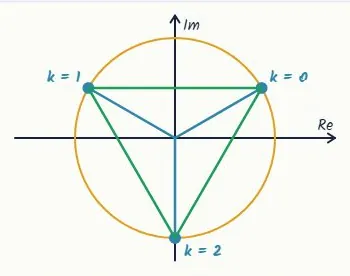
Try it: the roots on a circle
The 2025 error: the starting argument
- Sketch: second quadrant.
- Calculator: −π/3, wrong.
- Π − π/3 = 2π/3.
- −8 + 8√3i: x < 0, y > 0second quadrant
- r = √((−8)² + (8√3)²)modulus
- = √(64 + 192) = √256 = 16
- tan⁻¹(−√3) = −π/3fourth quadrant
- reference: tan⁻¹(√3) = π/3
- θ = π − π/3 = 2π/3second quadrant
- z⁴ = 16 cis(2π/3)
The four roots
- Modulus: ⁴√16 = 2.
- A quarter turn apart.
- Keep each one in range.
- z⁴ = 16 cis(2π/3)
- s⁴ = 16, so s = ⁴√16 = 2modulus
- 4α = 2π/3 + 2πk, α = π/6 + πk/2
- k = 0: α = π/6
- k = 1: π/6 + π/2 = 2π/3
- k = 2: π/6 + π = 7π/6
- 7π/6 − 2π = −5π/6more than π
- k = 3: π/6 + 3π/2 = 5π/3
- 5π/3 − 2π = −π/3more than π
Check on the Argand diagram
- Four roots on the circle of radius 2.
- A quarter turn apart: a square.
- A wrong start turns the whole square.
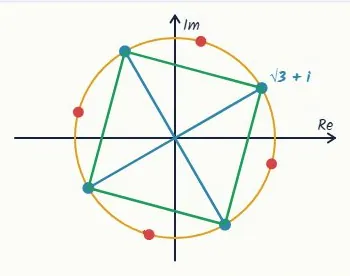
Try it: predict powers and roots
The roots in rectangular form
- Exact cos and sin.
- Answer in the form asked.
- 2 cis(π/6) = 2(√3/2 + i/2)
- = √3 + i
- 2 cis(2π/3) = 2(−1/2 + (√3/2)i)
- = −1 + √3i
- 2 cis(−5π/6) = 2(−√3/2 − i/2)
- = −√3 − i
- 2 cis(−π/3) = 2(1/2 − (√3/2)i)
- = 1 − √3i
Check: a root to the fourth
- Square, then square again.
- It gives back the number.
- z⁴ = −8 + 8√3i
- (√3 + i)² = 3 + 2√3i + i²expand
- = 2 + 2√3ii² = −1
- (√3 + i)⁴ = (2 + 2√3i)²square again
- = 4 + 8√3i + 12i²expand
- = 4 + 8√3i − 12i² = −1
- = −8 + 8√3i
Setting out a roots question
- Sketch, then write it in polar form.
- Nth root of the modulus.
- Argument with k; keep each in range.
Where the marks are
- Achieved: de Moivre for a power.
- Merit: all the roots of zⁿ = a + bi.
- Excellence: roots inside longer problems.
What to take away
- Sketch first, get the starting argument right, then add 2π/n.
| Power | rⁿ cis(nθ) |
| Sketch first | the right argument |
| Root modulus | positive nth root |
| Arguments | (θ + 2πk)/n |
| n roots | spaced 2π/n |
| Answer | in the form asked |
Common mistakes
- −8 + 8√3i has argument tan⁻¹(−√3) = −π/3.Sketch it first: it is in the second quadrant, so θ = π − π/3 = 2π/3. A wrong start turns every root.
- (2 cis(π/3))⁵ = 10 cis(5π/3)De Moivre raises the modulus to the power: 2⁵ = 32, so it is 32 cis(5π/3) = 32 cis(−π/3) in range.
- z³ = 8i, so z = 2 cis(π/6).A cube equation has three roots: add 2πk/3 for k = 0, 1, 2 to get 2 cis(π/6), 2 cis(5π/6) and 2 cis(−π/2).
- z⁴ = 16 cis(2π/3), so each root has modulus 16 ÷ 4 = 4.Take the fourth root of the modulus, ⁴√16 = 2; only the argument is divided by 4.
Your turn: eight questions
- Sketch the number in 3 and 4 first.
- Give every root.
| Given | Find | |
|---|---|---|
| 1 | (−1 + i)⁶ | a + bi |
| 2 | (2 cis(π/8))⁴ | a + bi |
| 3 | z³ = −27 | all roots, polar |
| 4 | z² = −2 − 2√3i | both roots, a + bi |
| 5 | (3 cis(2π/5))³ | polar form |
| 6 | z⁶ = 64 | how many roots are real |
| 7 | z⁴ = w, one root 2 cis(π/5) | the other three roots |
| 8 | z = √3 + i | smallest n > 0, zⁿ real |
Show answer
1. −1 + i = √2 cis(3π/4), so the power is 8 cis(9π/2) = 8 cis(π/2) = 8i. 2. 16 cis(π/2) = 16i. 3. −27 = 27 cis π: 3 cis(π/3), 3 cis π and 3 cis(−π/3). 4. −2 − 2√3i = 4 cis(−2π/3): 1 − √3i and −1 + √3i. 5. 27 cis(−4π/5). De Moivre gives 3³ cis(6π/5) = 27 cis(6π/5), and 6π/5 − 2π = −4π/5 brings it into range. 6. 2. 64 = 64 cis 0, so the six roots are 2 cis(kπ/3), π/3 apart, and only k = 0 and k = 3 land on the real axis: 2 and −2. 7. 2 cis(7π/10), 2 cis(−4π/5), 2 cis(−3π/10). Four roots are 2π/4 = π/2 apart: π/5 + π/2 = 7π/10, then 6π/5 − 2π = −4π/5 and 17π/10 − 2π = −3π/10. 8. n = 6. z = 2 cis(π/6), so zⁿ = 2ⁿ cis(nπ/6), which is real when nπ/6 is a multiple of π; the first is n = 6, giving −64.
The answers: questions 1 and 2
- 1. −1 + i: second quadrant
- r = √2, θ = π − π/4 = 3π/4
- (√2)⁶ cis(18π/4) = 8 cis(9π/2)de Moivre
- 9π/2 − 4π = π/2into range
- 8 cis(π/2) = 8(0 + i) = 8i
- 2. 2⁴ cis(4π/8) = 16 cis(π/2)de Moivre
- = 16(0 + i) = 16i
The answers: question 3
- 3. −27 = 27 cis πnegative real axis
- s³ = 27, so s = 3modulus
- 3α = π + 2πk, α = π/3 + 2πk/3
- k = 0, 1, −1: π/3, π, −π/3all in range
- 3 cis(π/3), 3 cis π, 3 cis(−π/3)
- 3 cis π = −3
The answers: question 4
- 4. −2 − 2√3i: third quadrant
- r = √(4 + 12) = 4modulus
- reference: tan⁻¹(2√3/2) = π/3
- θ = −(π − π/3) = −2π/3below the axis
- s² = 4, s = 2; 2α = −2π/3 + 2πk
- α = −π/3 + πk: −π/3, 2π/3k = 0, 1
- 2 cis(−π/3) = 1 − √3i
- 2 cis(2π/3) = −1 + √3i
Sample question: Achieved
Use de Moivre's theorem to write (√3 + i)⁴ in the form a + bi.
Hint
Write √3 + i in polar form first. Then raise the modulus to the power 4 and multiply the argument by 4.
Answer
(√3 + i)⁴ = −8 + 8√3i
Step by step
- De Moivre's theorem: (r cis θ)ⁿ = rⁿ cis(nθ). So we need the polar form first.
- √3 + i has both parts positive, so it is in the first quadrant.
- Modulus: r = √(3 + 1) = 2. Argument: θ = tan⁻¹(1√3) = π6.
- So (√3 + i)⁴ = (2 cis(π6))⁴ = 2⁴ cis(4π6) = 16 cis(2π3).
- Back to a + bi: cos(2π3) = −12 and sin(2π3) = √32.
- 16(−12) + 16(√32)i = −8 + 8√3i.
- Check the modulus: √(64 + 192) = √256 = 16 = 2⁴. Correct.
Full working
- √3 + i = 2 cis(π6)r = √(3 + 1), first quadrant
- (2 cis(π6))⁴ = 16 cis(2π3)de Moivre
- 16(−12) + 16(√32)iexact values
- −8 + 8√3i
Sample questions: Merit
Solve z³ = −8i. Give all the roots in the form a + bi.
Hint
−8i lies on the negative imaginary axis, so its argument is −π2. The three roots are 2π3 apart.
Answer
z = √3 − i, 2i or −√3 − i
Step by step
- Write −8i in polar form. It sits on the negative imaginary axis, 8 from the origin: −8i = 8 cis(−π2).
- Let z = s cis α. Then z³ = s³ cis(3α), and this must equal 8 cis(−π2).
- Moduli: s³ = 8, so s = 2. The modulus is the positive real cube root.
- Arguments: 3α = −π2 + 2πk, so α = −π6 + 2πk3.
- Take k = 0, 1 and −1 to keep each argument between −π and π: α = −π6, π2 and −5π6.
- Convert each one. 2 cis(−π6) = 2(√32 − i2) = √3 − i.
- 2 cis(π2) = 2(0 + i) = 2i.
- 2 cis(−5π6) = 2(−√32 − i2) = −√3 − i.
- Check one: (2i)³ = 8i³ = −8i. Correct. The three roots are 2π3 apart on a circle of radius 2.
Full working
- −8i = 8 cis(−π2)negative imaginary axis
- s³ = 8, s = 2modulus
- 3α = −π2 + 2πk, α = −π6 + 2πk3
- k = 0, 1, −1: α = −π6, π2, −5π6keep −π < α ≤ π
- 2 cis(−π6) = √3 − i, 2 cis(π2) = 2i, 2 cis(−5π6) = −√3 − i
- z = √3 − i, 2i, −√3 − i
Solve z³ = 4√3 − 4i. Give the roots in polar form r cis θ with −π < θ ≤ π.
Hint
Sketch 4√3 − 4i first: it is in the fourth quadrant, so its argument is negative.
Answer
z = 2 cis(−π18), 2 cis(11π18) or 2 cis(−13π18)
Step by step
- Sketch first. The real part is positive and the imaginary part is negative, so 4√3 − 4i is in the fourth quadrant.
- Modulus: √((4√3)² + 4²) = √(48 + 16) = √64 = 8.
- Reference angle: tan⁻¹(44√3) = tan⁻¹(1√3) = π6. In the fourth quadrant the argument is −π6.
- So the equation is z³ = 8 cis(−π6). Getting this starting argument right matters: a wrong one makes every root wrong.
- Let z = s cis α. Moduli: s³ = 8, so s = 2.
- Arguments: 3α = −π6 + 2πk, so α = −π18 + 2πk3.
- k = 0: α = −π18. k = 1: −π18 + 12π18 = 11π18. k = −1: −π18 − 12π18 = −13π18.
- All three are between −π and π, so the roots are 2 cis(−π18), 2 cis(11π18) and 2 cis(−13π18).
- Check one: (2 cis(−π18))³ = 8 cis(−3π18) = 8 cis(−π6). Correct.
Full working
- |4√3 − 4i| = √(48 + 16) = 8
- arg = −π6fourth quadrant, reference tan⁻¹(1√3)
- s³ = 8, s = 2
- α = −π18 + 2πk33α = −π6 + 2πk
- k = 0, 1, −1: −π18, 11π18, −13π18
- z = 2 cis(−π18), 2 cis(11π18), 2 cis(−13π18)
Sample questions: Excellence
Use de Moivre's theorem to prove that cos 3θ = 4cos³θ − 3cos θ. Hence solve 8x³ − 6x − 1 = 0, giving the three solutions in the form cos(aπ).
Hint
(cos θ + i sin θ)³ = cos 3θ + i sin 3θ. Expand the left side and compare real parts. For the hence, let x = cos θ.
Answer
x = cos(π9), cos(5π9) or cos(7π9)
Step by step
- De Moivre's theorem with n = 3 gives (cos θ + i sin θ)³ = cos 3θ + i sin 3θ.
- Expand the left side with the binomial pattern (a + b)³ = a³ + 3a²b + 3ab² + b³. Write c for cos θ and s for sin θ.
- (c + is)³ = c³ + 3c²(is) + 3c(is)² + (is)³ = c³ + 3ic²s − 3cs² − is³.
- The real part is c³ − 3cs². That must equal the real part of the right side, cos 3θ.
- Replace s² with 1 − c²: cos 3θ = c³ − 3c(1 − c²) = 4c³ − 3c. That proves cos 3θ = 4cos³θ − 3cos θ.
- Hence: 8x³ − 6x − 1 = 0 is 2(4x³ − 3x) = 1. Let x = cos θ. Then this says 2cos 3θ = 1, so cos 3θ = 12.
- A cubic has three roots, so we need three different values of cos θ. Take 0 ≤ θ ≤ π, so 0 ≤ 3θ ≤ 3π.
- cos 3θ = 12 gives 3θ = π3, 5π3 or 7π3 in that range.
- So θ = π9, 5π9 or 7π9, and x = cos(π9), cos(5π9) or cos(7π9).
- These are three different numbers, so they are all three roots.
- Check with a calculator: cos(π9) ≈ 0.9397, and 8(0.9397)³ − 6(0.9397) − 1 ≈ 0. Correct.
Full working
- (cos θ + i sin θ)³ = cos 3θ + i sin 3θde Moivre
- real part of (c + is)³ = c³ − 3cs²binomial expansion
- cos 3θ = c³ − 3c(1 − c²) = 4c³ − 3cs² = 1 − c²
- 8x³ − 6x − 1 = 0 becomes 2cos 3θ = 1x = cos θ
- 3θ = π3, 5π3, 7π30 ≤ 3θ ≤ 3π
- θ = π9, 5π9, 7π9
- x = cos(π9), cos(5π9), cos(7π9)
w = −1 + √3i. Find the smallest positive integer n for which wⁿ is real and positive, and find the value of wⁿ. Hence write down all three solutions of z³ = 8 and explain why they are the solutions.
Hint
Write w in polar form. wⁿ is real and positive when its argument is a whole number of turns, 2πm.
Answer
n = 3 and w³ = 8. The solutions of z³ = 8 are 2, −1 + √3i and −1 − √3i.
Step by step
- Sketch w: real part negative, imaginary part positive, so it is in the second quadrant.
- Modulus: √(1 + 3) = 2. Reference angle tan⁻¹(√3) = π3, so the argument is π − π3 = 2π3. So w = 2 cis(2π3).
- De Moivre: wⁿ = 2ⁿ cis(2nπ3).
- A complex number is real and positive when it lies on the positive real axis, so its argument is 0, 2π, 4π, and so on.
- 2nπ3 = 2πm means n = 3m. The smallest positive n is 3.
- w³ = 2³ cis(2π) = 8.
- Hence: w³ = 8 tells us w = −1 + √3i is a solution of z³ = 8.
- z³ − 8 = 0 has real coefficients, so the conjugate −1 − √3i is also a solution.
- 2 is a solution too, because 2³ = 8.
- A cubic has exactly three roots, so these are all of them: 2, −1 + √3i and −1 − √3i.
- They all have modulus 2 and arguments 0, 2π3 and −2π3, a third of a turn apart, as the cube roots of 8 should be.
Full working
- w = 2 cis(2π3)second quadrant, π − π3
- wⁿ = 2ⁿ cis(2nπ3)de Moivre
- 2nπ3 = 2πm, so n = 3mpositive real axis
- n = 3, w³ = 8 cis(2π) = 8
- w and its conjugate −1 − √3i are roots of z³ − 8 = 0real coefficients
- 2³ = 8, and a cubic has three roots
- n = 3, w³ = 8; z = 2, −1 + √3i, −1 − √3i
Challenge
Let Sₙ = (√3 + i)ⁿ + (√3 − i)ⁿ, where n is a positive integer. (a) Show that Sₙ = 2ⁿ⁺¹ cos(nπ6), so Sₙ is always real. (b) Find the exact value of S₁₀. (c) Find every n from 1 to 12 for which Sₙ = 0.
Hint
Write √3 + i and √3 − i in polar form. They are conjugates, so their arguments are opposites. What happens to the sine parts when you add the two powers?
Answer
(a) √3 ± i = 2 cis(±π6), so Sₙ = 2ⁿ[cis(nπ6) + cis(−nπ6)] = 2ⁿ⁺¹ cos(nπ6), which is real. (b) S₁₀ = 1024. (c) n = 3 and n = 9.
Step by step
- Put √3 + i into polar form: modulus 2, argument π6. Its conjugate √3 − i has modulus 2 and argument −π6.
- De Moivre raises each modulus to 2ⁿ and multiplies each argument by n.
- Adding cis(nπ6) and cis(−nπ6), the cosines double and the sines cancel, so the sum is real.
- For n = 10, 10π6 = 5π3, whose cosine is 12.
- Sₙ = 0 exactly when cos(nπ6) = 0, and from 1 to 12 that happens twice.
Full working
- |√3 + i| = √(3 + 1) = 2, arg = tan⁻¹(1√3) = π6first quadrant
- √3 − i = 2 cis(−π6)the conjugate: opposite argument
- (√3 + i)ⁿ = 2ⁿ cis(nπ6), (√3 − i)ⁿ = 2ⁿ cis(−nπ6)de Moivre
- Sₙ = 2ⁿ[cos(nπ6) + i sin(nπ6) + cos(nπ6) − i sin(nπ6)]cos(−A) = cos A, sin(−A) = −sin A
- Sₙ = 2ⁿ⁺¹ cos(nπ6), which is realthe sines cancel
- S₁₀ = 2¹¹ cos(10π6) = 2048 cos(5π3) = 2048 × 12 = 10245π3 is π3 short of 2π
- cos(nπ6) = 0 means nπ6 = π2 or 3π20 < nπ6 ≤ 2π for 1 ≤ n ≤ 12
- n = 3 or n = 9check: (√3 + i)³ = 8 cis(π2) = 8i and (√3 − i)³ = −8i
- S₁₀ = 1024; Sₙ = 0 for n = 3 and n = 9
Solve (z − 1)³ = 8z³. Give every solution in the form a + bi.
Hint
z = 0 is not a solution, so divide both sides by z³ and let w = z − 1z. Solve for w first, then turn each w back into z.
Answer
z = −1, z = 27 + (√37)i and z = 27 − (√37)i.
Step by step
- z = 0 does not work, so dividing both sides by z³ is safe.
- Then (z − 1z)³ = 8, so w = z − 1z is a cube root of 8.
- The cube roots of 8 = 8 cis 0 are 2, 2 cis(2π3) and 2 cis(−2π3).
- Rearrange w = z − 1z to z = 11 − w, and realise each denominator.
- The equation is a cubic, so three solutions is all of them.
Full working
- z = 0: (−1)³ = −1, but 8(0)³ = 0so z ≠ 0
- (z − 1z)³ = 8divide by z³
- w³ = 8 cis 0, so w = 2 cis(2πk3), k = 0, 1, −1three cube roots
- w = 2, −1 + √3i, −1 − √3iexact cos and sin
- wz = z − 1, so z = 11 − wrearrange
- w = 2: z = 11 − 2 = −1first solution
- w = −1 + √3i: z = 12 − √3i = 2 + √3i(2 − √3i)(2 + √3i) = 2 + √3i7realise the denominator
- w = −1 − √3i: z = 12 + √3i = 2 − √3i7the conjugate
- check z = −1: (−2)³ = −8 = 8(−1)³works
- z = −1, 27 + (√37)i, 27 − (√37)i
z = cis θ. (a) Show that zⁿ + 1zⁿ = 2cos nθ for any positive integer n. (b) By expanding (z + 1z)⁵, show that 16cos⁵θ = cos 5θ + 5cos 3θ + 10cos θ. (c) Hence solve cos 5θ + 5cos 3θ + 10cos θ = 12 for 0 ≤ θ ≤ π.
Hint
1zⁿ = z⁻ⁿ = cis(−nθ) by de Moivre. For (b), the binomial coefficients for power 5 are 1, 5, 10, 10, 5, 1: pair each power of z with the matching power of 1z.
Answer
(a) zⁿ + z⁻ⁿ = cis nθ + cis(−nθ) = 2cos nθ. (b) (2cos θ)⁵ = 2cos 5θ + 10cos 3θ + 20cos θ; divide by 2. (c) 16cos⁵θ = 12, so cos θ = 12 and θ = π3.
Step by step
- De Moivre gives zⁿ = cis nθ and z⁻ⁿ = cis(−nθ); adding them cancels the sines.
- With n = 1, z + 1z = 2cos θ, so the left side of the expansion is 32cos⁵θ.
- In the expansion, z⁵ pairs with z⁻⁵, 5z³ with 5z⁻³, and 10z with 10z⁻¹.
- Each pair is a cosine by part (a). Divide everything by 2.
- In (c) the left side is 16cos⁵θ, so cos⁵θ = 132. A real number has only one real fifth root.
Full working
- zⁿ = cis nθ, 1zⁿ = z⁻ⁿ = cis(−nθ)de Moivre
- zⁿ + z⁻ⁿ = 2cos nθthe sines cancel
- z + 1z = 2cos θn = 1
- (z + 1z)⁵ = z⁵ + 5z³ + 10z + 10z⁻¹ + 5z⁻³ + z⁻⁵binomial: 1, 5, 10, 10, 5, 1
- = (z⁵ + z⁻⁵) + 5(z³ + z⁻³) + 10(z + z⁻¹)pair the terms
- 32cos⁵θ = 2cos 5θ + 10cos 3θ + 20cos θpart (a) on both sides
- 16cos⁵θ = cos 5θ + 5cos 3θ + 10cos θdivide by 2
- 16cos⁵θ = 12, so cos⁵θ = 132the equation in (c)
- cos θ = 12the only real fifth root of 132
- θ = π3
Practise this
Report a mistake
More in AS 91577
 Complex arithmetic, conjugates and equating parts9 min
 Polar form by hand: modulus, argument and quadrants10 minDe Moivre's theorem: powers and roots of complex numbers11 min
 Complex roots of polynomials: factor theorem and conjugates11 min
 Algebra with k: quadratics, discriminants and surd equations10 min
 Complex loci, purely real conditions and proofs11 min
 Complex arithmetic: 7 exam questions solved step by step11 min
 Polar form: 7 exam questions solved step by step11 min
 De Moivre's theorem: 7 exam questions solved step by step12 min
 Complex polynomials: 7 exam questions solved step by step12 min
 Algebra with constants: 7 exam questions solved step by step12 min
 Complex loci and proof: 7 exam questions solved step by step12 min