Trig identities and proofs
What this lesson covers
- sin²x + cos²x = 1.
- 1 + tan²x = sec²x.
- Start from one side and finish at the other.
Where the main identity comes from
- Take a point on the unit circle. The right-angled triangle has sides cos x and sin x, and hypotenuse 1.
- Pythagoras gives sin²x + cos²x = 1. Divide every term by cos²x to get tan²x + 1 = sec²x.
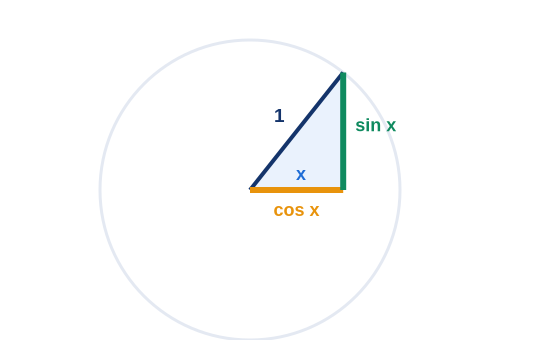
Try it: where sin² + cos² = 1 comes from
The facts you need
- Tan x = sin x ÷ cos x.
- Sec x = 1 ÷ cos x, cosec x = 1 ÷ sin x and cot x = cos x ÷ sin x.
- Sin²x + cos²x = 1 and 1 + tan²x = sec²x.
Try it: both sides, every x
Simplify (1 − cos²x) ÷ sin x
- Replace the top with a single term.
- = sin²x ÷ sin x
- = sin x
Prove tan x + cot x = sec x cosec x
- Work from the left side, and write everything in sine and cosine.
- LHS = sin x/cos x + cos x/sin x
- = (sin²x + cos²x) ÷ (sin x cos x)
- = 1 ÷ (sin x cos x)
- = sec x cosec x = RHS
Try it: build a proof line by line
Finding the other ratios
- Given sin x = 3/5 with x in the second quadrant, find cos x and tan x. Cosine is negative there.
- cos²x = 1 − 9/25 = 16/25the main identity
- cos x = −4/5second quadrant
- tan x = (3/5) ÷ (−4/5)
- tan x = −3/4
Using 1 + tan²x = sec²x
- Simplify (sec²x − 1) ÷ tan x.
- sec²x − 1 = tan²xrearrange the identity
- = tan²x ÷ tan x
- = tan x
A proof with two fractions
- Prove 1/(1 − cos x) + 1/(1 + cos x) = 2 cosec²x. Combine the fractions first.
- LHS = ((1 + cos x) + (1 − cos x)) ÷ (1 − cos²x)
- = 2 ÷ (1 − cos²x)
- = 2 ÷ sin²x
- = 2 cosec²x = RHS
Common mistakes
- Moving terms across the equals sign in a proof.Work on one side only.
- Cancelling sin from sin x + 1 ÷ sin x.Only common factors cancel.
Your turn
Simplify sin x cot x.
Simplify (1 − cos²x) ÷ (sin x cos x).
sin x = −5/13 with x in the fourth quadrant. Find cos x.
Simplify sec²x − tan²x.
Simplify sin²x sec²x.
tan x = 4/3 with x in the third quadrant. Find sin x.
Which of these is an identity, true for every value of x?
Simplify sin x ÷ (1 + cos x) + (1 + cos x) ÷ sin x.
Show answer
1. cos x 2. sin²x ÷ (sin x cos x) = tan x 3. Cosine is positive there, so 12/13 4. 1 5. tan²x. sec²x = 1 ÷ cos²x, so sin²x sec²x = sin²x ÷ cos²x = tan²x. 6. −4/5. A 3, 4, 5 triangle gives sin x = 4/5 in size, and sine is negative in the third quadrant, so −4/5. 7. 1 + cot²x = cosec²x. Divide every term of sin²x + cos²x = 1 by sin²x. 8. 2 cosec x. Over sin x (1 + cos x) the top is sin²x + 1 + 2cos x + cos²x = 2(1 + cos x), which cancels to 2 ÷ sin x.
Sample question: Achieved
Simplify cos x tan x.
Hint
Write tan x as sin xcos x.
Answer
sin x
Step by step
- tan x is not in the answer, so change it into sin and cos: tan x = sin xcos x.
- cos x tan x = cos x × sin xcos x.
- cos x on the top cancels cos x on the bottom.
- That leaves sin x.
Full working
- cos x tan x = cos x × sin xcos xtan x = sin xcos x
- = sin xcancel cos x
Sample questions: Merit
Prove tan²x − sin²x = tan²x sin²x.
Hint
Write tan²x as sin²xcos²x and put the left side over a common denominator.
Answer
LHS = sin²x(1 − cos²x)cos²x = sin⁴xcos²x = tan²x sin²x = RHS
Step by step
- For a proof, start with one side (usually the messier one) and change it step by step into the other side.
- Start with the left side: tan²x − sin²x.
- Write tan in sin and cos: tan x = sin xcos x, so tan²x = sin²xcos²x.
- LHS = sin²xcos²x − sin²x.
- Put it over one denominator: sin²x is the same as sin²x cos²xcos²x. So LHS = sin²x − sin²x cos²xcos²x.
- Take out sin²x on top: sin²x(1 − cos²x)cos²x.
- From sin²x + cos²x = 1, 1 − cos²x = sin²x. So we have sin²x × sin²xcos²x.
- Split it: (sin²xcos²x) × sin²x = tan²x sin²x, the right side.
Full working
- LHS = sin²xcos²x − sin²xtan x = sin xcos x
- = sin²x − sin²x cos²xcos²xcommon denominator
- = sin²x(1 − cos²x)cos²xfactorise
- = sin²x × sin²xcos²x1 − cos²x = sin²x
- = tan²x sin²x = RHS
Prove 11 − sin x + 11 + sin x = 2 sec²x.
Hint
Add the two fractions, then use 1 − sin²x = cos²x.
Answer
LHS = 21 − sin²x = 2cos²x = 2 sec²x = RHS
Step by step
- Start with the left side. It has two fractions, so add them.
- The common denominator is (1 − sin x)(1 + sin x).
- Top: (1 + sin x) + (1 − sin x) = 2. The sin x terms cancel.
- Bottom: (1 − sin x)(1 + sin x) = 1 − sin²x, a difference of two squares.
- So LHS = 21 − sin²x.
- 1 − sin²x = cos²x, so LHS = 2cos²x.
- sec x = 1cos x, so 1cos²x = sec²x. LHS = 2 sec²x, the right side.
Full working
- LHS = (1 + sin x) + (1 − sin x)(1 − sin x)(1 + sin x)common denominator
- = 21 − sin²xdifference of two squares
- = 2cos²x1 − sin²x = cos²x
- = 2 sec²x = RHS
Sample questions: Excellence
Prove 1 − cos xsin x = sin x1 + cos x, and state the values of x for which the identity has no meaning.
Hint
Multiply the top and bottom of the left side by (1 + cos x).
Answer
Proved; it has no meaning where sin x = 0, that is x = nπ
Step by step
- The left side has 1 − cos x on top. Multiply top and bottom by 1 + cos x. Like rationalising, it makes a difference of two squares.
- Top: (1 − cos x)(1 + cos x) = 1 − cos²x.
- 1 − cos²x = sin²x, so the top is sin²x.
- LHS = sin²xsin x(1 + cos x).
- Cancel one sin x from top and bottom: sin x1 + cos x, the right side.
- When does it have no meaning? Whenever a denominator is 0.
- Left side: sin x = 0, at x = 0, π, 2π, ..., that is x = nπ.
- Right side: 1 + cos x = 0, so cos x = −1, at x = π, 3π, ... These are already in x = nπ.
- So the identity has no meaning at x = nπ.
Full working
- LHS = (1 − cos x)(1 + cos x)sin x(1 + cos x)multiply top and bottom by 1 + cos x
- = 1 − cos²xsin x(1 + cos x)
- = sin²xsin x(1 + cos x)1 − cos²x = sin²x
- = sin x1 + cos x = RHScancel sin x, allowed when sin x ≠ 0
- Undefined when sin x = 0 or 1 + cos x = 01 + cos x = 0 at x = π, 3π, ..., already in sin x = 0
- No meaning at x = nπ
Prove (sec x − tan x)² = 1 − sin x1 + sin x. Hence solve (sec x − tan x)² = 13 for 0 ≤ x ≤ 2π.
Hint
Write sec x and tan x in terms of sin x and cos x first. Then replace cos²x with 1 − sin²x and factorise.
Answer
x = π6 or 5π6
Step by step
- Change everything into sin and cos: sec x = 1cos x and tan x = sin xcos x.
- sec x − tan x = 1 − sin xcos x.
- Square it: (1 − sin x)²cos²x.
- The right side has only sin x, so replace cos²x with 1 − sin²x: (1 − sin x)²1 − sin²x.
- Factorise the bottom as a difference of two squares: (1 − sin x)(1 + sin x).
- Cancel one (1 − sin x): 1 − sin x1 + sin x, the right side.
- Hence, solve 1 − sin x1 + sin x = 13.
- Cross-multiply: 3(1 − sin x) = 1 + sin x, so 3 − 3 sin x = 1 + sin x.
- Collect: 2 = 4 sin x, so sin x = 12.
- sin x = 12 at x = π6 and 5π6.
- Check they are allowed: sec x and tan x need cos x ≠ 0. cos(π6) and cos(5π6) are not 0, so both answers stand.
Full working
- sec x − tan x = 1cos x − sin xcos x = 1 − sin xcos x
- LHS = (1 − sin x)²cos²x
- = (1 − sin x)²1 − sin²xcos²x = 1 − sin²x
- = (1 − sin x)²(1 − sin x)(1 + sin x)difference of two squares
- = 1 − sin x1 + sin x = RHS
- 1 − sin x1 + sin x = 13hence
- 3 − 3 sin x = 1 + sin x, so sin x = 12
- x = π6 or 5π6cos x ≠ 0 at both, so both stand
What to take away
- When stuck, write it all in sine and cosine.
- A proof runs from one side to the other.
Challenge
Prove that sec⁴x − sec²x = tan⁴x + tan²x. Hence solve sec⁴x − sec²x = 2 for 0 ≤ x ≤ 2π.
Hint
Take out a common factor on the left, then replace sec²x using 1 + tan²x = sec²x. For the equation, treat tan²x as a single unknown.
Answer
LHS = sec²x(sec²x − 1) = (1 + tan²x)tan²x = tan²x + tan⁴x = RHS. The solutions are x = π4, 3π4, 5π4 and 7π4.
Step by step
- Start with the left side and take out the common factor sec²x.
- The bracket sec²x − 1 is tan²x, and the factor sec²x outside is 1 + tan²x.
- Multiply out to reach tan²x + tan⁴x, the right side.
- Now the equation reads tan⁴x + tan²x − 2 = 0, a quadratic in tan²x, which factorises.
- tan²x = −2 is impossible, so tan²x = 1 and tan x = 1 or −1, giving one angle in each quadrant.
Full working
- LHS = sec²x(sec²x − 1)common factor sec²x
- = (1 + tan²x)(tan²x)1 + tan²x = sec²x
- = tan²x + tan⁴x = RHSexpand
- tan⁴x + tan²x − 2 = 0use the identity in the equation
- (tan²x + 2)(tan²x − 1) = 0factorise as a quadratic in tan²x
- tan²x = −2 has no solutiona square cannot be negative
- tan x = ±1, reference angle π4tan²x = 1
- x = π4, 3π4, 5π4, 7π4
An angle x satisfies sec x + tan x = 3. Without finding x, find the exact values of sin x and cos x.
Hint
Rearrange 1 + tan²x = sec²x so that one side is a difference of two squares. What does that tell you about sec x − tan x?
Answer
sin x = 45 and cos x = 35.
Step by step
- From 1 + tan²x = sec²x, sec²x − tan²x = 1, and the left side factorises as (sec x + tan x)(sec x − tan x).
- Since sec x + tan x = 3, it follows that sec x − tan x = 13.
- Adding and subtracting the two equations gives sec x = 53 and tan x = 43.
- So cos x = 35, and sin x = tan x × cos x = 45.
- Check: sin²x + cos²x = 1625 + 925 = 1.
Full working
- sec²x − tan²x = 1from 1 + tan²x = sec²x
- (sec x + tan x)(sec x − tan x) = 1difference of two squares
- sec x − tan x = 13divide by 3
- 2 sec x = 3 + 13 = 103, so sec x = 53add the two equations
- 2 tan x = 3 − 13 = 83, so tan x = 43subtract them
- cos x = 1 ÷ sec x = 35definition of sec
- sin x = tan x × cos x = 43 × 35 = 45tan x = sin x ÷ cos x
- sin x = 45, cos x = 35
An angle x satisfies sin x + cos x = 12. Without finding x, find the exact values of (a) sin x cos x, (b) sin³x + cos³x and (c) tan x + cot x.
Hint
Square both sides of the given equation and use the main identity. For (b), a³ + b³ = (a + b)(a² − ab + b²). For (c), write tan x + cot x as one fraction.
Answer
(a) sin x cos x = −38. (b) sin³x + cos³x = 1116. (c) tan x + cot x = −83.
Step by step
- Squaring gives sin²x + 2 sin x cos x + cos²x = 14, and sin²x + cos²x = 1, so 2 sin x cos x = −34.
- For (b), factorise the sum of cubes. The second bracket contains sin²x + cos²x, which is 1.
- So sin³x + cos³x = (sin x + cos x)(1 − sin x cos x) = (12)(1 + 38).
- For (c), tan x + cot x = (sin²x + cos²x) ÷ (sin x cos x) = 1 ÷ (sin x cos x).
- Substitute sin x cos x = −38 to get −83.
Full working
- (sin x + cos x)² = 14square both sides
- 1 + 2 sin x cos x = 14sin²x + cos²x = 1
- sin x cos x = −38(a)
- sin³x + cos³x = (sin x + cos x)(sin²x − sin x cos x + cos²x)sum of two cubes
- = (12)(1 − (−38)) = (12)(118) = 1116(b)
- tan x + cot x = (sin²x + cos²x) ÷ (sin x cos x) = 1 ÷ (sin x cos x)common denominator
- = 1 ÷ (−38) = −83(c)
- (a) −38, (b) 1116, (c) −83