Modelling periodic situations
What this lesson covers
- The midline is the average of the maximum and minimum.
- The amplitude is half their difference.
- b = 2π ÷ period.
Building the model
- Use a cosine if it starts at a maximum.
- Use −cos if it starts at a minimum.
- Use sine if it starts on the midline, going up.
A tide
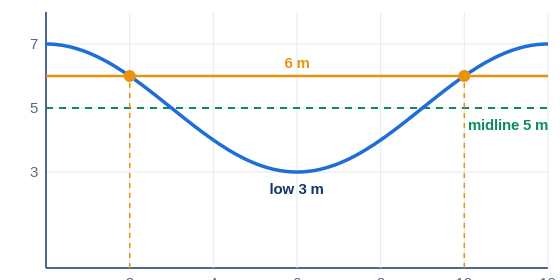
- High tide is 7 m at t = 0 and low tide is 3 m six hours later.
- midline = 5, amplitude = 2
- period 12, so b = π/6
- h = 2 cos(πt/6) + 5
When is the water 6 m deep?
- Solve with the model.
- 2 cos(πt/6) + 5 = 6
- cos(πt/6) = 1/2
- πt/6 = π/3 or 5π/3
- t = 2 and t = 10 hours
Try it: when is the water 6 m?
See the two answers
- The line h = 6 crosses the tide curve twice in 12 hours, at t = 2 and t = 10.
Try it: build a model
- Set a, b, c and the shift to fit a situation. Press Match this curve for practice.
Graphing calculator
Daylight hours
- In an invented town, daylight peaks at 15 hours in December and falls to 9 hours in June. Let t be months after December.
- midline = 12, amplitude = 3
- period 12, so b = π/6
- H = 3 cos(πt/6) + 12
- H = 13.5: cos(πt/6) = 1/2
- t = 2 and t = 10
Try it: build the model
Common mistakes
- Using the time from high to low as the period.That is half a period.
- Giving only the first solution.Check for every time in the range asked.
Your turn
A pattern repeats every 24 hours. Find b.
A model has a maximum of 20 and a minimum of 8. Find the midline and amplitude.
A model starts at its minimum. Which form fits?
Find the period of h = 3 sin(πt/2) + 5.
A model for daylight in Invercargill is D = 3.5 cos(πt/6) + 12 hours. How much longer is the longest day than the shortest?
A Ferris wheel seat goes from 2 m to 22 m above the ground and back every 8 minutes, starting at the bottom. Which model fits?
Water depth is h = 3 cos(πt/6) + 5 m, t hours after midnight. When in 0 ≤ t ≤ 12 is the depth 3.5 m?
A seat's height is h = −10 cos(πt/4) + 12 m after t minutes. For how long in each turn is it above 17 m?
Show answer
1. 2π ÷ 24 = π/12 2. Midline 14, amplitude 6 3. A negative cosine: y = −a cos(bt) + c 4. 2π ÷ (π/2) = 4 5. 7 hours. The longest is 12 + 3.5 = 15.5 hours and the shortest 12 − 3.5 = 8.5 hours, twice the amplitude apart. 6. h = −10 cos(πt/4) + 12. Midline 12, amplitude 10, b = 2π ÷ 8 = π/4, and −cos because it starts at a minimum. 7. t = 4 and t = 8 hours. cos(πt/6) = −1/2, so πt/6 = 2π/3 or 4π/3. 8. 2 min 40 s. h = 17 when cos(πt/4) = −1/2, at t = 8/3 and 16/3, so 16/3 − 8/3 = 8/3 minutes, which is 2 min 40 s.
Sample question: Achieved
A model has a maximum of 18, a minimum of 6 and a period of 12. Find a, b and c for y = a cos(bt) + c.
Hint
a is half the distance from the minimum to the maximum, c is the midline, and b = 2π ÷ period.
Answer
a = 6, b = π6, c = 12
Step by step
- The amplitude a is half the gap between the maximum and the minimum: (18 − 6) ÷ 2 = 6.
- The midline c is halfway between them: (18 + 6) ÷ 2 = 12.
- The period is 12, and period = 2π ÷ b, so b = 2π ÷ 12 = π6.
- Check: the largest value is 6 + 12 = 18 and the smallest is 12 − 6 = 6. Correct.
Full working
- a = (18 − 6) ÷ 2 = 6amplitude
- c = (18 + 6) ÷ 2 = 12midline
- b = 2π ÷ 12 = π6period = 2π ÷ b
- a = 6, b = π6, c = 12
Sample questions: Merit
With h = 4 cos(πt6) + 10, for how long in the 12 hours from t = 0 is the depth above 12 m?
Hint
Find when h = 12 first. Then use the starting depth to decide which parts are above 12 m.
Answer
4 hours (from t = 0 to 2 and from t = 10 to 12)
Step by step
- Read the model h = 4 cos(πt6) + 10: the midline is 10 m and the amplitude is 4 m, so the depth goes between 6 m and 14 m.
- The period is 2π ÷ (π6) = 12 hours, so 0 ≤ t ≤ 12 is exactly one cycle.
- Find when the depth is exactly 12 m: 4 cos(πt6) + 10 = 12.
- Subtract 10 and divide by 4: cos(πt6) = 12.
- Call the angle θ = πt6. For 0 ≤ t ≤ 12, θ goes from 0 to 2π. cos θ = 12 at θ = π3 and θ = 5π3.
- Change back to t: πt6 = π3 gives t = 2, and πt6 = 5π3 gives t = 10.
- Which parts are above 12 m? At t = 0 the depth is 4 + 10 = 14 m, above 12. So it is above from t = 0 to 2, below until t = 10, then above again to t = 12.
- Total: 2 + 2 = 4 hours.
Full working
- 4 cos(πt6) + 10 = 12, so cos(πt6) = 12
- πt6 = π3 or 5π30 ≤ πt6 ≤ 2π for 0 ≤ t ≤ 12
- t = 2 or t = 10
- h(0) = 14, above 12 mthe model starts at its maximum
- Above 12 m for 0 ≤ t < 2 and 10 < t ≤ 12
- 2 + 2 = 4 hours
A Ferris wheel has a radius of 20 m, its centre is 22 m above the ground and it turns once every 8 minutes. A rider gets on at the bottom at t = 0. Write a model for the rider's height h metres after t minutes, and find the exact height after 3 minutes.
Hint
Starting at the bottom means the height starts at its minimum, so use a negative cosine.
Answer
h = 22 − 20 cos(πt4); after 3 minutes h = 22 + 10√2 ≈ 36.1 m
Step by step
- Picture the wheel. The centre is 22 m up and the radius is 20 m, so the top is 42 m and the bottom is 2 m.
- Amplitude = radius = 20. Midline = height of the centre = 22.
- One turn takes 8 minutes, so the period is 8 and b = 2π ÷ 8 = π4.
- At t = 0 the rider is at the bottom. A cos graph starts at its top; a negative cos starts at its bottom. So use −20 cos.
- Model: h = 22 − 20 cos(πt4).
- Check: t = 0 gives 22 − 20 = 2 m, the bottom. t = 4 (half a turn) gives 22 + 20 = 42 m, the top.
- At t = 3: h = 22 − 20 cos(3π4).
- 3π4 is in quadrant 2, where cos is negative, with reference angle π4. So cos(3π4) = −√22.
- h = 22 − 20 × (−√22) = 22 + 10√2 ≈ 36.1 m.
Full working
- a = 20 and c = 22the radius and the height of the centre
- b = 2π ÷ 8 = π4one turn every 8 minutes
- h = 22 − 20 cos(πt4)check: h(0) = 2, the bottom
- h(3) = 22 − 20 cos(3π4)cos(3π4) = −√22
- h(3) = 22 + 10√2 ≈ 36.1 m
Sample questions: Excellence
High tide is 4.6 m at 3:00 am and the next low tide is 1.2 m at 9:15 am. A boat needs at least 2.5 m of water. Model the depth with a cosine function and find, to the nearest minute, the times when the boat cannot cross before the next high tide.
Hint
High tide to low tide is half a period. Measure t in hours from 3:00 am, so the model starts at a maximum and is a plain cosine.
Answer
h = 1.7 cos(4πt25) + 2.9; the boat cannot cross from about 6:36 am to 11:54 am
Step by step
- Set the clock: t is hours after 3:00 am. At t = 0 it is high tide, the maximum, so a plain cos curve fits.
- Amplitude = (high − low) ÷ 2 = (4.6 − 1.2) ÷ 2 = 1.7.
- Midline = (high + low) ÷ 2 = (4.6 + 1.2) ÷ 2 = 2.9.
- 3:00 am to 9:15 am is 6 h 15 min = 6.25 h. High to low is half a cycle, so the period is 12.5 h.
- b = 2π ÷ 12.5 = 4π25, about 0.5027.
- Model: h = 1.7 cos(4πt25) + 2.9.
- The boat is stuck when h < 2.5. Find when h = 2.5: 1.7 cos(4πt25) = −0.4, so cos(4πt25) = −0.2353.
- Calculator in radians: cos⁻¹(−0.2353) = 1.8083. The other angle in the same cycle is 2π − 1.8083 = 4.4749.
- Solve for t: t = 1.8083 × 25 ÷ 4π ≈ 3.598 h and t = 4.4749 × 25 ÷ 4π ≈ 8.902 h.
- Change to minutes: 0.598 × 60 ≈ 36 and 0.902 × 60 ≈ 54. So 3 h 36 min and 8 h 54 min after 3:00 am.
- That is 6:36 am and 11:54 am. Low tide (9:15 am) is between them, so the water is too shallow from about 6:36 am to 11:54 am.
Full working
- a = (4.6 − 1.2) ÷ 2 = 1.7, c = (4.6 + 1.2) ÷ 2 = 2.9amplitude and midline
- period = 2 × 6.25 = 12.5 h3:00 am to 9:15 am is half a period
- b = 2π ÷ 12.5 = 4π25 ≈ 0.5027
- h = 1.7 cos(4πt25) + 2.9t hours after 3:00 am
- 1.7 cos(4πt25) + 2.9 = 2.5, so cos(4πt25) = −0.4 ÷ 1.7 ≈ −0.2353
- 4πt25 = 1.8083 or 2π − 1.8083 = 4.4749calculator in radians
- t ≈ 3.598 h or 8.902 h3 h 36 min and 8 h 54 min after 3:00 am
- Below 2.5 m from about 6:36 am to 11:54 am
In a town, the longest day has 15 hours of daylight, on day 355 of the year, and the shortest has 9 hours, half a year later. Using a 365-day year, write a model for the hours of daylight D on day t, and find, to the nearest day, for how many days a year there is more than 13 hours of daylight.
Hint
The longest day is a maximum, so use a cosine shifted to t = 355. Then find the fraction of each cycle where D > 13.
Answer
D = 3 cos(2π(t − 355)365) + 12; about 143 days
Step by step
- Amplitude = (15 − 9) ÷ 2 = 3. Midline = (15 + 9) ÷ 2 = 12.
- One cycle is one year, 365 days, so b = 2π365.
- The longest day is a maximum. Cos starts at its maximum, so shift it to start at t = 355: D = 3 cos(2π(t − 355)365) + 12.
- Check: t = 355 gives 3 × 1 + 12 = 15 hours. Correct.
- We want D > 13: 3 cos(...) + 12 > 13, so cos(...) > 13.
- Calculator in radians: cos⁻¹(13) ≈ 1.231. Cos is above 13 when the angle is between −1.231 and 1.231, the part around each maximum.
- That window is 2 × 1.231 = 2.462 radians out of a full cycle of 2π ≈ 6.283.
- Fraction of the year: 2.462 ÷ 6.283 ≈ 0.392.
- Days: 0.392 × 365 ≈ 143 days.
Full working
- a = (15 − 9) ÷ 2 = 3, c = (15 + 9) ÷ 2 = 12, b = 2π365
- D = 3 cos(2π(t − 355)365) + 12maximum at t = 355
- D > 13 when cos(2π(t − 355)365) > 13
- cos θ > 13 for −1.231 < θ < 1.231cos⁻¹(13) ≈ 1.231
- fraction of the year = 2 × 1.231 ÷ 2π ≈ 0.392
- 0.392 × 365 ≈ 143 days
What to take away
- Max and min give the midline and amplitude.
- The period gives b.
Challenge
In a harbour, high tide is 7 m at t = 0 hours and the tide repeats every 12 hours. In each cycle the water is deeper than 4 m for exactly 8 hours. Model the depth as h = a cos(bt) + c, find the depth at low tide, and find, to the nearest minute, how long in each cycle the water is deeper than 5.5 m.
Hint
The 8 hours above 4 m sit evenly around high tide, from t = −4 to t = 4. So h(4) = 4 gives a second equation with a + c = 7.
Answer
h = 2 cos(πt6) + 5; low tide is 3 m; deeper than 5.5 m for about 5 hours 2 minutes
Step by step
- The period is 12, so b = 2π ÷ 12 = π6. High tide at t = 0 gives a + c = 7.
- The 8 hours above 4 m are centred on high tide, so the depth is exactly 4 m at t = 4: a cos(2π3) + c = 4, which is −a2 + c = 4.
- Subtract: 3a2 = 3, so a = 2 and c = 5. Low tide is c − a = 3 m.
- Deeper than 5.5 m: 2 cos(πt6) + 5 > 5.5, so cos(πt6) > 14.
- This holds for −t₁ < t < t₁ around high tide with πt₁6 = cos⁻¹(14) = 1.3181, so t₁ = 2.5174 hours. The time is 2t₁ = 5.035 hours, about 5 hours 2 minutes.
Full working
- b = 2π ÷ 12 = π6; a + c = 7period and high tide
- a cos(4π6) + c = 4, so −a2 + c = 44 m at t = 4
- a = 2, c = 5, low tide = 5 − 2 = 3 msolve the pair
- 2 cos(πt6) + 5 > 5.5, so cos(πt6) > 14deeper than 5.5 m
- πt6 = cos⁻¹(0.25) = 1.3181, so t = 2.5174 hedge of the window
- time = 2 × 2.5174 = 5.035 h = 5 h 2 minthe window is symmetric about high tide
- h = 2 cos(πt6) + 5; low tide 3 m; about 5 h 2 min above 5.5 m
In an invented southern town, the hours of daylight follow a cosine model with a midline of 12 hours and a period of 365 days. For exactly one quarter of the year, the town has more than 14 hours of daylight. Find the exact amplitude, the length of the longest day to the nearest minute, and, to the nearest day, how many days a year have less than 11 hours of daylight.
Hint
Measure t from the longest day, so D = a cos(2πt365) + 12. The quarter of the year above 14 hours is centred on t = 0, so it runs from t = −3658 to t = 3658. What angle is that?
Answer
a = 2√2; the longest day is about 14 hours 50 minutes; about 141 days have less than 11 hours
Step by step
- With t days from the longest day, D = a cos(2πt365) + 12.
- The quarter of the year above 14 hours runs from t = −3658 to 3658, which is an angle of ±π4. So D = 14 exactly at angle π4.
- a cos(π4) = 2, so a = 2 ÷ (1√2) = 2√2. The longest day is 12 + 2√2 = 14.828 hours, about 14 hours 50 minutes.
- Less than 11 hours: 2√2 cos θ < −1, so cos θ < −12√2, with θ = 2πt365.
- cos⁻¹(−12√2) = 1.9322, so θ runs from 1.9322 to 2π − 1.9322, a length of 2.4188 out of 2π. That is 2.4188 ÷ 2π × 365 = 140.5, about 141 days.
Full working
- D = a cos(2πt365) + 12t days after the longest day
- 2π × (3658) ÷ 365 = π4the edge of the quarter-year window
- a cos(π4) = 2, so a = 2√2D = 14 there
- longest day = 12 + 2√2 = 14.828 h = 14 h 50 minmaximum is midline plus amplitude
- cos θ < −12√2, cos⁻¹(−0.35355) = 1.9322less than 11 hours
- (2π − 2 × 1.9322) ÷ 2π × 365 = 140.5the part of the cycle below 11 hours
- a = 2√2; longest day 14 h 50 min; about 141 days under 11 hours
A Ferris wheel has radius 15 m, its centre is 17 m above the ground, and it turns once every 10 minutes. Ana gets on at the bottom at t = 0. Ben gets on at the bottom 4 minutes later. Write a model for each rider's height, find the first time after Ben boards when they are at the same height, and that height to 0.1 m. How often after that are they at the same height?
Hint
Ben's model is Ana's shifted 4 minutes later. Equal heights means cos(πt5) = cos(π(t − 4)5): use the general solution A = 2nπ ± B.
Answer
Ana h = 17 − 15 cos(πt5), Ben h = 17 − 15 cos(π(t − 4)5); first at t = 7 minutes, height about 21.6 m; then every 5 minutes
Step by step
- Both start at the bottom, so each model is −cos: amplitude 15, midline 17, b = 2π ÷ 10 = π5. Ben's has t − 4 in place of t.
- Equal heights: cos(πt5) = cos(π(t − 4)5), so πt5 = 2nπ ± π(t − 4)5.
- The plus sign gives 0 = 2nπ − 4π5, which has no integer solution.
- The minus sign gives t + (t − 4) = 10n, so t = 5n + 2. The first time with t ≥ 4 is t = 7 (t = 2 is before Ben boards).
- At t = 7, h = 17 − 15 cos(7π5) = 21.6 m: Ana is coming down as Ben goes up. The next times are 12, 17, ..., every 5 minutes.
Full working
- Ana: h = 17 − 15 cos(πt5); Ben: h = 17 − 15 cos(π(t − 4)5)b = 2π ÷ 10, start at the bottom
- πt5 = 2nπ ± π(t − 4)5cos A = cos B
- plus: 0 = 2nπ − 4π5, so n = 25not an integer, no solutions
- minus: 2t − 4 = 10n, so t = 5n + 2multiply through by 5π
- t ≥ 4 gives t = 7 firstt = 2 is before Ben boards
- h = 17 − 15 cos(7π5) = 17 + 4.635 = 21.6 mcos(7π5) = −0.309
- t = 7 min at 21.6 m, then every 5 minutes