Trig functions and radians
What this lesson covers
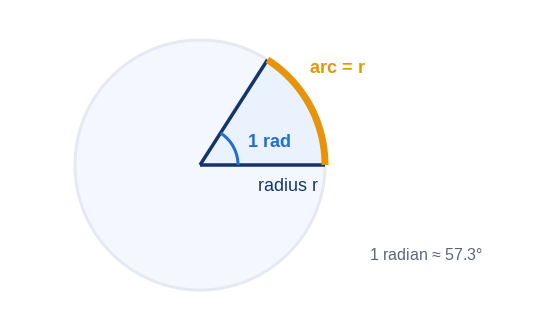
- A radian is the angle whose arc equals the radius, so a full turn is 2π radians.
- On the unit circle, cos θ is the x value and sin θ is the y value.
- Exact values for π/6, π/4 and π/3 extend round the circle using symmetry.
- In y = a sin(b(x − d)) + c, a gives the amplitude, b sets the period, d shifts the graph and c is the midline.
- You can write an equation from a graph and solve simple equations exactly.
What a radian is
- Wrap the radius of a circle along its edge. The angle that arc makes at the centre is one radian.
- The whole circumference is 2πr, which is 2π radius lengths, so a full turn is 2π radians.
- That gives the one fact worth memorising: π radians = 180°.
Converting between degrees and radians
- Multiply by π/180 to reach radians. Multiply by 180/π to reach degrees.
- 150° = 150 × π/180degrees to radians
- = 5π/6simplify the fraction
- 3π/4 = 3π/4 × 180/πradians to degrees
- = 135°the π cancels
The unit circle
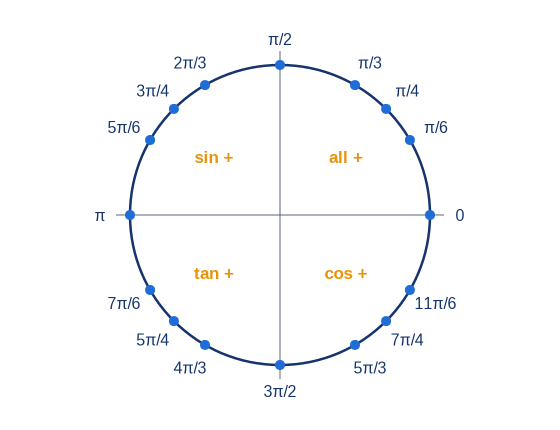
- Take a circle of radius 1 and turn anticlockwise from the positive x-axis by an angle θ.
- The point you reach is (cos θ, sin θ), and tan θ = sin θ ÷ cos θ.
- Each quadrant has its own signs, shown in orange below. All are positive in the first, sine in the second, tangent in the third and cosine in the fourth.
Watch the circle draw the wave
- Press Play. The height of the point on the circle is sin θ, and plotting that height against the angle draws the sine wave.
Exact values round the circle
- Learn the first quadrant, then find any other angle from its quadrant and its reference angle.
| θ | sin θ | cos θ | tan θ |
|---|---|---|---|
| 0 | 0 | 1 | 0 |
| π/6 | 1/2 | √3/2 | 1/√3 |
| π/4 | 1/√2 | 1/√2 | 1 |
| π/3 | √3/2 | 1/2 | √3 |
| π/2 | 1 | 0 | undefined |
- sin(5π/6) = sin(π/6) = 1/2second quadrant, sine positive
- cos(4π/3) = −cos(π/3) = −1/2third quadrant, cosine negative
- tan(7π/4) = −tan(π/4) = −1fourth quadrant, tangent negative
The sine and cosine graphs
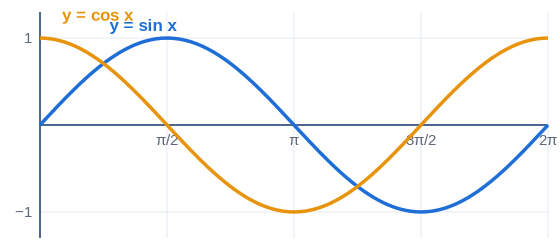
- Both repeat every 2π and stay between −1 and 1.
- Sine starts at 0 going up. Cosine starts at 1 and is the same wave shifted left by π/2.
The tangent graph
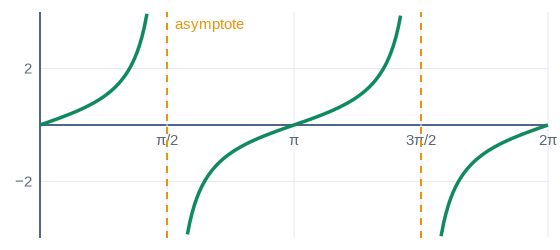
- Tangent repeats every π, not 2π.
- It has vertical asymptotes wherever cos x = 0, at x = π/2 + nπ, and its range is every real number.
What each number does
- Every sine or cosine graph fits y = a sin(b(x − d)) + c.
| Number | Job | Effect |
|---|---|---|
| a | Amplitude | Height above the midline is |a|; negative a flips the graph |
| b | Frequency | Period = 2π ÷ b |
| d | Horizontal shift | Moves the graph right by d |
| c | Midline | Moves the graph up by c |
Try it: change the numbers
- Move one slider at a time and watch which feature changes. Then press Match this curve and find the equation of the dashed graph.
Reading y = 3 sin(2x) + 1
- Each number gives one feature, and the maximum and minimum follow.
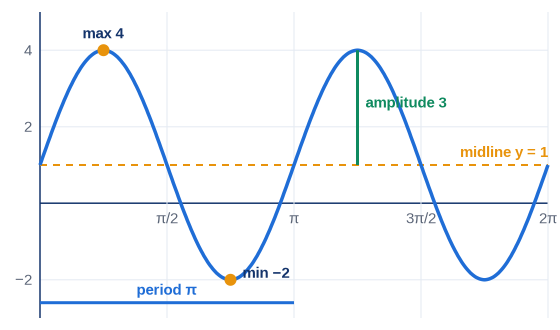
- amplitude = 3a = 3
- period = 2π ÷ 2 = πb = 2
- midline: y = 1c = 1
- maximum = 1 + 3 = 4, at x = π/4where sin(2x) = 1
- minimum = 1 − 3 = −2, at x = 3π/4where sin(2x) = −1
- range: −2 ≤ y ≤ 4
Graphing calculator
Writing the equation from a graph
- This graph has a maximum of 5, a minimum of −1, and one full wave from 0 to 4π. It starts on the midline going up, so it is a positive sine.
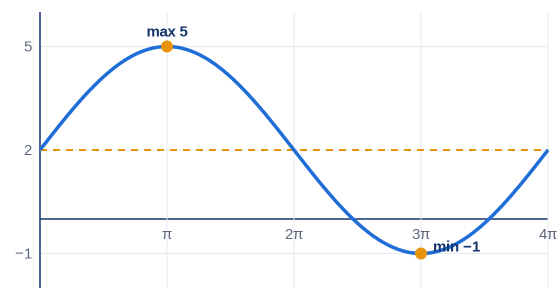
- c = (5 + (−1)) ÷ 2 = 2midline is the average
- a = (5 − (−1)) ÷ 2 = 3half the height
- b = 2π ÷ 4π = 1/2from the period
- y = 3 sin(x/2) + 2
Solving with a graph beside you
- Solve 2 sin x − 1 = 0 for 0 ≤ x ≤ 2π. The line y = 1/2 crosses the wave twice, so expect two answers.
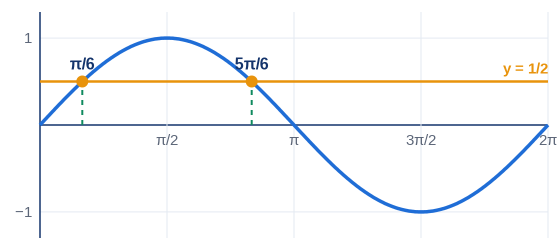
- sin x = 1/2rearrange
- reference angle = π/6
- x = π/6 or x = π − π/6sine is positive in quadrants 1 and 2
- x = π/6 or 5π/6
When the bracket is 2x
- Solve sin(2x) = √3/2 for 0 ≤ x ≤ π. Solve for 2x first, across the doubled range, and divide last.
- 0 ≤ 2x ≤ 2πdouble the range
- 2x = π/3 or 2π/3quadrants 1 and 2
- x = π/6 or π/3divide by 2
Try it: radians, exact values, solutions
Common mistakes
- The period of sin(2x) is 4π, because the 2 stretches it.A bigger b squeezes the wave: the period is 2π ÷ 2 = π.
- In y = 2 sin x + 3, the maximum is 2.Add the amplitude to the midline: 3 + 2 = 5.
- Dividing sin(2x) = 1/2 by 2 to get sin x = 1/4.Sine is a function, so solve for 2x first and divide at the end.
- Giving only one solution to sin x = 1/2.Check every quadrant in the range: there are usually two answers per turn.
- Leaving the calculator in degrees.Set it to radians, and test it: sin(π/2) should give 1.
Your turn
What is the period of y = 4 sin(3x) − 2?
What is the range of y = 4 sin(3x) − 2?
Find cos(5π/3) exactly.
Write 150° in radians.
A graph starts at its maximum of 7, has a minimum of 1 and a period of π. Which equation fits?
Solve 2 cos x + 1 = 0 for 0 ≤ x ≤ 2π.
Where is the first maximum of y = −2 cos x + 3 for x ≥ 0?
Solve sin(2x) = −1/2 for 0 ≤ x ≤ π.
Show answer
1. 2π ÷ 3 = 2π/3. 2. Midline −2 and amplitude 4 give −6 to 2. 3. Fourth quadrant with reference angle π/3, so 1/2. 4. 150 × π/180 = 5π/6. 5. Starting at a maximum means cosine: midline 4, amplitude 3, b = 2, so y = 3 cos(2x) + 4. 6. x = 2π/3 or 4π/3. cos x = −1/2 with reference angle π/3, and cosine is negative in quadrants 2 and 3. 7. (π, 5). The negative a flips the cosine, so x = 0 is a minimum of 1 and the maximum 3 + 2 = 5 comes at x = π. 8. x = 7π/12 or 11π/12. For 0 ≤ 2x ≤ 2π, sine is negative in quadrants 3 and 4, so 2x = 7π/6 or 11π/6; then divide by 2.
Sample question: Achieved
For y = 5 sin(4x) + 2, state the amplitude, the period and the maximum value.
Hint
For y = a sin(bx) + c: the amplitude is a, the period is 2π ÷ b and the maximum is c + a.
Answer
Amplitude 5, period π2, maximum 7
Step by step
- Compare y = 5 sin(4x) + 2 with y = a sin(bx) + c: a = 5, b = 4, c = 2.
- The amplitude is a = 5.
- The period is 2π ÷ b = 2π ÷ 4 = π2.
- The graph goes 5 above the midline y = 2, so the maximum is 2 + 5 = 7.
Full working
- a = 5, b = 4, c = 2match y = a sin(bx) + c
- period = 2π ÷ 4 = π2
- maximum = 2 + 5 = 7
- Amplitude 5, period π2, maximum 7
Sample questions: Merit
A graph y = a sin(bx) + c has a maximum of 9 at x = π6, and its next minimum is −3 at x = π2. Find a, b and c, then find the exact values of x in 0 ≤ x ≤ 2π3 where y = 0.
Hint
The midline is halfway between the maximum and minimum. A maximum to the next minimum is half a period.
Answer
a = 6, b = 3, c = 3; y = 0 at x = 7π18 and 11π18
Step by step
- For y = a sin(bx) + c the maximum is c + a and the minimum is c − a.
- The midline c is halfway between them: (9 + (−3)) ÷ 2 = 3.
- The amplitude a is the distance from the midline to the top: 9 − 3 = 6.
- A maximum to the next minimum is half of one wave: π2 − π6 = 3π6 − π6 = π3.
- So one whole wave, the period, is 2 × π3 = 2π3.
- Period = 2π ÷ b, so b = 2π ÷ (2π3) = 3.
- Check: at x = π6, y = 6 sin(π2) + 3 = 6 + 3 = 9. Correct.
- Now y = 0: 6 sin(3x) + 3 = 0, so sin(3x) = −12.
- Call θ = 3x. Since 0 ≤ x ≤ 2π3, θ goes from 0 to 2π.
- sin θ = −12: reference angle π6, and sin is negative in quadrants 3 and 4. So θ = π + π6 = 7π6 or θ = 2π − π6 = 11π6.
- Divide by 3: x = 7π18 or 11π18.
Full working
- c = (9 + (−3)) ÷ 2 = 3 and a = 9 − 3 = 6midline and amplitude
- half a period = π2 − π6 = π3, so the period is 2π3
- b = 2π ÷ (2π3) = 3
- y(π6) = 6 sin(π2) + 3 = 9check the maximum
- 6 sin(3x) + 3 = 0, so sin(3x) = −120 ≤ 3x ≤ 2π
- 3x = 7π6 or 11π6sin is negative in quadrants 3 and 4
- x = 7π18 or 11π18
Solve 3 tan(2x) = √3 exactly for 0 ≤ x ≤ π.
Hint
Solve for 2x over the doubled interval 0 ≤ 2x ≤ 2π. Tangent repeats every π.
Answer
x = π12 or 7π12
Step by step
- Divide by 3: tan(2x) = √33, which is the same as 1√3.
- Call θ = 2x. Since 0 ≤ x ≤ π, θ goes from 0 to 2π.
- tan θ = 1√3 gives θ = π6.
- Tan repeats every π, not 2π, so the next one is π6 + π = 7π6. The one after, 13π6, is too big.
- Divide by 2: x = π12 or 7π12.
Full working
- tan(2x) = √33 = 1√3divide by 3
- 2x = π6 or π6 + π = 7π60 ≤ 2x ≤ 2π
- x = π12 or 7π12
Sample questions: Excellence
For y = 4 sin(2x − π3) + 1, find the exact values of x in 0 ≤ x ≤ π where y = 3. Then find where the graph has its maximum in that interval, and explain why the two solutions sit symmetrically about it.
Hint
Set y = 3 and solve for the angle 2x − π3 over its own interval first. Then change back to x.
Answer
x = π4 or 7π12; the maximum is at x = 5π12, exactly halfway between them
Step by step
- y = 3: 4 sin(2x − π3) + 1 = 3. Subtract 1 and divide by 4: sin(2x − π3) = 12.
- Call θ = 2x − π3 and find its range: x = 0 gives −π3, x = π gives 2π − π3 = 5π3.
- sin θ = 12 at θ = π6 and 5π6. The next one, 13π6, is bigger than 5π3, so it is out.
- Change back: 2x − π3 = π6 gives 2x = π2, so x = π4. 2x − π3 = 5π6 gives 2x = 7π6, so x = 7π12.
- The maximum is where sin = 1, that is θ = π2: 2x − π3 = π2, so 2x = 5π6 and x = 5π12. There y = 4 + 1 = 5.
- Compare them in twelfths: π4 = 3π12, the maximum is at 5π12, and 7π12. Both answers are 2π12 from the maximum.
- Why: a sine wave is a mirror image either side of its peak, so a horizontal line below the peak cuts both sides at the same distance from it.
Full working
- 4 sin(2x − π3) + 1 = 3, so sin(2x − π3) = 12
- −π3 ≤ 2x − π3 ≤ 5π3from 0 ≤ x ≤ π
- 2x − π3 = π6 or 5π613π6 is outside the interval
- x = π4 or 7π12
- maximum when 2x − π3 = π2, so x = 5π12 and y = 5
- (3π12 + 7π12) ÷ 2 = 5π12the midpoint of the two solutions
- A sine curve is symmetric about its maximum, so y = 3 cuts it at equal distances either side of x = 5π12
For which values of k does the equation 3 sin(2x) + 1 = k have exactly two solutions in 0 ≤ x ≤ π? Justify your answer with the graph.
Hint
Sketch y = 3 sin(2x) + 1 for 0 ≤ x ≤ π and slide a horizontal line y = k up and down. Count the crossings, including the end points.
Answer
−2 < k < 4, with k ≠ 1
Step by step
- Sketch y = 3 sin(2x) + 1 for 0 ≤ x ≤ π. The period is 2π ÷ 2 = π, so you draw exactly one wave.
- Key points: x = 0, y = 1. x = π4, y = 4 (top). x = π2, y = 1. x = 3π4, y = −2 (bottom). x = π, y = 1.
- The solutions of 3 sin(2x) + 1 = k are where the flat line y = k crosses the curve.
- Slide the line from high to low and count the crossings.
- Above 4 or below −2: the line misses the curve, 0 solutions.
- At 4 or at −2: it just touches the top or the bottom, 1 solution.
- Between 1 and 4: it cuts the hump twice, 2 solutions.
- At exactly 1: it goes through the start, the middle and the end (x = 0, π2, π), 3 solutions.
- Between −2 and 1: it cuts the dip twice, 2 solutions.
- So there are exactly two solutions when −2 < k < 4, but not when k = 1.
Full working
- period = 2π ÷ 2 = π, so 0 ≤ x ≤ π is one full cycle
- y = 1, 4, 1, −2, 1 at x = 0, π4, π2, 3π4, π
- k = 4 or k = −2: one solutionthe line just touches a turning point
- k = 1: three solutions, x = 0, π2 and πthe line also meets both ends
- k > 4 or k < −2: no solutions
- −2 < k < 4, k ≠ 1
What to take away
- Π radians = 180°.
- On the unit circle, a point is (cos θ, sin θ).
- Amplitude is |a|, period is 2π ÷ b, midline is y = c.
- Solve for the whole bracket first, then divide.
Challenge
Find the exact sum of all the solutions of 2 sin(3x) = 1 in the interval 0 ≤ x ≤ 2π.
Hint
Let t = 3x and find the range t covers. Then pair up the two solutions in each turn: what does each pair add up to?
Answer
There are six solutions, π18, 5π18, 13π18, 17π18, 25π18 and 29π18, and their sum is 5π.
Step by step
- Solve for 3x first: sin(3x) = 12, and 3x runs from 0 to 6π, which is three full turns.
- In each turn sine equals 12 twice, at the reference angle π6 and at π − π6, so there are six values of 3x.
- The two values in each turn are symmetric about the peak of that turn, so each pair adds to twice the peak angle: π, 5π and 9π.
- So the six values of 3x add to 15π, and dividing by 3 gives the sum of the x values, 5π.
Full working
- sin(3x) = 12divide both sides by 2
- 0 ≤ 3x ≤ 6πtriple the range
- 3x = π6, 5π6, 13π6, 17π6, 25π6, 29π6quadrants 1 and 2, then add 2π and 4π
- π6 + 5π6 = π, 13π6 + 17π6 = 5π, 25π6 + 29π6 = 9πpairs symmetric about each peak
- sum of the 3x values = π + 5π + 9π = 15πadd the pairs
- x = π18, 5π18, 13π18, 17π18, 25π18, 29π18divide each by 3
- Sum of the solutions = 15π ÷ 3 = 5π
The graph of y = a sin(b(x − d)) + c, with a > 0, b > 0 and 0 ≤ d < 2πb, has a maximum value of 7 and a minimum value of −1. It crosses the y-axis at y = 5 while increasing, and its first maximum to the right of the y-axis is at x = π9. Find a, b, c and d, and the first value of x > 0 where the graph reaches its minimum.
Hint
Find a and c from the maximum and minimum first. Then write the inside of the sine as one angle θ: what is θ at x = 0, and what is it at the first maximum?
Answer
a = 4, b = 3, c = 3 and d = 11π18, so y = 4 sin(3(x − 11π18)) + 3, which is the same as y = 4 sin(3x + π6) + 3. The first minimum for x > 0 is at x = 4π9.
Step by step
- The midline is halfway between 7 and −1, so c = 3, and the amplitude is half the gap, so a = 4.
- At x = 0, y = 5, so sin θ = 12 where θ is the angle inside the sine. Increasing means θ is in the rising part of the wave, so θ = π6 (plus whole turns).
- The next maximum comes when θ reaches π2, an increase of π3. That happens over a distance π9 in x, so b × π9 = π3 and b = 3.
- At x = 0 the angle is −3d, which must equal π6 plus a whole number of turns. The only d in 0 ≤ d < 2π3 is 11π18.
- The minimum comes when θ reaches 3π2, so 3x + π6 = 3π2.
Full working
- c = (7 + (−1)) ÷ 2 = 3midline is the average
- a = (7 − (−1)) ÷ 2 = 4half the height
- 4 sin θ + 3 = 5, so sin θ = 12at x = 0
- θ = π6 at x = 0increasing, so the rising branch
- b × π9 = π2 − π6 = π3angle grows from π6 to π2
- b = 3multiply by 9π
- −3d = π6 − 2π, so d = 11π18needs 0 ≤ d < 2π3
- 3x + π6 = 3π2, so x = 4π9first minimum
- y = 4 sin(3(x − 11π18)) + 3, first minimum at x = 4π9
b is a positive constant. Find all values of b for which the equation sin(bx) = √32 has exactly 7 solutions in the interval 0 ≤ x ≤ 2π. For the smallest such b, what is the largest solution?
Hint
Let t = bx. As x goes from 0 to 2π, t goes from 0 to 2πb. List the values of t where sin t = √32 in order, and ask where the interval must end.
Answer
196 ≤ b < 103. When b = 196 the largest solution is x = 2π.
Step by step
- Put t = bx. Then t runs from 0 up to 2πb, and we need exactly 7 values of t in that range with sin t = √32.
- In order, those values are π3, 2π3, 7π3, 8π3, 13π3, 14π3, 19π3, 20π3, and so on.
- To include the 7th value but not the 8th, the top of the range must be at least 19π3 and less than 20π3.
- Solving 19π3 ≤ 2πb < 20π3 gives the range of b. The left end is allowed because x = 2π is inside the interval.
- When b = 196 the 7th value of t sits exactly at the end, so the largest solution is x = 2π.
Full working
- t = bx, 0 ≤ t ≤ 2πbsubstitute
- sin t = √32: t = π3, 2π3, 7π3, 8π3, 13π3, 14π3, 19π3, 20π3, ...quadrants 1 and 2, every 2π
- 19π3 ≤ 2πb < 20π3the 7th value in, the 8th value out
- 196 ≤ b < 103divide by 2π
- b = 196: x = (19π3) ÷ (196) = 2πlargest solution, x = t ÷ b
- 196 ≤ b < 103, and the largest solution when b = 196 is x = 2π