Trig equations and general solutions
What this lesson covers
- sin x = sin α: x = nπ + (−1)ⁿα.
- cos x = cos α: x = 2nπ ± α.
- tan x = tan α: x = nπ + α.
Why there are endless answers
- The line y = 1/2 crosses the cosine wave again in every turn.
- The answers come in a pattern, 2π apart, so one line with n can hold them all.
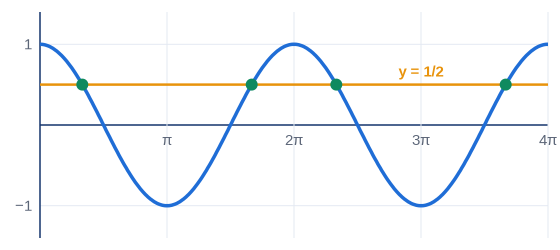
Try it: every solution
The three forms
- In each one, α is a known solution and n is any integer.
- Solve for the whole bracket first when the equation has 2x or 3x.
sin x = 1/2
- The known angle is π/6.
- α = π/6
- x = nπ + (−1)ⁿ π/6
2cos²x − cos x − 1 = 0
- It is a quadratic in cos x.
- (2cos x + 1)(cos x − 1) = 0
- cos x = 1 gives x = 2nπ
- cos x = −1/2 gives x = 2nπ ± 2π/3
cos 2x = 1/2, for 0 ≤ x < 2π
- Solve for 2x, then divide.
- 2x = 2nπ ± π/3
- x = nπ ± π/6
- x = π/6, 5π/6, 7π/6, 11π/6
Try it: a double angle
Listing the answers
- Try n = 0, 1, 2 in x = nπ + (−1)ⁿ π/6.
- n = 0: x = π/6
- n = 1: x = π − π/6 = 5π/6
- n = 2: x = 2π + π/6 = 13π/6
Try it: general solutions
A quadratic in sin x
- Solve 2 sin²x + 3 sin x + 1 = 0 in general.
- (2 sin x + 1)(sin x + 1) = 0
- sin x = −1/2: x = nπ + (−1)ⁿ(−π/6)
- sin x = −1: x = 2nπ − π/2
Common mistakes
- Dividing by cos x in an equation.That loses solutions, so factorise instead.
- Giving one answer with no n.A general solution needs n.
Your turn
Solve cos x = −1/2 in general.
Solve tan x = −1 in general.
Solve 2 sin x = 1 in general.
Solve sin 2x = 0 in general.
Which equation has the general solution x = 2nπ ± π/4?
List the solutions of x = nπ + (−1)ⁿ π/3 that lie in 0 ≤ x < 2π.
Solve 2 sin²x = sin x in general.
Solve tan 3x = 1 for 0 ≤ x < π.
Show answer
1. x = 2nπ ± 2π/3 2. x = nπ − π/4 3. x = nπ + (−1)ⁿ π/6 4. 2x = nπ, so x = nπ/2 5. cos x = 1/√2. The ± form belongs to cosine, and cos(π/4) = 1/√2. 6. x = π/3, 2π/3. n = 0 gives π/3, n = 1 gives π − π/3 = 2π/3, and n = 2 gives 7π/3, which is too big. 7. x = nπ or x = nπ + (−1)ⁿ π/6. Factorise sin x(2 sin x − 1) = 0: sin x = 0 or sin x = 1/2. Dividing by sin x loses x = nπ. 8. x = π/12, 5π/12, 3π/4. 3x = nπ + π/4, so x = nπ/3 + π/12; n = 0, 1, 2 give π/12, 5π/12 and 9π/12 = 3π/4.
Sample question: Achieved
Solve cos x = √32 in general.
Hint
Find the basic angle α with cos α = √32, then use x = 2nπ ± α.
Answer
x = 2nπ ± π6, where n is an integer
Step by step
- First find one angle: cos α = √32 gives α = π6.
- The general solution of cos x = cos α is x = 2nπ ± α. It is on the formula sheet.
- So x = 2nπ ± π6, where n is any integer.
- Check with n = 1: x = 2π − π6 = 11π6, and cos(11π6) = √32. Correct.
Full working
- α = π6cos(π6) = √32
- x = 2nπ ± αgeneral solution for cos
- x = 2nπ ± π6
Sample questions: Merit
Solve 2cos²x + sin x − 1 = 0 in general.
Hint
Replace cos²x with 1 − sin²x, so the equation has only sin x. Then factorise.
Answer
x = 2nπ + π2 or x = nπ + (−1)ⁿ(−π6), where n is an integer
Step by step
- The equation has cos²x and sin x. Change cos²x so everything is in sin x.
- From sin²x + cos²x = 1 we get cos²x = 1 − sin²x.
- 2(1 − sin²x) + sin x − 1 = 0 becomes 2 − 2sin²x + sin x − 1 = 0, that is −2sin²x + sin x + 1 = 0.
- Multiply by −1 so the first term is positive: 2sin²x − sin x − 1 = 0.
- Factorise, like 2s² − s − 1: (2 sin x + 1)(sin x − 1) = 0. So sin x = 1 or sin x = −12.
- The general solution of sin x = sin α is x = nπ + (−1)ⁿα, where n is any integer. It is on the formula sheet.
- sin x = 1: sin is 1 only once each turn, at π2. So x = 2nπ + π2.
- sin x = −12: α is the angle between −π2 and π2 with sin α = −12, so α = −π6. Then x = nπ + (−1)ⁿ(−π6).
- Check with n = 1: x = π + π6 = 7π6, and sin(7π6) = −12. Correct.
Full working
- 2(1 − sin²x) + sin x − 1 = 0cos²x = 1 − sin²x
- 2sin²x − sin x − 1 = 0tidy and multiply by −1
- (2 sin x + 1)(sin x − 1) = 0factorise
- sin x = 1 gives x = 2nπ + π2sin is 1 once each turn
- sin x = −12 gives x = nπ + (−1)ⁿ(−π6)x = nπ + (−1)ⁿα with α = −π6
- x = 2nπ + π2 or x = nπ + (−1)ⁿ(−π6)
Solve 2 sin(x + π4) = √3 in general.
Hint
Solve for the whole angle x + π4 first, then subtract π4.
Answer
x = nπ + (−1)ⁿ(π3) − π4
Step by step
- Divide both sides by 2: sin(x + π4) = √32.
- Treat the whole bracket as one angle, θ = x + π4, and solve sin θ = √32 first.
- sin α = √32 gives α = π3, so θ = nπ + (−1)ⁿ(π3).
- Put the bracket back: x + π4 = nπ + (−1)ⁿ(π3).
- Subtract π4 from both sides: x = nπ + (−1)ⁿ(π3) − π4.
- Check with n = 0: x = π3 − π4 = π12. Then x + π4 = π3 and 2 sin(π3) = √3. Correct.
Full working
- sin(x + π4) = √32divide both sides by 2
- x + π4 = nπ + (−1)ⁿ(π3)general solution of sin θ = √32
- x = nπ + (−1)ⁿ(π3) − π4
Sample questions: Excellence
Solve sin 2x = cos x in general, then list the solutions in 0 ≤ x ≤ 2π.
Hint
Use sin 2x = 2 sin x cos x, move everything to one side and factorise. Dividing by cos x would lose solutions.
Answer
x = 2nπ ± π2 or x = nπ + (−1)ⁿ(π6); in 0 ≤ x ≤ 2π: π6, π2, 5π6, 3π2
Step by step
- sin 2x and cos x have different angles. Use sin 2x = 2 sin x cos x.
- 2 sin x cos x = cos x. Move everything to the left: 2 sin x cos x − cos x = 0.
- Many students divide by cos x here. Don't: it throws away the answers where cos x = 0.
- cos x is in both terms, so factorise: cos x(2 sin x − 1) = 0.
- First factor: cos x = 0. The general solution of cos x = cos α is x = 2nπ ± α. Here α = π2, so x = 2nπ ± π2.
- Second factor: sin x = 12, α = π6, so x = nπ + (−1)ⁿ(π6).
- To list the answers in 0 ≤ x ≤ 2π, try n = 0, 1, 2 and keep the ones in range.
- cos x = 0: n = 0 gives ±π2, keep π2. n = 1 gives 2π ± π2, keep 3π2.
- sin x = 12: n = 0 gives π6. n = 1 gives π − π6 = 5π6. n = 2 gives 2π + π6, too big.
- Answers: π6, π2, 5π6, 3π2.
Full working
- 2 sin x cos x − cos x = 0sin 2x = 2 sin x cos x
- cos x(2 sin x − 1) = 0factorise
- cos x = 0 gives x = 2nπ ± π2the same as x = nπ + π2
- sin x = 12 gives x = nπ + (−1)ⁿ(π6)
- Try n = 0, 1, 2 and keep values in 0 ≤ x ≤ 2π
- x = π6, π2, 5π6, 3π2
Find the general solution of 4 sin²x = 3, and show that it can be written as the single form x = nπ ± π3.
Hint
sin x can be positive or negative. Write both general solutions and list a few values of each. Or use cos 2x = 1 − 2sin²x to get one equation.
Answer
x = nπ ± π3
Step by step
- 4 sin²x = 3, so sin²x = 34.
- Take the square root and remember both signs: sin x = √32 or sin x = −√32.
- sin x = √32: α = π3, so x = nπ + (−1)ⁿ(π3). Some values: π3, 2π3, 7π3.
- sin x = −√32: α = −π3, so x = nπ + (−1)ⁿ(−π3). Some values: −π3, 4π3, 5π3.
- Put the values in order: π3, 2π3, 4π3, 5π3, 7π3, ...
- Look for the pattern: π3 = 0 + π3, 2π3 = π − π3, 4π3 = π + π3, 5π3 = 2π − π3.
- Every value is a multiple of π, plus or minus π3. So one form covers both: x = nπ ± π3.
- A quicker check: cos 2x = 1 − 2sin²x = 1 − 32 = −12, so 2x = 2nπ ± 2π3 and x = nπ ± π3.
Full working
- sin²x = 34, so sin x = ±√32
- sin x = √32 gives x = nπ + (−1)ⁿ(π3)π3, 2π3, 7π3, ...
- sin x = −√32 gives x = nπ + (−1)ⁿ(−π3)−π3, 4π3, 5π3, ...
- Together: π3, 2π3, 4π3, 5π3, ...each is a multiple of π, plus or minus π3
- Check: cos 2x = 1 − 2 × 34 = −12, so 2x = 2nπ ± 2π3the same result in one step
- x = nπ ± π3
What to take away
- Solve for the bracket first.
- Factorise, never divide by a trig function.
Challenge
Solve cos 3x = cos x in general. Show that all the solutions can be written as one family, x = nπ2, and list the solutions in 0 ≤ x ≤ 2π.
Hint
Use cos A = cos B, so A = 2nπ ± B, with A = 3x and B = x. Treat the + and − cases separately, then compare the two families.
Answer
x = nπ2, where n is an integer; in 0 ≤ x ≤ 2π: 0, π2, π, 3π2, 2π
Step by step
- cos 3x = cos x means 3x = 2nπ ± x, from the general solution of cos.
- Plus sign: 3x = 2nπ + x, so 2x = 2nπ and x = nπ.
- Minus sign: 3x = 2nπ − x, so 4x = 2nπ and x = nπ2.
- Every multiple of π is also a multiple of π2, so the first family sits inside the second. One form covers all: x = nπ2.
- Take n = 0 to 4 for the interval: 0, π2, π, 3π2, 2π. Check π2: cos(3π2) = 0 = cos(π2).
Full working
- 3x = 2nπ ± xcos A = cos B gives A = 2nπ ± B
- 3x = 2nπ + x gives x = nπplus sign
- 3x = 2nπ − x gives x = nπ2minus sign
- nπ = (2n)π2, so x = nπ is inside x = nπ2combine the families
- n = 0, 1, 2, 3, 4values in 0 ≤ x ≤ 2π
- x = nπ2; in range: 0, π2, π, 3π2, 2π
Hemi solves sin x + cos x = 1 by squaring both sides: 1 + 2 sin x cos x = 1, so sin 2x = 0 and x = nπ2. Find the correct general solution, and say exactly which of Hemi's solutions are wrong and why they appeared.
Hint
Write sin x + cos x as one wave, R sin(x + α), then solve for the whole bracket. Split the answer by whether n is even or odd. Test Hemi's values in the original equation.
Answer
x = 2nπ or x = 2nπ + π2; Hemi's extra values x = 2nπ + π and x = 2nπ + 3π2 give sin x + cos x = −1, created by squaring
Step by step
- sin x + cos x = √2 sin(x + π4), since R = √(1 + 1) = √2 and tan α = 1, so α = π4.
- So sin(x + π4) = 1√2, and x + π4 = nπ + (−1)ⁿ(π4).
- n even, n = 2k: x + π4 = 2kπ + π4, so x = 2kπ.
- n odd, n = 2k + 1: x + π4 = 2kπ + π − π4, so x = 2kπ + π2.
- Hemi's list also has π and 3π2 (plus whole turns). There sin x + cos x = −1, and squaring −1 gives 1 too, so squaring let in the answers to sin x + cos x = −1.
Full working
- sin x + cos x = √2 sin(x + π4)R = √2, tan α = 1
- sin(x + π4) = 1√2divide by √2
- x + π4 = nπ + (−1)ⁿ(π4)general solution of sin
- n = 2k: x = 2kπ; n = 2k + 1: x = 2kπ + π2even and odd n
- x = π: sin π + cos π = −1; x = 3π2: −1 + 0 = −1Hemi's extra values fail
- x = 2nπ or x = 2nπ + π2; Hemi's x = 2nπ + π and 2nπ + 3π2 are wrong
Solve tan 3x = cot x in general. Check that no solution makes either side undefined, then find how many solutions there are in 0 ≤ x ≤ 2π, and list them.
Hint
Write cot x as the tangent of the complementary angle, cot x = tan(π2 − x), then use the general solution of tan on the whole bracket. Writing each answer as a number of eighths of π makes the checks easy.
Answer
x = π8 + nπ4, where n is an integer; 8 solutions in 0 ≤ x ≤ 2π: π8, 3π8, 5π8, 7π8, 9π8, 11π8, 13π8, 15π8
Step by step
- cot x = cos xsin x = sin(π2 − x)/cos(π2 − x) = tan(π2 − x), so the equation is tan 3x = tan(π2 − x).
- General solution of tan: 3x = nπ + π2 − x, so 4x = nπ + π2 and x = π8 + nπ4 = (2n + 1)π8.
- tan 3x is undefined when 3x is an odd multiple of π2, that is (8m + 4)π8. Here 3x = (6n + 3)π8 has an odd number of eighths, so it never happens.
- cot x is undefined when x = mπ = 8mπ8. Here x = (2n + 1)π8 has an odd number of eighths, so that never happens either. Every value in the family is a true solution.
- n = 0 to 7 gives the odd eighths of π from π8 to 15π8; n = 8 gives 17π8, too big. Check π8: 3x = 3π8 and π2 − π8 = 3π8, so both sides are tan(3π8).
Full working
- cot x = tan(π2 − x)cos xsin x = sin(π2 − x)/cos(π2 − x)
- 3x = nπ + π2 − xtan A = tan B gives A = nπ + B
- 4x = nπ + π2, so x = π8 + nπ4 = (2n + 1)π8divide by 4
- 3x = (6n + 3)π8, never (8m + 4)π8tan 3x is always defined
- x = (2n + 1)π8, never 8mπ8cot x is always defined
- n = 0, 1, ..., 7: π8, 3π8, 5π8, 7π8, 9π8, 11π8, 13π8, 15π8n = 8 gives 17π8 > 2π
- x = π8 + nπ4; 8 solutions: π8, 3π8, 5π8, 7π8, 9π8, 11π8, 13π8, 15π8