
Sketching the gradient graph of a function
What this lesson covers
- The gradient graph is zero where the function turns, positive where it rises and negative where it falls.
- A cubic has a quadratic gradient graph and a quadratic has a straight-line gradient graph.
The gradient graph
- Underneath a function, draw its gradient.
- Same x-axis, new y-axis: the gradient.
- Start with f(x) = x³ − 3x.
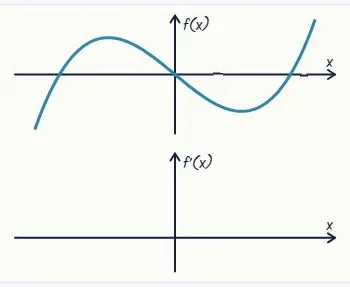
Turning points become x-intercepts
- At a turning point the gradient is zero.
- f turns at x = −1 and x = 1.
- So the gradient graph crosses there.
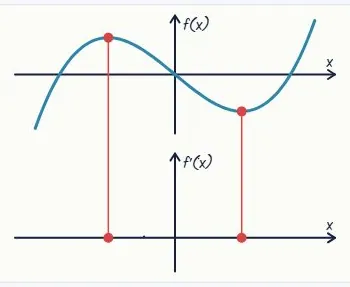
Rising is positive, falling is negative
- Before −1, f is rising: gradient positive.
- Between −1 and 1, f falls: gradient negative.
- After 1, rising again: positive.
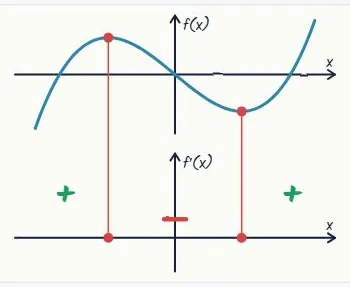
Join it as one smooth curve
- Lowest where f falls most steeply, at x = 0.
- Through both intercepts, symmetric.
- A parabola: f′(x) = 3x² − 3.
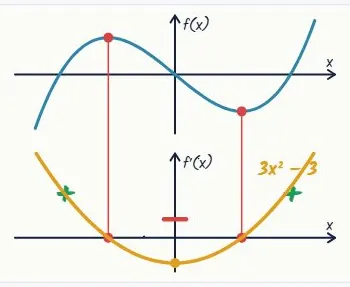
Try it: the curve and its gradient graph
Check it with the derivative
- Differentiate to check.
- Zeros under the turns.
- Symmetric about x = 0.
- f(x) = x³ − 3x
- f′(x) = 3x² − 3differentiate
- = 3(x − 1)(x + 1)factorise
- = 0 at x = −1 and x = 1the intercepts
- f′(0) = 3(0)² − 3 = −3the lowest point
- f′(2) = 3(2)² − 3 = 9
- f′(−2) = 3(−2)² − 3 = 9symmetric
The degree drops by one
- A cubic has a quadratic gradient graph.
- A quadratic has a straight-line gradient graph.
- Knowing the shape stops wild sketches.
| Function | Gradient is | So draw |
|---|---|---|
| Cubic | quadratic | a parabola |
| Quadratic | linear | a straight line |
| Straight line | constant | a flat line |
A quadratic: the gradient is a line
- g(x) = x² − 4x + 3 turns at x = 2.
- Falling before 2, rising after.
- So g′ is a line through (2, 0), going up.
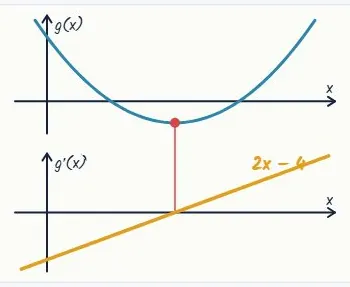
Confirm it by differentiating
- Differentiate to confirm.
- Then check the signs.
- g(x) = x² − 4x + 3
- g′(x) = 2x − 4differentiate
- 2x − 4 = 0, so x = 2the intercept
- g(2) = 4 − 8 + 3 = −1the minimum
- g′(0) = −4 < 0falling
- g′(3) = 2 > 0rising
Steep means far from the axis
- Gentle slope: gradient graph near zero.
- Steep slope: gradient graph far from zero.
- Steep and falling: far below.
Graphing calculator
Four ways sketches lose marks
- The examiner wants one smooth curve.
- Intercepts exactly under the turning points.
- A parabola that is symmetric.
| Mistake | Instead |
|---|---|
| Copying the curve | the gradient graph is a new shape |
| Intercepts in the wrong place | they sit under the turning points |
| Two separate pieces | one smooth curve |
| Lopsided parabola | symmetric about its lowest point |
The reverse: from gradient to function
- Here f′(x) = 2x: negative, then positive.
- So f falls, turns at 0, then rises.
- Any curve x² + c fits: the height is unknown.
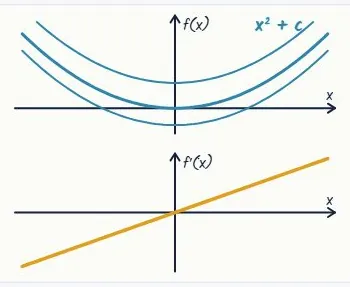
Reading a gradient graph
- Where it is zero, the function turns.
- The sign change says max or min.
- Minus to plus is a minimum.
| Gradient graph | Function |
|---|---|
| f′ = 0 | f has a turning point |
| f′ above the axis | f is rising |
| f′ below the axis | f is falling |
| − then + | a minimum |
| + then − | a maximum |
Try it: build the gradient graph
How the grades step up
- Achieved: intercepts and signs correct.
- Merit: the right shape, checked by differentiating.
- Excellence: justify every feature you draw.
What to take away
- Turning points first, then signs, then one smooth curve.
| Turning points | become x-intercepts |
| Rising | gradient graph above the axis |
| Falling | gradient graph below the axis |
| Steepest | furthest from the axis |
| Degree | drops by one |
| Draw | one smooth, symmetric curve |
| Reverse | sign change tells max or min |
Common mistakes
- The gradient graph of f(x) = x³ − 3x is another S-shaped cubic.The degree drops by one, so a cubic's gradient graph is a parabola: f′(x) = 3x² − 3.
- The gradient graph crosses the x-axis where f crosses it.It crosses under the turning points of f, where the gradient is zero: x = −1 and x = 1 for x³ − 3x.
- f is below the x-axis there, so f′ is negative there.The sign of f′ shows whether f is rising or falling, not whether f is above or below the axis.
- f′ goes from − to + at x = 1, so f has a maximum there.Falling then rising is a minimum; a maximum is where f′ goes from + to −.
Your turn: eight questions
- Sketch where it helps.
- Question 4: think about the sign change.
f(x) = x² − 6x + 5. Where does f′ cross the x-axis?
Cubic: max at x = −2, min at x = 4. Where is f′ < 0?
f(x) = x³ − 12x. Find f′(x) and where it is zero.
f′ goes from − to + at x = 1. Max or min?
f is a cubic. What shape is its gradient graph?
f(x) = x³ − 6x². At what value of x is its gradient graph lowest?
f′(x) = 4 − 2x. Which describes f?
A cubic has a maximum at x = −3 and a minimum at x = 1. Which could be its gradient function?
Show answer
1. f′(x) = 2x − 6, which is zero at x = 3. 2. Between the turning points, −2 < x < 4, where the cubic is falling. 3. f′(x) = 3x² − 12 = 3(x − 2)(x + 2), crossing at x = −2 and x = 2. 4. A minimum: the function falls, then rises. 5. A parabola: the degree drops by one, so a cubic has a quadratic gradient graph. 6. x = 2. f′(x) = 3x² − 12x is a parabola with zeros at 0 and 4, so it is lowest halfway, at x = 2, where f falls most steeply. 7. f rises, then has a maximum at x = 2: f′ is zero at x = 2 and goes from + to −. 8. f′(x) = 3(x + 3)(x − 1): zero at −3 and 1, positive outside them and negative between, so + then − at −3 and − then + at 1.
The answers
- 1. f′(x) = 2x − 6differentiate
- 2x − 6 = 0, so x = 3crosses here
- 2. f falls from max to min
- f′ < 0 for −2 < x < 4
- 3. f′(x) = 3x² − 12differentiate
- = 3(x² − 4) = 3(x − 2)(x + 2)factorise
- zero at x = −2 and x = 2
- 4. f′: − then + at x = 1
- f falls, then rises: a minimum
Sample question: Achieved
A cubic y = f(x) rises until it reaches a local maximum at x = −1, falls to a local minimum at x = 3, and then rises again. Describe the gradient graph y = f′(x): where it crosses the x-axis, where it is above and below the axis, and its shape.
Hint
Turning points have gradient zero, rising parts have positive gradient and falling parts have negative gradient.
Answer
f′(x) crosses the x-axis at x = −1 and x = 3; it is above the axis for x < −1 and x > 3 and below for −1 < x < 3; it is a ∪-shaped parabola
Step by step
- The gradient graph shows the gradient of f at each x, so read the gradient off each part of the description.
- At a turning point the tangent is flat, so the gradient is zero. f′(x) = 0 at x = −1 and x = 3, so the gradient graph crosses the x-axis there.
- For x < −1 the curve is rising, so the gradient is positive. The gradient graph is above the axis there.
- Between −1 and 3 the curve is falling, so the gradient is negative. The gradient graph is below the axis there.
- For x > 3 the curve rises again, so the gradient graph is above the axis again.
- A cubic's gradient graph is a quadratic, one degree lower. Above, then below, then above means a ∪-shaped parabola.
- Classic mistake: drawing the gradient graph through the turning points' y values. The turning points move to the x-axis on the gradient graph.
- Check with an example: f(x) = x³3 − x² − 3x has f′(x) = x² − 2x − 3 = (x + 1)(x − 3), a ∪ parabola crossing at −1 and 3.
Full working
- f′(−1) = 0 and f′(3) = 0turning points: x-intercepts of f′
- f′(x) > 0 for x < −1 and x > 3f is rising
- f′(x) < 0 for −1 < x < 3f is falling
- Cubic, so f′ is quadratic: a ∪ paraboladegree drops by one
- ∪ parabola, crossing at x = −1 and x = 3, below the axis between them
Sample questions: Merit
For f(x) = x³ − 3x² − 9x + 2, find f′(x). Give the x- and y-intercepts and the vertex of the gradient graph, and use them to say where f is decreasing and where f is falling most steeply.
Hint
Differentiate, then factorise to get the x-intercepts. The vertex of a parabola is halfway between its x-intercepts.
Answer
f′(x) = 3x² − 6x − 9; x-intercepts −1 and 3, y-intercept −9, vertex (1, −12); f is decreasing for −1 < x < 3 and falls most steeply at x = 1
Step by step
- Differentiate term by term: f′(x) = 3x² − 6x − 9.
- Factorise: 3(x² − 2x − 3) = 3(x − 3)(x + 1). So the gradient graph crosses the x-axis at x = −1 and x = 3.
- These are the x values of the turning points of f.
- y-intercept: f′(0) = −9.
- The gradient graph is a ∪-shaped parabola, so its vertex is halfway between the x-intercepts: x = (−1 + 3) ÷ 2 = 1.
- f′(1) = 3 − 6 − 9 = −12, so the vertex is (1, −12).
- f is decreasing where the gradient is negative, which is where the gradient graph is below the axis: −1 < x < 3.
- The most negative gradient is at the vertex, −12, so f falls most steeply at x = 1.
- Classic mistake: saying f is decreasing for x < 1 because the gradient graph is going down there. The sign of f′ matters, not whether f′ is rising or falling.
- Check: f′(−2) = 12 + 12 − 9 = 15 > 0, so f is rising before x = −1. That fits.
Full working
- f′(x) = 3x² − 6x − 9 = 3(x − 3)(x + 1)
- x-intercepts −1 and 3; f′(0) = −9
- vertex x = (−1 + 3) ÷ 2 = 1, f′(1) = −12halfway between the roots
- f′(x) < 0 for −1 < x < 3f decreasing
- Intercepts −1, 3 and −9; vertex (1, −12); f decreasing for −1 < x < 3, steepest at x = 1
The gradient graph of a function f is the straight line through (2, 0) with gradient −3. Describe what f looks like, explaining your reasoning. Given f(0) = 1, find f(x) and the coordinates of its turning point.
Hint
Write the equation of the line: that is f′(x). Where it is positive f rises, where it is negative f falls. Then anti-differentiate.
Answer
f′(x) = 6 − 3x, so f is a ∩-shaped parabola; f(x) = −1.5x² + 6x + 1, with a maximum at (2, 7)
Step by step
- The line has gradient −3 and passes through (2, 0): y − 0 = −3(x − 2), so f′(x) = 6 − 3x.
- A straight-line gradient graph means f is a quadratic, one degree higher.
- For x < 2 the line is above the axis, so f′(x) > 0 and f is rising.
- For x > 2 the line is below the axis, so f′(x) < 0 and f is falling.
- Rising then falling means f has a maximum at x = 2, so f is a ∩-shaped parabola.
- Classic mistake: thinking f has a maximum where the gradient graph is highest. f turns where the gradient graph crosses the axis.
- Anti-differentiate: f(x) = 6x − 3x²2 + c = 6x − 1.5x² + c.
- Use f(0) = 1: c = 1. So f(x) = −1.5x² + 6x + 1.
- Turning point: f(2) = −6 + 12 + 1 = 7. So the maximum is (2, 7).
- Check: differentiating gives −3x + 6, the line we started with. Correct.
Full working
- f′(x) = −3(x − 2) = 6 − 3xline through (2, 0), gradient −3
- f′ > 0 for x < 2, f′ < 0 for x > 2rising then falling
- f(x) = 6x − 1.5x² + c, c = 1f(0) = 1
- f(2) = 12 − 6 + 1 = 7
- f(x) = −1.5x² + 6x + 1; maximum (2, 7)
Sample questions: Excellence
The gradient graph of a cubic f is a ∩-shaped parabola that crosses the x-axis at x = 1 and x = 5 and has a greatest value of 12. Find f′(x). Given that f(1) = 0, find f(x), the coordinates and nature of both turning points of f, and the point where f is rising most steeply.
Hint
Write f′(x) = k(x − 1)(x − 5). The greatest value is at the vertex, halfway between the roots. Then anti-differentiate and use f(1) = 0.
Answer
f′(x) = −3x² + 18x − 15; f(x) = −x³ + 9x² − 15x + 7; minimum (1, 0), maximum (5, 32); steepest rise at (3, 16)
Step by step
- A parabola crossing at x = 1 and x = 5 has the form f′(x) = k(x − 1)(x − 5). It is ∩-shaped, so k is negative.
- The vertex is halfway between the roots, at x = 3, and the greatest value 12 is there: k(3 − 1)(3 − 5) = −4k = 12, so k = −3.
- So f′(x) = −3(x − 1)(x − 5) = −3x² + 18x − 15.
- Anti-differentiate: f(x) = −x³ + 9x² − 15x + c. f(1) = 0 gives −1 + 9 − 15 + c = 0, so c = 7.
- f(x) = −x³ + 9x² − 15x + 7.
- Nature from the gradient graph: for x < 1 it is below the axis (f falling), between 1 and 5 above (f rising), and after 5 below (f falling).
- Falling then rising at x = 1 means a minimum: (1, 0).
- Rising then falling at x = 5 means a maximum: f(5) = −125 + 225 − 75 + 7 = 32, so (5, 32).
- f rises most steeply where its gradient is greatest, which is at the vertex of the gradient graph, x = 3. f(3) = −27 + 81 − 45 + 7 = 16.
- Classic mistake: taking x = 3 as a turning point of f. At x = 3 the gradient is 12, the steepest rise, not zero.
- Check: differentiating f gives −3x² + 18x − 15, which is f′(x). And f′(3) = −27 + 54 − 15 = 12, the greatest value. Correct.
Full working
- f′(x) = k(x − 1)(x − 5); k × 2 × (−2) = 12, so k = −3vertex at x = 3
- f′(x) = −3x² + 18x − 15
- f(x) = −x³ + 9x² − 15x + c; f(1) = 0 gives c = 7
- f′ negative, positive, negative: min at x = 1, max at x = 5
- f(5) = 32; steepest rise at x = 3, f(3) = 16
- Minimum (1, 0), maximum (5, 32), steepest rise (3, 16)
f(x) = ax³ + bx² + cx + d is a cubic with a > 0. Explain why its gradient graph is a ∪-shaped parabola, and prove that f has no turning points exactly when b² ≤ 3ac. Hence decide whether f(x) = x³ − 3x² + 5x has any turning points, and describe its gradient graph.
Hint
Differentiate. f has a turning point only where the gradient graph crosses the x-axis, so use the discriminant of f′(x).
Answer
f′(x) = 3ax² + 2bx + c is ∪-shaped since 3a > 0; no turning points when 4b² − 12ac ≤ 0, that is b² ≤ 3ac; x³ − 3x² + 5x has b² = 9 ≤ 15 = 3ac, so no turning points, and its gradient graph 3x² − 6x + 5 stays above the axis with lowest point (1, 2)
Step by step
- Differentiate: f′(x) = 3ax² + 2bx + c. It is a quadratic, so the gradient graph is a parabola. Its x² coefficient is 3a > 0, so it is ∪-shaped.
- f has a turning point where the gradient changes sign, which is where the gradient graph crosses the x-axis.
- A ∪ parabola crosses the x-axis when its discriminant is positive. Its discriminant is (2b)² − 4 × 3a × c = 4b² − 12ac.
- If 4b² − 12ac < 0, the gradient graph stays above the axis, so f always rises: no turning points.
- If 4b² − 12ac = 0, the gradient graph just touches the axis. The gradient is zero at one point but positive either side, so f flattens and keeps rising. That is not a turning point.
- If 4b² − 12ac > 0, the gradient graph crosses the axis twice, giving a maximum and a minimum.
- So f has no turning points exactly when 4b² ≤ 12ac. Dividing by 4: b² ≤ 3ac.
- Classic mistake: treating every point where f′(x) = 0 as a turning point. For example x³ + 3x² + 3x has f′(x) = 3(x + 1)², zero at x = −1, but the gradient is positive on both sides.
- Hence: x³ − 3x² + 5x has a = 1, b = −3, c = 5. b² = 9 and 3ac = 15. 9 ≤ 15, so there are no turning points.
- Its gradient graph is f′(x) = 3x² − 6x + 5 = 3(x − 1)² + 2. Its lowest point is (1, 2), so the gradient is always at least 2.
- So f rises everywhere, flattest at x = 1. Check: f′(0) = 5 and f′(2) = 5, both positive.
Full working
- f′(x) = 3ax² + 2bx + c3a > 0, so a ∪ parabola
- Turning points need f′ to change signthe gradient graph must cross the axis
- No crossing: (2b)² − 4(3a)c ≤ 0Δ = 0 only touches
- 4b² ≤ 12ac, so b² ≤ 3ac
- a = 1, b = −3, c = 5: 9 ≤ 15hence
- f′(x) = 3(x − 1)² + 2 ≥ 2
- No turning points; f′ is a ∪ parabola above the axis with vertex (1, 2)
Calculus Grapher
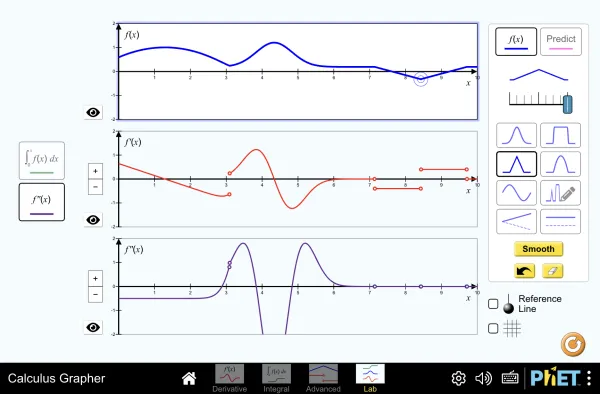
Full screen · PhET Interactive Simulations, University of Colorado Boulder, CC BY 4.0
Challenge
The gradient graph of a function f is y = x³ − 4x. Without sketching f first, say how many turning points f has and whether each is a maximum or a minimum. Given that f(0) = 4, find f(x) and the least value of f.
Hint
Factorise the gradient graph to find where it crosses the x-axis, then check whether it goes from minus to plus or plus to minus at each crossing.
Answer
Three turning points: minima at x = −2 and x = 2, a maximum at x = 0. f(x) = x⁴4 − 2x² + 4, and the least value of f is 0 (at x = ±2).
Step by step
- The gradient graph is x(x − 2)(x + 2), so it crosses the x-axis at x = −2, 0 and 2. These are the turning points of f.
- A cubic with a positive x³ term is below the axis on the far left, so the signs go minus, plus, minus, plus.
- Minus to plus is a minimum, plus to minus is a maximum.
- Anti-differentiate to get f, and use f(0) = 4 to find c.
- The least value is at one of the minima; both give the same height.
Full working
- x³ − 4x = x(x − 2)(x + 2)factorise
- f′ < 0 for x < −2, f′ > 0 for −2 < x < 0minimum at x = −2
- f′ < 0 for 0 < x < 2, f′ > 0 for x > 2maximum at x = 0, minimum at x = 2
- f(x) = x⁴4 − 2x² + canti-differentiate
- f(0) = c = 4given
- f(2) = 164 − 8 + 4 = 0, f(−2) = 0heights of the minima
- Minima (−2, 0) and (2, 0), maximum (0, 4); least value 0
The gradient graph of a cubic f is a parabola whose line of symmetry is x = 1. The cubic f has a local maximum at (−1, 9) and passes through (0, 4). Find f(x) and its local minimum. Then find every x for which f is decreasing while its gradient is increasing.
Hint
The gradient graph crosses the x-axis at x = −1. Its line of symmetry tells you the other crossing.
Answer
f(x) = x³ − 3x² − 9x + 4, with a local minimum at (3, −23). f is decreasing while its gradient is increasing for 1 < x < 3.
Step by step
- The maximum at x = −1 means the gradient graph crosses the x-axis there. By symmetry about x = 1, it also crosses at x = 3.
- So f′(x) = k(x + 1)(x − 3). Anti-differentiate with + c, then use (0, 4) and (−1, 9).
- The second crossing, x = 3, is the local minimum.
- f is decreasing where the gradient graph is below the x-axis: −1 < x < 3.
- The gradient is increasing where the gradient graph rises, to the right of its vertex x = 1. Both hold for 1 < x < 3.
Full working
- f′(x) = k(x + 1)(x − 3) = k(x² − 2x − 3)crosses at −1, and at 3 by symmetry
- f(x) = k(x³3 − x² − 3x) + c, c = 4anti-differentiate, f(0) = 4
- k(−13 − 1 + 3) + 4 = 5k3 + 4 = 9, so k = 3f(−1) = 9
- f(x) = x³ − 3x² − 9x + 4, f′(x) = 3(x + 1)(x − 3)substitute k = 3
- f(3) = 27 − 27 − 27 + 4 = −23, f′ goes − to +local minimum (3, −23)
- f′ < 0 for −1 < x < 3; gradient graph rises for x > 1∪-shaped, vertex at x = 1
- f(x) = x³ − 3x² − 9x + 4; minimum (3, −23); decreasing with increasing gradient for 1 < x < 3
Let f(x) = ax³ + bx² + cx + d, with a > 0, have two turning points. Prove that f falls most steeply at the x-value exactly halfway between the x-values of its turning points. Hence find exactly the point where f(x) = x³ − 6x² + 3x + 1 falls most steeply, and its gradient there.
Hint
The gradient graph is a ∪-shaped parabola. Where is a parabola lowest, and where is that compared with its two x-intercepts?
Answer
f′(x) = 3ax² + 2bx + c has its vertex at x = −b3a, and its two roots have mean −b3a, so they match. For x³ − 6x² + 3x + 1 the turning points are at x = 2 ± √3, and it falls most steeply at (2, −9), with gradient −9.
Step by step
- The gradient graph of f is f′(x) = 3ax² + 2bx + c, a ∪-shaped parabola because 3a > 0.
- f falls most steeply where its gradient is least, at the vertex x = −B2A = −2b6a = −b3a.
- The turning points are the roots of f′. By the quadratic formula they are −2b ± √(4b² − 12ac)6a, so their mean is −2b6a = −b3a.
- The two values are the same, which proves the result.
- For the given cubic, find the turning points' x-values, take their mean, and find the height and gradient there.
Full working
- f′(x) = 3ax² + 2bx + c, vertex at x = −2b2 × 3a = −b3aleast gradient at the vertex
- roots −2b ± √(4b² − 12ac)6a, mean = −2b6a = −b3athe ± parts cancel
- steepest fall is halfway between the turning pointsthe two match
- f′(x) = 3x² − 12x + 3 = 0, so x² − 4x + 1 = 0, x = 2 ± √3turning points
- halfway: x = 2mean of 2 − √3 and 2 + √3
- f(2) = 8 − 24 + 6 + 1 = −9, f′(2) = 12 − 24 + 3 = −9height and gradient
- Proved; steepest fall at (2, −9) with gradient −9
Practise this
Report a mistake
More in AS 91262
 The derivative: what the gradient function means6 min
 Differentiating polynomials, fractions and all7 min
 Equation of a tangent to a curve, step by step8 min
 Turning points: finding and proving max or min8 minSketching the gradient graph of a function7 min
 Optimisation with calculus: the biggest box8 min
 Anti-differentiation and why you need + c7 min
 Kinematics: displacement, velocity and acceleration8 min
 The derivative: 7 exam questions solved step by step11 min
 Differentiating: 7 exam questions solved step by step11 min
 Tangents: 7 exam questions solved step by step11 min
 Turning points: 7 exam questions solved step by step12 min
 Gradient graphs: 7 exam questions solved step by step12 min
 Optimisation: 7 exam questions solved step by step11 min
 Anti-differentiation: 7 exam questions solved step by step11 min
 Kinematics: 7 exam questions solved step by step11 min