
Optimisation: 7 exam questions solved step by step
What this lesson covers
- An optimisation problem is solved by writing the quantity as a function of one variable and finding its turning point.
- The answer must be shown to be a maximum or minimum, and must make sense in context.
Finding a maximum or minimum
- Write the quantity in terms of one variable.
- Differentiate and set the derivative to 0.
- Show it is a maximum or a minimum.
- Answer the question asked, with units.
Question 1 · Achieved, in context
- A school fundraiser sells tickets at $x.
- Profit: P = −5x² + 80x − 120 dollars
- Find the price for the greatest profit,
- And the greatest profit.
Q1: the best ticket price
- Set P′ = 0.
- The shape proves a max.
- P′ = −10x + 80differentiate
- −10x + 80 = 0, so x = 8stationary
- −5 < 0: opens downwardso a maximum
- P = −5(8)² + 80(8) − 120x = 8
- = −320 + 640 − 120 = 200
- $8 a ticket, profit $200
Question 2 · Achieved, in context
- Packhouse cost per tray, x workers:
- C = 2x² − 48x + 400 cents
- How many workers give the least cost?
- What is that cost, in dollars?
Q2: the cheapest tray
- Gradient either side.
- Cents to dollars.
- C′ = 4x − 48differentiate
- 4x − 48 = 0, so x = 12stationary
- C′(11) = 44 − 48 = −4 < 0falling
- C′(13) = 52 − 48 = 4 > 0rising
- − then +: a minimum
- C = 2(12)² − 48(12) + 400
- = 288 − 576 + 400 = 112
- 112 cents = $1.12answer in dollars
- 12 workers, $1.12 a tray
Question 3 · Merit, in context
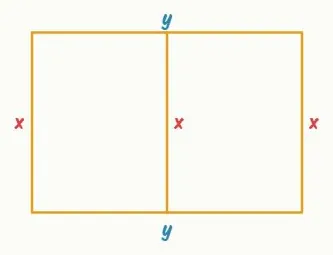
- A farmer has 120 m of fencing for a
- Rectangular paddock, split into two pens
- By one more fence parallel to two sides.
- Find the greatest total area.
Q3: form the area
- Name both lengths.
- Then one variable only.
- 3x + 2y = 120three x, two y
- y = 60 − 1.5x− 3x, then ÷ 2
- A = xy = x(60 − 1.5x)length × width
- A = 60x − 1.5x²expand
Q3: the greatest area
- Check either side.
- Answer with units.
- A = 60x − 1.5x²
- A′ = 60 − 3xdifferentiate
- 60 − 3x = 0, so x = 20stationary
- A′(19) = 3 > 0, A′(21) = −3 < 0
- + then −: a maximum
- y = 60 − 1.5 × 20 = 30
- A = 20 × 30 = 600 m²
- 20 m by 30 m, area 600 m²
Try it: the greatest area
Question 4 · Merit, in context
- A Rotorua tour company runs x tours a week.
- Profit: P = −x³ + 6x² + 15x
- In hundreds of dollars.
- Find the greatest weekly profit.
Q4: the tour company
- Reject what cannot be.
- P is in hundreds.
- P′ = −3x² + 12x + 15differentiate
- = −3(x² − 4x − 5)take out −3
- = −3(x − 5)(x + 1) = 0factorise
- x = 5 or x = −1
- x = −1tours cannot be negative
- P′(4) = 15 > 0, P′(6) = −21 < 0
- P = −125 + 150 + 75 = 100x = 5
- 100 × $100 = $10,000hundreds of dollars
- 5 tours a week: $10,000 profit
Question 5 · Merit, in context
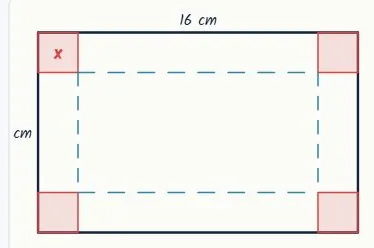
- A box is made from a 16 cm by 10 cm card
- By cutting a square of side x cm from
- Each corner and folding up the sides.
- Find the greatest volume.
Q5: form the volume
- Base loses 2x each way.
- Expand fully.
- length 16 − 2x, width 10 − 2x
- height x
- V = x(16 − 2x)(10 − 2x)length × width × height
- (16 − 2x)(10 − 2x)
- = 160 − 32x − 20x + 4x²
- = 160 − 52x + 4x²collect
- V = 4x³ − 52x² + 160xmultiply by x
Q5: the greatest volume
- Reject the root that fails.
- Answer with units.
- V = 4x³ − 52x² + 160x
- V′ = 12x² − 104x + 160differentiate
- = 4(3x² − 26x + 40)take out 4
- = 4(3x − 20)(x − 2) = 0factorise
- x = 2 or x = 20/3 ≈ 6.67
- x = 20/3: 10 − 40/3 < 0negative width
- V′(1) = 68 > 0, V′(3) = −44 < 0
- V = 2 × 12 × 6 = 144 cm³x = 2
- cut 2 cm squares: 144 cm³
Try it: where the gradient is zero
Question 6 · Excellence
- A wire frame for a box with a square base
- Uses 60 cm of wire for its 12 edges.
- Find the largest volume the box can have.
Q6: form the volume
- Two unknowns: link them.
- Then one variable.
- base x by x, height h
- 8x + 4h = 608 base edges, 4 upright
- 4h = 60 − 8x
- h = 15 − 2x÷ 4
- V = x² × h = x²(15 − 2x)base area × height
- V = 15x² − 2x³expand
Q6: the largest volume
- Reject x = 0.
- Prove the maximum.
- V = 15x² − 2x³
- V′ = 30x − 6x²differentiate
- 6x(5 − x) = 0factorise
- x = 0 or x = 5
- x = 0no box at all
- V′(4) = 120 − 96 = 24 > 0rising
- V′(6) = 180 − 216 = −36 < 0falling
- h = 15 − 10 = 5, V = 5² × 5
- a 5 cm cube, 125 cm³
Question 7 · Excellence, in context
- A Wellington ferry charges $40 a ticket
- And sells 600 tickets a day. Each $1 rise
- In price loses 10 sales a day.
- What price gives the most revenue?
Q7: form the revenue
- x = number of $1 rises.
- Revenue = price × sales.
- price = 40 + x dollars
- tickets = 600 − 10x
- R = (40 + x)(600 − 10x)price × tickets
- = 24,000 − 400x + 600x − 10x²
- R = 24,000 + 200x − 10x²collect
Q7: the best price
- x is not the price.
- Answer the question asked.
- R = 24,000 + 200x − 10x²
- R′ = 200 − 20xdifferentiate
- 200 − 20x = 0, so x = 10stationary
- R′(9) = 20 > 0, R′(11) = −20 < 0
- + then −: a maximum
- price = 40 + 10 = $50x is not the price
- tickets = 600 − 100 = 500
- R = 50 × 500 = $25,000
- $50 a ticket, $25,000 a day
Try it: link, reject, answer
Common mistakes
- The largest value of P is at the x found from dP/dx = 0.That gives the x. Substitute it back to find the greatest P.
- Keeping x = 20/3 for a 10 cm wide card.Check the context: a width of 10 − 2x would be negative, so reject it.
- Differentiating with two letters still in the formula.Use the constraint first, so the quantity depends on one variable.
The method that solved all seven
- Form, solve, reject, prove, then answer the question.
| Step | How |
|---|---|
| Name | the variable, with units |
| Link | use the constraint |
| Form | one quantity, one variable |
| Solve | derivative = 0 |
| Reject | roots that cannot happen |
| Prove | gradient either side, or shape |
| Answer | the question asked, with units |
Challenge
The opening of a tunnel has the shape y = 12 − x², where x and y are in metres and the ground is y = 0. A rectangular door is fitted inside the opening, with its base on the ground and its two top corners touching the curve. Find the width and height of the door with the greatest area, and that area.
Hint
By symmetry, put the top right corner at (x, 12 − x²). Then the width is 2x, not x.
Answer
Width 4 m, height 8 m, greatest area 32 m².
Step by step
- The door is symmetric about the y-axis, so if the right corner is at x, the width is 2x and the height is 12 − x².
- Write the area in terms of x only and expand.
- Differentiate and set the derivative to 0. Reject the negative root: x is a distance.
- Use the second derivative to show it is a maximum, then give the width, height and area.
Full working
- width = 2x, height = 12 − x²corner on the curve
- A = 2x(12 − x²) = 24x − 2x³width × height
- A′ = 24 − 6x² = 0stationary
- x² = 4, so x = 2x = −2 is not a length
- A″ = −12x = −24 < 0 at x = 2a maximum
- width = 4 m, height = 12 − 4 = 8 msubstitute x = 2
- 4 m wide, 8 m high, area 32 m²
An open box is made from a 24 cm by 15 cm sheet of card by cutting a square of side x cm from each corner and folding up the sides. The customer insists the box must be at least 4 cm deep. Find the greatest volume the box can have, and its dimensions.
Hint
First find the best x with no depth rule. Then ask: is that x allowed? If not, look at whether V is rising or falling over the x values that are allowed.
Answer
Without the rule the best cut is 3 cm (486 cm³), but that is too shallow. For 4 ≤ x < 7.5, V is decreasing, so the best is x = 4: a box 16 cm by 7 cm by 4 cm, volume 448 cm³.
Step by step
- Form V = x(24 − 2x)(15 − 2x) and expand.
- V′ = 0 at x = 3 and x = 10. x = 10 is impossible (15 − 20 is negative). x = 3 is the unrestricted maximum, but it gives a 3 cm deep box.
- The allowed values are 4 ≤ x < 7.5 (the width 15 − 2x must stay positive).
- On that interval V′ is negative, so V falls as x grows. The greatest volume is at the smallest allowed x, which is 4.
- The answer is at an end of the allowed range, not at a turning point.
Full working
- V = x(24 − 2x)(15 − 2x)length × width × height
- V = 4x³ − 78x² + 360xexpand
- V′ = 12x² − 156x + 360 = 12(x − 3)(x − 10)factorise
- x = 3 gives V = 3 × 18 × 9 = 486 cm³but only 3 cm deep
- allowed: 4 ≤ x < 7.5depth rule, width 15 − 2x > 0
- V′(5) = 12(2)(−5) = −120 < 0V′ < 0 for 3 < x < 10, so V is falling
- x = 4: 16 × 7 × 4 = 448 cm³smallest allowed x
- greatest volume 448 cm³: 16 cm by 7 cm by 4 cm deep
A garden sprinkler sits at the point (0, 2) and a curved path follows y = x², with all lengths in metres. Find the points on the path closest to the sprinkler and the shortest distance. Explain why the point (0, 0) on the path, where the gradient is also 0, is not the answer.
Hint
Use Pythagoras for the distance from (x, x²) to (0, 2). The distance is smallest exactly when its square D is smallest, and D has no square root in it, so minimise D.
Answer
The closest points are (√62, 32) and (−√62, 32), about (±1.22, 1.5), at a distance √72 ≈ 1.32 m. At (0, 0) the squared distance has a local maximum (distance 2 m), not a minimum.
Step by step
- A point on the path is (x, x²). By Pythagoras, the squared distance to (0, 2) is D = x² + (x² − 2)².
- Minimising the distance is the same as minimising D, because distances are positive. Expand D.
- D′ = 4x³ − 6x. Take out 2x (never divide by x): stationary points at x = 0 and x² = 32.
- The second derivative shows x = 0 is a maximum of D, and x² = 32 gives two minima.
- Substitute x² = 32 into D, then take the square root for the distance.
Full working
- D = x² + (x² − 2)²Pythagoras, squared distance
- D = x⁴ − 3x² + 4expand
- D′ = 4x³ − 6x = 2x(2x² − 3) = 0factorise
- x = 0 or x² = 32so x = ±√62 ≈ ±1.22
- D″ = 12x² − 6: at x = 0, D″ = −6 < 0(0, 0) is a local maximum, D = 4
- at x² = 32, D″ = 18 − 6 = 12 > 0minima
- D = 94 − 92 + 4 = 74substitute x² = 32
- distance = √(74) = √72 ≈ 1.32 msquare root
- closest at (±√62, 32), shortest distance √72 ≈ 1.32 m
Practise this
Report a mistake
More in AS 91262
 The derivative: what the gradient function means6 min
 Differentiating polynomials, fractions and all7 min
 Equation of a tangent to a curve, step by step8 min
 Turning points: finding and proving max or min8 min
 Sketching the gradient graph of a function7 min
 Optimisation with calculus: the biggest box8 min
 Anti-differentiation and why you need + c7 min
 Kinematics: displacement, velocity and acceleration8 min
 The derivative: 7 exam questions solved step by step11 min
 Differentiating: 7 exam questions solved step by step11 min
 Tangents: 7 exam questions solved step by step11 min
 Turning points: 7 exam questions solved step by step12 min
 Gradient graphs: 7 exam questions solved step by step12 minOptimisation: 7 exam questions solved step by step11 min
 Anti-differentiation: 7 exam questions solved step by step11 min
 Kinematics: 7 exam questions solved step by step11 min