
The derivative: what the gradient function means
What this lesson covers
- The derivative gives the gradient of the curve at every point.
- The gradient at a point is the gradient of the tangent there, which the chord gradients approach.
How steep is a curve?
- A straight line has one gradient everywhere.
- A curve gets steeper or flatter as you go.
- The derivative gives its gradient at every point.
The gradient of y = x² at x = 3
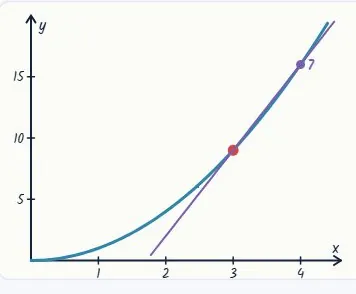
- Mark the point (3, 9) on the curve.
- A chord joins it to a second point.
- Chord to x = 4: gradient 7.
Move the second point closer
- To x = 3.5: gradient 6.5.
- To x = 3.1: gradient 6.1.
- The chords are closing in on one line.
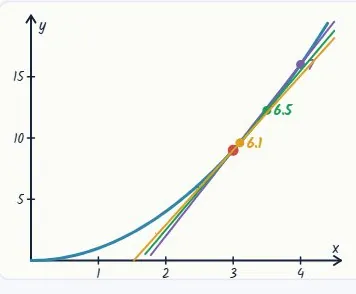
Try it: slide Q in towards P
The limit is the tangent
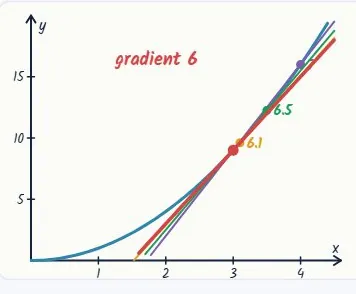
- As the gap shrinks, the gradient heads to 6.
- That line just touches the curve: the tangent.
- Gradient at x = 3 is 6, which is 2 × 3.
The numbers behind the drawing
- Rise ÷ run, each chord.
- The run shrinks to 0.
- Gradients close in on 6.
- gradient = rise ÷ run
- x = 4: (16 − 9) ÷ 1 = 7
- x = 3.5: (12.25 − 9) ÷ 0.5 = 6.5
- x = 3.1: (9.61 − 9) ÷ 0.1 = 6.1
- x = 3.01: (9.0601 − 9) ÷ 0.01
- = 0.0601 ÷ 0.01 = 6.01
- gradients → 6 as run → 0
A gradient for every x
- Repeat at any point on y = x²: the gradient is 2x.
- Dy/dx = 2x is the gradient function.
- It is a new function, not the curve.
| y = x² | the curve: heights |
| dy/dx = 2x | the gradient at every x |
| at x = 3 | height 9, gradient 6 |
| at x = −1 | height 1, gradient −2 |
Graphing calculator
The rule for xⁿ
- Bring the power down in front.
- Then reduce the power by one.
- A constant term has gradient 0.
| y | dy/dx |
|---|---|
| x² | 2x |
| x³ | 3x² |
| x⁵ | 5x⁴ |
| 5x | 5 |
| 7 (a constant) | 0 |
Using it at a point
- Differentiate first.
- Brackets around −2.
- Positive: the curve rises.
- y = x³
- dy/dx = 3x²power down, one less
- x = −2: 3 × (−2)²into dy/dx
- = 3 × 4 = 12
- x = 1: 3 × 1² = 3
The most common gradient mistake
- Substituting into y gives a height, not a gradient.
- For a gradient, substitute into dy/dx.
- Write which one you are using.
| Asked | the gradient of y = x³ at x = 2 |
| Wrong | substitute into y: 8 |
| Right | dy/dx = 3x², so 3 × 4 = 12 |
Try it: chord, tangent, rule
A gradient is a rate of change
- Units of y per unit of x.
- Metres per second, dollars per item.
- Say the rate in context, with units.
What to take away
- The derivative is the gradient, everywhere at once.
| Derivative | the gradient at every point |
| Tangent | the limit of the chords |
| Rule | xⁿ becomes nxⁿ⁻¹ |
| Constant | differentiates to 0 |
| Gradient at a point | substitute into dy/dx |
| Height at a point | substitute into y |
Common mistakes
- The gradient of y = x³ at x = 2 is 2³ = 8.Substituting into y gives the height. For the gradient use dy/dx = 3x²: 3 × 2² = 12.
- dy/dx = 3x² at x = −2: 3 × −2² = −12Bracket the value before squaring: 3 × (−2)² = 3 × 4 = 12.
- x⁵ differentiates to 5x⁵Bring the power down, then reduce it by one: x⁵ becomes 5x⁴.
- The chord from (1, 1) to (1.1, 1.21) has gradient 1.21 ÷ 1.1 = 1.1Gradient is rise ÷ run between the two points: (1.21 − 1) ÷ (1.1 − 1) = 0.21 ÷ 0.1 = 2.1.
Your turn: eight questions
- Question 3 is a chord, not a derivative.
- Question 4: set the gradient equal to 10.
Differentiate y = x⁴.
Find the gradient of y = x³ at x = −2.
Gradient of the chord (1, 1) to (1.1, 1.21) on y = x²?
Where does y = x² have a gradient of 10?
On y = x², chords from (2, 4) to x = 2.1 and to x = 2.01 have gradients 4.1 and 4.01. What is the gradient at x = 2?
Sam says the gradient of y = x⁴ at x = 2 is 16. What is the gradient there?
A stone has fallen d = 5t² metres after t seconds. How fast is it falling at t = 3?
Which statement about the gradient of y = x³ is true?
Show answer
1. dy/dx = 4x³. 2. dy/dx = 3x², so 3 × (−2)² = 12. 3. (1.21 − 1) ÷ (1.1 − 1) = 0.21 ÷ 0.1 = 2.1, close to the tangent gradient 2. 4. 2x = 10, so x = 5, at the point (5, 25). 5. 4. As the second point closes in, the chord gradients head to 4, and dy/dx = 2x gives 2 × 2 = 4. 6. 32. Sam found the height. The gradient comes from dy/dx = 4x³, so 4 × 2³ = 32. 7. 30 m/s. The rate is the derivative of 5t², which is 10t, so 10 × 3 = 30 metres per second. 8. It is never negative. dy/dx = 3x², and a square is never negative, so the curve never goes downhill.
The answers
- 1. y = x⁴, dy/dx = 4x³power down, one less
- 2. dy/dx = 3x²
- x = −2: 3 × (−2)² = 3 × 4 = 12
- 3. (1.21 − 1) ÷ (1.1 − 1)rise ÷ run
- = 0.21 ÷ 0.1 = 2.1
- close to dy/dx = 2(1) = 2the tangent
- 4. dy/dx = 2x = 10
- x = 5, y = 5² = 25
- the point (5, 25)
Sample question: Achieved
Find the gradient of the curve y = x⁴ − 3x at the point where x = 2, and say what it tells you about the curve there.
Hint
Use the rule for xⁿ to find dydx, then substitute x = 2 into dydx.
Answer
dydx = 4x³ − 3, so the gradient at x = 2 is 29: the curve is rising steeply there
Step by step
- The derivative dydx is the gradient function: it gives the gradient at any x.
- Recall the rule: xⁿ differentiates to nxⁿ⁻¹. So x⁴ gives 4x³.
- −3x differentiates to −3, because the gradient of the straight line −3x is −3.
- So dydx = 4x³ − 3.
- At x = 2: dydx = 4 × 2³ − 3 = 4 × 8 − 3 = 32 − 3 = 29.
- Classic mistake: putting x = 2 into y, which gives 16 − 6 = 10. That is the height of the point, not the gradient.
- Meaning: at x = 2 the tangent has gradient 29, so the curve is rising steeply. For each 1 unit across, it climbs about 29 units.
- Check numerically: the chord from x = 2 to x = 2.001 has gradient about 29.02, very close to 29.
Full working
- dydx = 4x³ − 3xⁿ gives nxⁿ⁻¹
- dydx at x = 2: 4 × 8 − 3substitute into the derivative
- Gradient = 29 (rising steeply)
Sample questions: Merit
For the curve y = x² + x, show that the gradient of the chord from x = 1 to x = 1 + h is 3 + h. Work out the chord gradient for h = 0.1 and h = 0.01, and hence state the gradient of the curve at x = 1. Confirm it with the derivative.
Hint
Chord gradient = (change in y) ÷ (change in x). Expand (1 + h)² and simplify before dividing by h.
Answer
Chord gradient 3 + h: 3.1 for h = 0.1 and 3.01 for h = 0.01; the gradient at x = 1 is 3, which matches dydx = 2x + 1 = 3
Step by step
- A chord joins two points on the curve. Its gradient is the rise over the run, and as the points get closer it approaches the tangent's gradient.
- First point: x = 1, y = 1 + 1 = 2.
- Second point: x = 1 + h, y = (1 + h)² + (1 + h) = 1 + 2h + h² + 1 + h = 2 + 3h + h².
- Rise: (2 + 3h + h²) − 2 = 3h + h². Run: (1 + h) − 1 = h.
- Gradient: 3h + h²h = 3 + h, after dividing each term by h. That is what we had to show.
- Classic mistake: writing (1 + h)² = 1 + h². The middle term 2h is needed.
- h = 0.1 gives 3.1, and h = 0.01 gives 3.01.
- As h gets closer to 0, the second point slides towards the first and 3 + h gets closer to 3. So the gradient of the curve at x = 1 is 3.
- Confirm with the derivative: dydx = 2x + 1, and at x = 1 that is 3. The two methods agree.
Full working
- y(1) = 2, y(1 + h) = 2 + 3h + h²expand (1 + h)²
- gradient = 3h + h²h = 3 + hrise over run
- h = 0.1: 3.1; h = 0.01: 3.01
- As h approaches 0, 3 + h approaches 3the chord becomes the tangent
- dydx = 2x + 1 = 3 at x = 1the derivative agrees
- Gradient at x = 1 is 3
The volume of water in a tank t minutes after a valve is opened is V = 200 + 30t − t² litres, for 0 ≤ t ≤ 15. Find the rate the volume is changing at t = 5 and at t = 12, and find when the volume is increasing at 10 litres per minute.
Hint
The rate of change of V is its derivative dVdt. Substitute for the rates; set dVdt = 10 for the last part.
Answer
20 litres per minute at t = 5; 6 litres per minute at t = 12; 10 litres per minute at t = 10
Step by step
- A rate of change is a gradient. The rate the volume changes is dVdt, measured in litres per minute.
- Differentiate term by term: 200 gives 0, 30t gives 30, and −t² gives −2t. So dVdt = 30 − 2t.
- At t = 5: dVdt = 30 − 10 = 20 litres per minute.
- At t = 12: dVdt = 30 − 24 = 6 litres per minute.
- Both rates are positive, so the volume is still increasing, but more slowly later on.
- Classic mistake: giving V(5) = 325 litres as the rate. That is how much water there is, not how fast it is changing.
- Increasing at 10 litres per minute: set 30 − 2t = 10, so 2t = 20 and t = 10 minutes.
- Check: t = 10 is inside 0 ≤ t ≤ 15, so the answer is allowed.
- So the rates are 20 and 6 litres per minute, and the rate is 10 litres per minute at t = 10.
Full working
- dVdt = 30 − 2trate = derivative
- t = 5: 30 − 10 = 20 L per min
- t = 12: 30 − 24 = 6 L per min
- 30 − 2t = 10, so t = 10inside 0 ≤ t ≤ 15
- 20 and 6 L per min; t = 10 min
Sample questions: Excellence
For the curve y = x³, show that the gradient of the chord from the point with x-coordinate x to the point with x-coordinate x + h is 3x² + 3xh + h². Hence explain why the gradient function of y = x³ is 3x², and use the chord formula with x = 2 and h = 0.1 to check it.
Hint
Expand (x + h)³ as (x + h)(x + h)², subtract x³, then divide each term by h. Think about what happens to the h terms as h gets closer to 0.
Answer
Chord gradient = 3x² + 3xh + h²; as h approaches 0 this approaches 3x², so dydx = 3x²; at x = 2, h = 0.1 the chord gradient is 12.61, close to 12
Step by step
- Two points on the curve: (x, x³) and (x + h, (x + h)³). The chord gradient is rise over run.
- Expand (x + h)³. First (x + h)² = x² + 2xh + h². Then multiply by (x + h): x³ + 2x²h + xh² + x²h + 2xh² + h³.
- Collect like terms: (x + h)³ = x³ + 3x²h + 3xh² + h³.
- Rise: (x + h)³ − x³ = 3x²h + 3xh² + h³. The x³ terms cancel.
- Run: (x + h) − x = h.
- Gradient: 3x²h + 3xh² + h³h = 3x² + 3xh + h². Every term on top has an h, so each one divides cleanly. That is what we had to show.
- Now let the second point slide towards the first, so h gets closer and closer to 0.
- 3xh and h² both shrink towards 0, but 3x² does not depend on h, so it stays.
- So the chord gradients approach 3x², which is the gradient of the tangent at x. That means dydx = 3x², matching the rule xⁿ gives nxⁿ⁻¹.
- Classic mistake: putting h = 0 straight into 3x²h + 3xh² + h³h. That gives 0 ÷ 0, which means nothing. Divide by h first, then let h approach 0.
- Check with x = 2 and h = 0.1: 3 × 4 + 3 × 2 × 0.1 + 0.01 = 12 + 0.6 + 0.01 = 12.61.
- The derivative gives 3 × 2² = 12, and 12.61 is close to it. A smaller h would give an even closer value.
Full working
- (x + h)³ = x³ + 3x²h + 3xh² + h³expand
- rise = 3x²h + 3xh² + h³, run = h
- gradient = 3x² + 3xh + h²divide each term by h
- As h approaches 0: 3xh and h² approach 0the chord becomes the tangent
- dydx = 3x²
- x = 2, h = 0.1: 12 + 0.6 + 0.01 = 12.61 ≈ 12
- dydx = 3x²
For the curve y = x² − 4x, find the point where the tangent is parallel to the chord joining the points with x = 1 and x = 5. Then prove that for any parabola y = ax² + bx + c, the tangent parallel to the chord from x = p to x = q is at x = p + q2.
Hint
Parallel lines have equal gradients. Find the chord's gradient, set dydx equal to it, then repeat the same steps with letters.
Answer
(3, −3); in general the chord gradient is a(p + q) + b and dydx = 2ax + b, so x = p + q2
Step by step
- Parallel lines have the same gradient. So find the chord's gradient, and then where the curve has that gradient.
- The chord ends: at x = 1, y = 1 − 4 = −3; at x = 5, y = 25 − 20 = 5.
- Chord gradient = (5 − (−3)) ÷ (5 − 1) = 8 ÷ 4 = 2.
- dydx = 2x − 4. Set it equal to 2: 2x − 4 = 2, so x = 3.
- y at x = 3: 9 − 12 = −3. So the tangent at (3, −3) is parallel to the chord. Notice 3 is halfway between 1 and 5.
- Now the general case. Chord rise: (aq² + bq + c) − (ap² + bp + c) = a(q² − p²) + b(q − p). The c terms cancel.
- Factorise the rise: q² − p² = (q − p)(q + p), so rise = (q − p)(a(q + p) + b).
- Divide by the run q − p: chord gradient = a(p + q) + b.
- The tangent's gradient is dydx = 2ax + b. Set them equal: 2ax + b = a(p + q) + b.
- Take b from both sides and divide by 2a (a ≠ 0 for a parabola): x = p + q2.
- So the tangent parallel to any chord of a parabola is always exactly halfway between the chord's ends, whatever a, b and c are.
- Classic mistake: proving it only with numbers, like 1 and 5. That shows one case; the letters p and q show every case.
- Check with the first part: p = 1 and q = 5 give x = 6 ÷ 2 = 3. It agrees.
Full working
- chord gradient = (5 − (−3)) ÷ (5 − 1) = 2
- 2x − 4 = 2, so x = 3, y = −3tangent parallel to the chord
- rise = (q − p)(a(q + p) + b), run = q − pgeneral parabola
- chord gradient = a(p + q) + b
- 2ax + b = a(p + q) + b, so x = p + q2a ≠ 0
- (3, −3); in general x = p + q2
Calculus Grapher
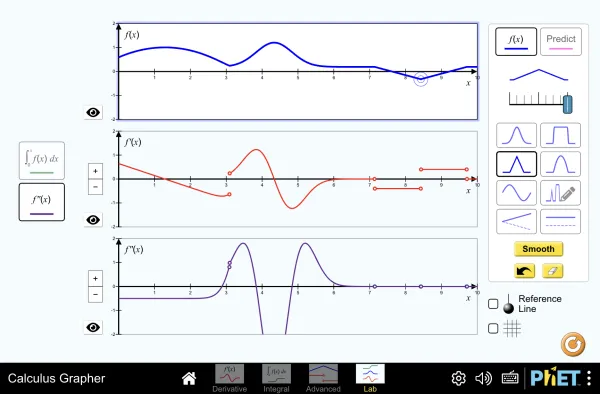
Full screen · PhET Interactive Simulations, University of Colorado Boulder, CC BY 4.0
Challenge
The curve y = x³ + px² + qx has the same gradient at x = −1 as at x = 3, and its gradient at x = 2 is −5. Find p and q. Then find the two points on the curve where the gradient is 4, and the steepest downhill gradient the curve ever has.
Hint
Write dydx with p and q in it. Equal gradients at x = −1 and x = 3 gives one equation; the gradient at x = 2 gives another. For the last part, complete the square on dydx.
Answer
p = −3, q = −5, so y = x³ − 3x² − 5x; gradient 4 at (−1, 1) and (3, −15); the steepest downhill gradient is −8, at x = 1
Step by step
- Differentiate with the letters left in: dydx = 3x² + 2px + q.
- Equal gradients at x = −1 and x = 3: 3 − 2p + q = 27 + 6p + q. The q terms cancel, so −24 = 8p and p = −3.
- Gradient −5 at x = 2: 12 − 12 + q = −5, so q = −5. The curve is y = x³ − 3x² − 5x.
- Gradient 4: 3x² − 6x − 5 = 4 gives x² − 2x − 3 = 0, so x = 3 or x = −1. These are the two x values from the start, which is a good check. Substitute into y (not dydx) for the points.
- The gradient function is a parabola: 3x² − 6x − 5 = 3(x − 1)² − 8. Its smallest value is −8, when x = 1.
Full working
- dydx = 3x² + 2px + qrule for xⁿ
- 3 − 2p + q = 27 + 6p + q, so p = −3gradients at x = −1 and x = 3 equal
- 12 − 12 + q = −5, so q = −5gradient at x = 2
- 3x² − 6x − 5 = 4, so (x − 3)(x + 1) = 0set dydx = 4
- y(−1) = −1 − 3 + 5 = 1, y(3) = 27 − 27 − 15 = −15heights from y
- dydx = 3(x − 1)² − 8 ≥ −8complete the square
- p = −3, q = −5; points (−1, 1) and (3, −15); steepest downhill gradient −8 at x = 1
Two different tangents to the curve y = x² − 2x + 9 pass through the origin. Find the point where each one touches the curve, and the gradient of each tangent.
Hint
Call the touching point (a, a² − 2a + 9). Write the tangent there using the gradient 2a − 2, then make the line pass through (0, 0).
Answer
Touching at (3, 12) with gradient 4, and at (−3, 24) with gradient −8
Step by step
- You do not know where the tangents touch, so call the x value a. The point is (a, a² − 2a + 9) and the gradient there is dydx = 2a − 2.
- A line through the origin has equation y = mx, so the height at the touching point must equal the gradient times a.
- That gives a² − 2a + 9 = (2a − 2)a = 2a² − 2a. The −2a terms cancel, leaving a² = 9, so a = 3 or a = −3.
- a = 3: the point is (3, 12) and the gradient is 4. Check: 4 × 3 = 12, so y = 4x passes through it.
- a = −3: the point is (−3, 24) and the gradient is −8. Check: −8 × −3 = 24, so y = −8x passes through it.
- The answers are not mirror images, because the curve's lowest point is at x = 1, not on the y-axis.
Full working
- touching point (a, a² − 2a + 9), gradient 2a − 2dydx = 2x − 2
- a² − 2a + 9 = (2a − 2) × atangent y = mx passes through (0, 0)
- a² − 2a + 9 = 2a² − 2a, so a² = 9simplify
- a = 3: point (3, 12), gradient 4tangent y = 4x
- a = −3: point (−3, 24), gradient −8tangent y = −8x
- (3, 12) with gradient 4; (−3, 24) with gradient −8
The tangent to y = x² − 2 at the point where x = a (a > 0) crosses the x-axis at x = b. (a) Show that b = a² + 22a. (b) Start with a = 2 and use the formula three times, each time taking the new b as the next a. Give exact fractions. (c) Show that b − √2 = (a − √2)²2a, and use it to explain why every b is bigger than √2 and why the values close in on √2 so quickly.
Hint
Write the tangent through (a, a² − 2) with gradient 2a, then put y = 0. For (c), put b − √2 over the common denominator 2a.
Answer
(a) The tangent is y − (a² − 2) = 2a(x − a); y = 0 gives b = a² + 22a. (b) 32, 1712, 577408. (c) A square divided by 2a > 0 is positive, so b > √2. The new error is the old error squared, divided by about 2√2, so it shrinks very fast: (577408)² = 2 + 1166464.
Step by step
- The point is (a, a² − 2) and dydx = 2x, so the tangent there has gradient 2a.
- Putting y = 0 in y − (a² − 2) = 2a(x − a) gives x − a = 2 − a²2a, so b = a² + 22a.
- From a = 2: b = 64 = 32. From 32: (94 + 2) ÷ 3 = 1712. From 1712: 577408.
- b − √2 = a² − 2√2a + 22a = (a − √2)²2a, which is positive whenever a is not √2.
- Because the error is squared each time, it falls from about 0.086 to 0.0025 to 0.000002.
Full working
- dydx = 2x, gradient 2a at x = arule for xⁿ
- y − (a² − 2) = 2a(x − a)tangent through (a, a² − 2)
- −(a² − 2) = 2a(b − a), so b = a + 2 − a²2aput y = 0
- b = 2a² + 2 − a²2a = a² + 22acommon denominator
- a = 2: b = 64 = 32first step
- a = 32: b = (94 + 2) ÷ 3 = 1712second step
- a = 1712: b = (577144) ÷ (176) = 577408third step
- b − √2 = a² − 2√2a + 22a = (a − √2)²2a > 0a perfect square on top
- (577408)² − 2 = 1166464very close to √2
- b = a² + 22a; values 32, 1712, 577408, each bigger than √2 and closing in fast
Where science uses this
Practise this
Report a mistake
More in AS 91262
The derivative: what the gradient function means6 min Differentiating polynomials, fractions and all7 min
 Equation of a tangent to a curve, step by step8 min
 Turning points: finding and proving max or min8 min
 Sketching the gradient graph of a function7 min
 Optimisation with calculus: the biggest box8 min
 Anti-differentiation and why you need + c7 min
 Kinematics: displacement, velocity and acceleration8 min
 The derivative: 7 exam questions solved step by step11 min
 Differentiating: 7 exam questions solved step by step11 min
 Tangents: 7 exam questions solved step by step11 min
 Turning points: 7 exam questions solved step by step12 min
 Gradient graphs: 7 exam questions solved step by step12 min
 Optimisation: 7 exam questions solved step by step11 min
 Anti-differentiation: 7 exam questions solved step by step11 min
 Kinematics: 7 exam questions solved step by step11 min