
Gradient graphs: 7 exam questions solved step by step
What this lesson covers
- The gradient graph is zero where the function turns, positive where it rises and negative where it falls.
- A cubic has a quadratic gradient graph and a quadratic has a straight-line gradient graph.
Sketching the gradient graph f′(x)
- Where f turns, f′ = 0: it crosses the x-axis.
- Where f rises, f′ is above the axis.
- Where f falls, f′ is below the axis.
- f′ is one degree lower: draw one smooth curve.
Question 1 · Achieved
- The graph of f(x) = x² + 2x − 3 is shown.
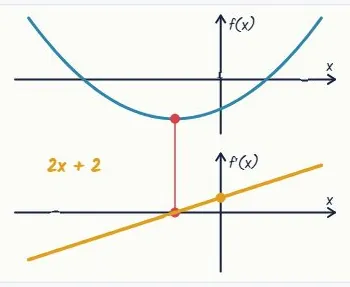
- Sketch the gradient graph, y = f′(x).
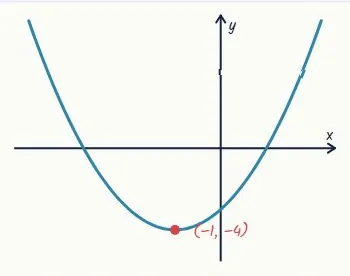
Q1: f(x) = x² + 2x − 3
- Turning point first.
- Then the signs.
- f turns at x = −1its minimum
- so f′(−1) = 0the x-intercept
- x < −1: falling, f′ < 0
- x > −1: rising, f′ > 0
- quadratic, so f′ is a linedegree drops by one
- f′(x) = 2x + 2differentiate
- 2x + 2 = 0 at x = −1
- f′(0) = 2the y-intercept
- line through (−1, 0) and (0, 2)
Q1: the sketch
- Cross at x = −1.
- Below, then above.
- One straight line.
Question 2 · Achieved, in context
- A drone takes off, rises, then comes down.
- Its gradient graph: dh/dt = 6 − 2t (m/s)
- When is the drone highest?
- Rising or falling at t = 4 s?
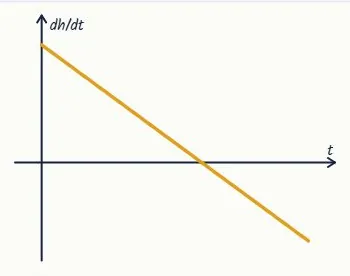
Q2: the drone
- Highest: gradient zero.
- Sign before and after.
- dh/dt = 0: 6 − 2t = 0stops rising
- t = 3
- t < 3: dh/dt > 0, rising
- t > 3: dh/dt < 0, falling
- + then −: a maximumsign change
- highest at t = 3 s
- t = 4: 6 − 2 × 4 = −2
- falling at 2 m/s when t = 4 s
Question 3 · Merit
- The cubic shown has a minimum at x = −1
- And a maximum at x = 3.
- Sketch y = f′(x). Where is it greatest?
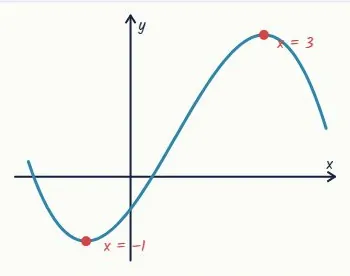
Q3: a cubic that ends falling
- Intercepts, then signs.
- Do not copy the curve.
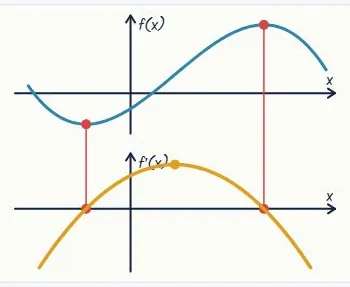
- f′ = 0 at x = −1 and x = 3turning points
- x < −1: falling, f′ < 0
- −1 < x < 3: rising, f′ > 0
- x > 3: falling, f′ < 0
- cubic, so f′ is a paraboladegree drops by one
- − + −: it opens downwardupside down
- top at x = (−1 + 3) ÷ 2 = 1symmetric
- f′ greatest at x = 1
Q3: the sketch
- Under each turning point.
- Opens downward.
- Top at x = 1.
Question 4 · Merit
- f(x) = x³ − 6x² + 9x + 1
- Where does y = f′(x) cross the x-axis?
- Find its lowest point, then sketch it.
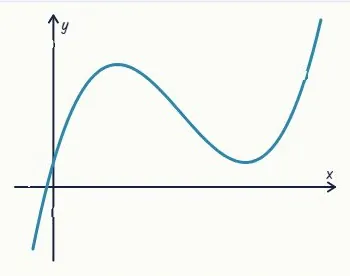
Q4: f(x) = x³ − 6x² + 9x + 1
- Term by term.
- Factorise for the zeros.
- x³ → 3x², −6x² → −12xpower down, minus 1
- 9x → 9, 1 → 0a constant → 0
- f′(x) = 3x² − 12x + 9
- = 3(x² − 4x + 3)take out 3
- = 3(x − 1)(x − 3)factorise
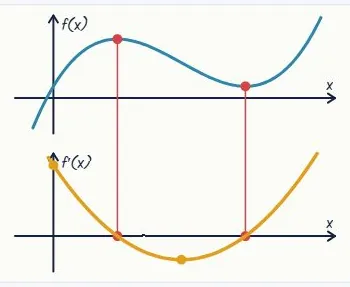
- crosses at x = 1 and x = 3
- lowest at x = (1 + 3) ÷ 2 = 2
- f′(2) = 12 − 24 + 9 = −3
- lowest point (2, −3)
Try it: from f to f′
Q4: the sketch
- Through x = 1 and x = 3.
- Lowest at (2, −3).
- Meets the y-axis at 9.
Question 5 · Merit
- The gradient graph y = f′(x) is shown.
- Find the turning points of f, and say
- Which is a max and which is a min.
- Sketch a possible graph of f.
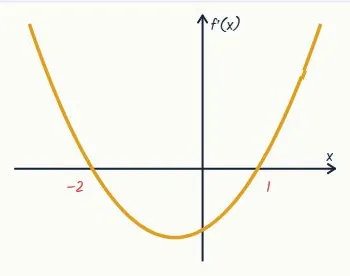
Q5: from f′ back to f
- Zeros are turning points.
- Sign change: max or min.
- f′ = 0 at x = −2 and x = 1turning points
- x < −2: f′ > 0, f rising
- −2 < x < 1: f′ < 0, f falling
- x > 1: f′ > 0, f rising
- x = −2: + then −, a maximum
- x = 1: − then +, a minimum
- f′ is a parabola, so f is cubic
- max at x = −2, min at x = 1
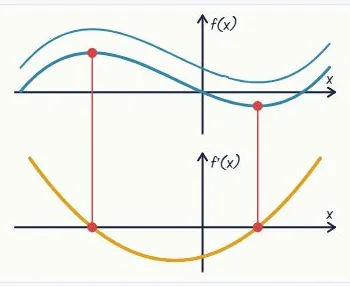
Try it: from f′ back to f
Q5: a possible f
- Rise, fall, rise.
- Max at −2, min at 1.
- Any height will do.
Question 6 · Excellence
- f(x) = x³ − 3x² + 3x + 2
- Sam says f′(1) = 0, so f turns at x = 1.
- Is Sam right? Sketch y = f′(x).
- Careful: zero gradient is not always a turn.
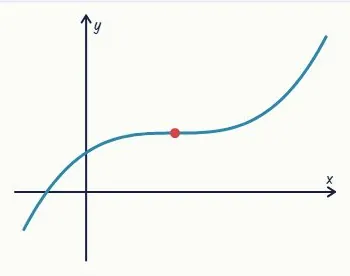
Q6: is it a turning point?
- Check the sign either side.
- No sign change, no turn.
- f′(x) = 3x² − 6x + 3differentiate
- = 3(x² − 2x + 1)take out 3
- = 3(x − 1)²a perfect square
- f′(1) = 3(0)² = 0stationary
- f′(0) = 3(−1)² = 3 > 0rising before
- f′(2) = 3(1)² = 3 > 0rising after
- turning point at x = 1no sign change
- f′ touches the axis at x = 1
- f flattens at x = 1, keeps rising
Q6: the sketch
- Touches at x = 1, no crossing.
- Above the axis everywhere else.
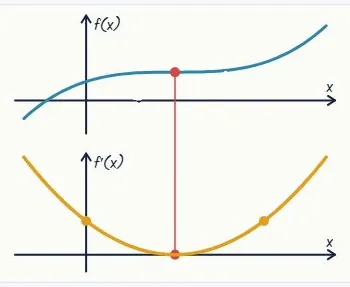
Try it: match f to f′
Question 7 · Excellence
- A cubic f has a positive x³ term and
- Turning points at x = a and x = b.
- Show f′ is lowest at x = (a + b) ÷ 2.
- Then use it for a = −3 and b = 5.
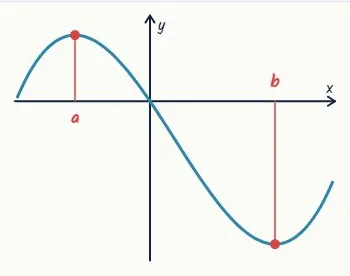
Q7: any cubic
- f′ is zero at a and b.
- Its turn is midway.
- f′(x) = k(x − a)(x − b), k > 0
- = k(x² − (a + b)x + ab)expand
- k(2x − (a + b)) = 0differentiate f′
- 2x = a + b
- x = (a + b) ÷ 2midway
- k > 0: f′ opens up, a minimum
- a = −3, b = 5: x = (−3 + 5) ÷ 2
- = 1
- f falls most steeply at x = 1
Common mistakes
- f has a maximum at x = 3, so f′ has a maximum at x = 3 too.At a turning point of f the gradient is 0, so turning points of f are where f′ crosses the x-axis.
- f is a cubic, so its gradient graph is a cubic too.Differentiating drops the degree by one, so the gradient graph of a cubic is a parabola.
- f′(1) = 0, so f has a turning point at x = 1.f′(x) = 3(x − 1)² does not change sign at x = 1, so it is not a turning point; f′ only touches the axis there.
- dh/dt = −2 at t = 4, so the drone is 2 m below the ground.dh/dt is a rate, not a height: −2 means the drone is falling at 2 m/s.
The method that solved all seven
- Turns, signs, degree, then one smooth curve.
| Step | How |
|---|---|
| Turns | f′ = 0: crosses the x-axis |
| Rising | f′ above the axis |
| Falling | f′ below the axis |
| Degree | drops by one |
| Steepest | furthest from the axis |
| Reverse | sign change: max or min |
| No change | flat, but not a turn |
Challenge
The gradient graph of a cubic f is a ∪-shaped parabola that touches the x-axis at x = 2 and passes through (0, 12). Also f(0) = −7. Find f′(x) and f(x). Explain why f has no turning points, even though f′(2) = 0, and find where the graph of f crosses the x-axis.
Hint
Touching the x-axis at x = 2 means f′(x) = k(x − 2)². For the crossing point, try small whole numbers in f(x), or notice f(x) is (x − 2)³ plus a number.
Answer
f′(x) = 3(x − 2)² = 3x² − 12x + 12, f(x) = x³ − 6x² + 12x − 7; f′ never goes below the axis, so f never turns; f crosses the x-axis only at x = 1
Step by step
- A parabola touching the axis at x = 2 is f′(x) = k(x − 2)². Through (0, 12): 4k = 12, so k = 3 and f′(x) = 3x² − 12x + 12.
- Anti-differentiate: f(x) = x³ − 6x² + 12x + c, and f(0) = −7 gives c = −7.
- f′(x) = 3(x − 2)² ≥ 0 for every x. It is 0 at x = 2 but positive on both sides, so f rises, flattens for a moment and keeps rising. No sign change means no turning point.
- f(1) = 1 − 6 + 12 − 7 = 0, so f crosses at x = 1. Because f is always rising, it can cross the x-axis only once.
- Check: f(x) = (x − 1)(x² − 5x + 7), and x² − 5x + 7 has Δ = 25 − 28 < 0, so there is no other root.
Full working
- f′(x) = k(x − 2)², 4k = 12, k = 3touches at x = 2, through (0, 12)
- f′(x) = 3x² − 12x + 12expand
- f(x) = x³ − 6x² + 12x + c, c = −7anti-differentiate, f(0) = −7
- f′(x) = 3(x − 2)² ≥ 0no sign change at x = 2
- f(1) = 1 − 6 + 12 − 7 = 0a root
- f(x) = (x − 1)(x² − 5x + 7), Δ = −3 < 0no other root
- f(x) = x³ − 6x² + 12x − 7; no turning points; crosses only at x = 1
The gradient graph of a cubic f is a parabola. Its line of symmetry is x = 12, it crosses the y-axis at (0, −12), and it passes through (3, 24). The graph of f crosses the y-axis at the same point as its gradient graph. (a) Find f′(x) and f(x). (b) Using only the signs of the gradient graph, find both turning points of f and say which is a maximum and which is a minimum. (c) Explain why the graph of f crosses the x-axis exactly once, and find the two whole numbers it crosses between.
Hint
Write f′(x) = px² + qx − 12. A parabola's line of symmetry is x = −q2p. Once you have f′, anti-differentiate and use f(0) = −12.
Answer
(a) f′(x) = 6x² − 6x − 12 and f(x) = 2x³ − 3x² − 12x − 12. (b) Maximum (−1, −5), minimum (2, −32). (c) Both turning points are below the x-axis, so f only crosses once, to the right of the minimum, between x = 3 and x = 4.
Step by step
- The gradient graph crosses the y-axis at −12, so f′(x) = px² + qx − 12.
- Symmetry about x = 12 gives −q2p = 12, so q = −p. Through (3, 24): 9p + 3q − 12 = 24, so 6p = 36 and p = 6.
- f′(x) = 6x² − 6x − 12 = 6(x + 1)(x − 2). Anti-differentiating gives f(x) = 2x³ − 3x² − 12x + c, and f(0) = −12 gives c = −12.
- The gradient graph is ∪-shaped: f′ changes from + to − at x = −1 (a maximum) and from − to + at x = 2 (a minimum).
- f(−1) = −5 and f(2) = −32. Left of x = 2, f is never higher than −5, so it can only cross the x-axis after x = 2, where it rises for ever, so it crosses once.
- f(3) = −21 and f(4) = 20, so the crossing is between 3 and 4.
Full working
- f′(x) = px² + qx − 12y-intercept −12
- −q2p = 12, so q = −pline of symmetry
- 9p + 3q − 12 = 24, so 6p = 36, p = 6, q = −6through (3, 24)
- f′(x) = 6x² − 6x − 12 = 6(x + 1)(x − 2)factorise
- f(x) = 2x³ − 3x² − 12x + c, c = −12anti-differentiate, f(0) = −12
- f′ is + for x < −1, − for −1 < x < 2, + for x > 2∪-shaped gradient graph
- f(−1) = −2 − 3 + 12 − 12 = −5, maximumturning point
- f(2) = 16 − 12 − 24 − 12 = −32, minimumturning point
- f(3) = 54 − 27 − 36 − 12 = −21; f(4) = 128 − 48 − 48 − 12 = 20sign change
- f(x) = 2x³ − 3x² − 12x − 12; maximum (−1, −5), minimum (2, −32); one crossing, between x = 3 and x = 4
f(x) = x⁴ − 8x³ + 18x² − 5. Its gradient graph y = f′(x) is a cubic. Find where f′(x) = 0 and decide which of these are turning points of f. Then find the point with 0 < x < 3 where f is rising most steeply, and its gradient there.
Hint
Factorise f′(x) fully. A root where f′ touches the axis without changing sign is not a turning point of f. f is steepest where f′ itself turns, so differentiate f′.
Answer
f′(x) = 4x(x − 3)²; f′ = 0 at x = 0 and x = 3, but only (0, −5) is a turning point (a minimum); f rises most steeply on 0 < x < 3 at (1, 6), gradient 16
Step by step
- f′(x) = 4x³ − 24x² + 36x = 4x(x² − 6x + 9) = 4x(x − 3)², so f′ = 0 at x = 0 and x = 3.
- At x = 0, f′ changes from negative (f′(−1) = −64) to positive (f′(1) = 16): a minimum, at (0, −5).
- At x = 3, (x − 3)² does not change sign: f′(2) = 8 and f′(4) = 16 are both positive. f flattens at (3, 22) but keeps rising, so this is not a turning point.
- Between 0 and 3, f′ goes up from 0 and back down to 0, so it has a maximum. Differentiate f′: 12x² − 48x + 36 = 12(x − 1)(x − 3) = 0 at x = 1.
- f′(1) = 4 × 1 × 4 = 16 and f(1) = 1 − 8 + 18 − 5 = 6. So f rises most steeply at (1, 6), with gradient 16.
Full working
- f′(x) = 4x³ − 24x² + 36x = 4x(x − 3)²differentiate, factorise
- f′(−1) = −64, f′(1) = 16sign change at x = 0: minimum
- f(0) = −5turning point (0, −5)
- f′(2) = 8, f′(4) = 16no sign change at x = 3
- f(3) = 81 − 216 + 162 − 5 = 22flat at (3, 22), not a turn
- 12x² − 48x + 36 = 12(x − 1)(x − 3) = 0f′ turns at x = 1
- f′(1) = 16, f(1) = 6steepest point
- Only turning point (0, −5), a minimum; steepest rise on 0 < x < 3 at (1, 6), gradient 16
Practise this
Report a mistake
More in AS 91262
 The derivative: what the gradient function means6 min
 Differentiating polynomials, fractions and all7 min
 Equation of a tangent to a curve, step by step8 min
 Turning points: finding and proving max or min8 min
 Sketching the gradient graph of a function7 min
 Optimisation with calculus: the biggest box8 min
 Anti-differentiation and why you need + c7 min
 Kinematics: displacement, velocity and acceleration8 min
 The derivative: 7 exam questions solved step by step11 min
 Differentiating: 7 exam questions solved step by step11 min
 Tangents: 7 exam questions solved step by step11 min
 Turning points: 7 exam questions solved step by step12 minGradient graphs: 7 exam questions solved step by step12 min
 Optimisation: 7 exam questions solved step by step11 min
 Anti-differentiation: 7 exam questions solved step by step11 min
 Kinematics: 7 exam questions solved step by step11 min