
Exponential growth and decay: interest, depreciation, half-life
What this lesson covers
- Growth or decay by a fixed percentage each period is multiplication by the same factor each period.
- Finding how long something takes means solving for an index, which needs logarithms.
Same percentage, every period
- Interest on interest. Value lost on value.
- Each period multiplies by the same factor.
- That is exponential: start × factorⁿ.
Turning a percentage into a factor
- Growing 4.5%: multiply by 1.045.
- Losing 15%: multiply by 0.85.
- Doubling every 3 hours: 2^(t/3).
| Situation | Each period | |
|---|---|---|
| Grows 4.5% a year | × 1.045 | |
| Loses 15% a year | × 0.85 | 1 − 0.15 |
| Doubles every 3 hours | × 2 every 3 hours | 2^(t/3) |
Compound interest
- $5000 at 4.5% a year.
- Compounded yearly.
- factor = 1 + 0.045 = 1.045grows 4.5%
- A = 5000 × 1.045ⁿstart × factorⁿ
- A = 5000 × 1.045⁶n = 6
- = $6511.30
Try it: grow by a ratio
Try it: compound interest
Depreciation
- A $28 000 car.
- Loses 15% a year.
- factor = 1 − 0.15 = 0.85loses 15%
- V = 28 000 × 0.85ⁿstart × factorⁿ
- V = 28 000 × 0.85⁴n = 4
- = 14 616.175
- = $14 616.18nearest cent
Not 15% × 4
- Not 60% off.
- 15% of what is left.
- Keeps 52.2%, not 40%.
- 4 × 15% = 60% off: keeps 40%not of the original
- 0.85 × 0.85 × 0.85 × 0.85each year × 0.85
- = 0.85⁴ = 0.5220
- keeps 52.2%, not 40%
Graphing calculator
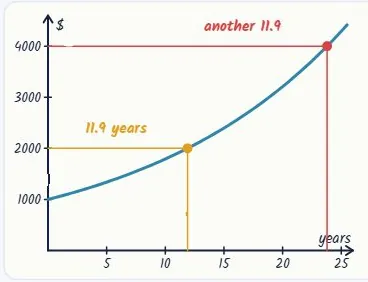
How long to double at 6%?
- Solve 1.06ⁿ = 2 with logs: 11.9 years.
- Doubling again takes the same time.
- That constant doubling time is the signature.
Try it: growth, decay and doubling
The working for doubling
- Logs bring n down.
- Round up, and say why.
- 1.06ⁿ = 2value doubles
- log 1.06ⁿ = log 2log both sides
- n log 1.06 = log 2power law
- n = log 2 ÷ log 1.06÷ log 1.06
- = 11.896
- 1.06¹¹ = 1.8983 < 2not yet doubled
- 1.06¹² = 2.0122 > 2doubled
- 12 years
Growth with a doubling time
- Divide by 200 first.
- Logs bring t/3 down.
- N = 200 × 2^(t/3)doubles every 3 h
- 200 × 2^(t/3) = 10 000N = 10 000
- 2^(t/3) = 50÷ 200
- (t/3) log 2 = log 50logs, power law
- t/3 = log 50 ÷ log 2÷ log 2
- = 5.6439
- t = 3 × 5.6439 ≈ 16.9 hours
Decay: when is it below 10 mg?
- Starts at 80 mg.
- Measured on the hour.
- 80 × 0.8ᵗ = 10loses 20% an hour
- 0.8ᵗ = 0.125÷ 80
- t log 0.8 = log 0.125logs, power law
- t = log 0.125 ÷ log 0.8
- = 9.32 hours
- 9 h: 80 × 0.8⁹ = 10.74 mgabove 10
- 10 h: 80 × 0.8¹⁰ = 8.59 mgbelow 10
- first below 10 mg: 10 hours
Try it: factors, years and rounding
Where the marks are
- Achieved: evaluate a given model.
- Merit: form the model and solve for time.
- Excellence: interpret, including the rounding.
What to take away
- A percentage becomes a factor; time comes from logs.
| Grow r% | multiply by 1 + r/100 |
| Lose r% | multiply by 1 − r/100 |
| Model | start × factorⁿ |
| How long | solve for the index with logs |
| Whole periods | round up, and say why |
Common mistakes
- The car loses 15% a year, so after 4 years it has lost 60% and keeps 40%.Each year loses 15% of what is left: 0.85⁴ = 0.5220, so it keeps 52.2% of its value.
- Grows 4.5% a year: A = 5000 × 0.045ⁿThe factor is 1 + 0.045 = 1.045, so A = 5000 × 1.045ⁿ. Multiplying by 0.045 would shrink the money.
- 80 × 0.8ᵗ = 10, so t = log 10 ÷ log 0.8Divide by the starting amount first: 0.8ᵗ = 10 ÷ 80 = 0.125, so t = log 0.125 ÷ log 0.8 = 9.32.
- n = log 2 ÷ log 1.06 = 11.896, so the money doubles after 11.9 years.Interest is added once a year, so round up and say why: 1.06¹¹ = 1.8983 < 2, so it takes 12 years.
Your turn: eight questions
- Questions 3 and 4 need logs.
- Think about rounding in context.
$3000 at 5% compound interest a year. Value after 8 years?
A $1200 phone loses 25% a year. Value after 3 years?
At 7% a year, whole years to triple?
A town of 5000 grows 3% a year. When does it pass 8000?
A $24 000 ute loses 18% of its value each year. Which model gives its value V after n years?
Mere says a car losing 12% a year keeps 64% of its value after 3 years. What percentage does it really keep?
A 60 mg dose of a drug halves every 4 hours. How much is left after 10 hours, to 2 decimal places?
Aroha invests $8000 at 4% and Tama $6000 at 7%, both compounded yearly. After how many whole years is Tama's balance first bigger?
Show answer
1. 3000 × 1.05⁸ = $4432.37. 2. 1200 × 0.75³ = $506.25. 3. 1.07ⁿ = 3, n = log 3 ÷ log 1.07 = 16.24, so 17 years. 4. 1.03ⁿ = 1.6, n = 15.90, so in the 16th year (after 16 years). 5. V = 24 000 × 0.82ⁿ. Losing 18% leaves 1 − 0.18 = 0.82 each year, so multiply by 0.82 once per year. 6. 68.1%. Each year keeps 0.88 of what is left, so 0.88³ = 0.681, not 100% − 3 × 12% = 64%. 7. 10.61 mg. The model is 60 × 0.5^(t/4), so 60 × 0.5^(10/4) = 60 × 0.5^2.5 = 10.61 mg. 8. After 11 years. 6000 × 1.07ⁿ > 8000 × 1.04ⁿ gives (1.07 ÷ 1.04)ⁿ > 8000 ÷ 6000, so n > 10.12, and after 10 years Tama is still behind.
The answers: questions 1 and 2
- 1. A = 3000 × 1.05ⁿgrows 5%: × 1.05
- A = 3000 × 1.05⁸n = 8
- = $4432.37
- 2. V = 1200 × 0.75ⁿloses 25%: × 0.75
- V = 1200 × 0.75³n = 3
- = 1200 × 0.421875
- = $506.25
The answers: question 3
- 3. P × 1.07ⁿ = 3Ptripled
- 1.07ⁿ = 3÷ P
- n log 1.07 = log 3logs, power law
- n = log 3 ÷ log 1.07
- = 16.24
- 1.07¹⁶ = 2.9522 < 3not yet tripled
- 17 years
The answers: question 4
- 4. 5000 × 1.03ⁿ = 8000grows 3%: × 1.03
- 1.03ⁿ = 8000 ÷ 5000 = 1.6÷ 5000
- n log 1.03 = log 1.6logs, power law
- n = log 1.6 ÷ log 1.03
- = 15.90
- 15 years: 5000 × 1.03¹⁵ ≈ 7790below 8000
- 16 years: 5000 × 1.03¹⁶ ≈ 8024above 8000
- passes 8000 after 16 years
Sample question: Achieved
Mere puts $7500 into a term deposit paying 3.9% a year, compounded yearly. How much is in the account after 5 years?
Hint
Turn the rate into a growth factor, then multiply the start amount by that factor once for each year.
Answer
$9081.11
Step by step
- Growth by the same percentage every year means multiplying by the same factor every year.
- Growing by 3.9% means keeping 100% and adding 3.9%, so the factor is 1 + 0.039 = 1.039.
- The model is A = 7500 × 1.039ⁿ, where n is the number of years.
- Put in n = 5: A = 7500 × 1.039⁵.
- Work out 1.039⁵ ≈ 1.21081 on your calculator, then multiply by 7500: A ≈ 9081.11.
- Classic mistake: 3.9% × 5 = 19.5% and 7500 × 1.195 = $8962.50. That is simple interest, and it misses the interest earned on the interest.
- Money goes to the nearest cent, so A = $9081.11.
- Check: the answer is a bit more than $8962.50, as compound interest should be.
Full working
- factor = 1 + 0.039 = 1.039grows 3.9% each year
- A = 7500 × 1.039ⁿstart × factorⁿ
- A = 7500 × 1.039⁵n = 5
- A = $9081.11
Sample questions: Merit
A ute bought for $32 000 loses 18% of its value each year. After how many whole years is it first worth less than $12 000?
Hint
Write the model with the factor 0.82, set it equal to 12 000, and solve for the index with logs. Then decide which whole year is first below.
Answer
After 5 years (it is worth about $11 863.67 then)
Step by step
- Losing 18% each year means keeping 82%, so the factor is 1 − 0.18 = 0.82.
- Model: V = 32 000 × 0.82ⁿ, where n is the number of years.
- Find when V = 12 000: 32 000 × 0.82ⁿ = 12 000.
- Divide both sides by 32 000: 0.82ⁿ = 0.375.
- The unknown is an index, so take logs of both sides: n log 0.82 = log 0.375.
- Divide: n = log 0.375 ÷ log 0.82 ≈ 4.94.
- The value only drops below $12 000 after 4.94 years, so after 4 whole years it is still above.
- Classic mistake: rounding 4.94 down to 4. Rounding down gives a time before the event happens, so round up to 5.
- Check both sides: after 4 years V = 32 000 × 0.82⁴ ≈ $14 467.90, above. After 5 years V ≈ $11 863.67, below.
- So it is first worth less than $12 000 after 5 years.
Full working
- V = 32 000 × 0.82ⁿkeeps 82% each year
- 0.82ⁿ = 12 000 ÷ 32 000 = 0.375
- n = log 0.375 ÷ log 0.82 ≈ 4.94take logs to bring down the index
- n = 4: $14 467.90; n = 5: $11 863.67check the whole years either side
- After 5 years
A culture starts with 500 bacteria and the number doubles every 20 minutes. Write a model for the number N after t minutes, and find how long it takes to reach 1 000 000 bacteria, to the nearest minute.
Hint
Doubling every 20 minutes means the number of doublings after t minutes is t20. Then solve for the index with logs.
Answer
N = 500 × 2^(t20); about 219 minutes (3 hours 39 minutes)
Step by step
- Each 20 minutes the number is multiplied by 2. After t minutes there have been t20 doublings.
- So the model is N = 500 × 2^(t20).
- Check the model: at t = 20, N = 500 × 2 = 1000. At t = 40, N = 500 × 4 = 2000. It doubles every 20 minutes, as it should.
- Set N = 1 000 000: 500 × 2^(t20) = 1 000 000.
- Divide by 500: 2^(t20) = 2000.
- Take logs of both sides: (t20) log 2 = log 2000.
- So t20 = log 2000 ÷ log 2 ≈ 10.966, which means a bit under 11 doublings.
- Multiply by 20: t ≈ 219.3 minutes.
- Classic mistake: forgetting the last step and giving 10.97 as the answer. That is the number of doublings, not the number of minutes.
- To the nearest minute that is 219 minutes, or 3 hours 39 minutes.
- Check: 11 doublings is 220 minutes and gives 500 × 2048 = 1 024 000, just over a million. So 219.3 minutes is about right.
Full working
- N = 500 × 2^(t20)t20 doublings in t minutes
- 2^(t20) = 2000divide by 500
- t20 = log 2000 ÷ log 2 ≈ 10.966take logs
- t ≈ 219.3 minutes
- About 219 minutes (3 h 39 min)
Sample questions: Excellence
Aroha invests $8000 at 5.2% a year and Ben invests $9000 at 3.8% a year, both compounded yearly. After how many whole years is Aroha's investment first worth more than Ben's? Show the values in that year and the year before.
Hint
Set 8000 × 1.052ⁿ > 9000 × 1.038ⁿ. Gather the powers of n on one side as one fraction raised to n, then take logs.
Answer
After 9 years (Aroha $12 625.01, Ben $12 589.80; after 8 years Aroha $12 000.96, Ben $12 128.90)
Step by step
- Write a model for each. Aroha: A = 8000 × 1.052ⁿ. Ben: B = 9000 × 1.038ⁿ.
- Ben starts higher, but Aroha's factor is bigger, so at some point she catches up. We want the first whole year where A > B.
- Set 8000 × 1.052ⁿ > 9000 × 1.038ⁿ.
- Get the powers together. Divide both sides by 8000 and by 1.038ⁿ: 1.052ⁿ ÷ 1.038ⁿ > 9000 ÷ 8000.
- By the index laws, 1.052ⁿ ÷ 1.038ⁿ = (1.0521.038)ⁿ. And 9000 ÷ 8000 = 1.125.
- So (1.0521.038)ⁿ > 1.125. Take logs: n log(1.0521.038) > log 1.125.
- log(1.0521.038) is positive, so dividing by it keeps the sign: n > log 1.125 ÷ log(1.0521.038) ≈ 8.79.
- Classic mistake: working out 5.2% − 3.8% = 1.4% and using 1.014. The ratio 1.0521.038 ≈ 1.0135 is close but not the same, and it can change the year.
- The first whole year after 8.79 is n = 9.
- Justify with values. After 8 years: Aroha 8000 × 1.052⁸ ≈ $12 000.96, Ben 9000 × 1.038⁸ ≈ $12 128.90. Ben is still ahead.
- After 9 years: Aroha ≈ $12 625.01, Ben ≈ $12 589.80. Aroha is now ahead.
- So Aroha's investment is first worth more after 9 years. This assumes both rates stay fixed and nothing is added or taken out.
Full working
- 8000 × 1.052ⁿ > 9000 × 1.038ⁿ
- (1.0521.038)ⁿ > 1.125divide by 8000 and by 1.038ⁿ
- n > log 1.125 ÷ log(1.0521.038) ≈ 8.79take logs; the divisor is positive
- n = 8: $12 000.96 < $12 128.90Ben still ahead
- n = 9: $12 625.01 > $12 589.80Aroha ahead
- After 9 years
A sample of a radioactive isotope decays from 80 g to 50 g in 6 days. Assuming exponential decay, find the daily decay rate as a percentage, the half-life, and how long it takes for less than 5 g to remain. Explain why the last answer is a whole number of half-lives.
Hint
Write 80 × r⁶ = 50 and solve for the daily factor r. For the half-life solve rᵗ = 0.5. Then compare 5 g with 80 g.
Answer
Decays about 7.5% a day; half-life ≈ 8.85 days; below 5 g after about 35.4 days, which is exactly 4 half-lives
Step by step
- Exponential decay means the mass is multiplied by the same factor r each day: M = 80 × rᵗ, with t in days.
- After 6 days M = 50, so 80 × r⁶ = 50 and r⁶ = 50 ÷ 80 = 0.625.
- Undo the power 6 by taking the sixth root: r = 0.625^(16) ≈ 0.9247.
- The sample keeps about 92.47% each day, so it loses 100% − 92.47% ≈ 7.5% each day.
- Half-life: find t when the mass is half of 80 g, so rᵗ = 0.5.
- Take logs: t = log 0.5 ÷ log r. A neater exact form uses r⁶ = 0.625: t = 6 × log 0.5 ÷ log 0.625 ≈ 8.85 days.
- Classic mistake: rounding r to 0.92 too early. That gives a half-life of about 8.3 days, which is noticeably wrong. Keep full accuracy until the end.
- Below 5 g: 5 ÷ 80 = 116, and 116 = (12)⁴. So 5 g is what is left after exactly 4 halvings.
- That means the time is 4 half-lives: 4 × 8.85 ≈ 35.4 days.
- Since the mass keeps falling, it is below 5 g from about 35.4 days on.
- Check with the model: 80 × 0.9247³⁵ ≈ 5.16 g (not yet below) and 80 × 0.9247³⁶ ≈ 4.77 g (below). This matches 35.4 days.
- Limitation: the model assumes the decay rate stays constant. For radioactive decay that is a good assumption, but the 80 g and 50 g readings have measurement error, so the half-life is an estimate.
Full working
- 80 × r⁶ = 50, so r⁶ = 0.625
- r = 0.625^(16) ≈ 0.9247about 7.5% lost each day
- rᵗ = 0.5, so t = 6 × log 0.5 ÷ log 0.625 ≈ 8.85 dayshalf-life
- 5 ÷ 80 = 116 = (12)⁴4 half-lives
- 4 × 8.85 ≈ 35.4 days
- 7.5% a day; half-life 8.85 days; below 5 g after about 35.4 days
Challenge
Bank A pays 6% a year, compounded monthly (0.5% each month). Bank B pays 6.15% a year, compounded yearly. Which bank grows money faster? At the faster bank, after how many whole months has a deposit first doubled?
Hint
Compare what $1 becomes after one whole year at each bank. For doubling, the unknown is the number of months, an index, so use logs.
Answer
Bank A (it grows $1 to about $1.0617 in a year, an effective 6.17%, against 6.15% at Bank B); a deposit first doubles after 139 months (11 years 7 months)
Step by step
- Bank A multiplies by 1.005 each month, so in a year by 1.005¹² ≈ 1.06168: an effective rate of about 6.17%.
- Bank B multiplies by 1.0615 a year: 6.15%. So Bank A is faster, because the interest starts earning interest every month.
- Doubling at Bank A: 1.005ⁿ = 2, where n is in months.
- Take logs: n = log 2 ÷ log 1.005 ≈ 138.98, so it has not quite doubled after 138 months.
- Check: 1.005¹³⁸ ≈ 1.9903 (not yet) and 1.005¹³⁹ ≈ 2.0002 (doubled). So 139 months, which is 11 years 7 months.
Full working
- 1.005¹² ≈ 1.06168Bank A, one year
- 1.06168 > 1.0615so Bank A is faster
- 1.005ⁿ = 2, n = log 2 ÷ log 1.005 ≈ 138.98logs bring the index down
- 1.005¹³⁸ ≈ 1.9903, 1.005¹³⁹ ≈ 2.0002check the whole months either side
- Bank A; doubled after 139 months (11 years 7 months)
A boat loses the same percentage of its value every year. It is worth $24 300 after 2 years and $17 714.70 after 5 years. Find the yearly percentage loss and the price when new. After how many whole years is it first worth less than half its price when new?
Hint
Divide the later value by the earlier one: three years of the same factor have passed. Then work backwards two years to the start.
Answer
It loses 10% a year; it cost $30 000 new; it is first worth less than $15 000 after 7 years
Step by step
- From year 2 to year 5 is three years, so 17 714.70 ÷ 24 300 = f³, where f is the yearly factor.
- 17 714.70 ÷ 24 300 = 0.729, and the cube root of 0.729 is 0.9. So it keeps 90% each year and loses 10%.
- Working back two years from $24 300: V₀ × 0.9² = 24 300, so V₀ = 24 300 ÷ 0.81 = $30 000.
- Half the new price is $15 000. Solve 0.9ⁿ = 0.5: n = log 0.5 ÷ log 0.9 ≈ 6.58.
- Round up: after 6 years it is worth $15 943.23 (still above), after 7 years $14 348.91 (below).
Full working
- f³ = 17 714.70 ÷ 24 300 = 0.729three years between the readings
- f = ∛0.729 = 0.9, loses 10% a year
- V₀ = 24 300 ÷ 0.9² = 30 000work back two years
- 0.9ⁿ = 0.5, n = log 0.5 ÷ log 0.9 ≈ 6.58half of $30 000
- n = 6: $15 943.23; n = 7: $14 348.91check either side
- 10% a year, $30 000 new, below half after 7 years
A patient's body removes 25% of a medicine each hour, so the amount left is multiplied by 0.75 every hour. They take a 200 mg dose at time 0 and another 200 mg dose 4 hours later. Each dose decays on its own. How long after the first dose does the total amount in the body first fall below 50 mg? Give your answer to 2 decimal places.
Hint
After the second dose, the total is 200 × 0.75ᵗ + 200 × 0.75ᵗ⁻⁴. Take out the common factor 0.75ᵗ, then it becomes one exponential equation.
Answer
About 9.77 hours after the first dose
Step by step
- After the first dose there is 200 × 0.75⁴ ≈ 63.28 mg at 4 hours, so the total has not fallen below 50 mg before the second dose.
- From t = 4 on, the first dose gives 200 × 0.75ᵗ and the second, which started 4 hours later, gives 200 × 0.75ᵗ⁻⁴.
- 0.75ᵗ⁻⁴ = 0.75ᵗ × 0.75⁻⁴, and 0.75⁻⁴ = 25681 ≈ 3.1605. So the total is 200 × 0.75ᵗ × (1 + 25681) ≈ 832.10 × 0.75ᵗ.
- Set 832.10 × 0.75ᵗ = 50, so 0.75ᵗ ≈ 0.060089.
- Take logs: t = log 0.060089 ÷ log 0.75 ≈ 9.77 hours.
- Check: at 9 hours the total is about 62.5 mg, and at 10 hours about 46.9 mg, so 9.77 hours sits between.
Full working
- 200 × 0.75⁴ ≈ 63.28 mg at t = 4still above 50 before dose 2
- total = 200 × 0.75ᵗ + 200 × 0.75ᵗ⁻⁴for t ≥ 4
- = 200 × 0.75ᵗ × (1 + 25681) ≈ 832.10 × 0.75ᵗ0.75⁻⁴ = 25681
- 0.75ᵗ = 50 ÷ 832.10 ≈ 0.060089
- t = log 0.060089 ÷ log 0.75 ≈ 9.77logs bring t down
- About 9.77 hours after the first dose
Where science uses this
Practise this
Report a mistake
More in AS 91261
 Index laws, fractional indices and surds7 min
 Expanding, factorising and simplifying algebraic fractions9 min
 Quadratic equations: solving, and forming from the roots8 min
 The discriminant: how many roots, and what kind9 min
 Logarithms: what they mean and the log laws7 minExponential growth and decay: interest, depreciation, half-life9 min
 Simultaneous equations: two lines, or a line and a curve8 min
 Algebraic modelling: completing a model from the context9 min
 Indices and surds: 7 exam questions solved step by step11 min
 Algebraic fractions: 7 exam questions solved step by step11 min
 Quadratic equations: 7 exam questions solved step by step11 min
 The discriminant: 7 exam questions solved step by step11 min
 Logarithms: 7 exam questions solved step by step10 min
 Exponential models: 7 exam questions solved step by step10 min
 Simultaneous equations: 7 exam questions solved step by step11 min
 Algebraic modelling: 6 exam questions solved step by step11 min