
Quadratic equations: solving, and forming from the roots
What this lesson covers
- Every quadratic can be solved by factorising, the formula, or completing the square, and each suits different equations.
- The roots of a quadratic fix its factors, so the equation can be rebuilt from its solutions.
A quadratic equation
- Ax² + bx + c = 0.
- Usually two solutions, called roots.
- Three ways: factorise, formula, or graph.
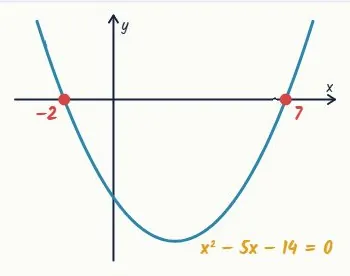
Roots are where the graph crosses
- y = x² − 5x − 14.
- It crosses the x-axis at −2 and 7.
- Those are the solutions of x² − 5x − 14 = 0.
Solving by factorising
- Product −14, sum −5.
- A factor must be zero.
- x² − 5x − 14 = 0
- −7 × 2 = −14, −7 + 2 = −5
- (x − 7)(x + 2) = 0factorise
- x − 7 = 0 or x + 2 = 0a factor is zero
- x = 7 or x = −2
Rearrange to zero first
- Make one side zero.
- Then factorise.
- x(x + 3) = 10
- x² + 3x = 10expand
- x² + 3x − 10 = 0subtract 10
- (x + 5)(x − 2) = 05 × (−2) = −10
- x = −5 or x = 2
- x = 2: 2 × 5 = 10
When it will not factorise
- Write a, b, c with signs.
- Brackets round negatives.
- x = (−b ± √(b² − 4ac))/2a
- 2x² − 3x − 4 = 0
- a = 2, b = −3, c = −4
- b² − 4ac = (−3)² − 4(2)(−4)
- = 9 + 32 = 41
- x = (3 ± √41)/4−b = 3, 2a = 4
- x = (3 + √41)/4 = 2.351
- x = (3 − √41)/4 = −0.851
Try it: roots on the graph
Working backwards: roots to equation
- Each root gives a factor.
- Clear the fraction first.
- x = 3, so x − 3 = 0
- x = −1/2
- 2x = −1, so 2x + 1 = 0double both sides
- (x − 3)(2x + 1) = 0
- 2x² + x − 6x − 3 = 0expand
- 2x² − 5x − 3 = 0collect
Graphing calculator
What a fractional root tells you
- A root x = p/q comes from a factor (qx − p).
- So the leading coefficient is a multiple of q.
- Fractional roots mean the equation factorises.
Try it: roots and equations, both ways
In context: reject what cannot be
- Write the equation first.
- Reject what cannot be.
- x(x + 3) = 40width × length
- x² + 3x − 40 = 0expand, subtract 40
- (x + 8)(x − 5) = 08 × (−5) = −40
- x = −8 or x = 5
- x = −8a width is positive
- x = 5, length 5 + 3 = 8
- 5 m by 8 m
- 5 × 8 = 40 m²
State the equation you formed
- Write the equation before solving it.
- The specification asks for this.
- An answer alone is not enough.
Where the marks are
- Achieved: solve, and form from roots.
- Merit: in context, choosing the method.
- Excellence: modelling a real situation.
What to take away
- Equal to zero first, then factorise or use the formula.
| First | rearrange to = 0 |
| Factorise | when the numbers are friendly |
| Formula | x = (−b ± √(b² − 4ac)) / 2a |
| From roots | each root gives a factor |
| Fractional root | x = p/q gives (qx − p) |
| Context | reject impossible answers |
Common mistakes
- x(x + 3) = 10, so x = 10 or x + 3 = 10A product only splits when it equals zero: x² + 3x − 10 = 0 gives (x + 5)(x − 2) = 0, so x = −5 or x = 2.
- 2x² − 3x − 4 = 0: b² − 4ac = −3² − 4(2)(−4) = −9 + 32 = 23Bracket negative values: (−3)² − 4(2)(−4) = 9 + 32 = 41.
- The root x = −1/2 gives the factor (2x − 1).x = −1/2 means 2x = −1, so 2x + 1 = 0 and the factor is (2x + 1).
- x² + 3x − 40 = 0, so the width is x = −8 or x = 5.Reject x = −8 because a width is positive, then answer in context: the garden is 5 m by 8 m.
Your turn: eight questions
- Question 3: whole-number coefficients.
- Question 4 needs the formula.
Solve x² + 2x − 15 = 0.
Solve 3x² + x − 2 = 0.
Form a quadratic with roots 2 and −3/4.
Solve x² − 4x − 1 = 0, to 3 decimal places.
Aroha solves x² = 6x by dividing both sides by x, and gets x = 6. What has she missed?
Solve x(x − 2) = 15.
A rectangular garden bed in Hamilton is 2 m longer than it is wide, with area 48 m². Find its width and length.
A netball's height is h = 20t − 5t² metres after t seconds. When is it 15 m high?
Show answer
1. (x + 5)(x − 3) = 0: x = 3 or −5. 2. (3x − 2)(x + 1) = 0: x = 2/3 or −1. 3. (x − 2)(4x + 3) = 4x² − 5x − 6 = 0. 4. x = (4 ± √20)/2 = 2 ± √5: 4.236 or −0.236. 5. x = 0 is also a root. Rearrange to x² − 6x = 0 first, then x(x − 6) = 0 gives x = 0 or x = 6; dividing by x loses x = 0. 6. x = 5 or −3. Expand and subtract 15: x² − 2x − 15 = 0, so (x − 5)(x + 3) = 0. 7. 6 m by 8 m. x(x + 2) = 48, so x² + 2x − 48 = 0 and (x + 8)(x − 6) = 0; reject x = −8, so the width is 6 m and the length 6 + 2 = 8 m. 8. t = 1 or 3 seconds. 20t − 5t² = 15 gives 5t² − 20t + 15 = 0, so t² − 4t + 3 = 0 and (t − 1)(t − 3) = 0: on the way up, then down.
The answers: questions 1 and 2
- 1. x² + 2x − 15 = 0
- (x + 5)(x − 3) = 05 × (−3) = −15, 5 − 3 = 2
- x = −5 or x = 3
- 2. 3x² + x − 2 = 0
- a × c = −6: use 3 and −2
- 3x² + 3x − 2x − 2 = 0split x
- 3x(x + 1) − 2(x + 1) = 0group in pairs
- (3x − 2)(x + 1) = 0common bracket
- x = 2/3 or x = −13x = 2
The answers: questions 3 and 4
- 3. x = 2 gives x − 2
- x = −3/4 gives 4x + 34x = −3
- (x − 2)(4x + 3) = 0
- 4x² + 3x − 8x − 6 = 0expand
- 4x² − 5x − 6 = 0collect
- 4. b² − 4ac = (−4)² − 4(1)(−1)
- = 16 + 4 = 20
- x = (4 ± √20)/2 = 2 ± √5√20 = 2√5
- x = 4.236 or x = −0.2363 decimal places
Sample question: Achieved
Solve x² = 3x + 10.
Hint
Rearrange so one side is zero before you factorise.
Answer
x = 5 or x = −2
Step by step
- To solve by factorising, one side must be zero, because the method relies on a product being zero.
- Take 3x and 10 from both sides: x² − 3x − 10 = 0.
- Find two numbers that multiply to −10 and add to −3. They are −5 and 2.
- So x² − 3x − 10 = (x − 5)(x + 2) = 0.
- If two brackets multiply to zero, one of them must be zero: x − 5 = 0 or x + 2 = 0.
- So x = 5 or x = −2.
- Classic mistake: dividing both sides by x first. That loses solutions and leaves x = 3 + 10x, which is harder, not easier.
- Check x = 5: 25 and 3 × 5 + 10 = 25. Check x = −2: 4 and −6 + 10 = 4. Both work.
Full working
- x² − 3x − 10 = 0rearrange to zero
- (x − 5)(x + 2) = 0−5 × 2 = −10, −5 + 2 = −3
- x = 5 or x = −2
Sample questions: Merit
Form a quadratic equation with integer coefficients whose roots are x = 23 and x = −52.
Hint
Turn each root into a factor with no fractions: x = 23 comes from 3x − 2 = 0.
Answer
6x² + 11x − 10 = 0
Step by step
- Each root comes from a bracket equal to zero. Work backwards from each root to its bracket.
- x = 23: multiply both sides by 3 to get 3x = 2, so 3x − 2 = 0. The factor is (3x − 2).
- x = −52: multiply by 2 to get 2x = −5, so 2x + 5 = 0. The factor is (2x + 5).
- Classic mistake: using (x − 23)(x + 52). That has the right roots but fraction coefficients, and the question asks for integers.
- Multiply the factors: (3x − 2)(2x + 5) = 6x² + 15x − 4x − 10.
- Collect like terms: 6x² + 11x − 10.
- So the equation is 6x² + 11x − 10 = 0. It is an equation, so it needs the = 0.
- Check x = 23: 6 × 49 + 223 − 10 = 83 + 223 − 303 = 0. Correct.
Full working
- x = 23 gives 3x − 2 = 0clear the fraction
- x = −52 gives 2x + 5 = 0
- (3x − 2)(2x + 5) = 0
- 6x² + 15x − 4x − 10 = 0expand
- 6x² + 11x − 10 = 0
Solve 2x(x − 3) = 1 − x, giving exact answers in simplest form and then values to 3 decimal places.
Hint
Expand and rearrange to the form ax² + bx + c = 0. It will not factorise, so use the quadratic formula.
Answer
x = 5 ± √334, so x ≈ 2.686 or x ≈ −0.186
Step by step
- Expand the left side: 2x(x − 3) = 2x² − 6x.
- Rearrange so one side is zero: 2x² − 6x − 1 + x = 0, which is 2x² − 5x − 1 = 0.
- Try to factorise: you need two numbers that multiply to 2 × (−1) = −2 and add to −5. There are none, so use the formula.
- Recall the formula: x = −b ± √(b² − 4ac)2a, with a = 2, b = −5 and c = −1.
- −b = 5. Under the root: b² − 4ac = 25 − 4 × 2 × (−1) = 25 + 8 = 33.
- Classic mistake: writing 25 − 8. When c is negative, −4ac becomes positive.
- So x = 5 ± √334. 33 has no square factor other than 1, so √33 cannot be simplified. This is the exact answer.
- To 3 decimal places: √33 ≈ 5.7446, so x ≈ 10.7446 ÷ 4 ≈ 2.686 or x ≈ −0.7446 ÷ 4 ≈ −0.186.
- Check x ≈ 2.686: the left side is 2 × 2.686 × (−0.314) ≈ −1.686, and the right side is 1 − 2.686 = −1.686. They match.
Full working
- 2x² − 6x = 1 − xexpand
- 2x² − 5x − 1 = 0rearrange to zero
- x = 5 ± √(25 + 8)4a = 2, b = −5, c = −1
- x = 5 ± √334
- x ≈ 2.686 or x ≈ −0.186
Sample questions: Excellence
x = 2 + √5 is a root of x² + bx + c = 0, where b and c are integers. Find b and c, and the other root. Justify your method.
Hint
Substitute x = 2 + √5 and expand. The whole-number parts and the √5 parts must each add to zero, because b and c are integers.
Answer
b = −4, c = −1; the other root is 2 − √5
Step by step
- Substitute the root into the equation: (2 + √5)² + b(2 + √5) + c = 0.
- Expand the square: (2 + √5)² = 4 + 4√5 + 5 = 9 + 4√5.
- So 9 + 4√5 + 2b + b√5 + c = 0. Group it: (9 + 2b + c) + (4 + b)√5 = 0.
- Why must each part be zero? b and c are integers, so 9 + 2b + c and 4 + b are integers. If 4 + b were not zero, √5 would equal a fraction of integers, but √5 is irrational.
- So 4 + b = 0, which gives b = −4.
- And 9 + 2b + c = 0, so 9 − 8 + c = 0 and c = −1.
- The equation is x² − 4x − 1 = 0.
- Find the other root with the formula: x = 4 ± √(16 + 4)2 = 4 ± √202 = 4 ± 2√52 = 2 ± √5.
- So the other root is 2 − √5.
- Classic mistake: assuming the other root is −2 − √5 or −(2 + √5). With integer coefficients, irrational roots come as a pair 2 ± √5, the same number with the surd's sign flipped.
- Another route: x − 2 = ±√5 means (x − 2)² = 5, which expands to x² − 4x − 1 = 0. The same answer.
- Check: (2 + √5)(2 − √5) = 4 − 5 = −1 = c, and (2 + √5) + (2 − √5) = 4 = −b. Both fit.
Full working
- (2 + √5)² + b(2 + √5) + c = 0substitute the root
- (9 + 2b + c) + (4 + b)√5 = 0(2 + √5)² = 9 + 4√5
- 4 + b = 0 and 9 + 2b + c = 0b, c integers and √5 is irrational
- b = −4, c = −1: x² − 4x − 1 = 0
- x = 4 ± √202 = 2 ± √5quadratic formula
- b = −4, c = −1, other root 2 − √5
A ferry travels 36 km down a river with the current and then 36 km back against it. The current flows at 3 km per hour, and the round trip takes 5 hours of travelling. Form an equation for the ferry's speed v in still water, and solve it to find v.
Hint
With the current the speed is v + 3, against it v − 3. Time = distance ÷ speed, and the two times add to 5.
Answer
v = 15 km per hour
Step by step
- Speed with the current is v + 3. Speed against it is v − 3, in km per hour.
- Time = distance ÷ speed. Downstream takes 36v + 3 hours and upstream takes 36v − 3 hours.
- The two times add to 5: 36v + 3 + 36v − 3 = 5.
- Clear the fractions by multiplying every term by (v + 3)(v − 3): 36(v − 3) + 36(v + 3) = 5(v + 3)(v − 3).
- Simplify the left side: 36v − 108 + 36v + 108 = 72v. The right side is 5(v² − 9) = 5v² − 45.
- So 72v = 5v² − 45, which rearranges to 5v² − 72v − 45 = 0.
- Use the formula with a = 5, b = −72 and c = −45: b² − 4ac = 5184 + 900 = 6084 = 78².
- v = 72 ± 7810, so v = 15 or v = −0.6.
- A speed in still water cannot be negative, and the ferry must go faster than the 3 km per hour current to get back at all. So reject −0.6.
- Classic mistake: adding the two speeds or averaging them. Times add, not speeds, because each leg takes a different time.
- So the ferry's speed in still water is 15 km per hour.
- Check: downstream 36 ÷ 18 = 2 hours and upstream 36 ÷ 12 = 3 hours, a total of 5 hours. Correct.
Full working
- 36v + 3 + 36v − 3 = 5time = distance ÷ speed
- 36(v − 3) + 36(v + 3) = 5(v² − 9)multiply by (v + 3)(v − 3)
- 5v² − 72v − 45 = 0
- v = 72 ± √608410 = 72 ± 7810quadratic formula
- v = 15 or v = −0.6; reject −0.6speed must be more than 3
- v = 15 km per hour
Graphing Quadratics
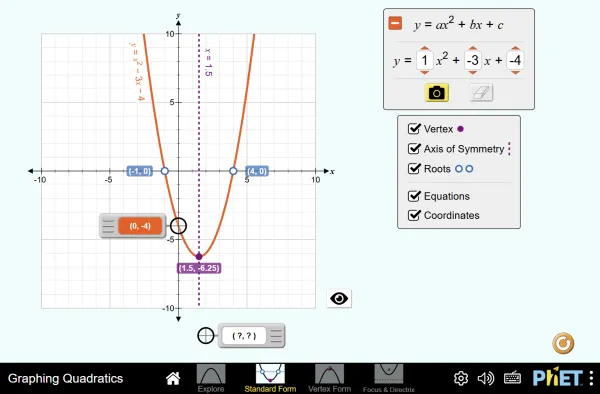
Full screen · PhET Interactive Simulations, University of Colorado Boulder, CC BY 4.0
Challenge
Find every real solution of x⁴ − 5x³ + 8x² − 5x + 1 = 0, giving exact answers.
Hint
x = 0 is not a solution, so divide every term by x². Then let u = x + 1x, and note that u² = x² + 2 + 1x².
Answer
x = 1, x = 3 + √52 or x = 3 − √52
Step by step
- x = 0 gives 1, not 0, so dividing by x² is safe.
- Dividing gives x² − 5x + 8 − 5x + 1x² = 0, which groups as (x² + 1x²) − 5(x + 1x) + 8 = 0.
- With u = x + 1x, x² + 1x² = u² − 2, so the equation becomes u² − 5u + 6 = 0, giving u = 2 or u = 3.
- x + 1x = 2 gives x² − 2x + 1 = 0, so x = 1 (a repeated root).
- x + 1x = 3 gives x² − 3x + 1 = 0, which needs the formula: x = 3 ± √52.
Full working
- x² − 5x + 8 − 5x + 1x² = 0÷ x² (x ≠ 0)
- (x² + 1x²) − 5(x + 1x) + 8 = 0group
- u² − 2 − 5u + 8 = 0u = x + 1x, x² + 1x² = u² − 2
- u² − 5u + 6 = 0, so (u − 2)(u − 3) = 0factorise
- x + 1x = 2: x² − 2x + 1 = 0, (x − 1)² = 0, x = 1u = 2, × x
- x + 1x = 3: x² − 3x + 1 = 0, x = 3 ± √52u = 3, × x, formula
- x = 1, 3 + √52 or 3 − √52
Solve x² − 6x + 4 = 0 exactly. Then form a quadratic equation with integer coefficients whose roots are the reciprocals of these two roots (1 divided by each root).
Hint
Rationalise 13 + √5 and 13 − √5. Each new root r gives a factor (x − r); multiply the two factors using the difference of two squares.
Answer
x = 3 + √5 or x = 3 − √5. The reciprocals are 3 − √54 and 3 + √54, and the equation is 4x² − 6x + 1 = 0.
Step by step
- The formula gives x = 6 ± √202 = 3 ± √5.
- 13 + √5 = 3 − √59 − 5 = 3 − √54, and in the same way 13 − √5 = 3 + √54.
- Multiply the factors (x − 3 − √54)(x − 3 + √54). The surds cancel: the x term is −(64)x and the constant is 9 − 516 = 14.
- So x² − (32)x + 14 = 0. Multiply by 4 to clear the fractions.
- The result, 4x² − 6x + 1 = 0, has the original coefficients in reverse order.
Full working
- x = 6 ± √(36 − 16)2 = 6 ± 2√52 = 3 ± √5formula, √20 = 2√5
- 13 + √5 = 3 − √54, 13 − √5 = 3 + √54rationalise, 9 − 5 = 4
- (x − 3 − √54)(x − 3 + √54) = 0each root gives a factor
- x² − (64)x + 9 − 516 = 0expand, difference of two squares
- x² − (32)x + 14 = 0simplify
- 4x² − 6x + 1 = 0× 4
- x = 3 ± √5; 4x² − 6x + 1 = 0
Show that x² − 2kx + k − 2 = 0 has two different real roots for every value of k. Then find the value of k for which the two roots are closest together, and the distance between them.
Hint
Find the discriminant in terms of k and complete the square. From the formula, the gap between the two roots is √Δ when a = 1.
Answer
Δ = (2k − 1)² + 7, which is always at least 7, so there are always two different real roots. They are closest when k = 12, and then they are √7 apart.
Step by step
- Here a = 1, b = −2k and c = k − 2.
- Δ = 4k² − 4(k − 2) = 4k² − 4k + 8.
- Complete the square: 4k² − 4k + 8 = (2k − 1)² + 7.
- A square is never negative, so Δ ≥ 7 > 0 for every k: always two different real roots.
- The roots are 2k ± √Δ2, so they are √Δ apart. This is smallest when 2k − 1 = 0, giving √7.
Full working
- a = 1, b = −2k, c = k − 2read off with signs
- Δ = (−2k)² − 4(1)(k − 2) = 4k² − 4k + 8discriminant
- = (2k − 1)² + 7(2k − 1)² = 4k² − 4k + 1
- (2k − 1)² ≥ 0, so Δ ≥ 7 > 0two different real roots for every k
- x = 2k ± √Δ2, gap = 2√Δ2 = √Δquadratic formula
- smallest Δ = 7 when k = 122k − 1 = 0
- k = 12, roots √7 apart
Practise this
Report a mistake
More in AS 91261
 Index laws, fractional indices and surds7 min
 Expanding, factorising and simplifying algebraic fractions9 minQuadratic equations: solving, and forming from the roots8 min
 The discriminant: how many roots, and what kind9 min
 Logarithms: what they mean and the log laws7 min
 Exponential growth and decay: interest, depreciation, half-life9 min
 Simultaneous equations: two lines, or a line and a curve8 min
 Algebraic modelling: completing a model from the context9 min
 Indices and surds: 7 exam questions solved step by step11 min
 Algebraic fractions: 7 exam questions solved step by step11 min
 Quadratic equations: 7 exam questions solved step by step11 min
 The discriminant: 7 exam questions solved step by step11 min
 Logarithms: 7 exam questions solved step by step10 min
 Exponential models: 7 exam questions solved step by step10 min
 Simultaneous equations: 7 exam questions solved step by step11 min
 Algebraic modelling: 6 exam questions solved step by step11 min