
Logarithms: what they mean and the log laws
What this lesson covers
- A logarithm is the index: log base a of x is the power a is raised to to give x.
- The log laws are the index laws written in log form.
A log answers one question
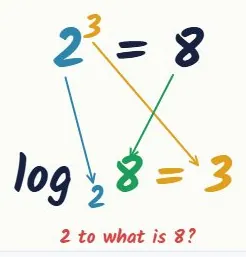
- Log₂ 8 asks: 2 to what power is 8?
- The answer is 3, because 2³ = 8.
- A logarithm is an index.
Two ways to write one fact
- Index form: 2³ = 8.
- Log form: log₂ 8 = 3.
- Same base, and the power becomes the answer.
Try it: a log is an index
Reading logs as questions
- Ask the question the log is asking.
- Log₅ 1 = 0, because 5⁰ = 1.
- Log₃(1/9) = −2, because 3⁻² = 1/9.
| Log | Asks | Answer |
|---|---|---|
| log₂ 8 | 2 to what is 8? | 3 |
| log₁₀ 1000 | 10 to what is 1000? | 3 |
| log₅ 1 | 5 to what is 1? | 0 |
| log₃(1/9) | 3 to what is 1/9? | −2 |
The log laws are the index laws
- Multiplying adds indices, so logs add.
- Dividing subtracts them.
- A power inside comes out the front.
| Log of | Equals | Because |
|---|---|---|
| log(ab) | log a + log b | multiply: add indices |
| log(a/b) | log a − log b | divide: subtract |
| log(aⁿ) | n log a | power: multiply |
Combining logs
- Powers first.
- Then add or subtract.
- 2 log 3 + log 5
- = log 3² + log 5power law
- = log 9 + log 5
- = log(9 × 5)add: multiply inside
- = log 45
Solving 3ˣ = 20
- The unknown is an index.
- Take logs of both sides.
- 3ˣ = 20
- log 3ˣ = log 20log both sides
- x log 3 = log 20power law
- x = log 20 ÷ log 3÷ log 3
- = 2.727
- 3^2.727 ≈ 20.00check
Try it: when does it pass the target?
A harder index: 5^(2x − 1) = 80
- Brackets round the index.
- Keep 4 decimal places.
- 5^(2x − 1) = 80
- (2x − 1) log 5 = log 80logs, power law
- 2x − 1 = log 80 ÷ log 5÷ log 5
- = 2.7227
- 2x = 3.7227add 1
- x = 3.7227 ÷ 2 = 1.861÷ 2
Try it: flip, trap, pinch
An equation with logs in it
- Combine into one log.
- Switch to index form.
- log₂ x + log₂(x + 2) = 3
- log₂(x(x + 2)) = 3add: multiply inside
- x(x + 2) = 2³index form
- x² + 2x = 8expand
- x² + 2x − 8 = 0subtract 8
- (x + 4)(x − 2) = 0factorise
- x = 2 or x = −4
Check in the original equation
- Substitute back.
- No logs of negatives.
- x = 2 or x = −4
- x = 2: log₂ 2 + log₂ 4
- = 1 + 2 = 3
- x = −4: log₂(−4)no log of a negative
- x = 2
Graphing calculator
Where the marks are
- Achieved: solve simple log and index equations.
- Merit: manipulate with the log laws.
- Excellence: logs inside a real model.
What to take away
- A log is an index. The log laws are the index laws.
| logₐ x = y | means aʸ = x |
| Multiply inside | add the logs |
| Divide inside | subtract the logs |
| Power inside | bring it to the front |
| aˣ = b | x = log b ÷ log a |
| Log equations | combine, then index form |
Common mistakes
- 2 log 3 + log 5 = log 6 + log 5 = log 30The power law makes 2 log 3 = log 3² = log 9, so the sum is log(9 × 5) = log 45.
- 3ˣ = 20, so x = 20 ÷ 3 = 6.667x is an index, so take logs and bring it down: x = log 20 ÷ log 3 = 2.727.
- 5^(2x − 1) = 80: 2x − 1 log 5 = log 80Keep the whole index in brackets: (2x − 1) log 5 = log 80, so 2x − 1 = 2.7227 and x = 1.861.
- log₂ x + log₂(x + 2) = 3 gives x = 2 or x = −4.Check in the original equation: log₂(−4) does not exist, so reject x = −4 and give x = 2 only.
Your turn: eight questions
- Question 1: ask the question the log asks.
- Question 4: switch to index form.
Evaluate log₄ 64.
Write 2 log 3 + log 5 as a single log.
Solve 2ˣ = 50, to 3 decimal places.
Solve log₃(x + 1) = 2.
Write 5³ = 125 in log form.
Which statement is true?
$5,000 is invested at 4% a year, so after n years it is worth 5000 × 1.04ⁿ dollars. After how many whole years is it first over $8,000?
Solve log₆ x + log₆(x − 5) = 2.
Show answer
1. 4³ = 64, so 3. 2. log 9 + log 5 = log 45. 3. x = log 50 ÷ log 2 = 5.644. 4. x + 1 = 3² = 9, so x = 8. 5. log₅ 125 = 3. The base stays the base, and the power 3 becomes the answer. 6. log 20 − log 4 = log 5, because subtracting logs means dividing inside: 20 ÷ 4 = 5. 7. 12 years. 1.04ⁿ = 8000 ÷ 5000 = 1.6, so n = log 1.6 ÷ log 1.04 = 11.98, which rounds up to 12 years (11 years gives only $7,697). 8. x = 9 only. x(x − 5) = 6² = 36, so x² − 5x − 36 = 0 and (x − 9)(x + 4) = 0; reject x = −4, since log₆(−4) does not exist.
The answers: questions 1 and 2
- 1. 4 to what power is 64?
- 4³ = 64, so log₄ 64 = 3
- 2. 2 log 3 = log 3² = log 9power law
- log 9 + log 5 = log(9 × 5)add: multiply inside
- = log 45
The answers: questions 3 and 4
- 3. 2ˣ = 50
- x log 2 = log 50logs, power law
- x = log 50 ÷ log 2÷ log 2
- = 5.644
- 4. log₃(x + 1) = 2
- x + 1 = 3²index form
- x + 1 = 9, so x = 8
- log₃ 9 = 2check
Sample question: Achieved
Solve 5ˣ = 40, giving x to 3 decimal places.
Hint
The unknown is an index, so take logs of both sides and bring the x down in front.
Answer
x ≈ 2.292
Step by step
- x is the power that 5 must be raised to to make 40. Logs find powers.
- Take log of both sides: log 5ˣ = log 40.
- The log law log aⁿ = n log a brings the index down: x log 5 = log 40.
- Divide both sides by log 5: x = log 40 ÷ log 5.
- On a calculator: x ≈ 1.60206 ÷ 0.69897 ≈ 2.292.
- Classic mistake: working out log(40 ÷ 5) = log 8. The rule is log 40 ÷ log 5, a division of two logs, not the log of a division.
- Sense check: 5² = 25 and 5³ = 125, and 40 lies between them, so x should be between 2 and 3. It is.
- Check: 5^2.292 ≈ 40.0 on a calculator.
Full working
- log 5ˣ = log 40take logs of both sides
- x log 5 = log 40log aⁿ = n log a
- x = log 40 ÷ log 5
- x ≈ 2.292
Sample questions: Merit
Solve 2^(3x − 1) = 7ˣ, giving x to 3 decimal places.
Hint
Take logs of both sides, bring both indices down, then collect the x terms on one side and factorise.
Answer
x ≈ 5.191
Step by step
- The two sides have different bases, 2 and 7, so you cannot just match the indices. Use logs.
- Take logs of both sides: log 2^(3x − 1) = log 7ˣ.
- Bring each index down with log aⁿ = n log a: (3x − 1) log 2 = x log 7.
- Classic mistake: writing 3x − 1 log 2 without the bracket. The whole index 3x − 1 multiplies log 2.
- Expand: 3x log 2 − log 2 = x log 7.
- Collect the x terms on one side: 3x log 2 − x log 7 = log 2.
- Take out x as a factor: x(3 log 2 − log 7) = log 2.
- Divide: x = log 2 ÷ (3 log 2 − log 7). Tidier: 3 log 2 = log 8, and log 8 − log 7 = log(87), so x = log 2 ÷ log(87).
- On a calculator: x ≈ 0.30103 ÷ 0.05799 ≈ 5.191.
- Check: 3x − 1 ≈ 14.573, and 2^14.573 ≈ 24 370, while 7^5.191 ≈ 24 370. The sides match.
Full working
- (3x − 1) log 2 = x log 7take logs; bring down the indices
- 3x log 2 − x log 7 = log 2expand and collect x terms
- x(log 8 − log 7) = log 23 log 2 = log 8
- x = log 2 ÷ log(87)
- x ≈ 5.191
Solve log₃ x + log₃(x − 8) = 2.
Hint
Combine the two logs into one with the product law, then rewrite the equation in index form. Check every answer in the original equation.
Answer
x = 9
Step by step
- Two logs with the same base are added, so use the law log a + log b = log(ab).
- log₃ x + log₃(x − 8) = log₃(x(x − 8)). So log₃(x² − 8x) = 2.
- Rewrite in index form: log₃ N = 2 means N = 3² = 9. So x² − 8x = 9.
- Rearrange to zero: x² − 8x − 9 = 0.
- Factorise: two numbers that multiply to −9 and add to −8 are −9 and 1. So (x − 9)(x + 1) = 0.
- That gives x = 9 or x = −1.
- Now check each one in the original equation, because you can only take the log of a positive number.
- x = −1: log₃(−1) does not exist, so reject x = −1.
- Classic mistake: giving both answers. The quadratic does not know about the logs, so it can produce a value the logs cannot use.
- x = 9: log₃ 9 + log₃ 1 = 2 + 0 = 2. It works, so x = 9.
Full working
- log₃(x(x − 8)) = 2log a + log b = log(ab)
- x² − 8x = 3² = 9index form
- (x − 9)(x + 1) = 0, so x = 9 or −1
- x = −1 is rejectedlog₃(−1) is undefined
- x = 9
Sample questions: Excellence
Solve 3^(2x) − 4 × 3ˣ − 45 = 0 exactly, and explain why there is only one solution.
Hint
3^(2x) = (3ˣ)². Let y = 3ˣ, and the equation becomes a quadratic in y.
Answer
x = 2 (the other factor would need 3ˣ = −5, which is impossible)
Step by step
- Spot the structure: by the index laws, 3^(2x) = (3ˣ)². So the equation only contains 3ˣ and its square.
- Let y = 3ˣ. Then the equation is y² − 4y − 45 = 0, a quadratic in y.
- Factorise: two numbers that multiply to −45 and add to −4 are −9 and 5. So (y − 9)(y + 5) = 0.
- So y = 9 or y = −5.
- Go back to x. y = 9 means 3ˣ = 9 = 3², so x = 2. That is exact, no calculator needed.
- y = −5 means 3ˣ = −5. A positive number raised to any power is always positive, so 3ˣ can never be −5.
- So y = −5 gives no solution at all, and x = 2 is the only one.
- Classic mistake: taking logs of both sides of 3ˣ = −5. log(−5) does not exist, which is the same reason the equation has no solution.
- Another trap: treating 3^(2x) as 6ˣ or as 9 × 3ˣ. 3^(2x) = (3²)ˣ = 9ˣ, which is (3ˣ)², not 9 × 3ˣ.
- Check x = 2: 3⁴ − 4 × 3² − 45 = 81 − 36 − 45 = 0. Correct.
Full working
- (3ˣ)² − 4 × 3ˣ − 45 = 03^(2x) = (3ˣ)²
- y² − 4y − 45 = 0let y = 3ˣ
- (y − 9)(y + 5) = 0, so y = 9 or y = −5
- 3ˣ = 9 = 3², so x = 2
- 3ˣ = −5 has no solution3ˣ > 0 for every x
- x = 2
Find all values of the constant k for which the equation log₂ x + log₂(k − x) = 2 has at least one solution. Find the solution when k takes its smallest possible value.
Hint
Combine the logs and turn it into a quadratic in x. Then you need real roots (the discriminant) and roots that keep both logs defined.
Answer
k ≥ 4; when k = 4 the only solution is x = 2
Step by step
- Combine with the product law: log₂(x(k − x)) = 2.
- Index form: x(k − x) = 2² = 4. Expand and rearrange: x² − kx + 4 = 0.
- For any solution, this quadratic needs real roots, so the discriminant must be zero or more: k² − 16 ≥ 0.
- k² ≥ 16 means k ≥ 4 or k ≤ −4.
- But the logs add another condition: x > 0 and k − x > 0. Adding these gives k > x > 0, so k must be positive. That rules out k ≤ −4.
- Now check that k ≥ 4 really works. The formula gives x = k ± √(k² − 16)2, and √(k² − 16) is less than k, so both roots are positive.
- For either root, k − x is the other root: k − k + √(k² − 16)2 = k − √(k² − 16)2. That is positive too, so both logs are defined.
- Classic mistake: stopping at k² ≥ 16 and giving k ≤ −4 as well. A log equation always needs a check that the logs exist.
- Smallest k: k = 4. Then x² − 4x + 4 = 0, so (x − 2)² = 0 and x = 2, a single repeated root.
- Check: log₂ 2 + log₂(4 − 2) = 1 + 1 = 2. Correct.
- For example k = 5 gives x² − 5x + 4 = 0, so x = 1 or 4, and log₂ 1 + log₂ 4 = 0 + 2 = 2. Larger k gives two solutions.
Full working
- log₂(x(k − x)) = 2, so x(k − x) = 4product law, then index form
- x² − kx + 4 = 0
- Δ = k² − 16 ≥ 0, so k ≥ 4 or k ≤ −4real roots
- x > 0 and k − x > 0, so k > 0logs must be defined
- x = k ± √(k² − 16)2 > 0 and k − x > 0 for k ≥ 4√(k² − 16) < k
- k = 4: (x − 2)² = 0, x = 2
- k ≥ 4; when k = 4, x = 2
Challenge
Solve log₂ x + log₄ x = 6 exactly.
Hint
Let log₄ x = y, so x = 4ʸ. Write 4ʸ as a power of 2 and compare with log₂ x.
Answer
x = 16
Step by step
- If log₄ x = y, then x = 4ʸ = 2^(2y).
- So log₂ x = 2y, which means log₄ x is half of log₂ x.
- The equation becomes log₂ x + ½ log₂ x = 6.
- So 1.5 log₂ x = 6 and log₂ x = 4.
- Switch to index form: x = 2⁴ = 16. Check: 4 + 2 = 6.
Full working
- log₄ x = y, so x = 4ʸ = 2^(2y)index form, 4 = 2²
- log₂ x = 2y = 2 log₄ xso log₄ x = ½ log₂ x
- log₂ x + ½ log₂ x = 6substitute
- (32) log₂ x = 6, so log₂ x = 4collect
- x = 2⁴index form
- x = 16
Find all pairs of positive numbers x and y with xy = 1000 and (log x)(log y) = 2, where log means log base 10.
Hint
Take logs of xy = 1000. Then let a = log x and b = log y, and solve for a and b first.
Answer
x = 10, y = 100 or x = 100, y = 10
Step by step
- Taking logs of xy = 1000 gives log x + log y = 3.
- Let a = log x and b = log y, so a + b = 3 and ab = 2.
- Substitute b = 3 − a to get a quadratic in a.
- a = 1 or a = 2, and then b = 2 or b = 1.
- Switch back: log x = 1 means x = 10, log x = 2 means x = 100.
Full working
- log(xy) = log 1000 = 3take logs
- a + b = 3, ab = 2a = log x, b = log y, log law
- a(3 − a) = 2b = 3 − a
- a² − 3a + 2 = 0, so (a − 1)(a − 2) = 0rearrange, factorise
- a = 1, b = 2 or a = 2, b = 1b = 3 − a
- x = 10¹, y = 10² or x = 10², y = 10¹index form
- (x, y) = (10, 100) or (100, 10)
Solve log₂ x + 2 logₓ 2 = 3, where x > 0 and x ≠ 1.
Hint
Let t = log₂ x, so x = 2ᵗ. Raise both sides to the power 1t to find logₓ 2 in terms of t.
Answer
x = 2 or x = 4
Step by step
- If log₂ x = t, then x = 2ᵗ, so x^(1t) = 2.
- That means logₓ 2 = 1t: the two logs are reciprocals.
- The equation becomes t + 2t = 3. Multiply by t to get a quadratic.
- t = 1 or t = 2, so x = 2¹ or x = 2².
- Check: x = 2 gives 1 + 2 × 1 = 3, and x = 4 gives 2 + 2 × ½ = 3.
Full working
- t = log₂ x, so x = 2ᵗindex form
- x^(1t) = 2, so logₓ 2 = 1tpower of a power
- t + 2t = 3substitute
- t² − 3t + 2 = 0multiply by t (t ≠ 0 since x ≠ 1)
- (t − 1)(t − 2) = 0, so t = 1 or t = 2factorise
- x = 2¹ or x = 2²x = 2ᵗ
- x = 2 or x = 4
Where science uses this
Practise this
Report a mistake
More in AS 91261
 Index laws, fractional indices and surds7 min
 Expanding, factorising and simplifying algebraic fractions9 min
 Quadratic equations: solving, and forming from the roots8 min
 The discriminant: how many roots, and what kind9 minLogarithms: what they mean and the log laws7 min
 Exponential growth and decay: interest, depreciation, half-life9 min
 Simultaneous equations: two lines, or a line and a curve8 min
 Algebraic modelling: completing a model from the context9 min
 Indices and surds: 7 exam questions solved step by step11 min
 Algebraic fractions: 7 exam questions solved step by step11 min
 Quadratic equations: 7 exam questions solved step by step11 min
 The discriminant: 7 exam questions solved step by step11 min
 Logarithms: 7 exam questions solved step by step10 min
 Exponential models: 7 exam questions solved step by step10 min
 Simultaneous equations: 7 exam questions solved step by step11 min
 Algebraic modelling: 6 exam questions solved step by step11 min