
Dating geological events

What this lesson covers
- Relative dating: superposition, original horizontality, cross-cutting relationships, inclusions and unconformities.
- Fossils and faunal succession, and why index fossils give relative ages.
- Radiometric dating: half-life, choosing the right isotope system, and calculating an age.
- Tephra layers as time markers across New Zealand, and how they are identified.
- Cross-correlating several kinds of evidence into a timeline, and what that adds for Excellence.
What AS 91412 asks of you
- AS 91412 is a 4-credit internal. You investigate one geological event or a sequence of events, often a New Zealand one such as the Taupō eruption, Alpine Fault ruptures or the formation of a local landscape, and how they have been dated.
- Achieved: explain the event, and explain a range of evidence used to date it.
- Merit: explain in detail how each key piece of evidence helps us know when the event happened.
- Excellence: justify why each key piece of evidence is trustworthy and useful, and explain how matching up different kinds of evidence (cross-correlation) strengthens the dates.
Relative dating: putting events in order
- Relative dating puts events in order without giving an age in years.
- Superposition: in undisturbed layers, each layer is younger than the one below it. Original horizontality: sediments settle in flat layers, so tilted or folded layers were disturbed later.
- Cross-cutting relationships: a dike, fault or erosion surface is younger than every layer it cuts. Inclusions: pieces of one rock inside another are older than the rock that holds them.
- An unconformity is a buried erosion surface: a gap in the record where rock was removed or none was laid down, so time is missing between the layers above and below it.
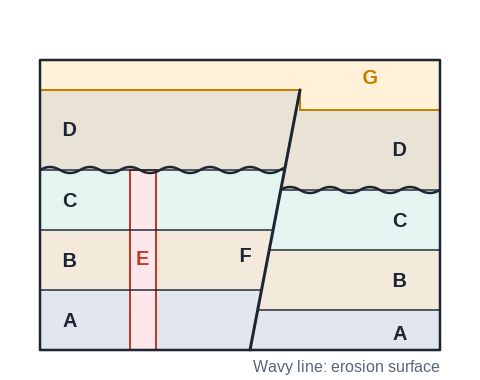
Example: reading the cross-section
- Use the cross-section above to list the events from oldest to youngest.
- A, then B, then Csuperposition: lowest is oldest
- dike E intrudesit cuts A, B and C, so it is younger than C
- uplift and erosion make the wavy surfaceit cuts the top of E, so erosion came after E
- D is laid down on the erosion surfacean unconformity: a time gap below D
- fault F movesit offsets A to D, so it is younger than D
- tephra G fallsG is not offset, so it came after the fault
- A, B, C, E, erosion, D, F, G
Try it: which principle?
Fossils and faunal succession
- Species appear, live for a time, and go extinct, always in the same order, so the fossils in a layer tell you its place in the sequence (faunal succession).
- The best index fossils lived for a short time but were widespread and common, so finding one dates a layer to a narrow window anywhere it occurs.
- New Zealand's geological timescale is divided into local stages defined by fossils, many of them foraminifera (tiny shelled plankton), which let geologists match marine layers from Northland to Southland.
- Fossils give relative ages; the ages in years come from radiometric dates on volcanic layers above and below the fossil-bearing beds.
Radiometric dating and half-life
- A radioactive parent isotope decays to a stable daughter at a fixed rate; which atom decays next is random, but half of any large sample decays every half-life, whatever the temperature or pressure.
- The clock starts when a mineral crystallises from magma and traps the parent but not the daughter, or when an organism dies and stops taking in carbon-14.
- Choose an isotope whose half-life suits the age: carbon-14 for the last 50 000 years or so, potassium-argon or argon-argon for volcanic rocks thousands to billions of years old, uranium-lead in zircon crystals for the oldest rocks.
- The age comes from N = N₀ × (½)^(t ÷ T½), so t = T½ × log₂(N₀ ÷ N), or with a daughter-to-parent ratio D ÷ P, t = T½ × log₂(1 + D ÷ P).
- Most sedimentary rocks cannot be dated directly, because their grains crystallised long before they were deposited; instead, date volcanic layers above and below them.
| Parent to daughter | Half-life | Dates |
|---|---|---|
| Carbon-14 to nitrogen-14 | 5730 years | Wood, charcoal, shell, bone |
| Potassium-40 to argon-40 | 1.25 billion years | Volcanic rock, lava, tephra |
| Uranium-238 to lead-206 | 4.47 billion years | Zircon in granite and tephra |
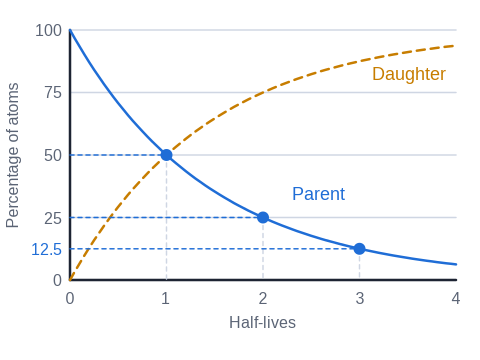
Try it: radioactive decay
Example: charcoal under the Taupō ignimbrite
- A tree trunk charred and buried by the Taupō eruption's ignimbrite has 80.5% of the carbon-14 of living wood when measured in 2026.
- Find how long ago the tree died, and the calendar year.
- N ÷ N₀ = 0.805, T½ = 5730 years
- t = 5730 × log₂(1 ÷ 0.805) = 5730 × ln(1.2422) ÷ ln 2
- t = 5730 × 0.2169 ÷ 0.6931 = 5730 × 0.3129 = 1793 years
- 2026 − 1793 = 233 CE
- less than one half-life, and more than 50% is left
- about 1790 years ago, around 230 CE
Example: uranium-lead in a zircon
- A zircon crystal from a granite has 0.0150 atoms of lead-206 for every atom of uranium-238. Assume all the lead-206 came from decay in the crystal.
- Find the age of the granite.
- t = T½ × log₂(1 + D ÷ P), T½ = 4.47 × 10⁹ years
- log₂(1.0150) = ln(1.0150) ÷ ln 2 = 0.014889 ÷ 0.69315 = 0.021480
- t = 4.47 × 10⁹ × 0.021480 = 9.60 × 10⁷ years
- a small D ÷ P means a small fraction of one half-life
- 96.0 million years
Tephra layers: New Zealand's time markers
- Tephra is the ash and pumice blasted out by an eruption. It falls over a huge area within days, so one tephra layer marks the same moment in time everywhere it is found: an isochron.
- Each eruption's glass has its own chemistry and its crystals their own minerals, so a tephra found in a lake core, a peat bog or a road cutting can be matched to its eruption by analysing it.
- Once one tephra is dated (by radiocarbon on charcoal or plant material, or by counting tree rings), that age applies to every site where the layer is found.
- The central North Island volcanoes have spread dozens of dated tephras over the North Island, so they are used to date lake sediments, archaeological sites and fault movements.
| Tephra | Volcano | Age |
|---|---|---|
| Tarawera | Mt Tarawera | 1886 CE |
| Kaharoa | Mt Tarawera | about 1314 CE |
| Taupō (Hatepe) | Taupō | about 232 CE |
| Waimihia | Taupō | about 3400 years ago |
| Oruanui (Kawakawa) | Taupō | about 25 500 years ago |
Example: matching tephras between two sites
- A lake core and a peat bog 40 km apart both contain three tephras whose glass chemistry matches Kaharoa, Taupō and Waimihia.
- In the bog, a buried soil with charcoal lies between the Taupō and Kaharoa tephras. What can you say about when the soil formed?
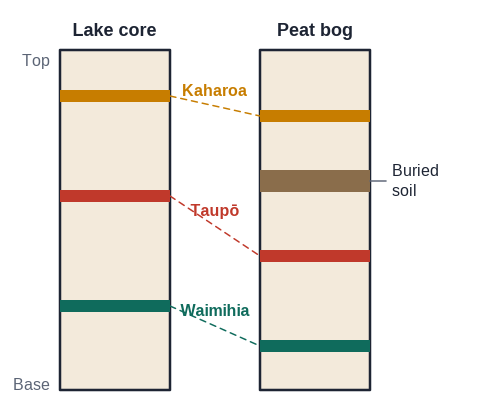
- the same three tephras in the same order at both sitessuperposition and chemistry agree
- soil is above Taupō, so younger than about 232 CE
- soil is below Kaharoa, so older than about 1314 CE
- a radiocarbon date on its charcoal must fall in this window
- the soil formed between about 232 CE and about 1314 CE
Cross-correlation: one timeline from many methods
- Each method has weaknesses: relative dating gives order but no years, radiocarbon needs calibration and only reaches about 50 000 years, and a reworked tephra or contaminated sample can give a false age.
- Confidence comes from independent methods agreeing. The Taupō eruption is dated by radiocarbon on charred trees, by matching tree-ring patterns in buried logs (wiggle-matching, giving 232 ± 5 CE), and by the eruption's place in the tephra sequence.
- Other records can join the timeline: sediment and ice cores, tree rings, stable oxygen isotopes, magnetism locked into lava and the rate of weathering and erosion.
- For Excellence, show how one line of evidence fixes a weakness in another: the tephra links distant sites, radiocarbon gives years, and superposition proves the order.
What Achieved, Merit and Excellence look like
- The same evidence, the Taupō tephra, written about at each grade.
| Grade | What the student wrote |
|---|---|
| Achieved | The Taupō eruption left a layer of tephra across the North Island. Charcoal buried by it was radiocarbon dated, which shows the eruption was about 1800 years ago. |
| Merit | Trees killed and buried by the eruption stopped taking in carbon-14, which then decayed with a half-life of 5730 years. Measuring the carbon-14 left gives the time since the trees died, about 1790 years, which dates the eruption to around 230 CE. |
| Excellence | Radiocarbon alone has an uncertainty of decades, but matching the tree-ring pattern in buried logs to a kauri calibration record narrows the date to 232 ± 5 CE. Because the Taupō tephra falls between the Waimihia and Kaharoa tephras everywhere it is found, and its glass chemistry identifies it in cores across the island, that date becomes a fixed marker: any layer above it is younger than 232 CE, so independent methods support one another. |
Common mistakes
- Carbon-14 dating shows the granite is 96 million years old.Carbon-14 only reaches about 50 000 years and dates once-living material; old igneous rocks need potassium-argon or uranium-lead.
- After two half-lives all the parent isotope has gone.Half remains after one half-life and a quarter after two; the amount halves each time and never quite reaches zero.
- The dike is older than the layers because it is underneath them.A dike that cuts through layers is younger than every layer it cuts.
- A sandstone can be dated by measuring argon in its grains.Its grains crystallised before being eroded and deposited, so date volcanic layers above and below it instead.
Model half-life with coins
You need: 100 coins (or 100 small buttons with one side marked), a large plastic container with a lid, paper and a pen
- Put all 100 coins in the container, close it, shake it well and tip the coins onto a table.
- Remove every coin showing tails: these atoms have decayed. Count and record the heads that remain.
- Put the remaining coins back and repeat, recording the count each round, until fewer than 3 are left.
- Plot coins remaining against the number of shakes, and mark where the curve crosses 50, 25 and 12.5.
- Look for: about half go each shake, so each shake is one half-life, but no one can predict which coin goes next.
Safety: Keep the coins away from small children, because coins are a choking hazard.
Your turn
Charcoal has 25.0% of its original carbon-14. How old is it?
Bone has 60.0% of its original carbon-14. How old is it?
In a cliff, a dike cuts layers 1 to 3 and is itself offset by a fault. Which happened first, the dike or the fault?
A peat layer lies between the Taupō tephra and the Kaharoa tephra. What is its age range?
Why can a sandstone not be dated by potassium-argon on its own grains?
Show answer
1. 25.0% is two half-lives: 2 × 5730 = 11,460 years. 2. t = 5730 × log₂(1 ÷ 0.600) = 5730 × 0.737 = 4220 years. 3. The dike: the fault cuts it, so the fault is younger. 4. Between about 232 CE and about 1314 CE. 5. The grains crystallised in an older rock before they were eroded and deposited, so their clocks date the source rock, not the sandstone.
Recap
- Relative dating gives order: superposition, cross-cutting, inclusions, unconformities and fossils.
- Radiometric dating gives years: t = T½ × log₂(N₀ ÷ N), with an isotope suited to the age and material.
- Tephras are isochrons that link sites; one dated tephra dates the layer everywhere.
- Excellence justifies each piece of evidence and shows how independent methods agree.
| Parent left | Half-lives | Age |
|---|---|---|
| 50% | 1 | 1 × T½ |
| 25% | 2 | 2 × T½ |
| 12.5% | 3 | 3 × T½ |
| Any fraction f | log₂(1 ÷ f) | T½ × log₂(1 ÷ f) |
Challenge
A Canterbury sandstone contains zircon grains washed in from older granites. Three grains have these lead-206 to uranium-238 ratios: 0.0480, 0.0215 and 0.0156. A tephra layer resting directly on top of the sandstone has an argon-40 to potassium-40 ratio of 0.00520. Assume all the daughter atoms came from decay. (a) Find the age of each grain and of the tephra. (b) Explain why the sandstone itself must have been laid down between the youngest grain's age and the tephra's age, and give that window. (c) A student suggests carbon-14 dating a shell in the sandstone. Using the youngest age the sandstone could be, find how many carbon-14 half-lives have passed and explain why the idea fails.
Hint
Use t = T½ × log₂(1 + D ÷ P) with the half-life of each system. A grain cannot be laid down before it exists, and the tephra could only land on sandstone that was already there.
Answer
(a) grains about 302, 137 and 99.8 million years; tephra about 9.35 million years (b) deposited between about 9.4 and 99.8 million years ago (c) about 1630 half-lives, so the fraction of carbon-14 left is about 10⁻⁴⁹¹: none at all can be measured
Step by step
- Each grain's age is when that zircon crystallised in its parent granite, not when the sand was deposited.
- The sand cannot have been laid down before its youngest grain formed, so 99.8 million years is the oldest it can be.
- The tephra lies on top, so by superposition it is younger than the sandstone: 9.35 million years is the youngest the sandstone can be.
- Carbon-14 is used for the last 50 000 years or so; at 9.35 million years over 1600 half-lives have passed.
- Halving 1600 times leaves essentially no carbon-14, so the method cannot work.
Full working
- grain 1: t = 4.47 × 10⁹ × log₂(1.0480) = 302 million yearsuranium-lead, T½ = 4.47 × 10⁹ years
- grain 2: t = 4.47 × 10⁹ × log₂(1.0215) = 137 million yearssame method
- grain 3: t = 4.47 × 10⁹ × log₂(1.0156) = 99.8 million yearsthe youngest grain
- tephra: t = 1.25 × 10⁹ × log₂(1.00520) = 9.35 million yearspotassium-argon, T½ = 1.25 × 10⁹ years
- half-lives of carbon-14 = 9.35 × 10⁶ ÷ 5730 = 1632at least this many
- fraction left = (½)^1632 ≈ 10⁻⁴⁹¹far below anything measurable
- (a) 302, 137, 99.8 and 9.35 million years (b) between about 9.4 and 99.8 million years ago (c) carbon-14 cannot be used
In a coastal cliff a fossil-rich sandstone lies between two basalt lava flows. A basalt dike cuts up through the lower flow, the sandstone and the upper flow. Argon-40 to potassium-40 ratios: lower flow 0.00450, upper flow 0.00380, dike 0.00300. (a) Find the three ages and the age window for the sandstone's fossils. (b) Check that the radiometric ages agree with the relative-dating principles. (c) A second sample of the lower flow, taken from weathered, crumbly rock, gave a ratio of 0.00310. Calculate its age, explain why it must be wrong, and suggest what went wrong with it.
Hint
t = T½ × log₂(1 + D ÷ P) with T½ = 1.25 × 10⁹ years. For (c), compare the new age with the upper flow's. Argon is a gas: think about what weathering does to the crystals that hold it.
Answer
(a) lower flow 8.10, upper flow 6.84, dike 5.40 million years; fossils between about 6.8 and 8.1 million years old (b) yes: lower older than upper (superposition) and the dike youngest (cross-cutting) (c) 5.58 million years, younger than the upper flow above it, which superposition forbids; argon escaped from the weathered minerals, so the clock reads too young
Step by step
- Turn each argon-to-potassium ratio into an age with the daughter-to-parent formula.
- The sandstone was laid down after the lower flow and before the upper flow covered it, so its fossils fall between those two ages.
- The lower flow is older than the upper flow (superposition) and the dike is younger than everything it cuts (cross-cutting), so all three dates fit.
- The weathered sample gives an age younger than the upper flow, but rock lying underneath cannot be younger than the rock on top of it.
- Weathering breaks down the minerals that trap argon, and the gas leaks out: less daughter means a smaller ratio and an age that is too young, so the fresh sample is the one to trust.
Full working
- lower flow: t = 1.25 × 10⁹ × log₂(1.00450) = 8.10 million yearsdaughter-to-parent ratio
- upper flow: t = 1.25 × 10⁹ × log₂(1.00380) = 6.84 million yearssame formula
- dike: t = 1.25 × 10⁹ × log₂(1.00300) = 5.40 million yearssame formula
- 8.10 > 6.84 > 5.40lower, upper, dike: superposition and cross-cutting agree
- weathered sample: t = 1.25 × 10⁹ × log₂(1.00310) = 5.58 million yearsyounger than 6.84, impossible
- (a) 8.10, 6.84 and 5.40 million years; fossils 6.8 to 8.1 million years old (b) consistent (c) 5.58 million years, rejected: argon lost by weathering
A peat core from a Waikato bog has the Kaharoa tephra (about 1314 CE) at 42 cm depth and the Taupō tephra (about 232 CE) at 150 cm. A piece of charcoal sits at 96 cm. (a) Assuming the peat built up at a steady rate, estimate the year the charcoal formed. (b) What percentage of the carbon-14 of living wood should the charcoal have when measured in 2026? (c) The lab measures 88.0%. What age and year does that give? (d) Give two different reasons why the radiocarbon date and the tephra estimate could disagree in this direction, and describe a test that would tell them apart.
Hint
Find how far 96 cm is between the two tephras as a fraction, then go the same fraction of the way between their years. For (b), use N ÷ N₀ = (½)^(t ÷ 5730).
Answer
(a) about 773 CE (b) about 85.9% (c) about 1057 years old, about 969 CE (d) the peat did not build up steadily (deeper peat compacted, so the 96 cm layer is younger than a straight line suggests), or young carbon such as plant roots grew down and contaminated the sample; date several more depths and pick out clean seeds or leaves: if the new dates make a smooth curve, the rate changed; if only root-rich samples look young, it was contamination
Step by step
- 96 cm is exactly halfway between 42 cm and 150 cm, so with a steady rate the charcoal is halfway between 1314 CE and 232 CE.
- That is 1253 years before 2026, which is less than one half-life, so well over half the carbon-14 should remain.
- 88.0% left gives a younger age than predicted, by nearly 200 years.
- Deeper peat is squashed by the weight above it, so the lower part of the core holds more years per centimetre; the 96 cm level is then younger than halfway in time.
- Roots growing down bring in modern carbon, raising the carbon-14 and making the charcoal look younger; dating several depths and picking clean plant pieces tests which is happening.
Full working
- fraction of the way down = (96 − 42) ÷ (150 − 42) = 54 ÷ 108 = 0.5halfway between the tephras
- year = 1314 − 0.5 × (1314 − 232) = 1314 − 541 = 773 CEsteady build-up
- t = 2026 − 773 = 1253 yearstime since the charcoal formed
- N ÷ N₀ = (½)^(1253 ÷ 5730) = 0.859about 85.9% expected
- t = 5730 × log₂(1 ÷ 0.880) = 1057 years; 2026 − 1057 = 969 CEfrom the measured 88.0%
- 969 − 773 = 196 years youngerthe two methods disagree
- (a) about 773 CE (b) 85.9% (c) about 1057 years, 969 CE (d) uneven build-up or compaction, or modern-root contamination